
Mortgages are loans secured by property, with payments divided between principal and interest. The guide compares conventional, FHA, VA, USDA, conforming, jumbo, fixed-rate, and adjustable-rate mortgages, along with 15- and 30-year terms, affordability factors, down payments, PMI, and debt-to-income ratios.
It also outlines potential benefits such as equity building, tax deductions, and credit improvement. Repayment strategies include larger down payments, refinancing, buying points, and recasting, while risks to evaluate include prepayment penalties, balloon payments, negative amortization, interest-only structures, and nonqualified loans.
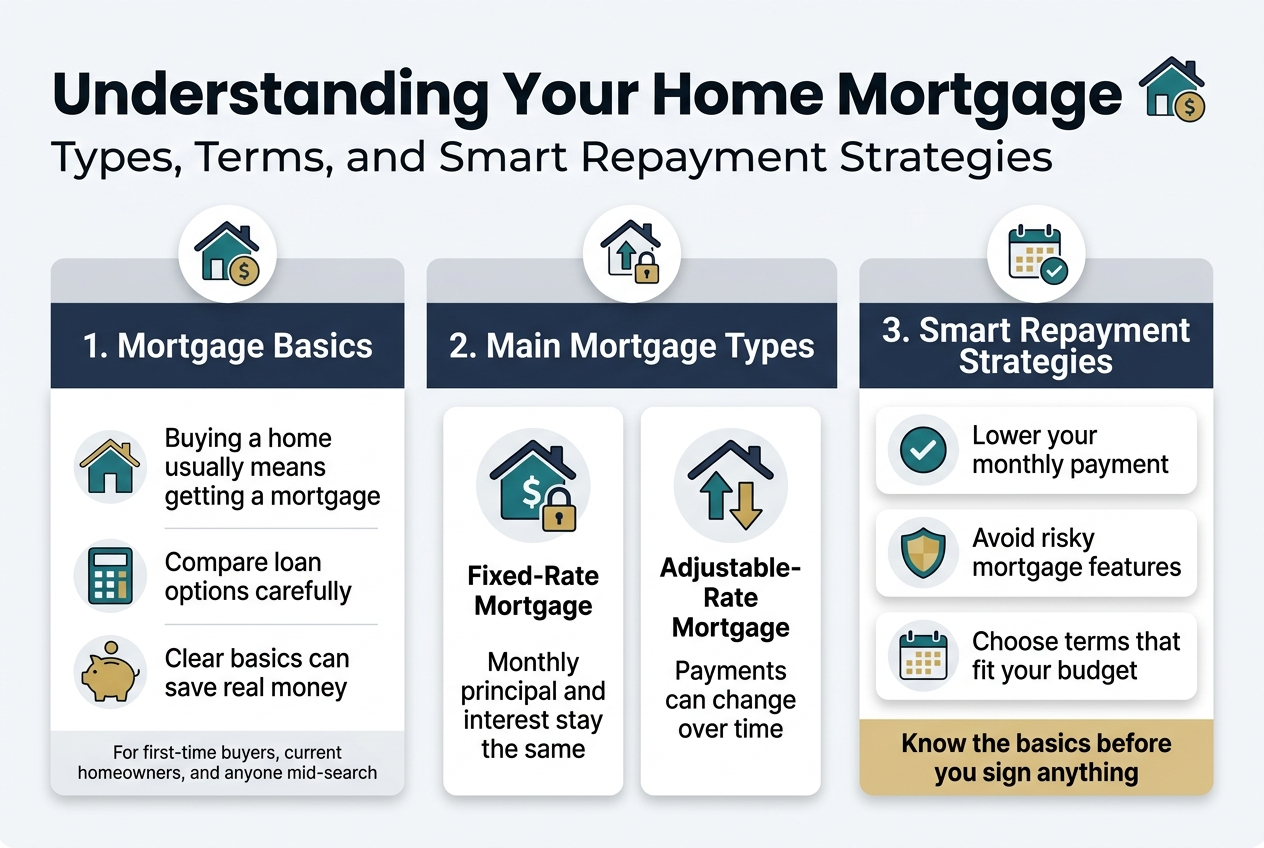
Understanding Your Home Mortgage: Types, Terms, and Smart Repayment Strategies
Buying a home is probably the biggest financial move you’ll ever make — and for most people, that means getting a mortgage. But if you’ve ever tried to compare loan options or figure out how much you can actually afford, you know how fast the details pile up.
This home mortgage guide is for first-time buyers, anyone mid-search who feels lost, and even current homeowners wondering if they’re making the most of their loan. No matter where you are in the process, getting clear on the basics saves you real money.
Here’s what we’ll walk through: the main types of mortgages and how to pick the right one for your situation, how fixed-rate vs. adjustable-rate mortgages actually differ in practice, and smart mortgage repayment strategies — including what moves can lower your monthly payment and which risky mortgage features to avoid before you sign anything.
What Is a Mortgage and How Does It Work
The Basic Definition: A Loan Secured by Your Property
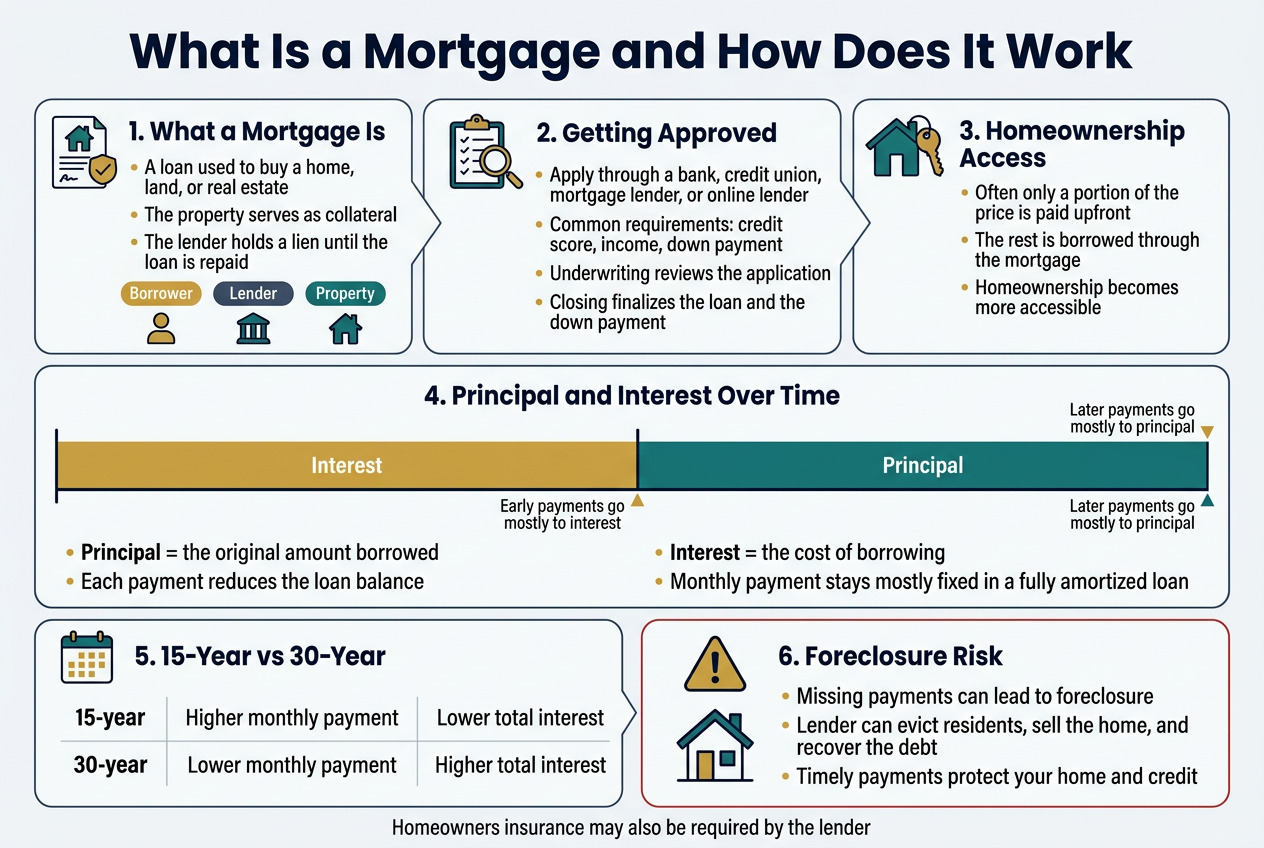
At its core, a mortgage is a loan used to purchase a home, plot of land, or other real estate. Instead of paying the full purchase price upfront—which few people can realistically afford—a borrower takes out a mortgage to cover most of the cost, then repays that amount over time with interest.
What makes a mortgage distinct from other types of loans is the role the property plays in the agreement. The home you purchase serves as collateral for the loan. This means the lender holds a legal claim, or lien, against the property until the debt is fully repaid. You still own your home during this time, but the lender’s claim on it is very real.
Here’s a straightforward breakdown of who’s involved and what each party brings to the agreement:
| Party | Role |
|---|---|
| Borrower | Takes out the loan; agrees to repay principal + interest |
| Lender | Provides the funds; holds a lien on the property as security |
| Property | Acts as collateral guaranteeing repayment |
To secure a mortgage, borrowers must apply through a lender—whether a bank, credit union, mortgage-specific lender, or online lender—and meet requirements such as a minimum credit score, sufficient income, and a down payment. The application goes through a thorough underwriting process before a loan is approved and finalized at closing, where the borrower also makes their initial down payment.
This structure makes the dream of homeownership accessible. Rather than needing hundreds of thousands of dollars in cash, a buyer can put down as little as a portion of the home’s price—often 20%—and borrow the rest through a mortgage.
How Principal and Interest Payments Are Divided Over Time
Understanding how your monthly mortgage payment is structured is one of the most important parts of this home mortgage guide. Every payment you make is split into two components: principal and interest.
- Principal is the original amount you borrowed. Each dollar applied to the principal reduces your outstanding loan balance.
- Interest is the cost of borrowing that money, expressed as a percentage of the remaining balance. It compensates the lender for taking on the risk of lending to you.
Most traditional mortgages are fully amortized, meaning your monthly payment amount stays consistent throughout the loan term, even though the proportion going toward principal versus interest shifts significantly over time.
Here’s how the split evolves over the life of a typical mortgage:
- Early in the loan: A larger portion of each payment goes toward interest, because interest is calculated on the full outstanding balance—which is at its highest at the start.
- Later in the loan: As the principal decreases, less interest accrues each month. This means a progressively larger share of your fixed payment goes toward reducing the principal.
To illustrate, consider a $320,000 mortgage at a fixed rate. In the early years, the majority of your monthly payment might be going to interest. By the final years of the loan, nearly all of each payment chips away at the remaining principal.
Typical mortgage terms are 15 or 30 years, and this choice meaningfully affects both your monthly payment and the total interest paid:
| Loan Term | Monthly Payment | Total Interest Paid |
|---|---|---|
| 15-year | Higher | Lower |
| 30-year | Lower | Higher |
A shorter term means you pay off the loan faster and pay significantly less interest over time, while a longer term stretches the payments out, reducing what you owe each month but increasing the cumulative interest cost. This trade-off is a key decision every borrower faces, and we’ll explore it in greater depth later when we look at choosing the right loan term.
The encouraging part? Once you make that final payment, the home is 100% yours—free and clear of any lender claim.
The Risk of Foreclosure and Why Timely Payments Matter
Now that we’ve covered how mortgage payments work, it’s equally important to understand what happens when those payments stop—because the stakes are high.
Because your home is collateral for the mortgage, missing payments puts you at risk of foreclosure. Foreclosure is the legal process by which a lender reclaims the property when a borrower defaults on their financial obligation. In a foreclosure scenario, the lender can:
- Evict the residents from the property
- Sell the home
- Use the proceeds from that sale to recover the outstanding mortgage debt
This is not a theoretical risk. It’s a built-in feature of how mortgages work, designed to protect the lender’s financial interest in the event a borrower cannot repay. The word “mortgage” itself reflects this gravity—it comes from Old English and French meaning “death vow,” a name it earned because the loan either “dies” when fully repaid or when the borrower defaults.
Beyond losing your home, foreclosure carries lasting consequences for your credit score and future ability to borrow. This is why timely, consistent payments are not just a good habit—they are the foundation of your mortgage agreement.
It’s also worth noting that lenders may require you to maintain homeowners insurance as a condition of the mortgage. Failing to meet that requirement, even if you continue making payments, can be considered a breach of your mortgage terms and could trigger lender action.
With this in mind, approaching a mortgage with a clear understanding of your budget and long-term payment capacity isn’t just smart financial planning—it’s essential protection for the home you’re working so hard to own.
Choosing the Right Mortgage Type for Your Situation
Conventional Loans: Best for Borrowers with Strong Credit
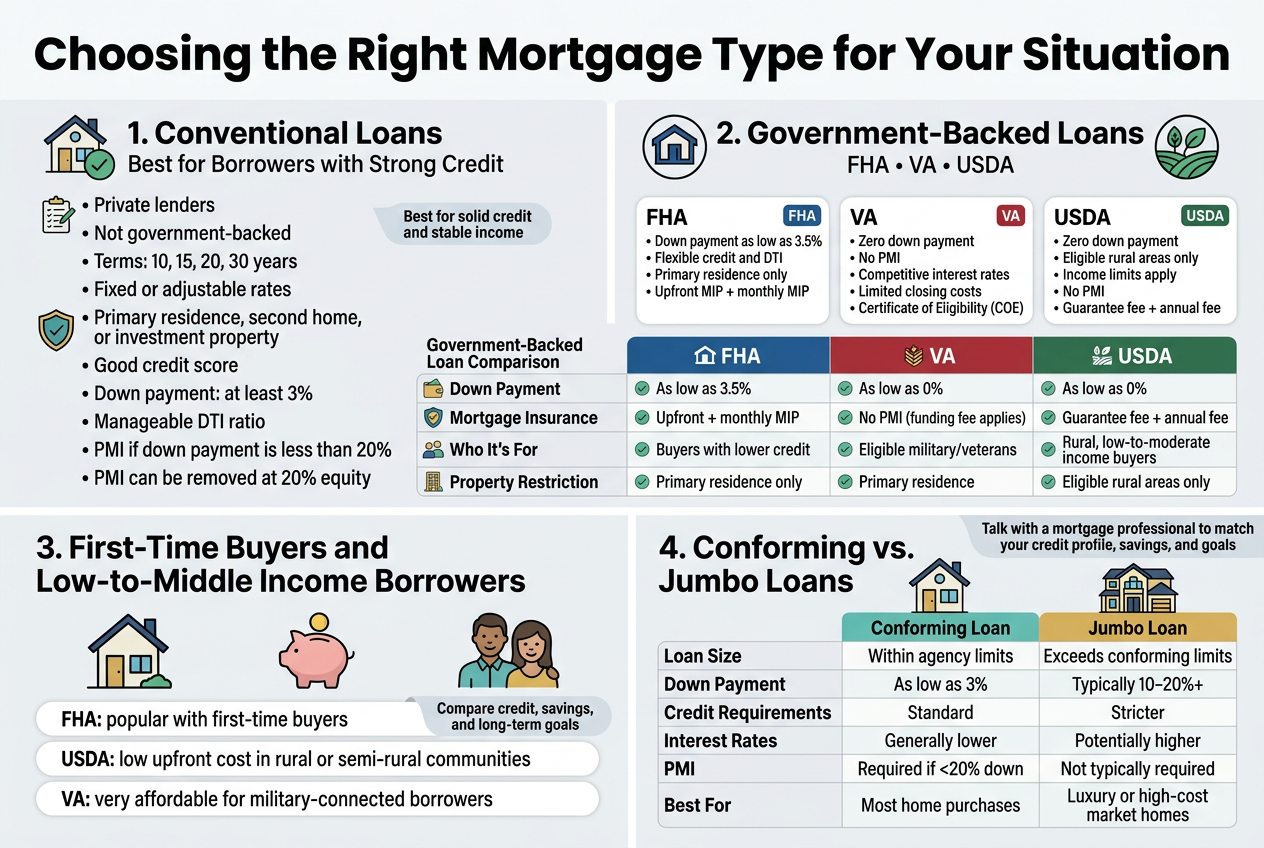
Conventional loans are the most common type of home financing in America. Issued by private lenders — such as banks and credit unions — they are not backed by any government agency, which means lenders rely more heavily on your financial profile to assess risk.
These loans offer considerable flexibility. They are available in terms of 10, 15, 20, and 30 years and can carry either fixed or adjustable interest rates. You can use a conventional loan to purchase a primary residence, a second home, or an investment property.
To qualify, you’ll generally need:
- Good credit score — lenders reward stronger credit with better rates
- A down payment of at least 3%
- A manageable debt-to-income (DTI) ratio
- Private mortgage insurance (PMI) if your down payment is less than 20%
Once you build at least 20% equity in your home, PMI can be removed, reducing your monthly costs. Conventional loans are typically the best fit for borrowers with solid credit histories and stable income who want broad flexibility in how they structure their loan.
Government-Backed Loans: FHA, VA, and USDA Options for Broader Access
For borrowers who don’t meet conventional loan requirements, the federal government sponsors three loan programs designed to expand access to homeownership. Each targets a specific group of buyers.
FHA Loans (Federal Housing Administration)
FHA loans are backed by the Federal Housing Administration and offered through private lenders. They are specifically designed to make homeownership more accessible for buyers with lower credit scores or limited savings.
Key features include:
- Down payment as low as 3.5%
- Flexible credit and DTI requirements
- Can only be used for a primary residence
- Requires an upfront Mortgage Insurance Premium (MIP) at closing plus ongoing monthly MIP payments
- Property must meet FHA safety and livability standards
FHA loans are a popular choice among first-time buyers who need more lenient qualification criteria but should be aware that mortgage insurance premiums add to the total cost of the loan.
VA Loans (Department of Veterans Affairs)
VA loans are exclusively available to eligible active-duty service members, veterans, National Guard members, reservists, and certain surviving spouses. Backed by the U.S. Department of Veterans Affairs, they offer some of the most borrower-friendly terms available anywhere in the mortgage market.
Notable benefits:
- Zero down payment required
- No private mortgage insurance (PMI)
- Competitive interest rates
- Limited closing costs
To qualify, borrowers must obtain a Certificate of Eligibility (COE) and meet service requirements — such as at least 90 consecutive days of active duty during wartime or 181 days during peacetime. VA loans do require a VA Funding Fee, but the overall savings on down payments and PMI make them exceptionally valuable for those who qualify.
USDA Loans (U.S. Department of Agriculture)
USDA loans are designed to encourage homeownership in eligible rural areas by offering zero-down-payment financing to low- and moderate-income buyers. Backed by the U.S. Department of Agriculture, these loans come with competitive interest rates and flexible credit requirements.
Key requirements and features:
- Property must be in a USDA-eligible rural area
- Borrower’s income must fall within program limits
- Zero down payment for eligible buyers
- No PMI required
- Upfront Guarantee Fee and an annual fee apply
Here’s a quick side-by-side comparison of government-backed loan options:
| Feature | FHA | VA | USDA |
|---|---|---|---|
| Down Payment | As low as 3.5% | As low as 0% | As low as 0% |
| Mortgage Insurance | Upfront + monthly MIP | No PMI (funding fee applies) | Guarantee fee + annual fee |
| Who It’s For | Buyers with lower credit | Eligible military/veterans | Rural, low-to-moderate income buyers |
| Property Restriction | Primary residence only | Primary residence | Eligible rural areas only |
Special Programs for First-Time Buyers and Low-to-Middle Income Borrowers
Now that we’ve covered the major government-backed loans, it’s worth noting how several of these programs overlap and specifically benefit first-time buyers and those with moderate incomes.
FHA loans are the most widely used option for first-time buyers because of their low down payment threshold (3.5%) and flexible qualification standards. They make entry into the housing market far more achievable for buyers who haven’t yet built up significant savings or credit history.
USDA loans serve low-to-moderate income buyers who are open to purchasing in rural or semi-rural communities. With no down payment requirement and no PMI, they significantly reduce the upfront cost of buying a home.
VA loans, while restricted to military-connected borrowers, are among the most generous loan products available — offering zero down, no PMI, and competitive rates — making homeownership substantially more affordable for those who have served.
If you’re a first-time buyer evaluating your options, comparing these programs carefully — ideally with guidance from a mortgage professional — can help you identify the loan that best aligns with your credit profile, savings, and long-term goals.
Conforming vs. Jumbo Loans: Understanding Borrowing Limits
With this in mind, next we’ll look at how loan size affects which mortgage product you need. Most conventional loans are categorized as conforming loans, meaning they fall within the maximum loan limits set by Fannie Mae, Freddie Mac, and the Federal Housing Finance Agency. These limits allow lenders to package and sell conforming loans on the secondary market, which keeps interest rates competitive.
When a home’s purchase price exceeds those limits, you’ll need a jumbo loan.
| Feature | Conforming Loan | Jumbo Loan |
|---|---|---|
| Loan Size | Within agency limits | Exceeds conforming limits |
| Down Payment | As low as 3% | Typically 10–20%+ |
| Credit Requirements | Standard | Stricter |
| Interest Rates | Generally lower | Potentially higher |
| PMI | Required if <20% down | Not typically required |
| Best For | Most home purchases | Luxury or high-cost market homes |
Jumbo loans are commonly used for luxury properties or homes in high-cost housing markets. Because lenders take on more risk — these loans can’t be sold to Fannie Mae or Freddie Mac — they typically require higher credit scores, larger down payments, and more thorough financial documentation. Interest rates may also be higher to compensate for that increased lender risk.
Picking the Best Loan Term to Match Your Financial Goals
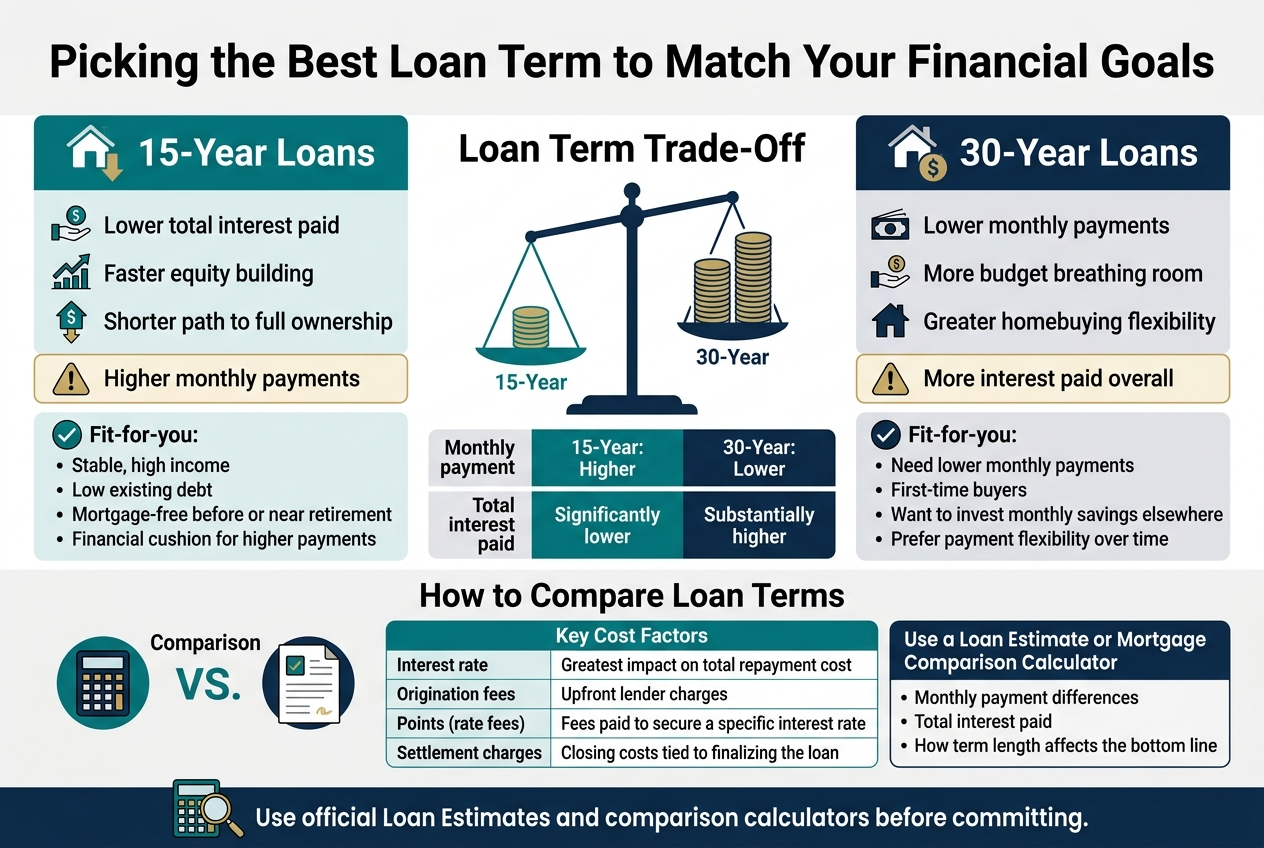
A. 15-Year Loans: Pay Less Interest but Handle Higher Monthly Payments
When evaluating mortgage loan terms, the 15-year loan stands out as a powerful option for borrowers who prioritize long-term savings over short-term cash flow flexibility. The core advantage is straightforward: because you’re repaying the principal over a shorter period, you accumulate significantly less interest over the life of the loan.
Here’s what makes a 15-year mortgage worth considering:
- Lower total interest paid: Spreading your payments across fewer years means the lender has less time to charge interest on the outstanding balance, which can translate into tens of thousands of dollars in savings.
- Faster equity building: Your monthly payments chip away at the principal more aggressively, helping you build home equity at a quicker pace.
- Shorter path to full ownership: You own your home outright in half the time compared to a standard 30-year loan.
The trade-off, however, is real and worth taking seriously. Because you’re compressing repayment into 15 years, your monthly payments will be noticeably higher than they would be on a longer-term loan for the same amount. This means your monthly budget needs to comfortably absorb that larger obligation before you commit.
A 15-year loan tends to be the right fit if you have:
- A stable, high income with consistent cash flow
- Low existing debt obligations
- A goal of being mortgage-free before or near retirement
- The financial cushion to handle higher monthly payments without stress
B. 30-Year Loans: Enjoy Lower Monthly Payments but Pay More Over Time
The 30-year mortgage is by far the most common loan term in the home mortgage landscape, and for good reason — it offers a level of monthly affordability that opens homeownership to a much wider range of buyers. For first-time buyers especially, the lower monthly payment can make the difference between qualifying for a home purchase and being priced out entirely.
With a 30-year loan, the same loan amount is spread across twice as many payments compared to a 15-year term. This directly reduces what you owe each month, giving your budget more breathing room. That flexibility can be valuable — it allows you to redirect funds toward other financial goals such as building an emergency fund, investing, or paying down other debt.
However, the long-term cost is the critical factor to weigh:
- More interest paid overall: Because the loan lasts twice as long, interest continues to accrue on the remaining balance for an extended period. Over the full 30 years, the total interest paid can be substantially higher than on a shorter-term loan.
- Slower equity growth: Early payments on a 30-year mortgage are weighted more heavily toward interest than principal, which means it takes longer to build meaningful home equity.
- Longer financial commitment: You remain obligated to mortgage payments for three decades, which requires careful consideration of long-term income stability and life circumstances.
A 30-year loan tends to be the right fit if you:
- Need lower monthly payments to manage your current budget
- Are buying your first home and want to maximize purchasing power
- Plan to invest the monthly savings elsewhere for potentially higher returns
- Want flexibility in how aggressively you pay down the loan over time
C. How to Compare Loan Terms Using Official Loan Estimates
Now that we have covered the key characteristics of both 15-year and 30-year mortgages, the next step is knowing how to compare them effectively before making a decision. The terms of the mortgage loan you choose will have a significant impact on how much your home costs you in the long run — and several specific factors drive that total cost.
According to mortgage comparison guidance, the elements that typically carry the most financial weight include:
| Cost Factor | Why It Matters |
|---|---|
| Interest rate | Has the greatest impact on your total repayment cost over time |
| Origination fees | Upfront lender charges that affect the true cost of the loan |
| Points (rate fees) | Fees paid to secure a specific interest rate, formerly called discount points |
| Settlement charges | Closing costs tied to finalizing the loan |
Of these, the interest rate you pay will likely matter most when comparing mortgage loan terms. Even a small difference in rate, compounded across 15 or 30 years, can result in a significant variation in total cost.
Using a Loan Estimate or Mortgage Comparison Calculator
When you apply for a mortgage, lenders are required to provide a standardized Loan Estimate document, which gives you a clear breakdown of loan terms, projected monthly payments, and estimated total interest paid. This document is one of the most effective tools for making an apples-to-apples comparison between different loan options.
Many financial institutions also offer mortgage comparison calculators that allow you to model different scenarios side by side. These tools let you input variables such as loan amount, interest rate, and term length to see:
- Monthly payment differences between a 15-year and 30-year loan
- Total interest paid across the full life of each loan option
- How the term length interacts with the interest rate to affect your bottom line
Here’s a simplified example of what that comparison might reveal:
| Loan Term | Monthly Payment | Total Interest Paid |
|---|---|---|
| 15-Year | Higher | Significantly lower |
| 30-Year | Lower | Substantially higher |
With this in mind, the smartest approach is to use both the official Loan Estimate and an online mortgage comparison calculator together. The Loan Estimate ensures you’re comparing real, lender-specific numbers, while a calculator lets you explore hypothetical scenarios to understand how adjusting variables — like making extra payments on a 30-year loan — might affect your outcomes.
Choosing between a 15-year and 30-year mortgage ultimately comes down to balancing your current monthly budget against your long-term financial goals. Use every available tool to run the numbers before committing.
Understanding Fixed-Rate vs. Adjustable-Rate Mortgages
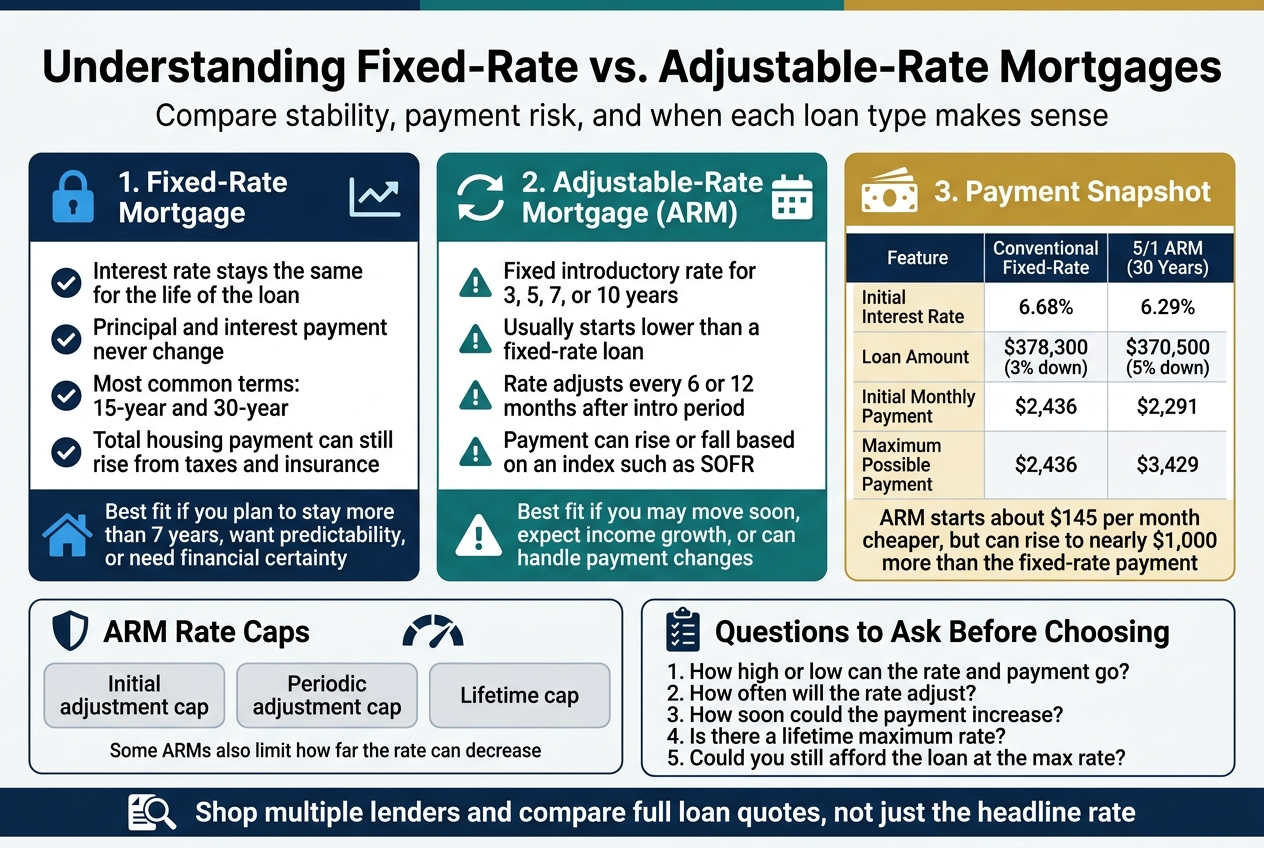
Fixed-Rate Mortgages: Stability and Predictability for Long-Term Homeowners
A fixed-rate mortgage does exactly what its name suggests — it locks in your interest rate at closing and keeps it there for the entire life of the loan. Your principal and interest payment will never change, regardless of what happens in the broader economy or interest rate environment.
This makes fixed-rate mortgages the most straightforward option in any home mortgage guide, and it explains why they remain the most common type of home loan available. The most popular terms are 15-year and 30-year mortgages, though some lenders offer custom terms ranging from 8 to 30 years.
It’s worth noting one important nuance: while your principal and interest payment stays fixed, your total housing payment isn’t entirely immune to change. Property taxes and homeowners insurance can still rise over time, nudging your overall monthly obligation upward — even if the mortgage portion itself never budges.
A fixed-rate mortgage is likely the right fit if you:
- Plan to stay in your home for more than seven years
- Are buying your first home and want a simple, predictable payment structure
- Have limited savings or less predictable income and need financial certainty
- Want to eliminate the risk of ever being forced into a higher monthly payment
The one trade-off to understand is this: if interest rates fall significantly after you lock in, you’re stuck paying the higher rate unless you refinance — which comes with its own closing costs and qualifying requirements.
Adjustable-Rate Mortgages: Lower Initial Rates with Future Uncertainty
Now that we’ve covered fixed-rate mortgages, it’s time to examine the other major category in the fixed-rate vs adjustable-rate mortgage debate — the ARM.
An adjustable-rate mortgage starts with a fixed interest rate for a set introductory period — typically three, five, seven, or ten years. During this window, you’ll generally pay a lower rate than you would on a comparable fixed-rate loan, which translates to lower monthly payments early in the loan.
Once that introductory period ends, however, the rate begins adjusting — usually every six or twelve months — based on a financial index such as the Secured Overnight Financing Rate (SOFR). When the index rises, your rate and payment rise with it. When the index falls, your payment may decrease, but that’s not guaranteed across all ARMs.
Here’s a real-world payment comparison using 30-year mortgages on a $390,000 home:
| Feature | Conventional Fixed-Rate | 5/1 ARM (30 Years) |
|---|---|---|
| Initial Interest Rate | 6.68% | 6.29% |
| Loan Amount | $378,300 (3% down) | $370,500 (5% down) |
| Initial Monthly Payment | $2,436 | $2,291 |
| Maximum Possible Payment | $2,436 | $3,429 |
At these rates, the ARM starts about $145 per month cheaper. But if the ARM adjusts to its lifetime cap of 11.29%, the monthly payment climbs to approximately $3,429 — nearly $1,000 more than the fixed-rate payment, and over $1,100 more than the initial ARM payment.
This is a critical distinction for anyone evaluating types of mortgages: a lower introductory payment is not the same as a lower-cost loan over time.
An ARM might suit your situation if you:
- Expect to sell or move within a few years, ideally before the rate adjusts
- Are comfortable with payment uncertainty and have the financial cushion to absorb higher payments
- Have income that’s expected to grow, making future payment increases manageable
- Are borrowing a large amount and want to meaningfully reduce early interest costs
One important caution: don’t count on refinancing as your safety net. Qualifying for a new loan requires meeting lender requirements at the time of application. If your credit score has dropped, your home’s value has declined, or rates have risen, refinancing may not be available or cost-effective when you need it most.
ARM Rate Caps and When an ARM Might Make Sense for You
With this in mind, let’s look at one of the most important protective features built into adjustable-rate mortgages — rate caps — and how to evaluate whether an ARM makes strategic sense for your financial goals.
Understanding ARM Rate Caps
Most ARMs include caps that limit how much your interest rate can move, providing a ceiling on worst-case scenarios. There are typically three types of caps to know:
- Initial adjustment cap – Limits how much the rate can rise at the first adjustment after the introductory period ends
- Periodic adjustment cap – Limits how much the rate can change at each subsequent adjustment interval
- Lifetime cap – Sets the maximum total increase the rate can ever reach over the entire life of the loan
Some ARMs also limit how far the rate can decrease, not just increase. Both directions matter for your financial planning.
Key questions to ask before committing to an ARM:
- How high or low can the interest rate and monthly payment go with each adjustment?
- How frequently will the rate adjust after the introductory period?
- How soon could the payment increase — and by how much?
- Is there a cap on the lifetime maximum rate?
- Could you still afford the loan if it hit the maximum rate allowed under the contract?
When an ARM genuinely makes sense:
- You have a concrete plan to sell or pay off the loan before the first rate adjustment
- You’re borrowing a large sum where the lower introductory rate produces meaningful savings
- Your income and cash reserves are strong enough to comfortably absorb the maximum possible payment — not just the starting one
- You’ve stress-tested the math and confirmed you could handle the worst-case scenario without financial strain
Regardless of which mortgage type you lean toward, shopping multiple lenders and comparing full loan quotes — not just the headline rate — is essential. The rate structure you choose matters far less if you’re overpaying on the rate itself from the start.
Determining How Much Mortgage You Can Afford
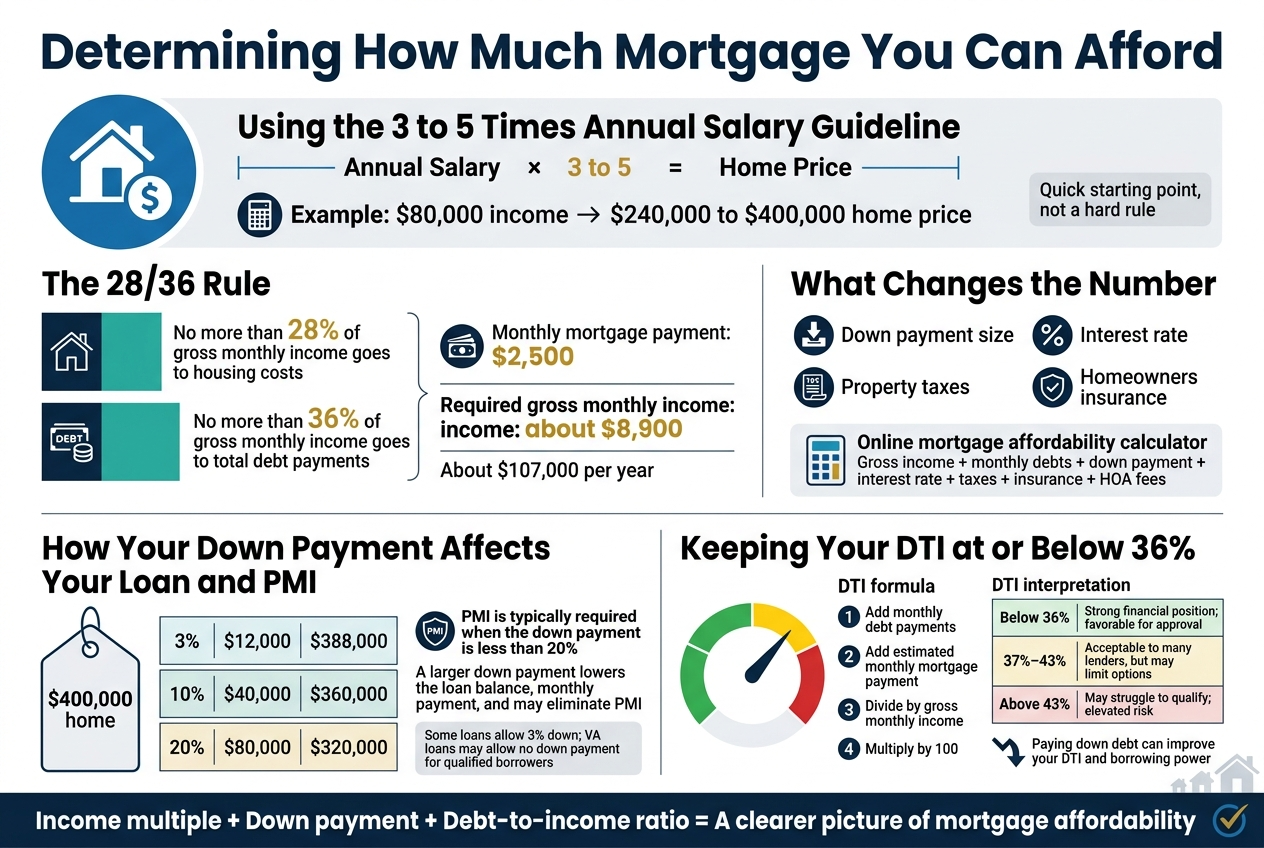
Using the 3 to 5 Times Annual Salary Guideline
One of the simplest ways to get a ballpark figure on how much mortgage you can afford is the 3 to 5 times your annual salary guideline. This rule suggests that a reasonable home purchase price falls somewhere between three and five times your gross annual income.
For example, if you earn $80,000 per year, this guideline points to a home in the $240,000 to $400,000 range. It is a quick mental check — not a hard rule — but it gives you a realistic starting point before you dive deeper into the numbers.
A more refined version of this thinking is the 28/36 rule, which many lenders actively apply when evaluating borrowers:
- No more than 28% of your gross monthly income should go toward housing costs.
- No more than 36% of your gross monthly income should go toward total debt payments, including your mortgage.
To put this into practice, consider a scenario where your monthly mortgage payment is approximately $2,500. To stay within the 28% housing cost guideline, you would need a gross monthly income of roughly $8,900 — or about $107,000 per year. Your actual required income will shift depending on your down payment size, interest rate, property taxes, insurance costs, and existing debts.
Using an online mortgage affordability calculator can sharpen this estimate significantly. By inputting your gross income, monthly debt obligations, planned down payment, and an estimated interest rate, you can calculate the maximum home price that fits your financial situation. More advanced calculator views also allow you to factor in homeowners insurance, property taxes, and HOA fees for a more complete picture.
How Your Down Payment Size Affects Your Loan and PMI Requirements
Now that we have covered how income guides affordability, it is equally important to understand how your down payment directly shapes both your loan amount and your monthly costs.
Your down payment is the portion of the home’s purchase price you pay upfront. A larger down payment produces two immediate benefits:
- It reduces your loan balance, which lowers the amount you need to borrow.
- It reduces your monthly mortgage payment, since you are financing less.
Here is a straightforward look at how different down payment amounts affect your loan on a $400,000 home:
| Down Payment (%) | Down Payment Amount | Loan Amount |
|---|---|---|
| 3% | $12,000 | $388,000 |
| 10% | $40,000 | $360,000 |
| 20% | $80,000 | $320,000 |
Beyond the loan amount itself, your down payment size has a critical impact on whether you will be required to pay Private Mortgage Insurance (PMI). PMI is typically required when your down payment is less than 20% of the home’s purchase price. It protects the lender — not you — in the event you default on the loan, and it adds to your monthly costs.
This is why the loan-to-value (LTV) ratio matters so much. A lower LTV ratio, achieved through a larger down payment, reduces the lender’s risk and can eliminate the PMI requirement entirely, lowering your effective monthly payment.
That said, a 20% down payment is not a hard requirement. Many loan programs allow significantly smaller down payments. For instance, some fixed-rate loan options allow down payments as low as 3%, and VA loans may offer no down payment at all for qualified borrowers. The trade-off is that lower down payments typically come with added costs like PMI and can also affect your loan terms and interest rate.
When planning your down payment strategy, weigh the upfront cash outlay against the long-term monthly savings. A higher down payment reduces your monthly burden and can potentially improve your loan terms, but it also requires having more cash available at closing.
Keeping Your Debt-to-Income Ratio at or Below 36 Percent
With this in mind, next we’ll examine the metric lenders scrutinize most closely when deciding how much they will lend you: your debt-to-income ratio (DTI).
Your DTI ratio is calculated by dividing your total monthly debt payments by your gross monthly income, then expressing the result as a percentage. Lenders use this figure to determine whether your income can comfortably support your existing debts plus a new mortgage payment.
How to calculate your DTI:
- Add up all your monthly debt payments — car loans, credit cards, student loans, and any other recurring obligations.
- Add your estimated monthly mortgage payment to that total.
- Divide the combined figure by your gross monthly income.
- Multiply by 100 to get your DTI percentage.
As a general standard, keeping your DTI at or below 36% is considered a healthy threshold. Here is how DTI ranges are typically interpreted:
| DTI Range | Lender Interpretation |
|---|---|
| Below 36% | Strong financial position; favorable for approval |
| 37% – 43% | Acceptable to many lenders, but may limit options |
| Above 43% | May struggle to qualify; signals elevated risk |
A high DTI signals to lenders that your income is already stretched thin by existing obligations, making it harder to comfortably absorb a mortgage payment. This can result in loan denial, less favorable interest rates, or a lower approved loan amount.
The practical takeaway is clear: before applying for a mortgage, reducing your existing debt load can meaningfully improve your DTI, expand your borrowing potential, and position you for better loan terms. Paying down credit card balances or eliminating a car loan prior to applying are common strategies buyers use to strengthen their DTI profile.
Taken together, your income multiple, down payment size, and debt-to-income ratio form a three-part framework for honestly assessing how much mortgage you can afford — helping you enter the homebuying process with both confidence and financial clarity.
Key Benefits of Having a Mortgage
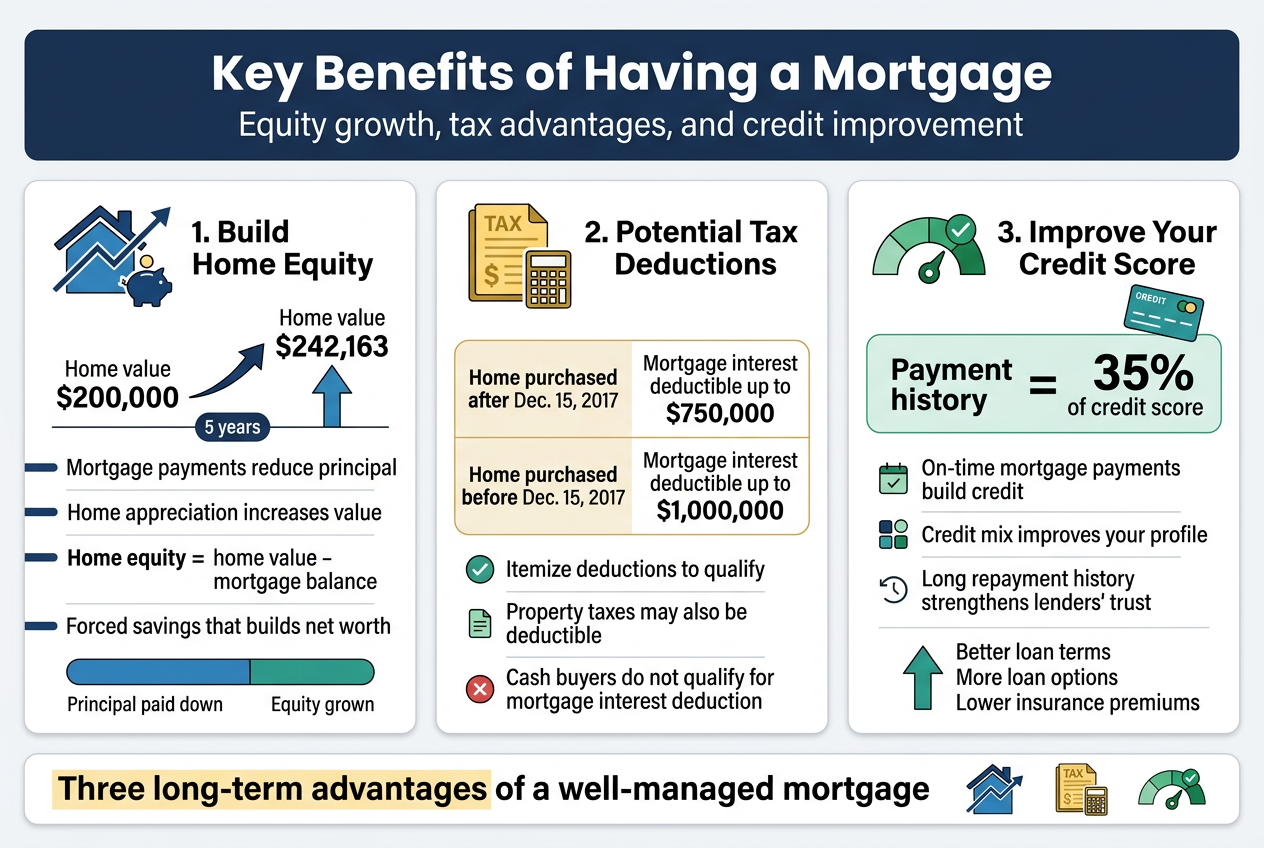
Building Home Equity as a Forced Savings Strategy
Every mortgage payment you make does more than keep a roof over your head — it steadily increases your ownership stake in the property. This is what makes a mortgage one of the most powerful wealth-building tools available to everyday Americans.
Lawrence Yun, chief economist for the National Association of Realtors, puts it plainly: “A monthly mortgage payment is often considered a forced savings account that helps homeowners build net worth.” Unlike rent, which returns nothing to you, each payment chips away at your principal balance and grows your home equity.
Home equity is simply the difference between what your home is worth and what you still owe on your mortgage. You build it in two key ways:
- Making consistent mortgage payments that reduce your outstanding balance
- Home appreciation over time, which increases the market value of your property
For example, a home purchased at $200,000 that appreciates at 3.9% annually would be worth approximately $242,163 after just five years — that’s meaningful wealth accumulation without any additional effort on your part.
Once you’ve built sufficient equity, you can tap into it as a source of cash without selling the property. Common options include:
| Method | How It Works | Typical Borrowing Limit |
|---|---|---|
| Home Equity Loan | A second mortgage with fixed payments | Up to ~70% of equity |
| HELOC | A revolving line of credit | Up to ~70% of equity |
| Cash-Out Refinance | New mortgage for more than you owe; keep the difference | Up to ~80% of equity |
This liquidity makes a mortgage-backed home far more financially flexible than most people realize. Rather than locking your wealth into an untouchable asset, you’re building a reserve you can access when life demands it.
Potential Tax Deductions on Mortgage Interest
Now that we’ve covered how a mortgage builds equity, it’s worth looking at another financial advantage that often goes underutilized: the mortgage interest deduction.
If you choose to itemize deductions on your federal tax return rather than taking the standard deduction, you may be eligible to deduct the interest paid on your mortgage. Specifically:
- You can deduct interest on up to $750,000 of total home-based debt (for homes purchased after December 15, 2017)
- If you purchased your home before December 15, 2017, that deduction cap rises to $1,000,000
In addition to mortgage interest, itemizing also allows you to deduct property taxes, and depending on your state, you may qualify for a state-level mortgage interest deduction as well.
It’s important to note that this benefit applies only when you itemize. Homeowners should weigh whether their total deductions — including mortgage interest and property taxes — exceed the standard deduction threshold before assuming they’ll see a tax benefit. Consulting a tax advisor is always a smart move to understand how homeownership specifically impacts your tax situation.
One often-overlooked point: homeowners who pay cash for a property don’t qualify for this deduction at all. In that sense, having a mortgage actually provides a tax advantage that outright cash buyers forfeit.
Improving Your Credit Score Through Consistent Payments
With the tax benefits in mind, there’s another long-term benefit of maintaining a mortgage that directly affects your broader financial health — your credit score.
Your payment history accounts for 35% of your credit score, making it the single largest factor in how lenders assess your creditworthiness. When you make on-time mortgage payments month after month, you’re actively building one of the most important components of a strong credit profile.
Here’s why a mortgage, specifically, carries so much weight in this area:
- Credit mix matters. Lenders and credit bureaus like to see a variety of debt types on your report — revolving credit (like credit cards) alongside installment loans (like mortgages). A mortgage adds valuable diversity to your credit profile.
- Mortgages are considered “good debt.” Because you’re borrowing to acquire an appreciating asset — not to fund consumption — it signals responsible financial behavior to future lenders.
- Long repayment history strengthens your profile. A 15- or 30-year loan that you manage responsibly becomes a long track record of on-time payments, which is exactly what lenders want to see.
While your credit score may take a temporary dip when you first take out a mortgage (due to the hard inquiry and new account opening), consistent, on-time payments over time not only restore your score but can elevate it above where it started.
A higher credit score translates into tangible financial benefits, including:
- Better terms on future loans (lower interest rates on auto loans, personal loans, etc.)
- More loan options when you need financing
- Lower insurance premiums in some states
- Stronger negotiating position with lenders
Previously, many first-time buyers focus exclusively on the cost side of a mortgage — the monthly payment, the interest rate, the total repayment amount. While those are critical considerations covered elsewhere in this home mortgage guide, it’s equally important to recognize what a well-managed mortgage gives back to you. Building equity, unlocking potential tax savings, and systematically improving your credit score are three compounding advantages that work in your favor for as long as you hold the loan.
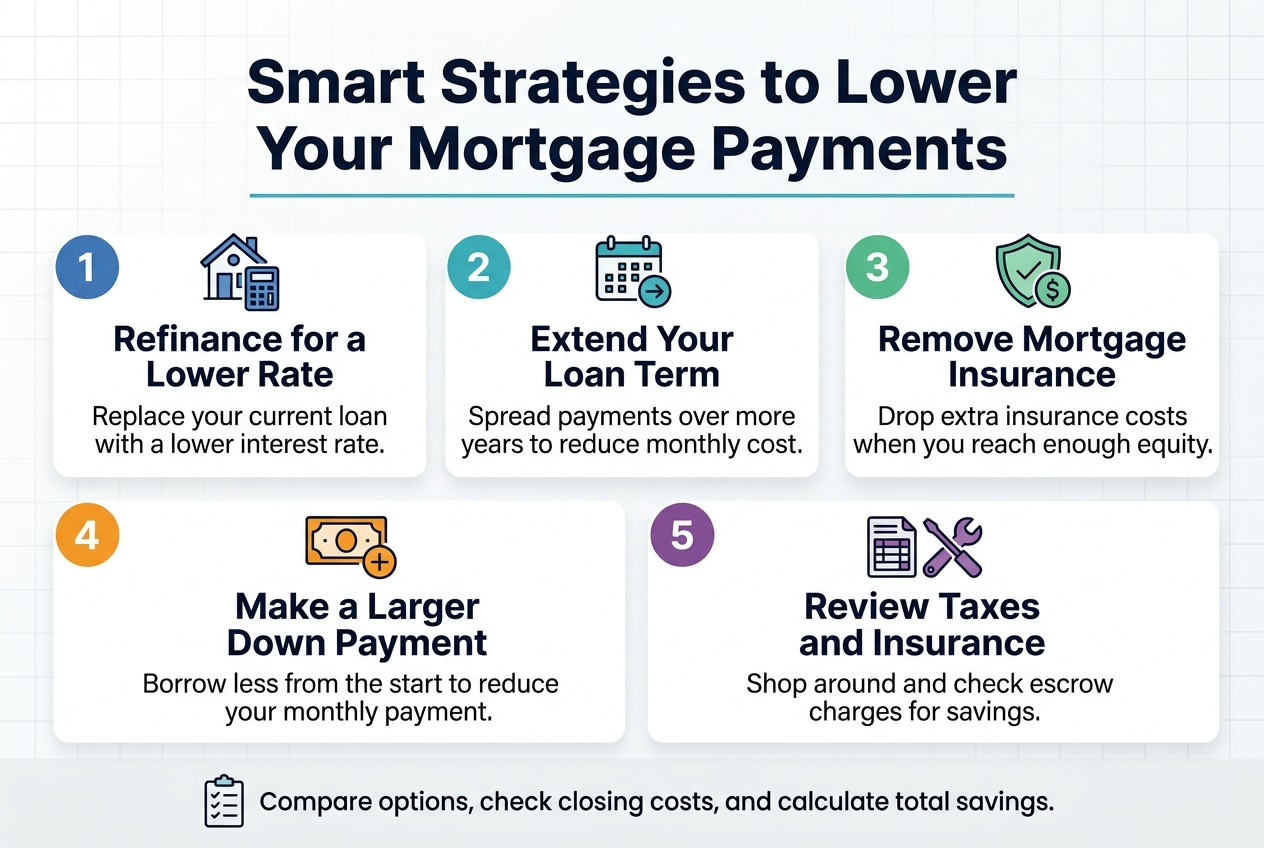
Smart Strategies to Lower Your Mortgage Payments
A. Increase Your Down Payment or Buy Points Before Closing
One of the most effective ways to reduce your monthly mortgage payments before you even sign the paperwork is to put more money down upfront. A larger down payment directly reduces the principal balance you borrow, which lowers both your monthly payment and the total interest you’ll pay over the life of the loan.
There’s another critical benefit tied to your down payment size: Private Mortgage Insurance (PMI). Lenders require PMI on conventional loans when your down payment is less than 20% of the home’s value. This insurance protects the lender — not you — and can add hundreds of dollars to your monthly payment.
Here’s a quick illustration of how equity thresholds affect PMI:
| Home Value | 20% Down Payment | PMI Required? |
|---|---|---|
| $300,000 | $60,000 | No |
| $300,000 | $15,000 (5%) | Yes |
| $500,000 | $100,000 | No |
| $500,000 | $25,000 (5%) | Yes |
If you can’t reach 20% at closing, get as close as possible. The sooner your loan balance drops below the 80% loan-to-value threshold, the sooner you can request PMI cancellation — which you have the legal right to do once that threshold is reached. Your lender is also required to automatically cancel PMI when your balance is first scheduled to reach 78% of the original property value based on your initial amortization schedule.
The takeaway: if you’re still in the planning stage of a home purchase, building a larger down payment is one of the smartest mortgage repayment strategies available to first-time buyers and seasoned homeowners alike.
B. Refinance to a Lower Interest Rate or Longer Term
Now that we’ve covered upfront strategies, let’s look at what you can do after you’ve already closed on a home. Refinancing is one of the most powerful tools in a homeowner’s arsenal for lowering mortgage payments.
How refinancing works: Refinancing replaces your existing mortgage with a new loan that has a different interest rate, loan term, or both. Either adjustment can meaningfully reduce what you pay each month.
Two Ways Refinancing Can Lower Your Payment
1. Securing a Lower Interest Rate
If market rates have dropped since you took out your original mortgage, refinancing into a lower rate can directly reduce your monthly payment. The difference can be significant. Consider this example using a $400,000 loan balance:
| Interest Rate | Monthly Payment (30-Year Term) |
|---|---|
| 7.00% | ~$2,661 |
| 5.00% | ~$2,147 |
| 4.00% | ~$1,909 |
That’s a potential savings of hundreds of dollars per month — simply by locking in a better rate.
2. Extending the Loan Term
Even without a rate reduction, refinancing into a longer term spreads your remaining balance over more months, reducing the monthly payment. For example, if you’re 10 years into a 30-year mortgage, refinancing into a new 30-year loan resets the clock and lowers your monthly obligation — though it does extend the total repayment period.
Important trade-off: A longer loan term lowers your monthly payment but increases the total interest you’ll pay over the life of the loan. Always calculate long-term cost alongside short-term relief.
What to Consider Before Refinancing
- Closing costs: Refinancing comes with closing costs, which can often be rolled into the new loan. Make sure the monthly savings outweigh these costs before proceeding.
- Qualification requirements: You’ll need to qualify for the new loan based on your income, credit score, debt-to-income (DTI) ratio, and mortgage payment history.
- Break-even point: Calculate how many months it will take for your monthly savings to offset the cost of refinancing. If you plan to move before that point, refinancing may not make financial sense.
Refinancing works best when you can secure a meaningfully lower interest rate than what you’re currently paying. With this in mind, next, we’ll look at a lesser-known but equally effective strategy: recasting.
C. Recast Your Mortgage with a Lump Sum Payment
Previously, I’ve outlined strategies that involve either upfront down payments or replacing your loan entirely. Mortgage recasting offers a middle-ground approach — you keep your existing loan but reduce your monthly payments by making a significant lump sum payment toward your principal.
How recasting works: You make a large one-time payment toward your loan balance. The lender then recalculates (or “recasts”) your remaining monthly payments based on the reduced principal. Your interest rate and loan term stay the same — only the monthly payment amount changes.
Recasting vs. Refinancing: A Quick Comparison
| Feature | Recasting | Refinancing |
|---|---|---|
| Changes interest rate | No | Yes |
| Changes loan term | No | Yes (optional) |
| Closing costs | Minimal or none | Yes |
| Requires requalification | Typically no | Yes |
| Requires lump sum payment | Yes | No |
| Lowers monthly payment | Yes | Yes |
This makes recasting an attractive option if you’ve come into a windfall — such as a bonus, inheritance, or proceeds from selling another property — and want a straightforward way to reduce your monthly obligation without the complexity or cost of a full refinance.
What to Know Before Recasting
- Not all lenders offer recasting. Check with your loan servicer first.
- Loan type restrictions may apply. Some loan programs are ineligible for recasting.
- Minimum lump sum requirements are common — lenders typically require the payment to be substantial enough to warrant the recalculation.
- Payment history matters. Some lenders require a strong on-time payment record before approving a recast.
One important clarification: simply making extra payments on your mortgage does not automatically trigger a recast or lower your monthly bill. You must formally request the recast from your lender after making the lump sum payment to see your monthly payment decrease going forward.
Risky Mortgage Features to Watch Out For
A. Prepayment Penalties, Balloon Payments, and Negative Amortization
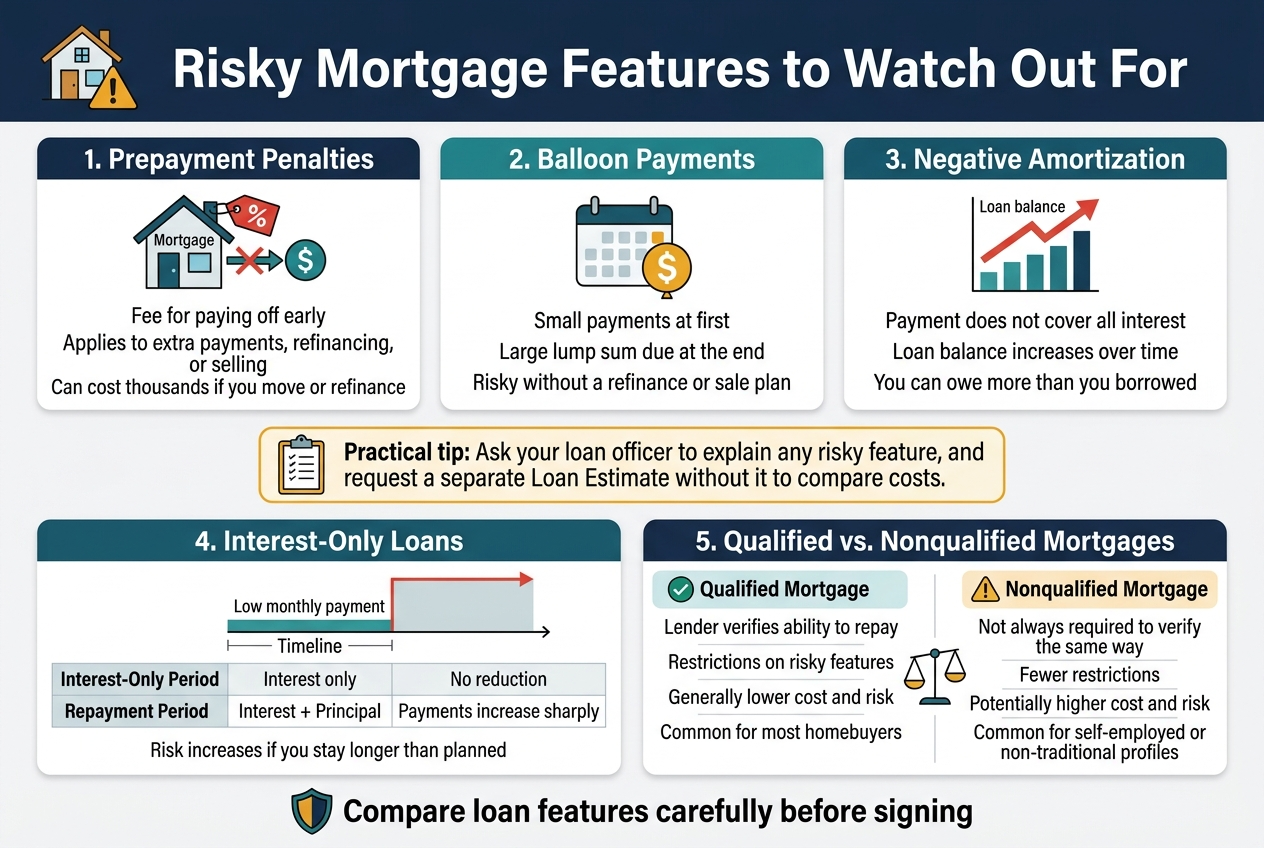
Now that we have covered smart strategies to lower your mortgage payments, it is equally important to recognize the features that can quietly work against you. Some loan structures carry hidden risks that do not become obvious until you are already locked in — and by then, the financial consequences can be significant.
Here are three risky mortgage features you should carefully scrutinize before signing any loan agreement:
Prepayment Penalties A prepayment penalty charges you a fee for paying off your mortgage early — whether through extra payments, refinancing, or selling your home. While this may seem uncommon, some lenders include this clause to protect their interest income. If you plan to pay down your loan aggressively or move within a few years, a prepayment penalty could cost you thousands of dollars.
Balloon Payments A balloon payment requires you to pay off a large lump sum at the end of a loan term, even though your monthly payments may have appeared manageable up until that point. For example, you might make regular payments for seven years, only to face a massive final payment you may not be prepared for. Unless you have a clear plan — such as refinancing or selling the property — this feature can put you in a very difficult financial position.
Negative Amortization Negative amortization occurs when your monthly payment is not enough to cover the interest owed, causing your loan balance to actually increase over time rather than decrease. This can happen with certain adjustable-rate mortgages or minimum-payment loan structures. Over time, you could end up owing significantly more than you originally borrowed — even after years of making payments.
Practical tip: If any of these features appear in your loan, ask your loan officer to explain the reasoning. Better yet, request a separate Loan Estimate for a loan without that feature so you can compare the true cost difference.
B. Interest-Only Loans and When They Become Costly
With this in mind, another loan structure that deserves close attention is the interest-only mortgage. At first glance, the appeal is understandable — lower initial monthly payments that make homeownership feel more accessible in the short term.
How Interest-Only Loans Work During the interest-only period, your payments cover only the interest on the loan. You are not paying down any of the principal balance. Once this period ends, your payments increase — sometimes substantially — because you now need to repay both interest and the full principal within a shorter remaining timeframe.
When the Costs Add Up The danger becomes clear when borrowers stay in a home longer than anticipated. Consider this scenario:
| Phase | What You Pay | What Happens to Principal |
|---|---|---|
| Interest-Only Period | Interest only | No reduction |
| Repayment Period | Interest + Principal | Payments increase sharply |
If your financial situation has not improved by the time the repayment period begins, you may struggle to keep up with the higher payments. Additionally, because you have not been building equity during the interest-only phase, you have less financial cushion if home values decline.
Interest-only loans are generally considered risky mortgage features to avoid unless you have a very specific, well-planned financial strategy — such as expecting a significant income increase or planning to sell the property before the repayment period begins.
C. Qualified vs. Nonqualified Mortgages and What the Difference Means for You
Previously, we explored various loan types and terms. Understanding the regulatory framework behind mortgage lending adds another critical layer to making a safe borrowing decision — and this is where the distinction between qualified and nonqualified mortgages becomes essential.
What Is a Qualified Mortgage? A qualified mortgage (QM) is a loan that meets specific criteria set by regulators. To issue a qualified mortgage, a lender must document and verify key financial information about you, including:
- Income and employment
- Assets and debts
- Credit history
This verification process is designed to confirm that you have a genuine ability to repay the loan. Qualified mortgages also cannot include certain risky features — such as excessive fees or balloon payments in most cases — providing an important layer of consumer protection.
What Is a Nonqualified Mortgage? Nonqualified mortgages (non-QM loans) do not meet the standard criteria required for qualified mortgage status. This does not automatically make them illegal or predatory, but it does mean they carry higher risk or higher costs and are often structured for borrowers with unique financial circumstances.
Nonqualified mortgages are sometimes marketed toward:
- Self-employed borrowers with non-traditional income documentation
- Borrowers without Social Security numbers
- Those with financial profiles that do not fit conventional lending criteria
Why This Distinction Matters for You If you are presented with a nonqualified mortgage, it is critical to understand why the loan falls outside standard guidelines and what specific risks or costs come with it. The flexibility that non-QM loans offer can be genuinely useful in certain situations, but that flexibility is also what allows riskier loan features to be included.
| Feature | Qualified Mortgage | Nonqualified Mortgage |
|---|---|---|
| Lender verifies ability to repay | ✅ Required | ❌ Not always required |
| Restrictions on risky features | ✅ Yes | ❌ Fewer restrictions |
| Cost and risk level | Generally lower | Potentially higher |
| Common borrowers | Most homebuyers | Self-employed, non-traditional profiles |
As a general rule of thumb: if a loan is described as nonqualified, ask detailed questions, request a full breakdown of all features and costs, and compare it against a qualified mortgage alternative before committing.
Recognizing these risky mortgage features to avoid — from balloon payments and negative amortization to interest-only structures and nonqualified loan terms — puts you in a far stronger position to protect your financial future when navigating your home mortgage guide.
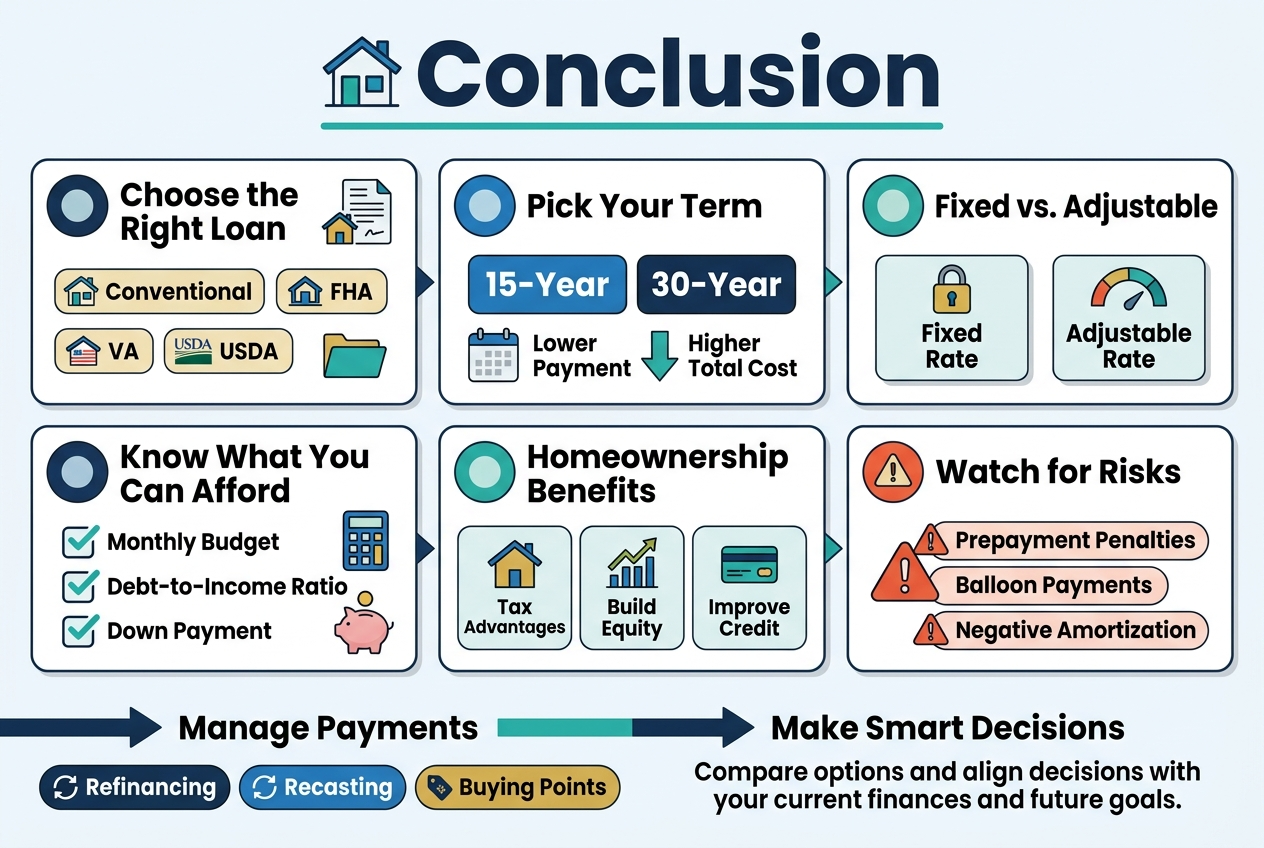
Understanding your home mortgage doesn’t have to feel overwhelming. From choosing the right loan type — whether conventional, FHA, VA, or USDA — to deciding between a 15-year or 30-year term, and weighing the stability of a fixed rate against the flexibility of an adjustable rate, every decision shapes the total cost of your home and your monthly budget. Knowing how much you can afford, keeping your debt-to-income ratio in check, and building toward a solid down payment are all steps that set you up for long-term success.
The benefits of homeownership — tax advantages, building equity, and improving your credit — are real and worth working toward. At the same time, it pays to stay alert to risky mortgage features like prepayment penalties, balloon payments, or negative amortization that could cost you down the road. Whether you’re just starting your search or already paying down a mortgage, smart strategies like refinancing, recasting, or buying points can help you manage your payments more effectively. Take your time, compare your options, and make decisions that align with both your current finances and your future goals.




Join the conversation
Share a thoughtful response, ask a question, or add something useful for other readers.
Be the first to add a helpful perspective.
Share to join the conversation
Choose a network to start a 120-second countdown. The comment form opens when the timer finishes.
Social networks do not tell this website whether a share was finally published. This is a sharing prompt, not proof of a completed share or a spam-security measure.
Waiting period: 120 seconds after opening a sharing option. Completed shares cannot be verified by this website.