
Building a personalised investment portfolio begins with defining measurable goals, time horizons, liquidity needs, and risk tolerance. These factors guide asset allocation among stocks, bonds, and cash, while diversification across sectors, regions, and investment vehicles can help manage risk. Dollar-cost averaging is presented as a disciplined way to invest consistently.
The guide also covers tax-advantaged accounts, transaction costs, alternative investments, and annual portfolio reviews. Rebalancing helps maintain intended risk levels as markets and personal circumstances change, while staying invested and using downturns to rebalance or continue investing supports a long-term strategy.
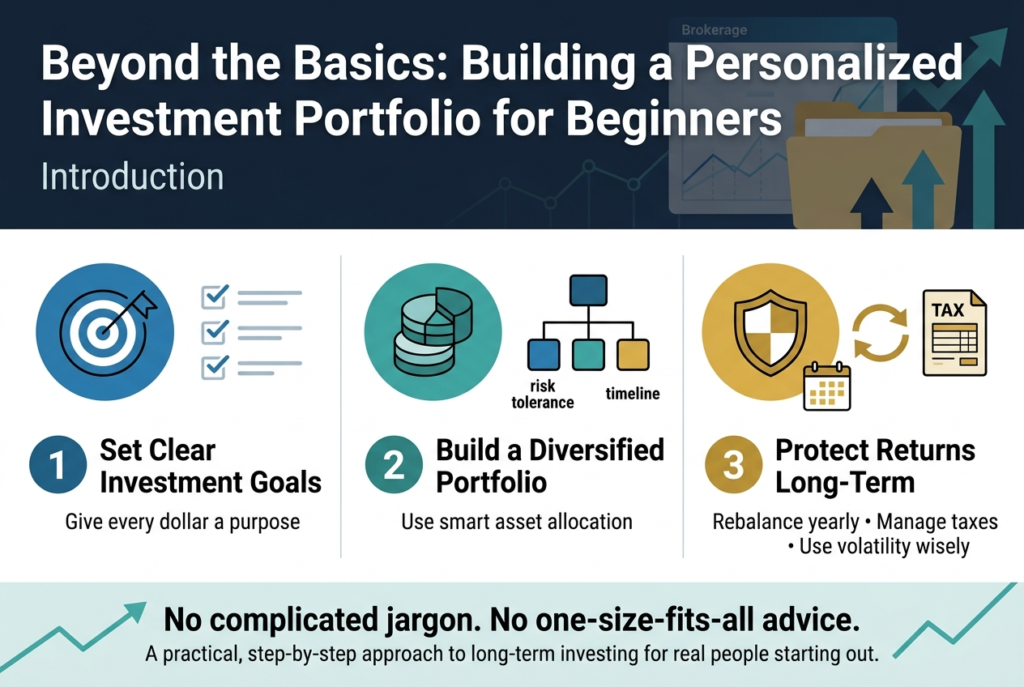
Beyond the Basics: Building a Personalised Investment Portfolio for Beginners
You’ve opened a brokerage account. Maybe you’ve bought a stock or two. Now you’re wondering — what’s next?
This guide is for beginners who are ready to move past the basics and start building a personalised investment portfolio that actually fits their life, not someone else’s financial situation.
Here’s what we’ll walk through together:
- How to set clear investment goals so every dollar you invest has a purpose
- How to build a diversified portfolio using a smart asset allocation strategy that matches your risk tolerance and timeline
- How to protect your returns long-term — from rebalancing your investment portfolio each year to managing taxes and using market volatility to your advantage instead of running from it
No complicated jargon. No one-size-fits-all advice. Just a practical, step-by-step approach to long-term investing that works for real people starting.
Let’s get into it.
Define Your Investment Goals Before You Start
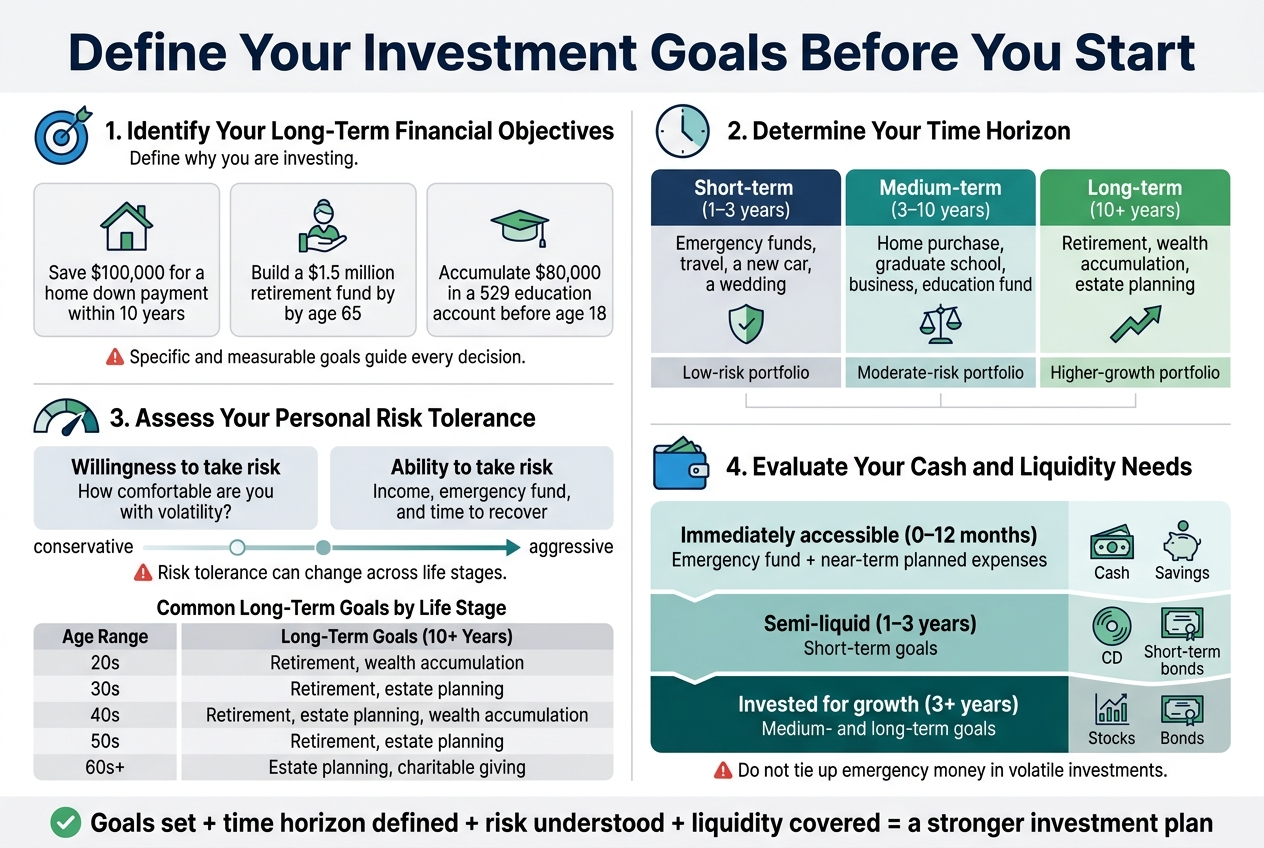
Identify Your Long-Term Financial Objectives
Before you make a single investment, you need a clear picture of why you’re investing. Investment goals are specific financial objectives — retirement savings, a college fund, a home down payment, or leaving a legacy — that form the foundation of every decision you’ll make along the way. Without them, you’re essentially driving without a destination.
The most effective goals are specific and measurable. Instead of vaguely aiming to “save more money,” define exactly what you want. For example:
- Save $100,000 for a home down payment within 10 years
- Build a retirement fund of $1.5 million by age 65
- Accumulate $80,000 in a 529 education account before your child turns 18
Specificity keeps you focused, helps you track progress, and makes it far easier to design an investment portfolio for beginners or experienced investors alike. Think of each goal as its own financial project — each requiring its own strategy, timeline, and funding plan.
Common long-term objectives, broken down by life stage, include:
| Age Range | Long-Term Goals (10+ Years) |
|---|---|
| 20s | Retirement, wealth accumulation |
| 30s | Retirement, estate planning |
| 40s | Retirement, estate planning, wealth accumulation |
| 50s | Retirement, estate planning |
| 60s+ | Estate planning, charitable giving |
Determine Your Time Horizon for Each Goal
Once your objectives are defined, the next critical step is attaching a realistic time horizon to each one. Your time horizon — how long you have before you need the money — directly shapes your long-term investing strategy and the level of risk you can afford to take on.
Goals-based investing recognises three distinct time frames:
- Short-term (1–3 years): Emergency funds, travel, a new car, or a wedding. With little time to recover from market swings, these goals call for low-risk, stable investments.
- Medium-term (3–10 years): A home purchase, graduate school, starting a business, or a child’s education fund. These goals benefit from a balanced mix of growth and stability.
- Long-term (10+ years): Retirement, wealth accumulation, and estate planning. The extended runway allows you to pursue higher-growth investments, even if they experience short-term volatility.
A practical rule of thumb:
| Time Horizon | Suggested Risk Approach |
|---|---|
| 1–3 years | Low-risk portfolio (cash, money market funds, short-term bonds) |
| 3–10 years | Moderate-risk portfolio (diversified mix of stocks and bonds) |
| 10+ years | Higher-growth portfolio (greater equity exposure) |
The more time you have, the more you can let compounding work in your favour — especially for retirement, where starting early can make an enormous difference in your final balance.
Assess Your Personal Risk Tolerance
With your goals and time horizons established, you now need to honestly evaluate how much risk you’re willing — and able — to accept. Risk tolerance is not just an emotional preference; it reflects both your willingness and your financial capacity to absorb losses without derailing your goals.
Two factors shape your risk profile:
- Willingness to take risk: How comfortable are you watching your portfolio drop 20% in a bad market year without panic-selling? Your emotional response to volatility matters as much as the numbers.
- Ability to take risk: Do you have stable income, an emergency fund, and enough time to recover from potential losses? Your financial situation sets the real boundaries.
Your risk tolerance will directly influence how you build a personalised investment portfolio. A higher risk tolerance with a long time horizon might lead you toward a stock-heavy allocation. A lower risk tolerance — or a shorter runway — may steer you toward bonds and cash equivalents that prioritise capital preservation over aggressive growth.
It’s also worth noting that risk tolerance can evolve. As you move through different life stages, you may shift from a growth-oriented approach in your 30s to a more conservative one as you near retirement. Reassessing your risk profile periodically ensures your asset allocation strategy continues to reflect your actual situation.
Evaluate Your Cash and Liquidity Needs
Before committing money to long-term investments, it’s essential to ensure you have enough liquid assets readily available for unexpected expenses and short-term needs. Liquidity — how quickly and easily you can access your money — must be balanced against your desire for growth.
The most fundamental liquidity goal is an emergency fund: a financial safety net typically covering three to six months of living expenses. This should be kept in low-risk, easily accessible accounts such as:
- High-yield savings accounts
- Cash management accounts
- Money market funds
Beyond emergencies, think through any planned expenses in the next one to three years — a major home appliance, medical costs, or a family event. Money earmarked for these near-term needs should not be tied up in volatile investments where a market downturn could force you to sell at a loss.
A simple framework for thinking about your liquidity needs:
- Immediately accessible (0–12 months): Emergency fund + near-term planned expenses → Keep in cash or cash equivalents
- Semi-liquid (1–3 years): Short-term goals → Low-risk instruments (CDs, short-term bonds)
- Invested for growth (3+ years): Medium- and long-term goals → Diversified portfolio of stocks and bonds
Getting this layered approach right from the start prevents a common and costly mistake: being forced to withdraw from retirement or investment accounts early, often at a loss and with tax consequences.
With your goals documented, time horizons set, risk tolerance understood, and liquidity needs accounted for, you now have the essential foundation for building a sound investment plan. With this in mind, next, we’ll explore how to translate these inputs into a smart asset allocation strategy that works for your specific situation.
Create Your Personal Investing Formula with Smart Asset Allocation
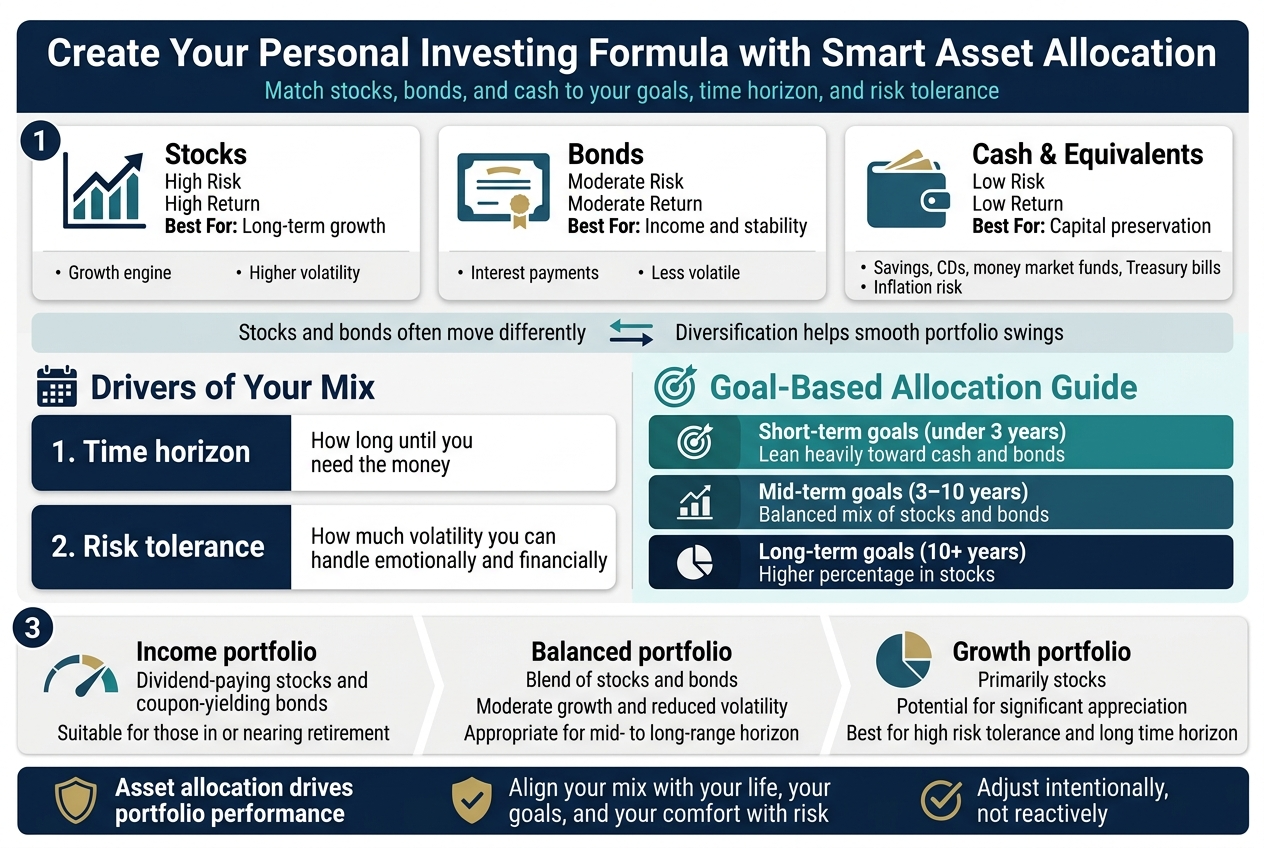
Understand the Three Core Asset Classes: Stocks, Bonds, and Cash
Before you can build a personalised investment portfolio, you need to understand the building blocks. Every solid asset allocation strategy begins with the same three core asset classes, each with its own risk-return profile.
| Asset Class | Risk Level | Return Potential | Best For |
|---|---|---|---|
| Stocks | High | High | Long-term growth |
| Bonds | Moderate | Moderate | Income and stability |
| Cash & Equivalents | Low | Low | Capital preservation |
Stocks are the growth engine of your portfolio. When you buy a stock, you own a small piece of a company and share in its profits. Historically, stocks have delivered the highest returns among the three major asset classes — but they come with the steepest volatility. Large company stocks have lost money roughly one out of every three years on average. That said, investors willing to stay the course over long periods have generally been rewarded with strong positive returns, making stocks a critical component of any long-term investing strategy.
Bonds play the stabilising role. When you purchase a bond, you are essentially lending money to a company or government in exchange for regular interest payments and the return of your principal. Bonds are generally less volatile than stocks, though they tend to generate more modest returns. As you approach a financial goal, shifting more of your portfolio toward bonds can help cushion against market swings.
Cash and cash equivalents — think savings accounts, certificates of deposit, money market funds, and Treasury bills — carry the least risk. They are highly liquid and offer capital protection, but their returns are the lowest of the three. The primary concern with holding too much cash is inflation risk: over time, rising prices can erode the purchasing power of your returns.
Understanding how each asset class responds differently to market conditions is foundational to building a diversified portfolio. When stocks struggle, bonds often hold steady or gain — and vice versa. This non-correlation is precisely what makes combining all three so powerful.
Match Your Asset Mix to Your Risk Tolerance and Time Horizon
Now that we have covered the three core asset classes, the next step is determining the right mix for you. This is where your asset allocation strategy becomes deeply personal.
Two factors drive this decision above all others: your time horizon and your risk tolerance.
Time horizon refers to how long you plan to keep your money invested before you need it. A 30-year-old saving for retirement has decades to ride out market downturns, which means they can afford to hold a higher percentage of stocks. A parent saving for a child’s college tuition starting in three years needs a more conservative mix, because there is little time to recover from a significant loss.
Risk tolerance is both emotional and financial. Emotionally, it is how comfortable you feel watching your portfolio drop in value during a market downturn. Financially, it reflects how much loss you can actually absorb without derailing your goals. Even if you feel confident about market volatility, your financial situation may still require a more conservative approach.
Here is a general framework for thinking about asset mix by goal type:
- Short-term goals (under 3 years): Lean heavily toward cash and bonds to preserve capital. A portfolio weighted toward stocks could expose you to a major loss right when you need the money.
- Mid-term goals (3–10 years): A balanced mix of stocks and bonds can offer moderate growth while managing downside risk.
- Long-term goals (10+ years): A growth-oriented allocation, with a higher percentage in stocks, gives your portfolio the runway it needs to compound meaningfully over time.
Vanguard outlines three primary portfolio models that reflect this spectrum:
- Income portfolio: Focused on dividend-paying stocks and coupon-yielding bonds — suitable for those in or nearing retirement.
- Balanced portfolio: A blend of stocks and bonds designed for moderate growth and reduced volatility — appropriate for investors with a mid- to long-range horizon.
- Growth portfolio: Primarily stocks with the potential for significant appreciation — best suited for investors with a high risk tolerance and a long time horizon.
The key principle is alignment. Your asset mix should match where you are in life, where you are going, and how much turbulence you can tolerate along the way.
Leverage Research That Proves Asset Allocation Drives Portfolio Performance
With this in mind, it is worth emphasising just how much your asset allocation decision matters — arguably more than any individual investment you choose.
As noted by Investor.gov, some financial experts believe that determining your asset allocation is the single most important investment decision you will make — more impactful than picking individual stocks, timing the market, or selecting a specific fund. This is not a minor detail. It is the foundation of your entire investment portfolio.
The historical data supports this view. The mix of stocks and bonds you hold is a primary driver of both your potential returns and your range of losses in any given year. Vanguard’s research shows that the more stocks you own, the higher your potential return — but also the greater your potential loss. A portfolio that is 100% stocks has historically delivered higher long-term returns than a 50/50 blend, but it has also experienced far more dramatic short-term swings.
This means two things for you as an investor building a personalized investment portfolio:
- Getting your allocation right from the start reduces costly mistakes. Too conservative an allocation may mean your portfolio does not grow enough to meet your goals. Too aggressive, and a poorly timed downturn could leave you short when you need the money most.
- Adjustments should be intentional, not reactive. Savvy investors do not shift their asset mix based on which asset class is performing well in the short term. Instead, they commit to a thoughtful allocation and adjust deliberately as their time horizon or risk tolerance changes.
If you are unsure where to start, a financial professional or an online risk tolerance questionnaire can help you identify an initial allocation — and suggest how to adjust it as your circumstances evolve.
Build a Diversified Portfolio That Protects and Grows Your Wealth
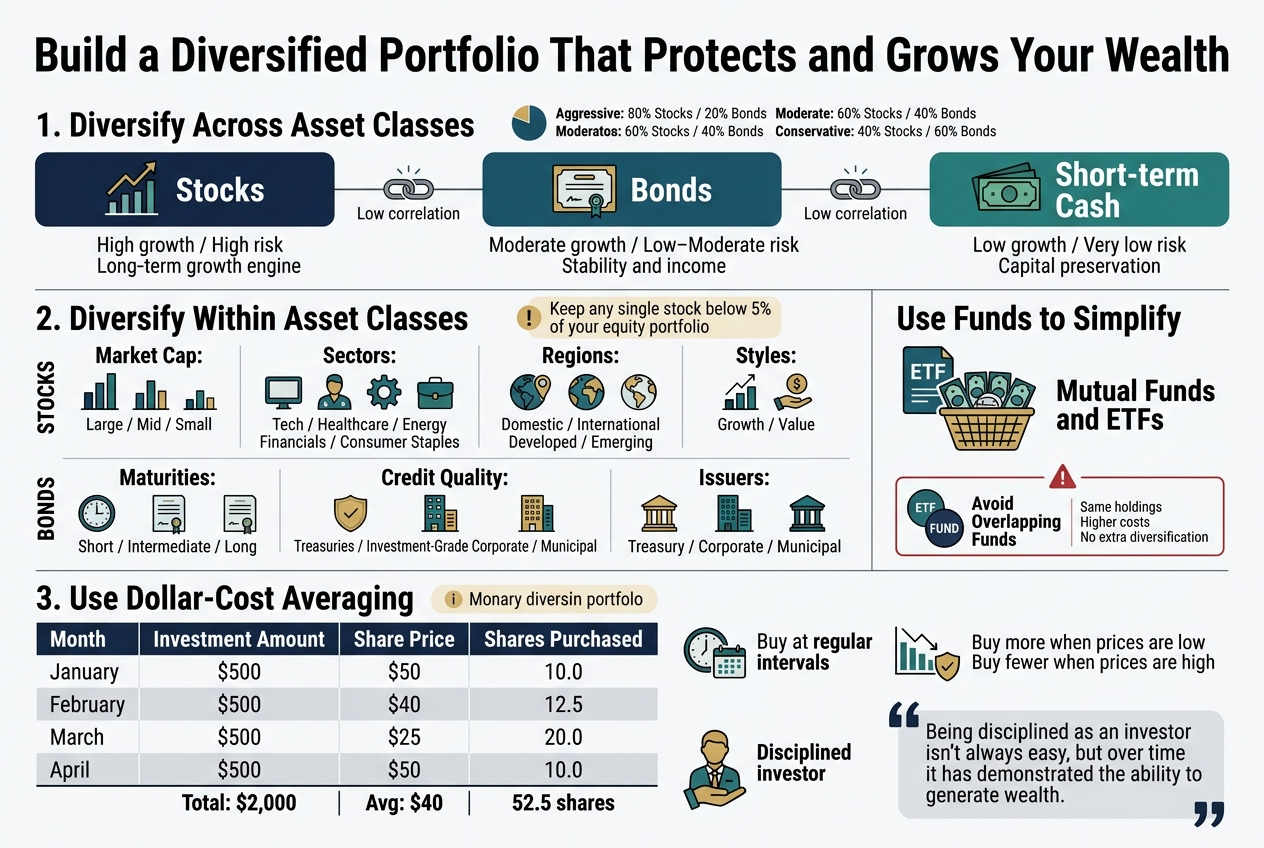
Diversify Across Asset Classes to Minimise Risk
Think of your investment portfolio like a carton of eggs — if you carry them all in one basket and it drops, you lose everything. Spreading your eggs across multiple baskets is exactly how diversification works, and it’s one of the most fundamental strategies for building a personalised investment portfolio geared toward long-term growth.
Diversification works through a concept called correlation — how different investments move relative to one another. When you combine assets that don’t move in the same direction at the same time, your portfolio has low correlation, which cushions it against extreme declines. The classic example: when stock prices fall, bonds typically rise. Owning both means big swings in one asset class are offset by stability in another.
Here’s a quick look at how the three core asset classes compare:
| Asset Class | Growth Potential | Risk Level | Role in Portfolio |
|---|---|---|---|
| Stocks | High | High | Long-term growth engine |
| Bonds | Moderate | Low–Moderate | Stability and income |
| Short-term/Cash | Low | Very Low | Capital preservation |
A real-world example drives the point home. During the 2008–2009 financial crisis, a diversified portfolio holding 70% stocks, 25% bonds, and 5% short-term investments lost significantly less than an all-stock portfolio — and still captured much of the subsequent market recovery. That’s the power of spreading risk across asset classes.
Your specific asset allocation — the percentage you invest in each class — should reflect your risk tolerance, time horizon, and financial goals. Three common frameworks to consider:
- Aggressive: 80% stocks / 20% bonds — higher growth potential, more volatility
- Moderate: 60% stocks / 40% bonds — balanced growth and stability
- Conservative: 40% stocks / 60% bonds — prioritises stability, lower long-term returns
Choosing the right mix is foundational to your asset allocation strategy and sets the stage for everything that follows in your portfolio-building journey.
Diversify Within Asset Classes Across Sectors and Regions
Now that we’ve covered diversifying across asset classes, it’s equally important to diversify within them. Owning a broad mix of stocks and bonds isn’t enough if all your stocks are concentrated in a single sector or country. True diversification requires spreading exposure across multiple dimensions.
Within Your Stock Holdings
Avoid letting any single stock represent more than 5% of your equity portfolio. Beyond that, diversify across these key dimensions:
- Market capitalisation: Include large-cap, mid-cap, and small-cap companies. Different market cap segments don’t always move in unison, giving your portfolio more balance.
- Sectors: Spread investments across industries such as technology, healthcare, energy, financials, and consumer staples. Sector performance rotates — what leads in one cycle often lags in the next.
- Geographic regions: Invest in both domestic and international markets, including developed economies and emerging markets. Global diversification reduces your dependence on any single country’s economic performance.
- Investment styles: Balance growth stocks (companies reinvesting for expansion) with value stocks (companies trading below their intrinsic value).
Within Your Bond Holdings
Bonds also require internal diversification. Consider varying:
- Maturities: Short-, intermediate-, and long-term bonds respond differently to interest rate changes
- Credit quality: Mix high-quality government bonds (Treasuries) with investment-grade corporate bonds and municipal bonds
- Issuers: A blend of Treasury, corporate, and municipal bonds provides exposure to different risk and return profiles
The good news for investors building a diversified portfolio without massive capital: mutual funds and ETFs solve the complexity problem immediately. By purchasing shares in a single fund, you gain instant exposure to hundreds or thousands of underlying securities. You can invest broadly — such as in a total market fund — or more narrowly with sector- or region-specific funds, all while achieving meaningful diversification at low cost.
One critical mistake to avoid: over-diversification through overlapping funds. Buying multiple funds that hold the same underlying stocks unnecessarily increases costs without adding real diversification benefit. Focus on funds that genuinely complement each other rather than duplicate holdings.
Use Dollar-Cost Averaging to Lower Your Average Cost Per Share
With this in mind, let’s look at one of the most practical tactics for executing your long-term investing strategy consistently: dollar-cost averaging (DCA).
Dollar-cost averaging means investing a fixed dollar amount at regular intervals — weekly, monthly, or quarterly — regardless of what the market is doing. Because you’re buying at different price points over time, you automatically purchase more shares when prices are low and fewer shares when prices are high. The result: a lower average cost per share compared to investing a lump sum at a single, potentially unfavourable, price point.
Here’s how DCA plays out in practice:
| Month | Investment Amount | Share Price | Shares Purchased |
|---|---|---|---|
| January | $500 | $50 | 10.0 |
| February | $500 | $40 | 12.5 |
| March | $500 | $25 | 20.0 |
| April | $500 | $50 | 10.0 |
| Total | $2,000 | Avg: $40 | 52.5 shares |
In this example, the investor acquired 52.5 shares at an average cost of roughly $38.10 per share — well below the simple average price of $41.25 across the same period.
Beyond the mathematical advantage, DCA addresses one of the biggest behavioural pitfalls in investing. As noted by Ann Dowd, CFP®, Vice President at Fidelity Investments: “Being disciplined as an investor isn’t always easy, but over time it has demonstrated the ability to generate wealth, while market timing has proven to be a costly exercise for many investors.”
DCA enforces that discipline automatically. Rather than trying to predict the perfect entry point — a strategy that consistently fails even professional investors — you stay invested consistently, allowing market volatility to work in your favour by lowering your average cost over time.
For beginners building an investment portfolio, DCA is particularly valuable. It removes the psychological burden of deciding when to invest, making it easier to stay the course through inevitable market fluctuations.
Round Out Your Portfolio with Additional Growth Opportunities
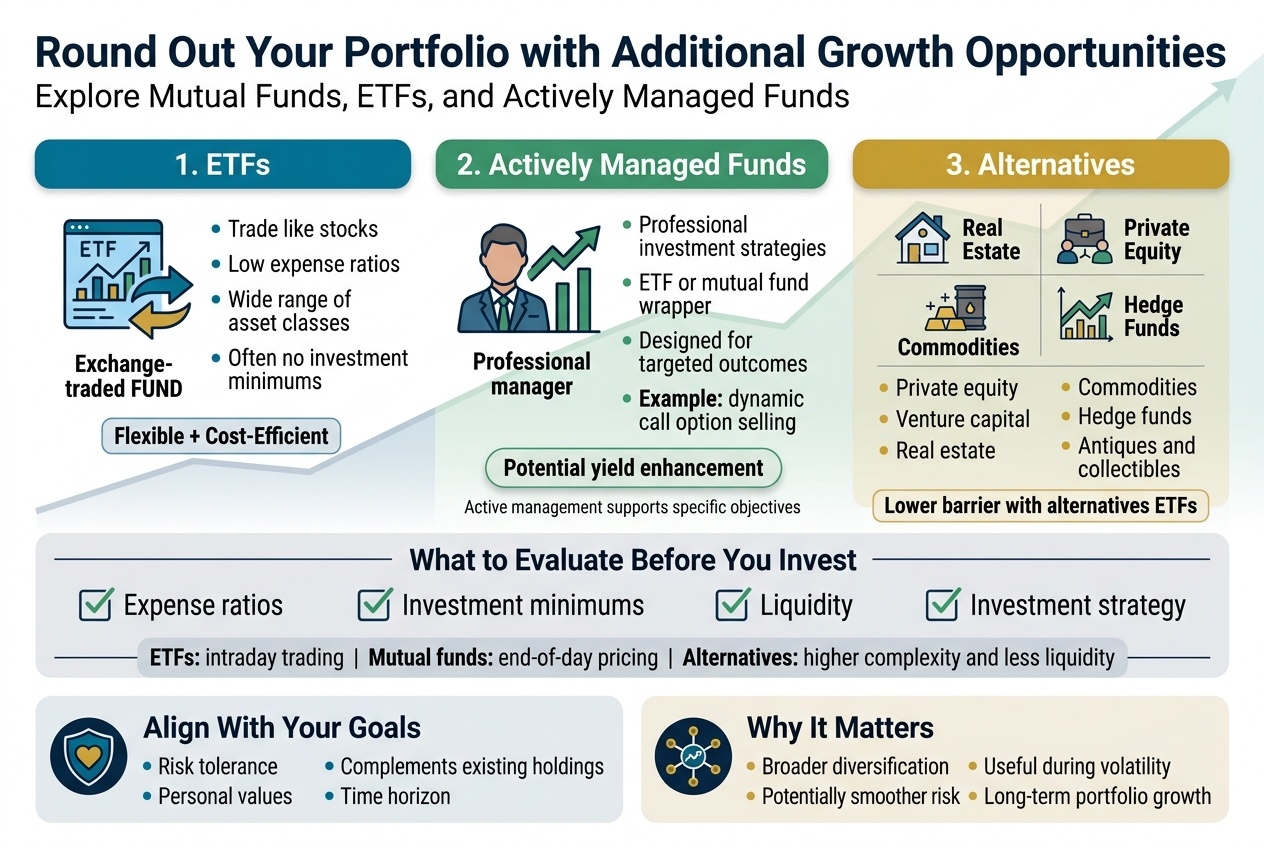
Explore Mutual Funds, ETFs, and Actively Managed Funds
Now that we have covered building a diversified core portfolio, it’s time to look at the tools that can help you round it out. Mutual funds, ETFs, and actively managed funds each offer distinct ways to expand your exposure and pursue additional growth within your personalised investment portfolio.
Exchange-Traded Funds (ETFs) have become one of the most accessible vehicles for investors at every level. They trade like stocks, often carry low expense ratios, and cover a wide range of asset classes — including some that were historically out of reach for everyday investors. For those building a diversified portfolio, ETFs offer a flexible and cost-efficient way to add exposure without the steep minimums or complex fee structures of traditional investment products.
Actively managed funds, including active alternative ETFs offered by firms like Fidelity, pair professional investment strategies with the convenience of the ETF or mutual fund wrapper. These funds are designed to support a variety of investment objectives and desired outcomes. For example, products like the Fidelity Yield Enhanced Equity ETF (FYEE) use dynamic call option selling to enhance portfolio yield potential — without adding duration or credit risk. This makes them worth considering if you’re looking for targeted outcomes beyond simple market exposure.
When evaluating any fund, pay attention to:
- Expense ratios — lower costs mean more of your returns stay with you
- Investment minimums — ETFs typically have none, while some mutual funds do
- Liquidity — ETFs trade intraday, while mutual funds settle at end-of-day pricing
- Investment strategy — passive index tracking vs. active management
Consider Alternative Investments Like Real Estate or Private Equity
With this in mind, next, we’ll look at a category that many beginner investors overlook entirely: alternative investments. Alternatives, or “alts,” refer to investments that fall outside the conventional buckets of stocks, bonds, and cash. Some of the most popular types include:
- Private equity
- Venture capital
- Real estate
- Commodities
- Hedge funds
- Antiques and collectables
Historically, these asset classes were accessible only to wealthy individuals and institutional investors. They tend to be more complex, less liquid, and often require significant minimum investments along with nuanced fee structures. However, the rise of alternatives ETFs has changed that landscape considerably.
Alternatives ETFs now open the door to these asset classes at a fraction of the traditional cost — with no upfront minimums and far lower fees than the underlying investments themselves. There are several alternative ETF classifications to be aware of:
| Alternative Type | What It Offers |
|---|---|
| Hedge fund ETFs | Exposure to hedge-fund-style strategies |
| Long/short ETFs | Potential gains in both rising and falling markets |
| Managed futures ETFs | Diversification through futures contracts |
| Real estate ETFs (REITs) | Income and growth through property exposure |
| Commodity ETFs | Exposure to physical goods like gold, oil, or agriculture |
It’s important to approach alternatives with a clear understanding of the risks involved. Alternative investments may be relatively illiquid, making it difficult to determine current market value. There may also be limited historical risk and return data, and a high degree of investment analysis may be required before committing capital. Additionally, costs of purchase and sale can be relatively high compared to standard equity investments.
That said, when used thoughtfully within a long-term investing strategy, alternatives can provide meaningful diversification benefits — particularly during periods of market volatility. Because they often behave differently from stocks and bonds, they may help smooth out risk in a broader portfolio.
For investors exploring private equity or real estate specifically, alternatives ETFs now provide a practical, lower-barrier entry point that was simply not available to everyday investors just a decade ago.
Align Additional Investments with Your Personal Values and Goals
Previously, I’ve emphasised the importance of defining your investment goals before anything else. That principle applies just as strongly when rounding out your portfolio with additional growth opportunities. Every investment you add should serve a specific purpose within your overall strategy.
As financial advisors and institutions increasingly note, alternatives are no longer a niche category. Research from Cerulli Associates projects that advisors are poised to direct significant capital — estimated at $2 trillion — into alternatives in the coming years. This shift reflects a growing recognition that a well-rounded portfolio extends beyond traditional stocks and bonds.
Before adding any new investment — whether an alternatives ETF, an actively managed fund, or a real estate vehicle — ask yourself:
- Does this align with my risk tolerance? Alternatives can be riskier and less liquid than conventional investments. Make sure you understand what you’re taking on.
- Does it complement what I already hold? The goal is to reduce overlap and add genuine diversification, not just more of the same exposure in a different wrapper.
- Does it reflect my values? If environmental responsibility, social impact, or ethical governance matters to you, look for funds that incorporate those priorities into their selection criteria.
- What is the time horizon for this investment? Some alternatives, like private equity or real estate, are better suited for longer holding periods. Make sure the liquidity profile matches your needs.
Building a diversified portfolio that protects and grows your wealth means going beyond the basics — but it also means being selective. Not every alternative investment will be right for every investor. Focus on options that genuinely fit your investment goals, complement your existing asset allocation strategy, and give you confidence in both their risk profile and their potential for growth.
Maximise Returns by Managing Taxes and Transaction Costs
A. Choose Between Traditional and Roth Retirement Accounts Strategically
Managing taxes is one of the most powerful — and most overlooked — levers in building a personalised investment portfolio. Before diving into specific strategies, it helps to understand the core tax treatments that shape your options:
| Term | What It Means |
|---|---|
| Pre-tax | Contributions reduce your taxable income in the current year |
| Tax-deferred | Growth isn’t taxed until you withdraw the funds |
| Tax-free | Qualified withdrawals are not subject to taxes |
| Tax-exempt | Interest income is exempt from certain taxes now and in the future |
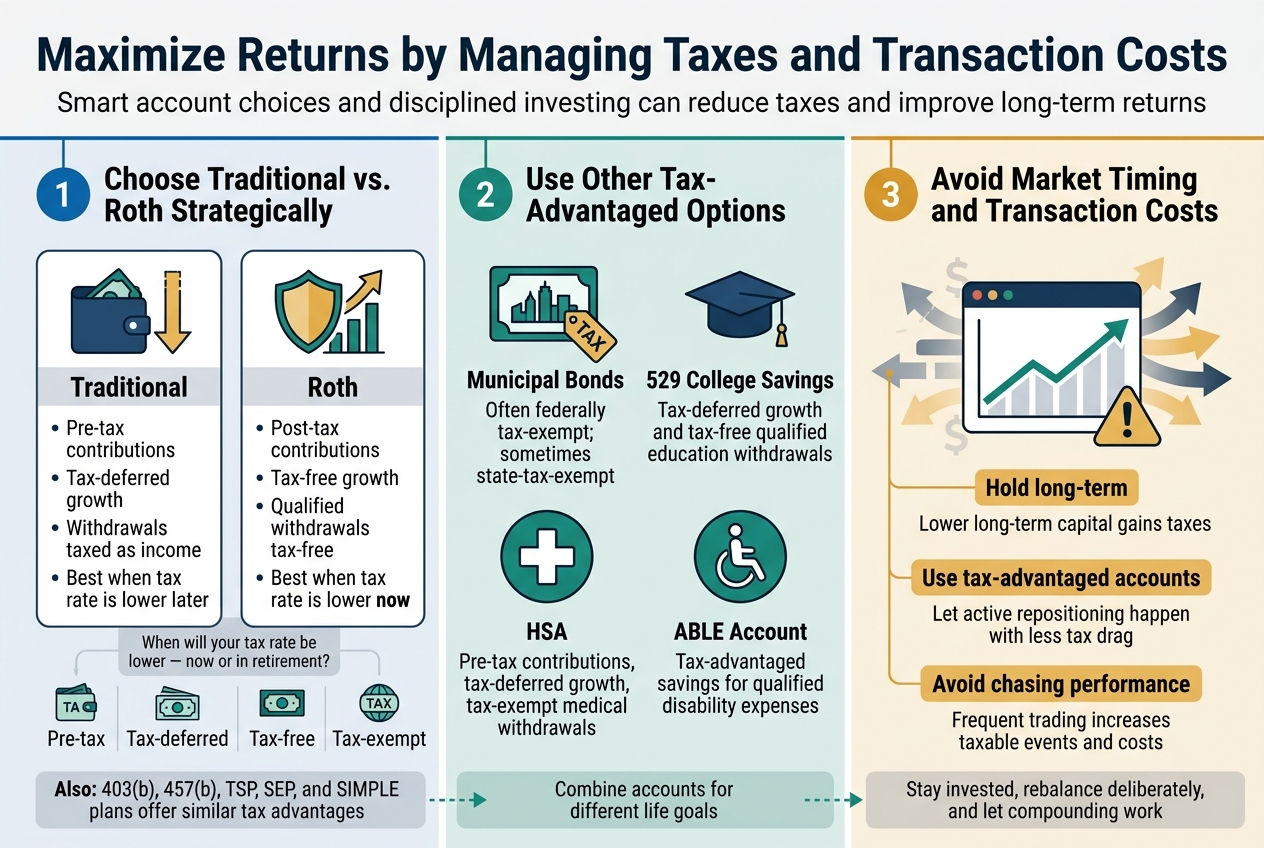
With this framework in mind, the choice between a Traditional and Roth retirement account comes down to one key question: When do you expect to pay a lower tax rate — now or in retirement?
Traditional 401(k)s and IRAs accept pre-tax contributions, which immediately lower your taxable income for the year. For example, contributing $5,000 to a traditional 401(k) means you only owe income taxes on your salary minus that $5,000. Your money then grows tax-deferred, meaning you won’t owe taxes on gains, dividends, or interest until you make withdrawals — typically in retirement. If you anticipate being in a lower tax bracket after you stop working, this approach can work strongly in your favour.
Roth IRAs and Roth 401(k)s, on the other hand, are funded with post-tax dollars. The trade-off is significant: your money grows completely tax-free, and qualified withdrawals in retirement are also tax-free — provided the account has been open for at least five years, and you are at least 59½. You can also withdraw your original Roth contributions at any time without taxes or penalties, adding a layer of flexibility.
Here’s a quick comparison to help guide your decision:
| Feature | Traditional Account | Roth Account |
|---|---|---|
| Contributions | Pre-tax | Post-tax |
| Growth | Tax-deferred | Tax-free |
| Withdrawals | Taxed as income | Tax-free (if qualified) |
| Best for | Higher income now, lower income in retirement | Lower income now, higher income in retirement |
Beyond these two, employer-sponsored plans like 403(b), 457(b), and Thrift Savings Plan (TSP) accounts offer similar tax-deferred benefits for eligible workers. SEP and SIMPLE plans extend comparable advantages to self-employed individuals and small business owners.
Because contribution limits apply to each account type annually, consulting a tax professional can help you determine the optimal contribution strategy based on your personal circumstances.
B. Consider Tax-Advantaged Options Like Municipal Bonds
Now that we’ve covered retirement accounts, it’s worth looking at other tax-advantaged vehicles that can round out a long-term investing strategy — particularly for investors who have already maximised their retirement contributions.
Municipal bonds are one of the most well-known tax-exempt investment options available. Interest earned on municipal bonds is generally exempt from federal income taxes and, in many cases, exempt from state taxes as well — particularly for bonds issued within your home state. This dual exemption can make municipal bonds especially attractive for investors in higher tax brackets.
Municipal bond funds — funds that invest primarily in obligations of state and local governments — also pass along this tax-exempt interest to shareholders, offering a straightforward way to gain exposure without purchasing individual bonds.
Other notable tax-advantaged options include:
- 529 College Savings Plans — Offer tax-deferred growth and tax-free withdrawals when used for qualified education expenses. Many states also provide tax deductions for contributions.
- Health Savings Accounts (HSAs) — Allow pre-tax contributions for qualified medical expenses. Earnings are tax-deferred, and withdrawals for eligible medical costs are tax-exempt. This triple tax benefit makes HSAs one of the most efficient accounts available.
- ABLE Accounts — Designed for individuals with disabilities to cover qualified disability expenses with tax advantages.
Each of these accounts is purpose-built to serve specific financial needs. Strategically combining them — for instance, using an HSA for healthcare costs while relying on a 529 for education funding — can significantly reduce your overall tax burden across multiple life areas, not just retirement.
C. Avoid Market Timing to Keep Transaction Costs Low
With tax strategy addressed, there’s another often-underestimated drag on portfolio returns: transaction costs and the temptation to time the market.
Frequent buying and selling might seem like a proactive approach to managing investment volatility, but it carries real costs. Every trade can generate taxable events — particularly short-term capital gains, which are taxed at higher ordinary income rates compared to long-term gains. Over time, these costs accumulate and erode the compounding growth that is central to a successful long-term investing strategy.
The most effective antidote to excessive trading is a disciplined, stay-the-course mindset. Here’s why this matters:
- Tax-deferred and tax-free accounts allow your investments to compound without triggering taxes on each transaction, but only if you let them grow rather than constantly repositioning.
- Pre-tax contributions lose their advantage if you’re frequently liquidating positions and triggering unnecessary taxable events outside these accounts.
- Market volatility, while uncomfortable, is a normal part of investing — not a signal to abandon your allocation strategy.
Rather than reacting to short-term market swings, a more effective approach is to stay invested and make deliberate, infrequent adjustments — such as scheduled rebalancing (covered in the next section) — rather than reactive trades driven by fear or speculation.
A few practical ways to minimise unnecessary transaction costs include:
- Hold investments long-term to benefit from lower long-term capital gains tax rates
- Use tax-advantaged accounts for more active positions where rebalancing may be needed
- Avoid chasing performance — frequent repositioning rarely improves outcomes and consistently increases costs
Managing taxes and keeping transaction costs low aren’t glamorous tasks, but they are among the highest-impact actions you can take to protect and grow your personalised investment portfolio over time.
Review and Rebalance Your Portfolio at Least Once a Year
Reassess Goals, Risk Tolerance, and Time Horizon Regularly
Now that you’ve built a diversified portfolio, the work doesn’t stop there. Markets move, life changes, and the portfolio you set up two years ago may no longer reflect where you are today. That’s why reviewing your portfolio at least once a year is one of the most important habits you can build as an investor.
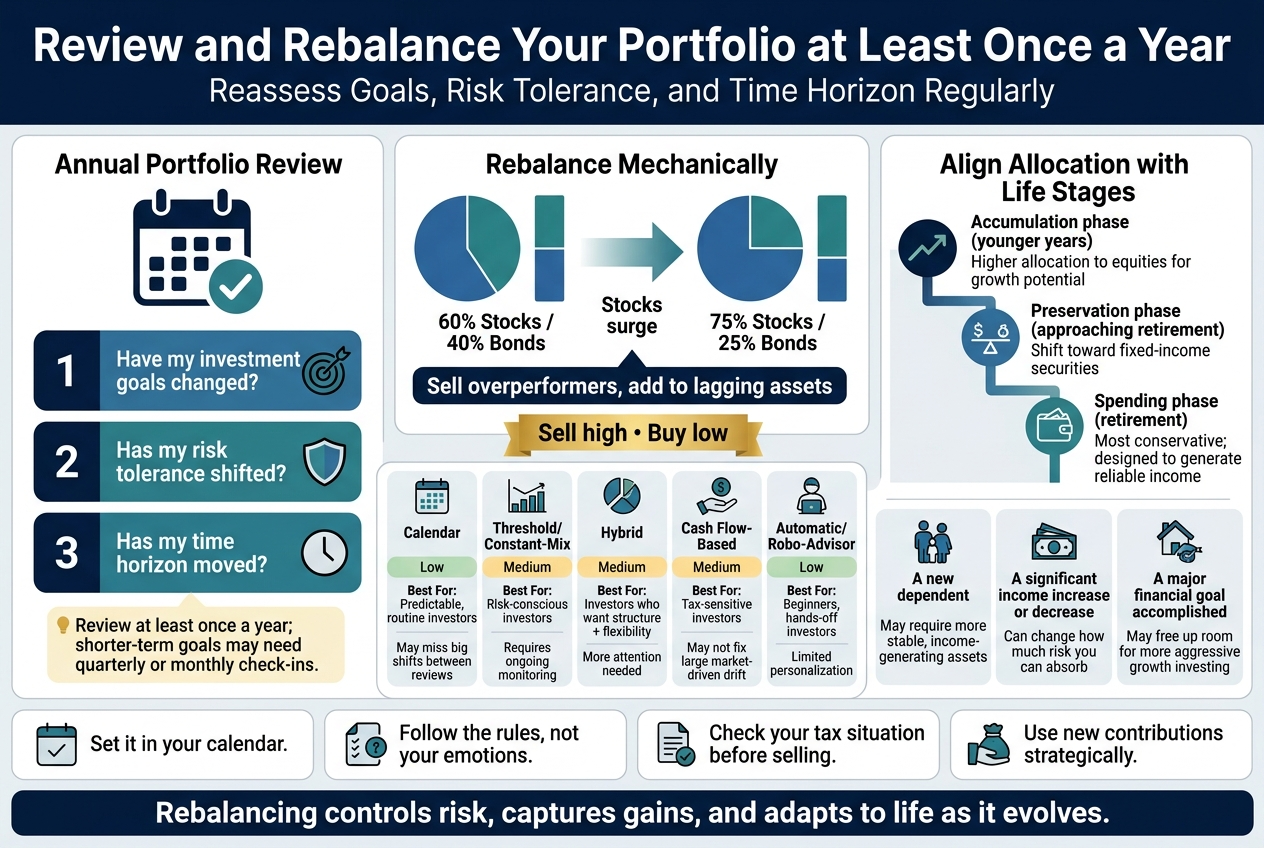
At every review, ask yourself three core questions:
- Have my investment goals changed? A shift from saving for a home to saving for retirement changes everything about how you should be invested.
- Has my risk tolerance shifted? A market downturn or a major life event can reveal that you’re less comfortable with volatility than you thought — or more.
- Has my time horizon moved? Someone in their 30s has decades of runway. Someone five years from retirement needs to be thinking differently about preservation.
Your answers to these questions should drive every rebalancing decision you make. According to portfolio management experts, long-term investors who take a buy-and-hold approach should review their allocations at least annually with a financial advisor to determine whether rebalancing is warranted. Investors with shorter-term goals may want to check in more frequently — quarterly or even monthly — to stay on course.
Rebalance by Selling Overperformers and Adding to Lagging Assets
With this in mind, let’s talk about the mechanics of rebalancing your investment portfolio. Over time, certain assets will grow faster than others. If your stocks surge while your bonds stay flat, your portfolio drifts away from its original allocation — and quietly takes on more risk than you intended.
Here’s a simple example: Suppose your target allocation is 60% stocks and 40% bonds. After a strong stock market run, your portfolio drifts to 75% stocks and 25% bonds. You’re now carrying significantly more equity risk than your plan called for. Rebalancing means selling a portion of your stocks and buying more bonds to return to your 60/40 target.
This process embodies the principle of selling high and buying low — one of the most disciplined approaches to long-term investing strategy. You’re taking gains from high-performing assets and reinvesting them in areas positioned for future growth.
Here’s a quick look at the most common rebalancing strategies and how they compare:
| Strategy | Complexity | Best For | Key Tradeoff |
|---|---|---|---|
| Calendar | Low | Predictable, routine investors | May miss big shifts between reviews |
| Threshold/Constant-Mix | Medium | Risk-conscious investors | Requires ongoing monitoring |
| Hybrid | Medium | Investors who want structure + flexibility | More attention needed |
| Cash Flow-Based | Medium | Tax-sensitive investors | May not fix large market-driven drift |
| Automatic/Robo-Advisor | Low | Beginners, hands-off investors | Limited personalization |
For most individual investors building a personalised investment portfolio, calendar rebalancing — once a year — is the most practical starting point. It’s low-cost, straightforward, and prevents the emotional decision-making that can derail long-term returns.
If you want more precision, a threshold-based approach sets tolerance bands around each asset class. For example, if your target is 30% in bonds, you might allow it to drift between 25% and 35%. Only when it breaches those bands do you rebalance. This method responds faster to market conditions without requiring constant attention.
One important note: rebalancing does come with costs. Selling appreciated assets can trigger transaction fees and, in taxable accounts, capital gains taxes. Factor these in when deciding how frequently to rebalance, and consider making adjustments inside tax-advantaged accounts first when possible.
Adjust Your Asset Allocation When Life Priorities Change
Previously, I’ve covered how to rebalance around market drift. But there’s another, equally important reason to adjust your portfolio: your life changes.
Rebalancing isn’t just about restoring percentages — it’s about ensuring your asset allocation continues to match where you are in life. Investors don’t keep a fixed allocation forever. The mix that was right at 30 is not the mix that’s right at 55.
A common pattern that many investors follow looks like this:
- Accumulation phase (younger years): Higher allocation to equities for growth potential. More risk is acceptable because time is on your side.
- Preservation phase (approaching retirement): Gradually shift toward a greater allocation in fixed-income securities like bonds. The priority becomes protecting what you’ve built.
- Spending phase (retirement): The portfolio is at its most conservative, designed to generate reliable income rather than aggressive growth.
Beyond retirement, other life events should also trigger a portfolio review:
- A new dependent (child, ageing parent) may require more stable, income-generating assets
- A significant income increase or decrease can change how much risk you’re able to absorb
- A major financial goal accomplished (home purchase, debt payoff) may free up room for more aggressive growth investing
The key insight here is that rebalancing is not a one-size-fits-all action. Your target allocation — whether it’s 70% stocks and 30% bonds, or 40% stocks and 60% bonds — should reflect your personal goals, risk tolerance, and time horizon. There’s no universal “correct” split.
A few practical tips to keep your rebalancing disciplined:
- Set it in your calendar. Treat your annual review like a financial appointment — non-negotiable.
- Follow the rules, not your emotions. In volatile markets, it’s tempting to abandon your plan. Stick to your predefined thresholds.
- Check your tax situation before selling. Rebalancing inside a 401(k) or IRA avoids triggering immediate capital gains taxes.
- Use new contributions strategically. Directing fresh money into underweighted assets is a tax-efficient way to rebalance without selling.
A well-maintained rebalancing habit keeps your diversified portfolio tips working in your favour — controlling risk, capturing gains, and adapting to life as it evolves.
Stay Invested and Use Market Volatility to Your Advantage
Recognize Volatility as a Normal and Manageable Part of Investing
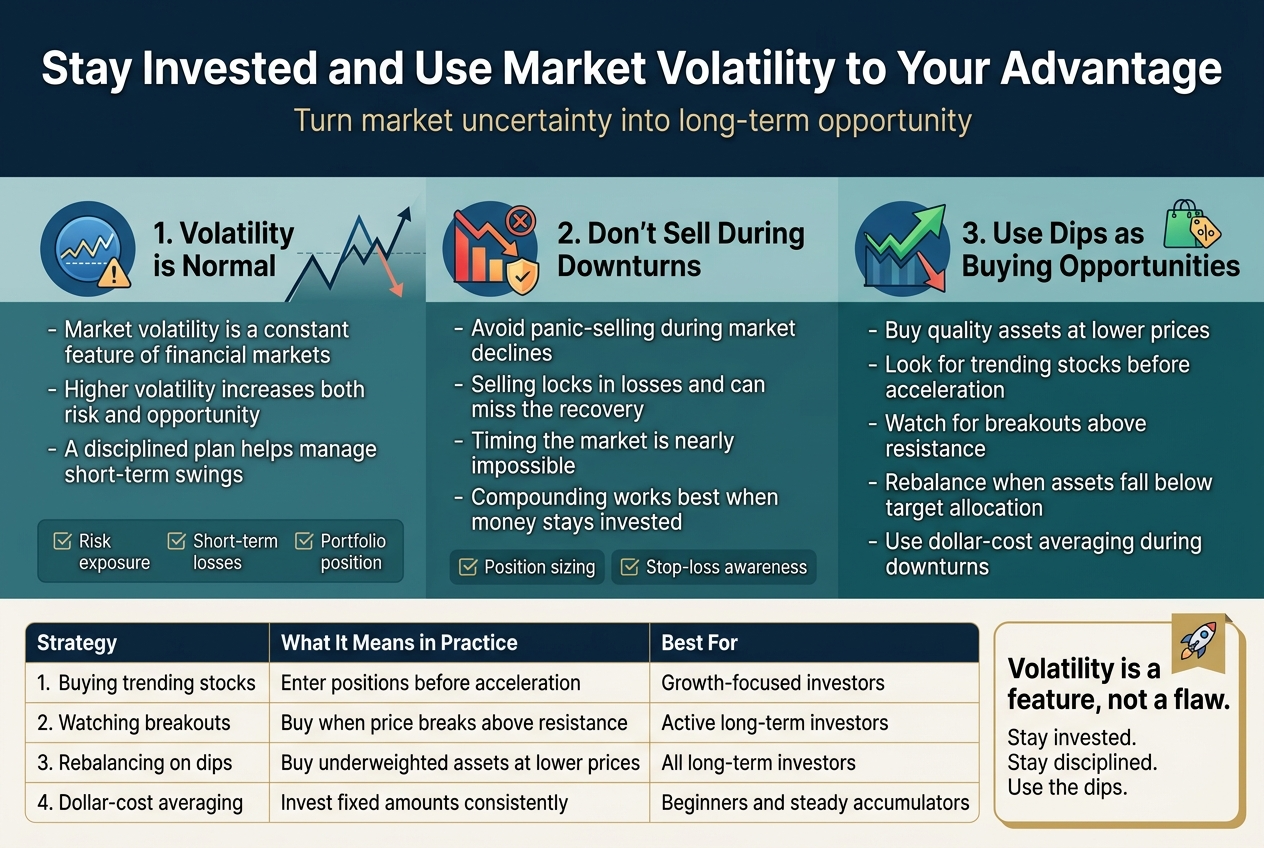
Market volatility is not an anomaly — it is a constant feature of financial markets. The speed and degree of price change will always be present, and as an investor, the most important mindset shift you can make is accepting this reality rather than fearing it.
The key insight from seasoned investors is straightforward: as volatility increases, so does the potential to benefit — provided you approach it with discipline. Yes, higher volatility also means higher risk, but with a structured plan in place, you can learn to manage that risk effectively rather than react emotionally to short-term price swings.
Think of it this way: a long-term investing strategy is built precisely for moments like these. Your asset allocation, your diversified portfolio, and your rebalancing schedule — all of which we’ve covered earlier in this post — are your defences. They exist so that when markets swing wildly, your financial foundation holds firm.
Before volatility hits, it helps to be mentally and tactically prepared. Ask yourself:
- Are you comfortable with your current level of risk exposure during high-volatility periods?
- Do you understand and accept that significant short-term losses are possible?
- Is your portfolio positioned in a way that doesn’t force you to sell at the worst possible time?
If you can answer those questions confidently, you are already ahead of most investors when it comes to navigating turbulent markets.
Avoid Selling During Downturns to Protect Long-Term Gains
Now that we have covered the importance of recognising volatility as manageable, the next — and arguably most critical — rule is this: do not sell during market downturns.
When prices fall sharply, fear kicks in. The instinct is to cut losses and move to cash. But this reaction is one of the most common and costly mistakes a long-term investor can make. Selling during a downturn locks in losses permanently and removes you from the recovery that almost always follows.
Here is why staying invested matters so much:
- Markets recover over time. Price movement is constant, and downturns — no matter how severe they feel in the moment — are historically followed by upward trends.
- Timing the market is nearly impossible. Investors who sell during dips often miss the strongest recovery days, which can dramatically reduce long-term returns.
- Your long-term investing strategy depends on compounding. Compounding only works when your money stays invested. Every time you exit the market and re-enter, you interrupt this process.
One practical way to protect yourself from panic-selling is to revisit your risk controls before volatility strikes. For example:
- Position sizing — Make sure no single holding is so large that a sharp decline in it forces you into a fear-based decision.
- Stop-loss awareness — While stop-loss orders are more relevant for active traders, understanding price thresholds for your holdings gives you a rational anchor rather than an emotional one.
With this in mind, the goal during a downturn is not to react — it is to hold your position, trust your long-term plan, and let the market do what it has historically always done: recover.
Treat Market Dips as Strategic Buying Opportunities
Previously, I’ve emphasised how important it is to stay invested when markets fall. Now, let’s take that one step further: market dips are not just something to survive — they are opportunities to act strategically.
When prices decline, you are essentially getting the same assets at a discount. For a long-term investor with a well-structured portfolio, this is one of the most powerful moments to build wealth.
Here are smart, disciplined ways to use market volatility to your advantage:
Look for Stocks Already Trending in a Positive Direction
During volatile markets, stocks that have been trending upward — but haven’t yet accelerated significantly — may offer strong entry points. The logic is simple: getting in before an acceleration in price, rather than after, positions you for greater gains as the market stabilises and moves higher.
Watch for Breakouts from Consolidation Ranges
A common strategy during volatile periods is watching for stocks trading within a defined support and resistance range. When a stock breaks out above that resistance in a volatile market, the subsequent price move can be more immediate and substantial than in quieter conditions. For long-term investors, this can signal the start of a meaningful upward trend worth buying into.
Use Market Dips to Rebalance Strategically
If your portfolio review (covered earlier) reveals that certain asset classes have fallen below their target allocation due to a downturn, this is the ideal time to rebalance. Buying underweighted assets when prices are low means you are automatically purchasing more at a discount — a built-in mechanism for long-term growth.
Consider Dollar-Cost Averaging During Downturns
Rather than trying to time the exact bottom of a market dip — which is nearly impossible — a disciplined approach is to invest a fixed amount consistently, regardless of market conditions. During downturns, your fixed investment buys more shares at lower prices, reducing your average cost over time.
| Strategy | What It Means in Practice | Best For |
|---|---|---|
| Buying trending stocks | Enter positions before acceleration | Growth-focused investors |
| Watching breakouts | Buy when price breaks above resistance | Active long-term investors |
| Rebalancing on dips | Buy underweighted assets at lower prices | All long-term investors |
| Dollar-cost averaging | Invest fixed amounts consistently | Beginners and steady accumulators |
The bottom line is this: volatility is a feature, not a flaw. It creates price movement, and price movement creates opportunity. With a disciplined, long-term investing strategy, the right mindset, and a clear plan for managing risk, you can turn market uncertainty into one of your greatest wealth-building tools.
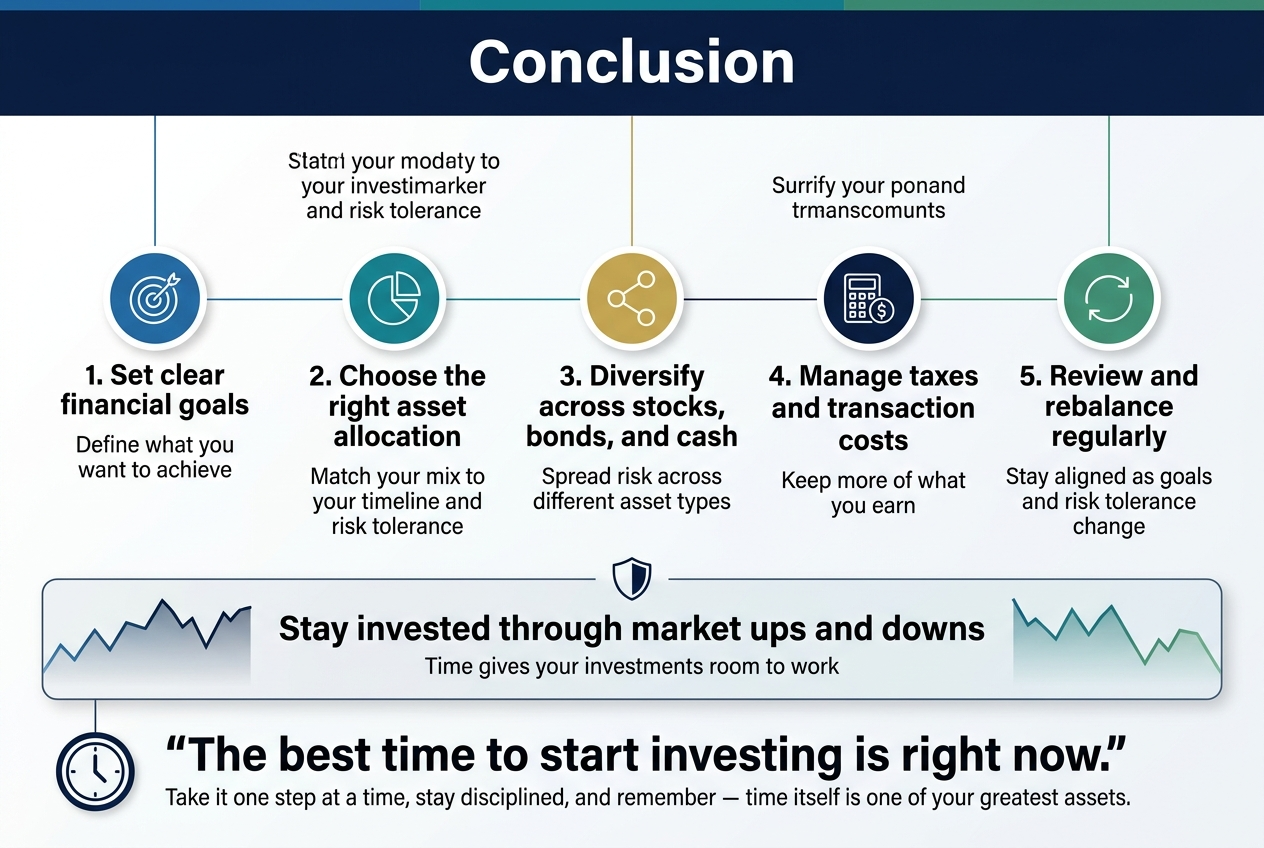
Building a personalised investment portfolio doesn’t have to be overwhelming. By starting with clear financial goals, choosing the right asset allocation, diversifying across stocks, bonds, and cash, and managing taxes and transaction costs, you create a strong foundation for long-term wealth. Regularly reviewing and rebalancing your portfolio ensures it stays aligned with your evolving goals and risk tolerance — while staying invested through market ups and downs gives time the chance to work in your favour.
The most important step is simply getting started. As Marci McGregor, head of Portfolio Strategy for the Chief Investment Office at Merrill and Bank of America Private Bank, puts it: “The best time to start investing is right now.” Take it one step at a time, stay disciplined, and remember — time itself is one of your greatest assets.




Join the conversation
Share a thoughtful response, ask a question, or add something useful for other readers.
Be the first to add a helpful perspective.
Share to join the conversation
Choose a network to start a 90-second countdown. The comment form opens when the timer finishes.
Social networks do not tell this website whether a share was finally published. This is a sharing prompt, not proof of a completed share or a spam-security measure.
Waiting period: 90 seconds after opening a sharing option. Completed shares cannot be verified by this website.