Student loan repayment starts with identifying all federal and private loans, balances, interest rates, servicers, and available protections. Borrowers can compare fixed and income-driven plans based on their income, loan type, disbursement date, and financial goals, including accelerated payoff, sustainable minimum payments, or pursuing forgiveness.
The guide covers PSLF and teacher forgiveness, annual income recertification, budgeting, and risks involving forbearance, consolidation, refinancing, and scams. It also highlights federal repayment changes taking effect July 1, 2026, which may limit plan choices for new or consolidated loans.
Stop Guessing, Start Paying: Your Real Guide to Student Loan Repayment
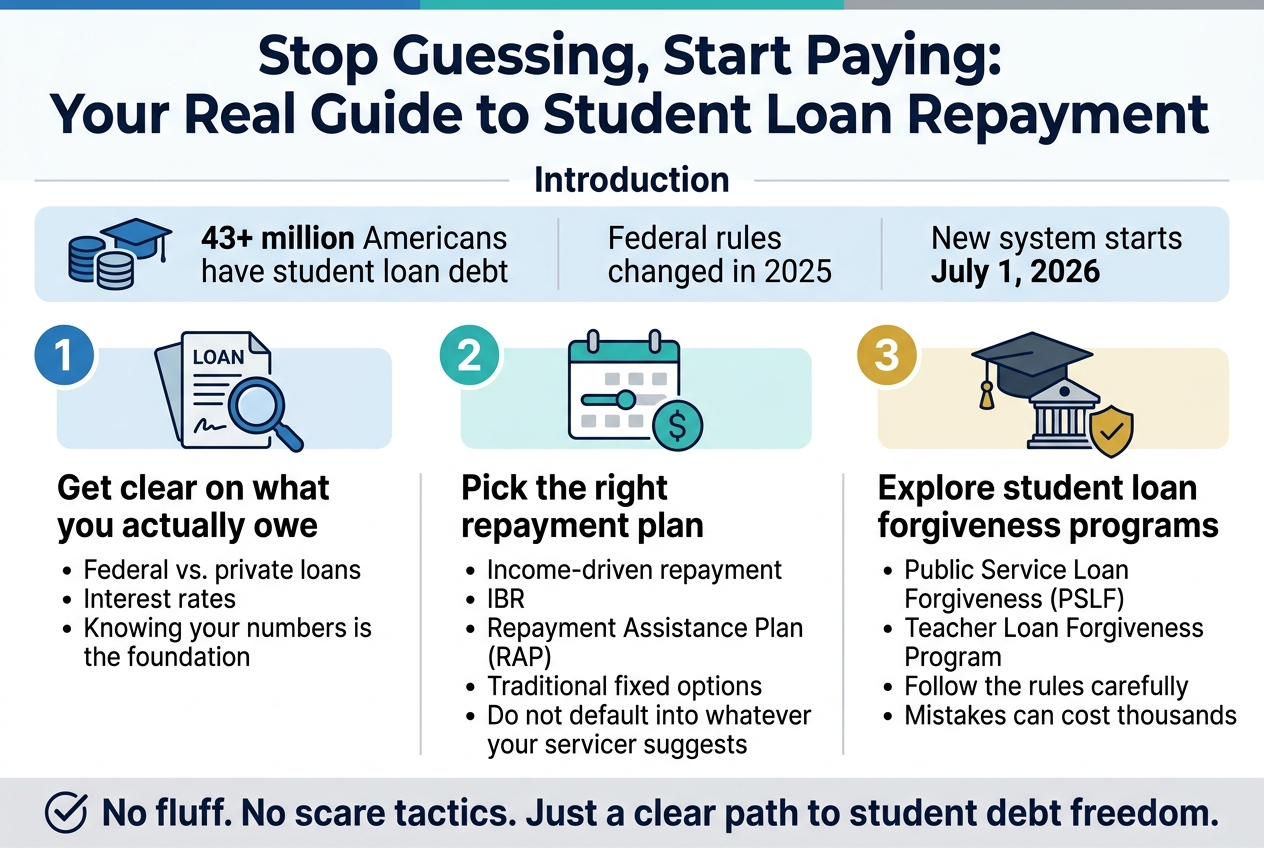
Over 43 million Americans have student loan debt, and if you’re one of them, you’ve probably felt that mix of confusion and dread every time you think about your repayment options. The rules have also changed significantly — the One Big Beautiful Bill Act, signed in 2025, has reshaped the federal student loan system starting July 1, 2026, which means the strategy that worked for your older sibling may not work for you.
This guide is for borrowers who are done feeling stuck — whether you just graduated, you’ve been in repayment for years, or you’re starting to wonder if loan forgiveness is actually on the table for you.
Here’s what we’ll walk through together:
- Getting clear on what you actually owe — federal vs. private loans, interest rates, and why knowing your numbers is the foundation of every good student loan repayment strategy
- Picking the right repayment plan — from income-driven repayment plans like IBR and the new Repayment Assistance Plan (RAP) to traditional fixed options, so you’re not just defaulting into whatever your servicer suggests
- Exploring student loan forgiveness programs — including Public Service Loan Forgiveness (PSLF) and the Teacher Loan Forgiveness Program, plus the mistakes that cost people thousands when they don’t follow the rules carefully
No fluff, no scare tactics — just a clear breakdown of your options so you can build a real path to student debt freedom.
Know Your Debt Before Making Any Moves
Locate All Federal Loans Using the National Student Loan Data System
Before you can build any effective student loan repayment strategies, you need a clear, complete picture of exactly what you owe. Trying to manage student loan debt without knowing the full scope of your balances, interest rates, and servicers is like navigating without a map — you will make costly wrong turns.
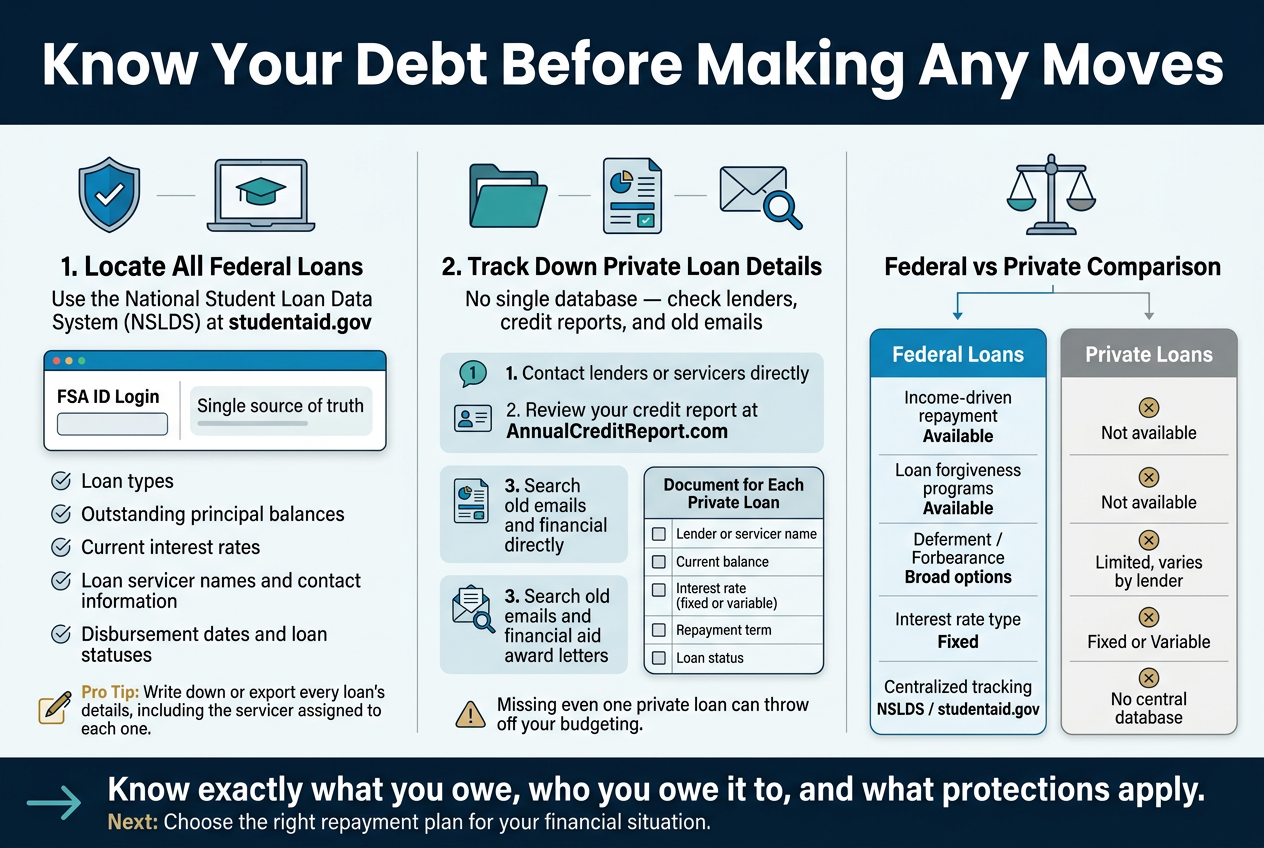
The first step is to locate every federal loan you hold. The National Student Loan Data System (NSLDS), accessible through the official Federal Student Aid website at studentaid.gov, is the centralized database maintained by the U.S. Department of Education. This is your single source of truth for all federal student loan information.
Here is what you can find by logging into studentaid.gov with your FSA ID:
- Loan types (Direct Subsidized, Direct Unsubsidized, PLUS Loans, Perkins Loans, etc.)
- Outstanding principal balances for each loan
- Current interest rates attached to each loan
- Loan servicer names and contact information
- Disbursement dates and loan statuses
Reviewing this information carefully matters because many borrowers are surprised to discover they have more loans — or more loan types — than they realized, especially if they borrowed across multiple academic years or attended more than one institution. Knowing whether your loans are subsidized or unsubsidized, for example, directly affects how interest accrues and which repayment options are available to you.
Pro Tip: Write down or export every loan’s details, including the servicer assigned to each one. Federal loans are often split across multiple servicers, meaning you may need to manage more than one account.
Track Down Private Loan Details From Individual Servicers
With your federal loan picture now clear, the next critical move is tracking down any private student loans you may have. Unlike federal loans, which are all documented in one centralized government system, private loans are issued by banks, credit unions, and other private lenders — and there is no single database that consolidates them.
To locate your private loans, use these methods:
Contact lenders or servicers directly — If you remember which bank or institution you borrowed from, reach out to them by phone or log into your account online to pull your current balance, interest rate, and repayment terms.
Review your credit report — Pull your free credit report from AnnualCreditReport.com. All active and closed loan accounts, including private student loans, will appear here. This is the most reliable method if you are unsure which lenders you worked with.
Check old emails and financial aid award letters — Lenders typically send loan disclosures and account confirmation emails at the time of borrowing. Searching your inbox for terms like “loan disclosure” or your school’s name can surface forgotten accounts.
For each private loan, make sure you document the following:
| Detail | Why It Matters |
|---|---|
| Lender or servicer name | Determines who you make payments to |
| Current balance | Helps prioritize payoff strategy |
| Interest rate (fixed or variable) | Affects total cost of repayment |
| Repayment term | Determines monthly payment amount |
| Loan status (in repayment, deferred, etc.) | Impacts immediate obligations |
This step is non-negotiable if you want to build a complete debt payoff plan. Missing even one private loan can throw off your budgeting and leave you blindsided by unexpected payments or interest accumulation.
Understand the Difference Between Federal and Private Loan Protections
Now that you have located all of your loans, it is essential to understand that federal and private student loans operate under fundamentally different rules — and those differences have a major impact on how you manage student loan debt going forward.
Federal student loans come with a robust set of borrower protections built into law. These include:
- Income-driven repayment (IDR) plans that cap monthly payments based on your income and family size
- Deferment and forbearance options if you face financial hardship
- Loan forgiveness programs, including Public Service Loan Forgiveness (PSLF) and forgiveness at the end of IDR plans
- Fixed interest rates set by Congress each year
- Discharge options in cases of school closure, total and permanent disability, or borrower defense
Private student loans, by contrast, offer far fewer protections. Since they are governed by the terms of your individual loan contract rather than federal law, what you receive depends entirely on your lender. Private loans typically:
- Do not qualify for federal income-driven repayment plans or forgiveness programs
- Offer limited or no deferment and forbearance options
- May carry variable interest rates that can increase over time
- Have fewer discharge protections in cases of hardship
Understanding this distinction is not just academic — it directly shapes which student loan repayment strategies apply to which loans. For example, pursuing an income-driven repayment plan or a forgiveness program only makes sense for your federal loans. For private loans, your focus will typically shift toward strategies like the avalanche or snowball method to pay off student loans fast, which we will cover in detail later in this post.
Here is a quick comparison to keep in mind:
| Feature | Federal Loans | Private Loans |
|---|---|---|
| Income-driven repayment | ✅ Available | ❌ Not available |
| Loan forgiveness programs | ✅ Available | ❌ Not available |
| Deferment / Forbearance | ✅ Broad options | ⚠️ Limited, varies by lender |
| Interest rate type | Fixed | Fixed or Variable |
| Centralized tracking | ✅ NSLDS / studentaid.gov | ❌ No central database |
With this foundation in place — knowing exactly what you owe, who you owe it to, and what protections apply — you are now positioned to make informed, strategic decisions about repayment. With this in mind, next, we’ll explore how to choose the right repayment plan for your specific financial situation.
Choose the Right Repayment Plan for Your Situation
Fixed Repayment Plans: Standard, Graduated, and Extended Options
When it comes to managing student loan debt, selecting the right repayment plan is one of the most consequential decisions you will make. Federal student loans offer two broad categories: fixed-term repayment plans and income-driven repayment plans. Understanding how each works puts you in control of your financial future.
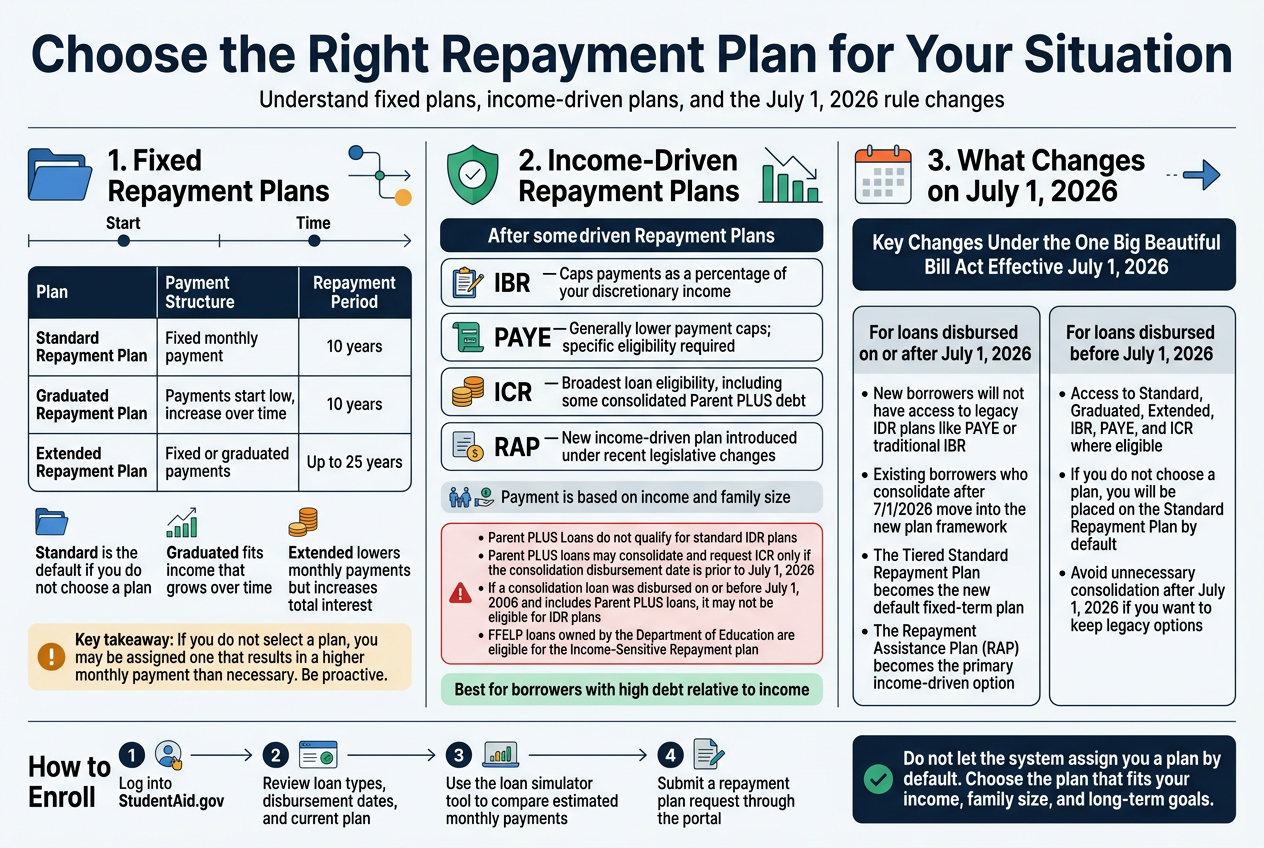
Fixed-term plans give you a set monthly payment over a defined period. Here is a quick overview of the core options available:
| Plan | Payment Structure | Repayment Period |
|---|---|---|
| Standard Repayment Plan | Fixed monthly payment | 10 years |
| Graduated Repayment Plan | Payments start low, increase over time | 10 years |
| Extended Repayment Plan | Fixed or graduated payments | Up to 25 years |
The Standard Repayment Plan is the default. If you do not actively choose a plan, the Department of Education places you on it automatically — or on the Tiered Standard Repayment Plan, depending on when your loans were disbursed. While predictable, this plan often results in the highest monthly payment, which can strain a tight budget.
The Graduated Repayment Plan works well if you expect your income to grow steadily over time, since payments begin lower and increase every two years. The Extended Repayment Plan stretches your timeline to lower monthly payments, though you will pay more in total interest over the life of the loan.
Key takeaway: If you do not select a plan, you may be assigned one that results in a higher monthly payment than necessary. Be proactive.
Income-Driven Repayment Plans: IBR, PAYE, ICR, and the New RAP
For borrowers whose monthly payment under a fixed plan feels unmanageable, income-driven repayment (IDR) plans offer a smarter alternative. These plans calculate your monthly payment based on your income and family size — meaning the lower your income or the larger your household, the less you pay each month.
The main IDR plans currently available include:
- Income-Based Repayment (IBR) – Caps payments as a percentage of your discretionary income; one of the most widely used IDR options.
- Pay As You Earn (PAYE) – Generally offers lower payment caps and is available to borrowers who meet specific eligibility requirements.
- Income-Contingent Repayment (ICR) – The broadest IDR option in terms of loan eligibility, including consolidated loans with Parent PLUS debt (subject to disbursement date restrictions).
- Repayment Assistance Plan (RAP) – A new income-driven plan being introduced as part of recent legislative changes (detailed below).
Important restrictions to know:
- Parent PLUS Loans do not qualify for standard IDR plans.
- Borrowers with Parent PLUS loans may consolidate and request ICR — but only if the consolidation disbursement date is prior to July 1, 2026.
- If a consolidation loan was disbursed on or before July 1, 2006, and it includes Parent PLUS loans, it may not be eligible for IDR plans at all.
- FFELP loans owned by the Department of Education are eligible for the Income-Sensitive Repayment plan.
Income-driven repayment plans are widely considered the best student loan repayment plan option for borrowers with high debt relative to income. They reduce financial pressure while keeping you in good standing on your loans.
Key Changes Under the One Big Beautiful Bill Act Effective July 1, 2026
Now that we have covered the existing plan landscape, it is critical to understand how the rules are shifting — because major changes are coming that will affect every borrower who takes out or consolidates loans on or after July 1, 2026.
Under the new framework:
Any borrower who takes out a new loan or consolidates existing loans on or after July 1, 2026 will be required to repay all their Direct Loans under either the Repayment Assistance Plan (RAP) or the Tiered Standard Repayment Plan.
This is a significant structural change. Here is what it means in practice:
- New borrowers (loan disbursement on or after 7/1/2026) will not have access to the full menu of legacy IDR plans like PAYE or traditional IBR.
- Existing borrowers who consolidate after 7/1/2026 will also be moved into the new plan framework.
- The Tiered Standard Repayment Plan becomes the new default fixed-term plan for loans disbursed on or after July 1, 2026.
- The Repayment Assistance Plan (RAP) becomes the primary income-driven option for eligible new borrowers.
If you are currently repaying loans and are satisfied with your existing plan, avoiding unnecessary consolidation after this date is important — consolidation could shift you into the new system and eliminate your access to legacy plan options.
How to Enroll in the Right Plan Based on When You Borrowed
With this in mind, your enrollment path depends heavily on your loan disbursement date. Here is a straightforward framework:
If your loans were disbursed before July 1, 2026:
- You retain access to the full range of plans: Standard, Graduated, Extended, IBR, PAYE, and ICR (where eligible).
- If you do not choose a plan, you will be placed on the Standard Repayment Plan by default.
- Carefully evaluate IDR options if your income is low relative to your debt.
If your loans were disbursed on or after July 1, 2026:
- Your eligible plans are the Tiered Standard Repayment Plan (fixed) or the Repayment Assistance Plan (income-driven).
- If you do not select a plan, you will be defaulted onto the Tiered Standard Repayment Plan.
To enroll or switch plans:
- Log into your account at StudentAid.gov.
- Review your current loan types, disbursement dates, and existing plan.
- Use the loan simulator tool to compare estimated monthly payments across plans.
- Submit a repayment plan request directly through the portal.
The bottom line: do not let the system assign you a plan by default. Take the time to evaluate which option aligns with your income, family size, and long-term student loan repayment strategies. The right plan today can save you thousands of dollars over the life of your loan.
Pick a Debt Payoff Strategy That Matches Your Financial Goals
Pay Off Debt Quickly by Making Extra Payments to Reduce Interest
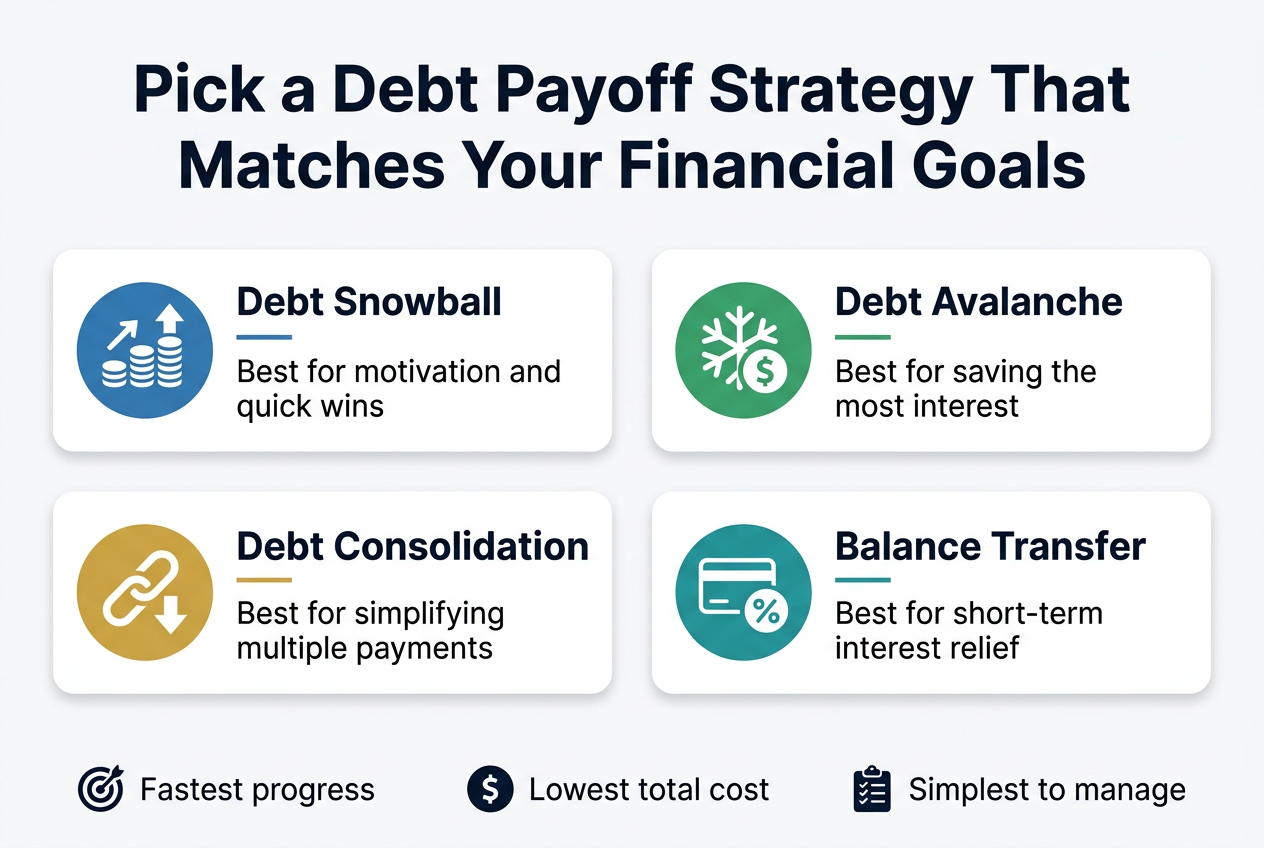
If your primary financial goal is becoming debt-free as fast as possible, making extra payments is one of the most powerful student loan repayment strategies available to you. Every dollar you pay above the minimum goes directly toward your principal balance, which shrinks the amount interest is calculated on — saving you money over the long run.
Two popular frameworks for tackling multiple loans with extra payments are the avalanche and snowball methods:
| Strategy | How It Works | Best For |
|---|---|---|
| Avalanche Method | Pay minimums on all loans, then put extra money toward the highest-interest loan first | Minimizing total interest paid over time |
| Snowball Method | Pay minimums on all loans, then put extra money toward the smallest balance first | Building momentum through quick early wins |
Both approaches work — the right one depends on what keeps you motivated. If watching balances disappear fuels your progress, the snowball method may keep you on track. If you’re focused purely on numbers and want to know how to pay off student loans fast while spending the least possible on interest, the avalanche method is mathematically superior.
A few practical ways to find extra money for payments include:
- Applying windfalls directly to your balance — tax refunds, bonuses, or cash gifts
- Rounding up your payment — if your bill is $247, pay $300 consistently
- Making bi-weekly payments — this results in one extra full payment per year without feeling the pinch
The key principle here is intentionality. Every extra payment, no matter how small, compounds over time to reduce your total student debt payoff timeline and the interest that accumulates along the way.
Pay the Minimum While Pursuing Loan Forgiveness Programs
Not every borrower should rush to pay off their loans aggressively. For some, the best student loan repayment plan is actually to pay the minimum — strategically — while positioning themselves for student loan forgiveness programs that could eliminate a significant portion of their remaining balance.
This approach makes the most sense if you:
- Work in public service, government, or non-profit sectors and may qualify for programs designed for those fields
- Are enrolled in an income-driven repayment (IDR) plan, which sets your monthly payments based on your income and family size
- Have a high loan balance relative to your income, making full repayment over a standard timeline impractical
Here’s why this matters: under income-driven repayment plans, after a set number of qualifying payments — typically 20 to 25 years, depending on the plan — any remaining balance may be forgiven. Certain public sector roles may qualify for forgiveness on a significantly shorter timeline.
With this in mind, aggressively overpaying your loans while pursuing forgiveness is a costly mistake. Every extra dollar you put toward a loan that would otherwise be forgiven is money you could have kept, invested, or used elsewhere.
Before committing to this path, consider the following:
- Confirm your loan types qualify — not all loans are eligible for every forgiveness program
- Verify your employer qualifies — for employment-based forgiveness, your organization must meet specific criteria
- Track your qualifying payments carefully — documentation errors can cost you years of progress
- Understand potential tax implications — forgiven amounts may be treated as taxable income in certain situations, though this varies
This strategy requires patience and careful record-keeping, but for the right borrower, it is one of the smartest student loan debt freedom paths available. Paying the minimum is not laziness — it is a calculated move aligned with a long-term plan.
Make Minimum Payments Sustainably When Full Payoff Is Unrealistic
Now that we have covered the aggressive payoff approach and the forgiveness-focused strategy, it’s important to acknowledge a third reality that many borrowers face: full repayment simply may not be realistic right now, and that is okay.
If your income is limited, your expenses are high, or you are navigating other financial priorities — like building an emergency fund or covering essential living costs — making sustainable minimum payments is a legitimate and responsible strategy for managing student loan debt.
The goal here is to avoid default at all costs. Defaulting on student loans carries severe consequences, including:
- Damage to your credit score, making future borrowing more expensive or inaccessible
- Wage garnishment and withholding of tax refunds
- Loss of eligibility for future federal financial aid or repayment assistance programs
- Immediate collection activity from loan servicers
If you’re in a tight financial situation, income-driven repayment plans are specifically designed for borrowers like you. These plans calculate your monthly payment as a percentage of your discretionary income — and in some cases, that payment could be as low as $0 per month if your income falls below a certain threshold.
Key options to explore:
- Income-Based Repayment (IBR)
- Pay As You Earn (PAYE)
- Saving on a Valuable Education (SAVE) — the newest IDR option, designed to lower payments further for many borrowers
- Income-Contingent Repayment (ICR)
Making minimum payments under an IDR plan keeps you in good standing, protects your credit, and preserves your eligibility for forgiveness programs down the line — even if you don’t currently qualify or plan to pursue them.
Student debt payoff tips for borrowers in survival mode:
- Contact your loan servicer immediately if you’re struggling — options exist before you miss a payment
- Re-certify your income annually to ensure your IDR payment remains accurate
- Avoid deferment as a long-term solution, since interest may continue to grow
- Check whether you qualify for any interest subsidies under newer repayment plans
The bottom line: there is no one-size-fits-all approach to student loan repayment strategies. Your best path forward depends entirely on your income, career trajectory, loan balance, and financial goals — and choosing a strategy aligned with all of those factors is what separates progress from frustration.
Explore Loan Forgiveness Programs That Could Reduce Your Balance
Public Service Loan Forgiveness for Government and Nonprofit Workers
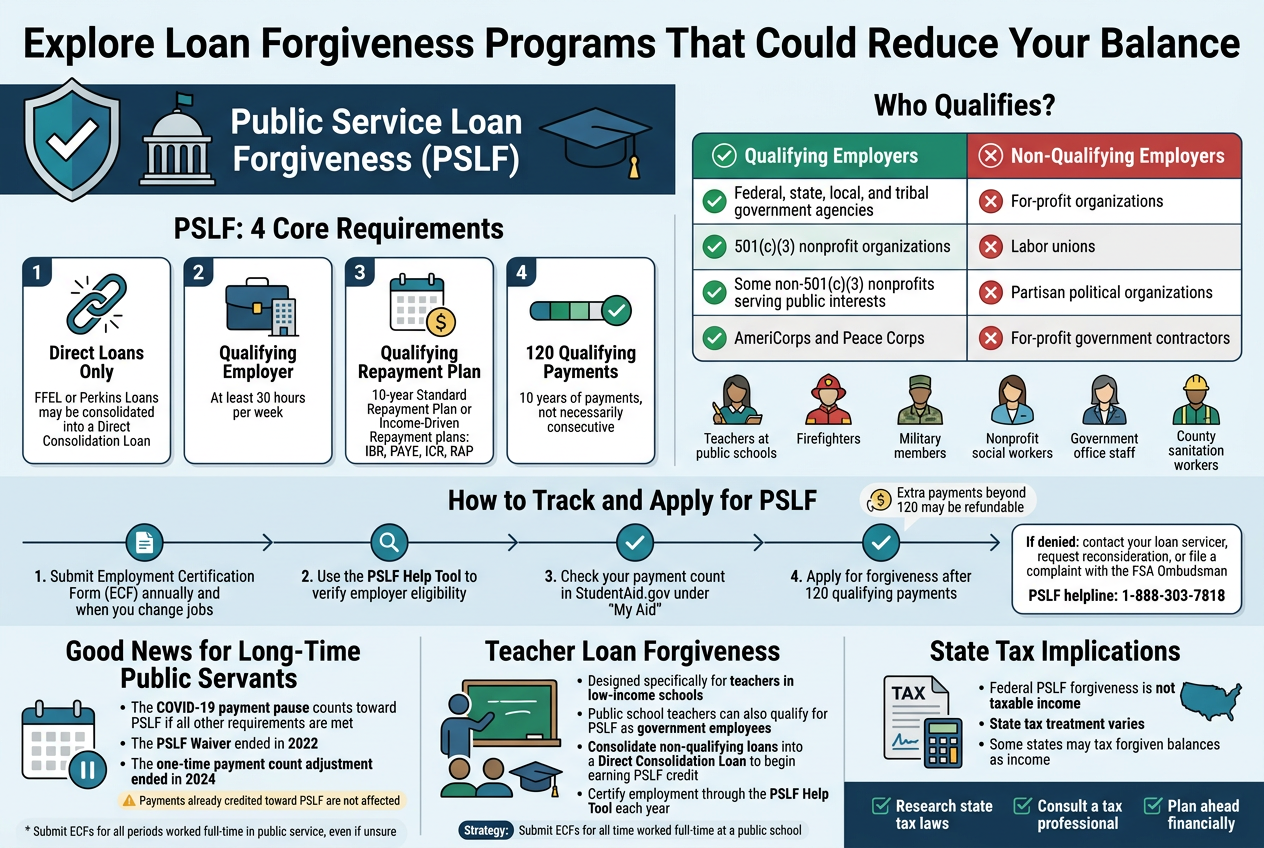
If you work in public service, one of the most powerful student loan forgiveness programs available to you is the Public Service Loan Forgiveness (PSLF) program. When used correctly, it can eliminate your remaining federal loan balance after 10 years of qualifying payments — a significant reward for those committed to public service careers.
To qualify for PSLF, you must meet four core requirements:
- Loan type: Only Direct Loans qualify. If you have FFEL or Perkins Loans, you may be able to consolidate them into a Direct Consolidation Loan to start earning credit.
- Qualifying employer: You must work full-time (at least 30 hours per week) for an eligible organization.
- Qualifying repayment plan: Payments made under the 10-year Standard Repayment Plan or any Income-Driven Repayment (IDR) plan — including IBR, PAYE, ICR, and the forthcoming RAP plan — count toward forgiveness.
- 120 qualifying payments: You need 10 years’ worth of payments, though they don’t need to be consecutive.
Who Qualifies as a Public Service Employer?
Not every organization qualifies. Here’s a quick breakdown:
| Qualifying Employers | Non-Qualifying Employers |
|---|---|
| All federal, state, local, and tribal government agencies | For-profit organizations |
| 501(c)(3) nonprofit organizations | Labor unions |
| Some non-501(c)(3) nonprofits serving public interests | Partisan political organizations |
| AmeriCorps and Peace Corps | For-profit government contractors |
Examples of qualifying roles include teachers at public schools, firefighters, military members, nonprofit social workers, government office staff, and county sanitation workers.
Important: New rules issued in fall 2025 would allow the Department of Education to disqualify certain employers beginning July 1, 2026. These rules are currently being challenged in court. Payments already credited toward PSLF would not be affected.
How to Track and Apply for PSLF
One of the most practical steps you can take is to submit your Employment Certification Form (ECF) annually and whenever you change public service jobs. You can use the Department of Education’s PSLF Help Tool to verify employer eligibility, complete your ECF, and apply for forgiveness once you’ve hit 120 qualifying payments.
After submitting your ECF, log in to StudentAid.gov to monitor your payment count under “My Aid” in your dashboard. Once you reach 120 qualifying payments, you can apply for forgiveness directly through the PSLF Help Tool. If you’ve made extra payments beyond the 120 required, you may be eligible for a refund on those overpayments.
If your application is denied, you can contact your loan servicer, submit a reconsideration request, or file a complaint with the FSA Ombudsman. The PSLF helpline is also available at 1-888-303-7818.
Good news for long-time public servants: The COVID-19 payment pause counts toward PSLF, provided you meet all other requirements. Additionally, past temporary programs — the PSLF Waiver (ended 2022) and the one-time payment count adjustment (ended 2024) — helped over a million borrowers receive forgiveness by crediting previously non-qualifying periods. If you haven’t already, submit ECFs covering all periods you worked full-time in public service, even if you’re unsure whether those payments qualified.
Teacher Loan Forgiveness for Educators in Low-Income Schools
With this in mind, educators should also know about Teacher Loan Forgiveness, a separate program designed specifically for teachers who serve in low-income schools. While the reference sources detail PSLF eligibility extensively — and note that a public school teacher is a clear example of qualifying employment for PSLF — teachers have the unique advantage of potentially accessing both programs over the course of their careers.
A public school teacher working full-time for a qualifying government employer can pursue PSLF just like any other government employee. Your payments under an income-driven repayment plan count toward the 120-payment threshold, and your employer as a public school qualifies as a government organization under PSLF guidelines.
For teachers specifically, the key is ensuring your loans are Direct Loans and that you’re enrolled in a qualifying repayment plan from the start. If you’ve been in non-qualifying loan types, consolidating into a Direct Consolidation Loan can help you begin earning PSLF credit going forward. Always certify your employment through the PSLF Help Tool each year to maintain an accurate record of your progress.
Strategy tip: If you’re a teacher uncertain whether your past payment periods counted, submit ECFs for all time you’ve worked full-time at a public school. There’s no penalty for over-certifying, and it may result in additional payment credit being applied to your account.
Tax Implications of Loan Forgiveness at the State Level
Now that we’ve covered how to pursue student loan forgiveness programs like PSLF, it’s equally important to understand what happens after forgiveness is granted — particularly the tax consequences.
At the federal level, PSLF forgiveness is not treated as taxable income. This is a major advantage of PSLF compared to some other forgiveness pathways, where forgiven amounts could be counted as income.
However, state tax treatment varies. While PSLF forgiveness is federally tax-exempt, some states do not conform to federal tax law in this regard. Depending on where you live, the forgiven loan balance could be considered taxable income at the state level, resulting in an unexpected tax bill in the year your loans are forgiven.
Here’s what you should do to protect yourself:
- Research your state’s tax laws regarding student loan forgiveness well before you reach your 120th payment.
- Consult a tax professional familiar with both federal and state student loan tax rules to understand your specific liability.
- Plan ahead financially so that if your state does tax the forgiven amount, you have funds set aside to cover the bill.
Managing student loan debt effectively means looking beyond the forgiveness moment itself and preparing for what comes after. Understanding the full financial picture — including potential state taxes — ensures you’re never caught off guard when relief finally arrives.
Protect Yourself From Costly Mistakes and Pitfalls
Advocate for Yourself Instead of Relying Solely on Your Loan Servicer
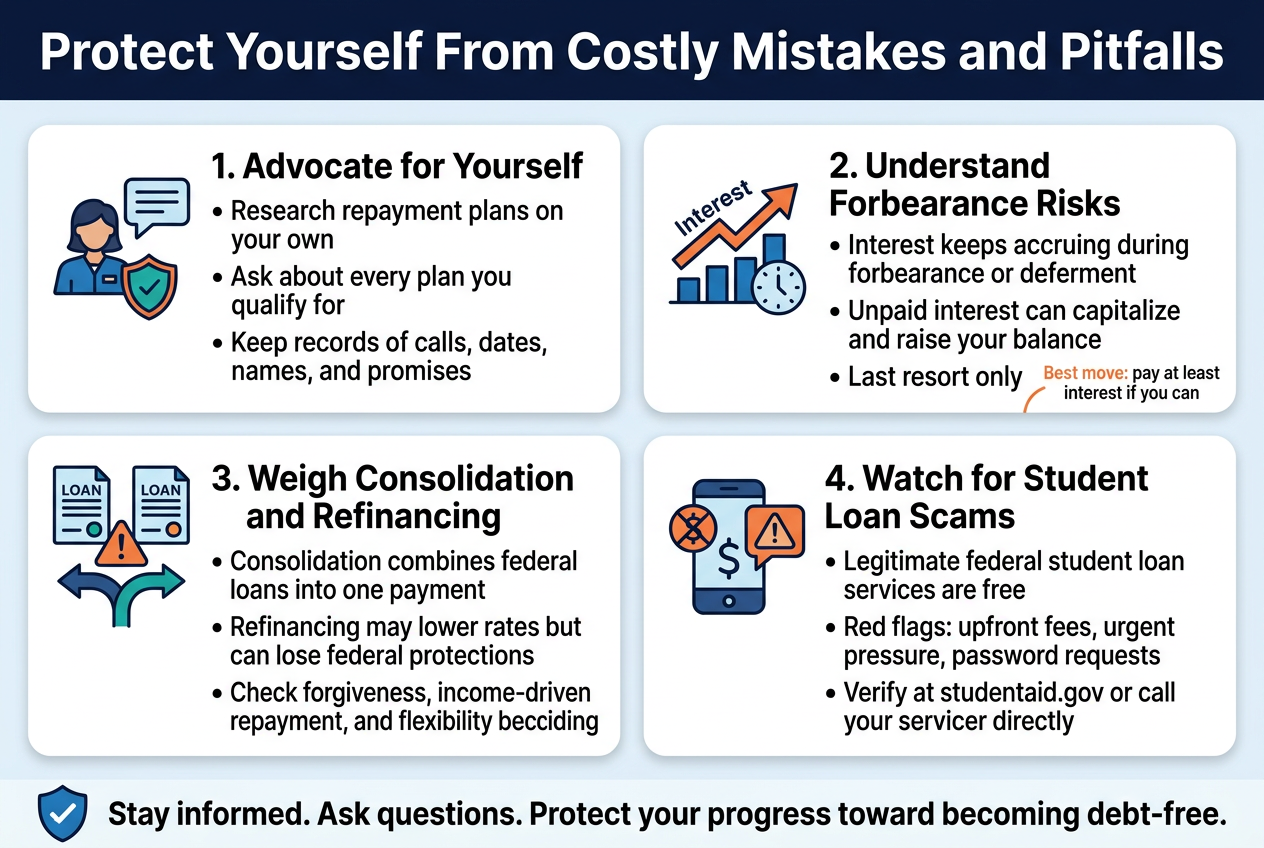
Your loan servicer is a resource, but they shouldn’t be your only source of guidance when managing student debt. While servicers can walk you through repayment options, the responsibility of understanding your loans ultimately falls on you. Take time to independently research the repayment plans available through the U.S. Department of Education so you can enter any conversation with your servicer already informed.
When you contact your servicer, come prepared with specific questions. Ask about every repayment plan you qualify for, not just the one they recommend first. Knowing your options ahead of time puts you in a stronger position to push back, compare plans, and make choices that align with your actual financial goals — whether that’s paying off student loans fast or keeping monthly payments manageable through an income-driven repayment plan.
Staying proactive also means keeping records of every interaction. Document the date, the representative’s name, and the details of what was discussed. If something changes with your account or a promise goes unfulfilled, having a paper trail protects you and gives you leverage to resolve disputes.
Understand the Risks of Forbearance Before Accepting It
Forbearance might sound like a straightforward solution when you’re struggling to make payments — and in some situations, it genuinely is. But it comes with a significant hidden cost that many borrowers don’t fully grasp until it’s too late.
When your loans are placed in forbearance (or deferment), interest continues to accrue. Depending on your total loan balance and interest rate, this can add thousands of dollars to your debt over time. Once the forbearance period ends, that unpaid interest capitalizes — meaning it gets added to your principal balance — and your monthly payments increase accordingly.
Here’s what this looks like in practice:
| Scenario | What Happens |
|---|---|
| You make payments during repayment | Interest accrues, but you’re reducing the principal |
| You enter forbearance and make no payments | Interest accrues and capitalizes, increasing your balance |
| You enter forbearance but pay interest only | You prevent capitalization without full payment burden |
The key takeaway: forbearance should be a last resort, reserved for situations where you genuinely have no financial means to make any payment. If you do need to use it, try to at least cover the interest charges each month. This small step prevents your loan balance from ballooning and keeps your long-term student debt payoff on track.
Avoid treating forbearance as a convenient way to delay the inevitable. You will still need to repay your loans — and delaying without a plan almost always makes the total cost higher.
Weigh the Pros and Cons of Consolidation and Refinancing
Now that we have covered the risks of pausing payments, it’s equally important to think carefully before combining or restructuring your loans. Consolidation and refinancing are two tools that can simplify repayment — but each comes with trade-offs worth understanding before you commit.
Loan consolidation through the federal government allows you to combine multiple federal loans into a single loan with one monthly payment. This can make managing student loan debt easier and may extend your repayment term, lowering your monthly payment. However, extending your repayment period means you’ll pay more interest over the life of the loan.
Refinancing through a private lender replaces your existing loans — federal, private, or both — with a new private loan, often at a different interest rate. If you qualify for a lower rate, refinancing can reduce the total cost of your debt. But refinancing federal loans with a private lender means permanently losing access to federal protections, including income-driven repayment plans, federal forbearance options, and student loan forgiveness programs.
Before making any moves with consolidation or refinancing, ask yourself:
- Do I plan to pursue Public Service Loan Forgiveness or any other federal forgiveness program?
- Do I need the flexibility of income-driven repayment if my financial situation changes?
- Am I refinancing to get a genuinely lower rate, or just to lower my monthly payment by extending the term?
If federal loan forgiveness is part of your broader student debt payoff strategy, refinancing into a private loan would disqualify you from those programs entirely. That’s a trade-off that rarely makes financial sense for borrowers with significant federal loan balances.
Stay Alert to Student Loan Scams Targeting Borrowers
With millions of Americans managing student loan debt, scammers have found a ready pool of targets. These operations typically promise fast loan forgiveness, dramatically lower payments, or complete debt elimination — often in exchange for an upfront fee or your personal account information.
The rule to remember is simple: legitimate student loan services are free. The U.S. Department of Education and your federal loan servicer will never charge you a fee to enroll in a repayment plan, apply for forgiveness, or get information about your account. If a company is asking for money to do something your servicer would do at no cost, that’s a red flag.
Common signs of a student loan scam include:
- Promises that sound too good to be true — such as immediate or guaranteed loan forgiveness
- Requests for your FSA ID or login credentials — legitimate organizations never need your password
- Pressure to act quickly — scammers create urgency to prevent you from doing proper research
- Upfront fees for services — any company charging you to access free federal programs is operating deceptively
If you’re ever unsure whether a company or offer is legitimate, go directly to the source. Visit the official Federal Student Aid website at studentaid.gov or call your loan servicer directly. Taking 10 minutes to verify can protect you from losing money and potentially compromising your personal information.
Avoiding student loan mistakes like these is a critical part of any solid student loan repayment strategy — protecting both your finances and your progress toward becoming debt-free.
Build Good Financial Habits to Stay on Track
Keep Your Contact Information Current With All Loan Providers
Managing student loan debt effectively goes far beyond choosing the right repayment plan. One of the simplest yet most overlooked student debt payoff tips is keeping your contact details up to date with every loan servicer you work with.
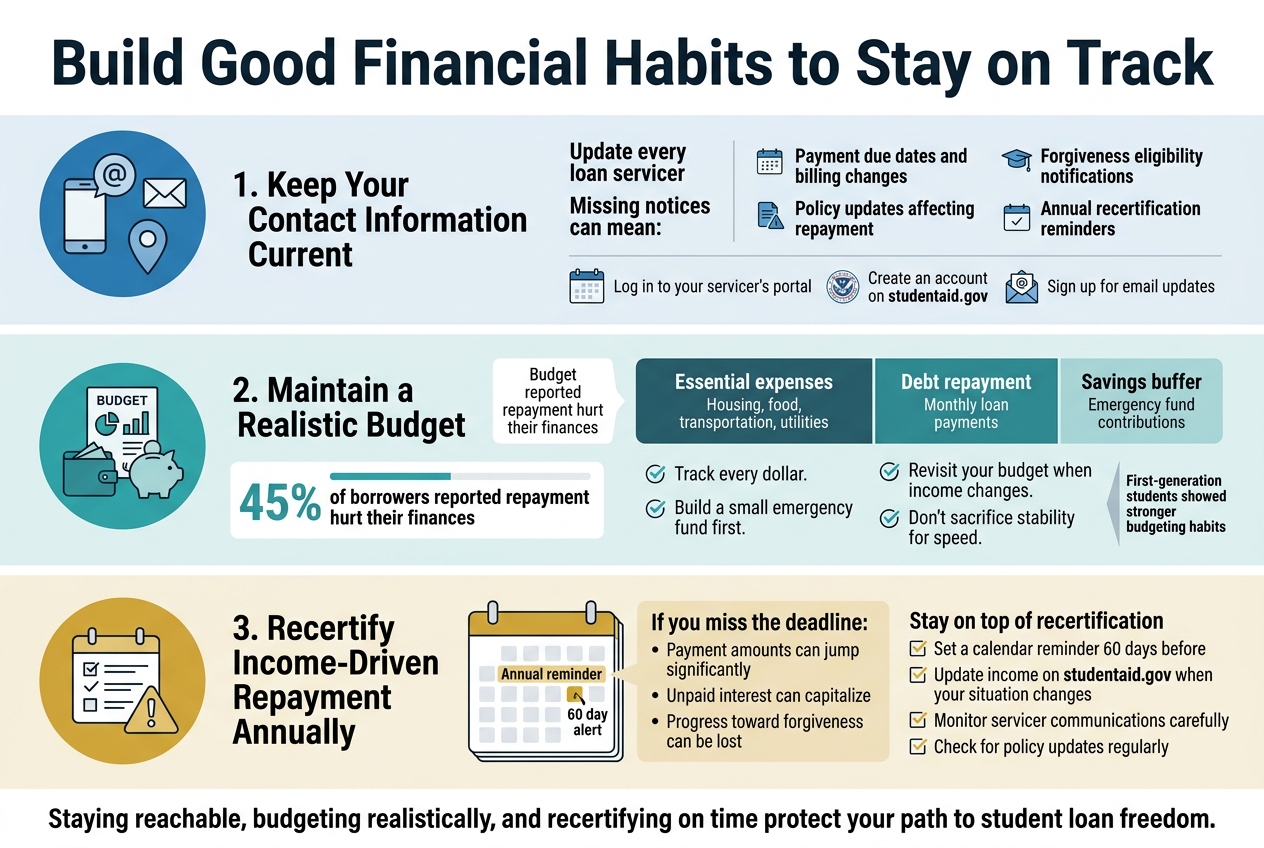
If your servicer cannot reach you, you risk missing critical notices about:
- Payment due dates and billing changes
- Policy updates affecting your repayment plan
- Forgiveness program eligibility notifications
- Annual recertification reminders for income-driven repayment
The student loan landscape is actively shifting. Major changes to the student loan system are underway, with key updates taking effect on July 1, 2026, and additional changes rolling out beyond that date — all stemming from legislation enacted in July 2025. The Department of Education continues to release new guidance on implementation, which means borrowers who are out of contact with their servicers are the most likely to be caught off guard.
What you should do right now:
- Log in to your servicer’s portal and confirm your current mailing address, email, and phone number
- Create an account on studentaid.gov to receive official federal communications
- Sign up for email updates from reputable advocacy organizations to stay informed on regulatory changes
Staying reachable is not just a formality — it is a core part of actively managing student loan debt and avoiding costly administrative mistakes.
Maintain a Realistic Budget to Balance Debt Repayment and Savings
Now that we have covered the importance of staying in contact with your servicers, let’s look at the financial foundation that keeps everything else in place: your budget.
Research from the TIAA Institute and Trellis Strategies — based on a survey of 2,001 student loan borrowers conducted in 2024 — highlights a critical finding: when the federal loan repayment pause was in effect from 2020 to 2023, financially vulnerable borrowers redirected what would have been loan payments toward basic living expenses. This reveals just how thin the financial margin is for many borrowers and why a realistic, well-structured budget is non-negotiable.
The same research found that first-generation college students, despite facing greater financial hardship, actually demonstrated stronger budgeting habits. This is a powerful lesson — disciplined budgeting is not about income level; it is about intention and consistency.
How to Build a Budget That Works for Student Loan Repayment
A sound budget for borrowers managing student loan repayment strategies should account for three core priorities:
| Priority | Description |
|---|---|
| Essential expenses | Housing, food, transportation, utilities |
| Debt repayment | Monthly loan payments (minimum or accelerated) |
| Savings buffer | Emergency fund contributions, even if small |
The 2024 TIAA/Trellis study also documented how student loan debt limits housing options and delays homeownership — particularly for historically marginalized groups. With this in mind, your budget should realistically reflect your actual financial situation, not an aspirational one. Overcommitting to aggressive loan payoff strategies at the expense of savings can leave you financially exposed.
Practical budgeting tips for borrowers:
- Track every dollar. Know exactly what comes in and what goes out each month before assigning anything to extra loan payments.
- Build a small emergency fund first. Even $500–$1,000 in savings can prevent you from going further into debt during an unexpected expense.
- Revisit your budget when your income changes. Raises, new jobs, or side income are opportunities to redirect more toward your loans without affecting your quality of life.
- Don’t sacrifice stability for speed. Paying off student loans fast is a worthwhile goal, but not at the cost of your financial security.
The research is clear: 45% of borrowers reported that student loan repayment had negatively impacted their financial situation. A realistic budget is the primary tool that keeps repayment from becoming a financial crisis.
Recertify Income-Driven Repayment Plans Annually to Stay Compliant
With a working budget in place, there is one more critical habit every borrower on an income-driven repayment (IDR) plan must build into their annual calendar: recertification.
Income-driven repayment plans calculate your monthly payment based on your income and family size. However, this calculation is not permanent. You are required to recertify your income and household information every year to remain on the plan and keep your payment accurate. Failing to recertify on time is one of the most preventable — and most damaging — mistakes borrowers make.
What Happens If You Miss the Recertification Deadline?
Missing your annual IDR recertification can trigger serious consequences, including:
- Payment amounts jumping significantly, reverting to what you would owe under a standard repayment plan
- Unpaid interest capitalizing onto your principal balance, increasing your total debt
- Potential loss of progress toward loan forgiveness programs that require a certain number of qualifying payments
Given the major changes to the student loan system currently being implemented — with regulatory updates still being released as of mid-2025 — the rules around income-driven repayment plan recertification may evolve. Staying current is essential.
How to Stay on Top of Annual Recertification
- Set a calendar reminder at least 60 days before your recertification deadline
- Update your income information on studentaid.gov as soon as your financial situation changes, rather than waiting for the annual window
- Monitor your servicer communications carefully — they are required to notify you, but only if your contact information is current (another reason the first habit in this section matters so much)
- Check for policy updates regularly, as new guidance from the Department of Education may affect your recertification requirements or options
Staying compliant with your income-driven repayment plan is not just about avoiding penalties — it is about protecting the progress you have already made toward student loan debt freedom.
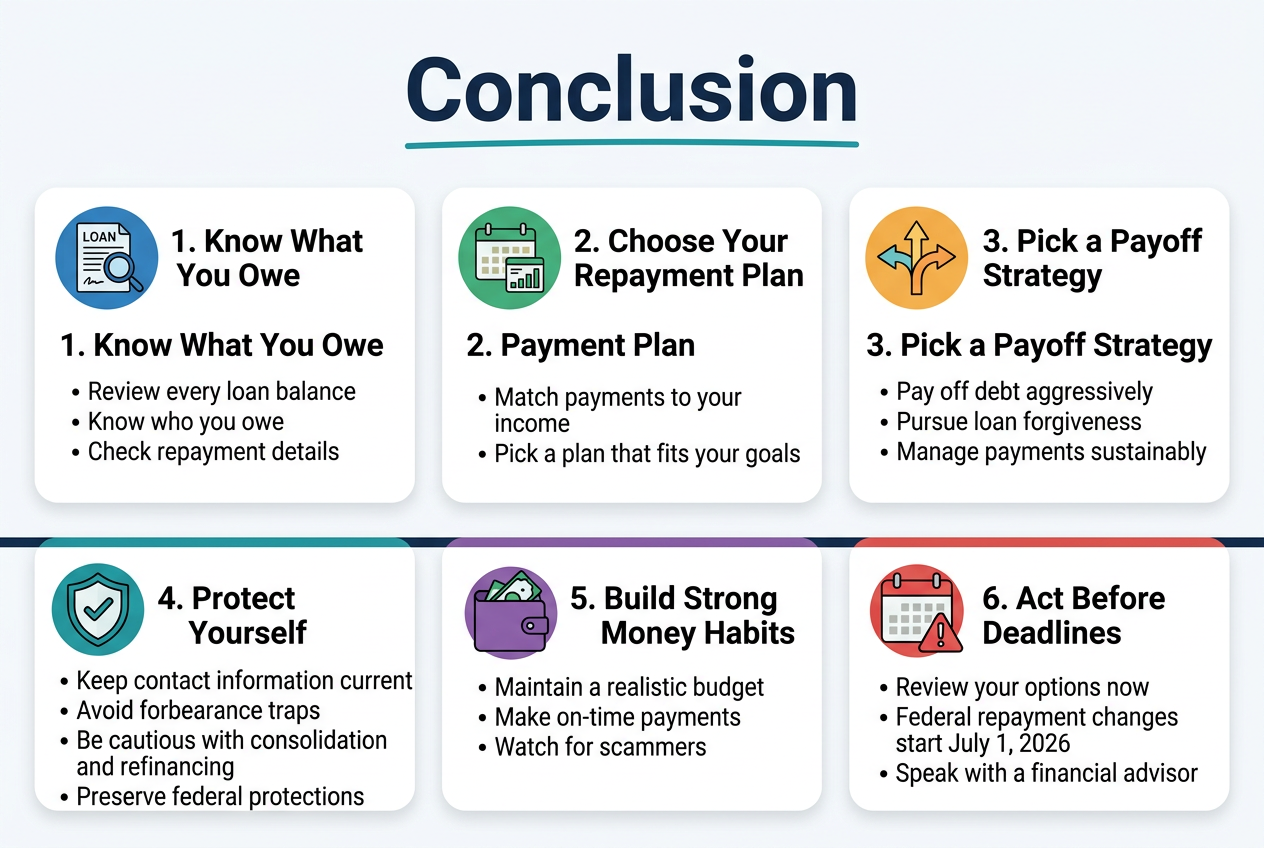
Paying off student loans isn’t a one-size-fits-all journey. It starts with knowing exactly what you owe and who you owe it to, then choosing the repayment plan that fits your income and goals. From there, it’s about picking a payoff strategy — whether that means aggressively eliminating debt, pursuing loan forgiveness, or simply managing payments sustainably over time. Along the way, protecting yourself means staying informed, keeping your contact information current, avoiding forbearance traps, and being cautious about consolidation and refinancing decisions that could cost you valuable federal protections.
The path to debt freedom also requires building consistent financial habits — maintaining a realistic budget, making on-time payments, and staying alert to scammers who prey on borrowers looking for help. With recent changes under the One Big Beautiful Bill Act reshaping federal repayment options starting July 1, 2026, now is the time to review where you stand and take action before key deadlines arrive. If you’re unsure where to start, consider speaking with a financial advisor who can help you navigate your options and build a plan that puts you in control of your financial future.