
How to Map a Simple Customer Journey Before Choosing Marketing Channels
A business can publish regularly on social media, invest in search engine optimization, send email newsletters, and even run paid advertising campaigns without seeing the results it expects. The problem is not always the quality of its marketing. Sometimes, the business is simply reaching people at the wrong time, using the wrong message, or choosing channels without understanding how customers make decisions.
Consider a small business selling handmade skincare products. Its owner decides to focus on Instagram because similar businesses appear to be successful there. The owner starts publishing product photographs, promotional posts, and customer testimonials. However, potential customers still hesitate to purchase.
Why?
Some people may not know which ingredients suit their needs. Others may be comparing products from different brands. Some might want to understand the company’s return policy, while existing customers may simply need advice on using the products they have already purchased.
All these people have different questions, even though they are interested in the same business.
This is where customer journey mapping becomes useful.
Instead of beginning with a list of marketing platforms, a business can first understand what customers experience before, during, and after making a purchase. Once those needs become clearer, selecting appropriate marketing channels becomes a more practical decision.
The good news is that customer journey mapping does not require expensive software, complicated diagrams, or a large marketing team. A simple document or spreadsheet can provide enough structure to understand the most important customer interactions.
This guide explains how to create that map, identify meaningful customer touchpoints, and use the findings to choose marketing channels more intelligently.
What Is a Customer Journey?
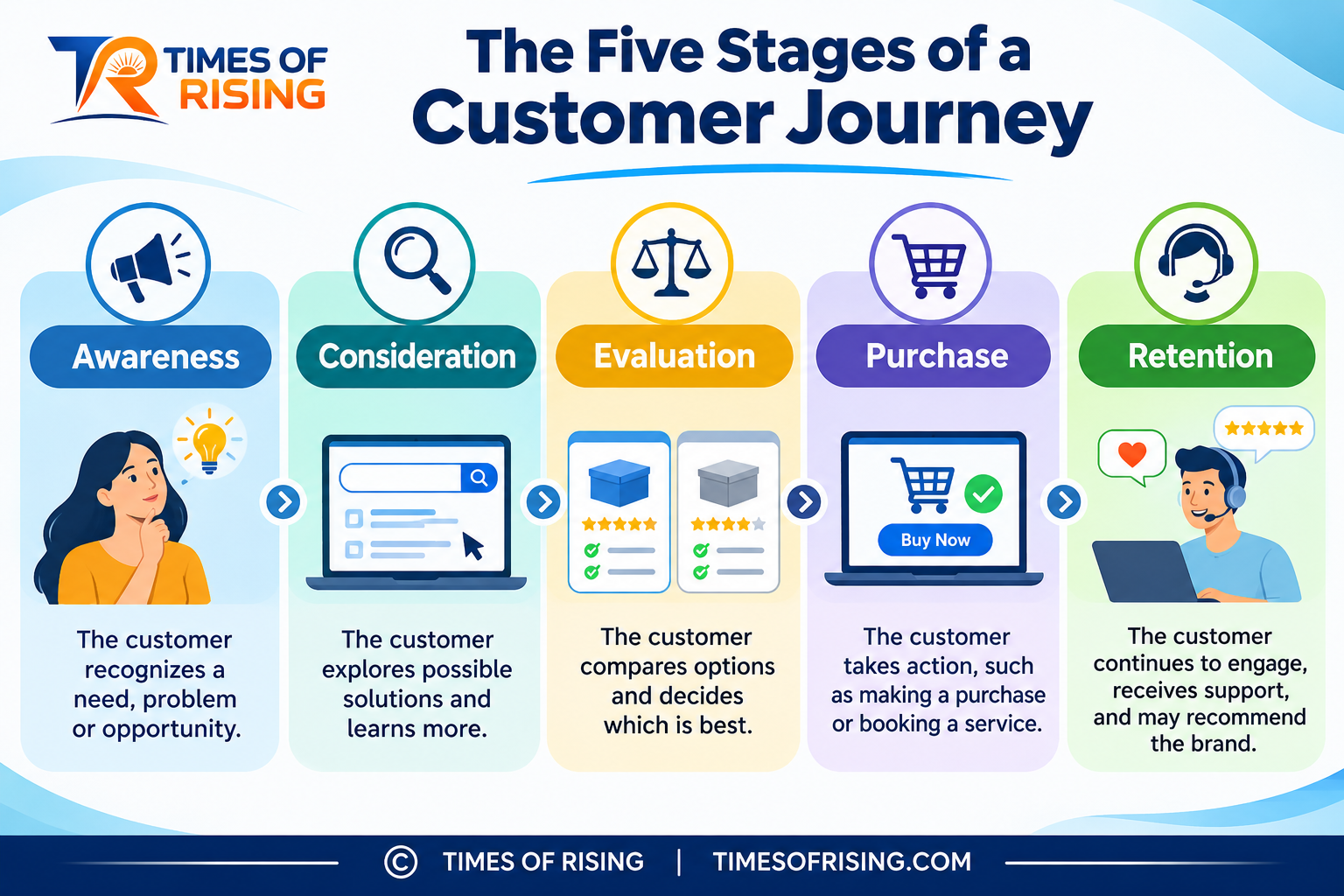
A customer journey is the series of experiences and interactions a person has while moving from an initial need or problem towards a solution.
For a business, this journey may begin when someone first discovers a product or service. It can continue through research, comparisons, conversations with the company, purchasing, receiving the product, and seeking further assistance.
For example, imagine someone who wants to purchase a new laptop.
The person may initially notice that their existing laptop is becoming too slow. They search online for ways to improve performance, discover that replacing the device might be a better option, and begin researching available models.
They may watch product reviews, compare specifications, read customer feedback, visit online stores, and eventually purchase a laptop.
The journey does not necessarily finish after payment. The customer may need help setting up the device, understanding its features, or resolving a technical issue.
Every one of these experiences contributes to the relationship between the customer and the business.
A customer journey map is a simplified visual or written representation of these experiences. It organizes the customer’s actions, questions, needs, touchpoints, and difficulties into a structure that a business can understand and improve.
Salesforce’s journey-mapping guidance identifies elements such as customer actions, thoughts, feelings, and touchpoints as useful parts of a journey map.
The important distinction is that a customer journey map describes the customer’s experience, not simply the company’s marketing activities.
Why Should Businesses Map the Customer Journey Before Choosing Marketing Channels?
Many marketing plans begin with questions such as:
- Should we invest in Instagram or Facebook?
- Is Google Ads better than SEO?
- Do we need an email marketing campaign?
- Should we create videos for YouTube?
- Would influencer marketing help us reach more people?
These are reasonable questions, but they are not necessarily the right starting point.
A marketing channel is a way to reach or communicate with an audience. It does not automatically tell a business what the audience wants to know or what would encourage someone to take the next step.
A person discovering a business for the first time may need educational information. Someone comparing alternatives may need detailed product information and credible reviews. A customer who is ready to purchase may simply need a clear price, an easy checkout process, and confidence that the business is reliable.
If every person receives the same promotional message, the business risks ignoring these differences.
Mapping the customer journey helps solve this problem in several ways.
1. It reveals what customers actually need
A business may believe its customers primarily want discounts, but customer conversations might reveal that they are more concerned about product quality, delivery time, or after-sales support.
Understanding these concerns helps businesses create more relevant communication.
2. It prevents unnecessary marketing expenditure
Not every business needs to maintain an active presence on every marketing platform.
If research shows that potential customers regularly search Google for detailed comparisons before making a purchase, investing in useful search-focused content may deserve more attention than publishing frequent promotional updates on several social networks.
This does not mean other channels are useless. It means their importance should be evaluated against customer behaviour.
3. It improves the timing of marketing messages
A person who is still learning about a problem may not respond positively to an immediate sales offer.
Similarly, someone who has already decided to purchase may not need another introductory article.
A journey map helps businesses match communication with the customer’s current needs.
4. It identifies problems beyond marketing
Sometimes, a business successfully attracts visitors but struggles to convert them into customers.
The reason may not be insufficient advertising.
The website might have confusing navigation, unclear pricing, missing product information, or a complicated checkout process.
A customer journey map can reveal these obstacles and show where improvements are needed.
5. It creates a better foundation for long-term relationships
Customer relationships continue after the first transaction.
Useful onboarding information, timely support, relevant follow-ups, and consistent service can encourage repeat purchases and recommendations.
A journey map makes these post-purchase experiences part of the marketing discussion rather than treating them as separate concerns.
Step 1: Decide Whose Customer Journey You Want to Map
The first step is to select one specific customer group.
Trying to map the journey of every possible customer at once can make the exercise unnecessarily complicated. Different audiences may have different motivations, purchasing habits, budgets, and expectations.
For example, consider a company selling website development services.
Its potential customers might include:
- A new entrepreneur creating a first website.
- An established business owner planning to redesign an existing website.
- An online store owner looking for better website performance.
- A marketing manager searching for ongoing technical support.
Although all four groups may need website-related services, their journeys are unlikely to be identical.
A new entrepreneur may need explanations of domains, hosting, and website costs. An established business owner may already understand those basics and want to compare service providers, timelines, and previous work.
Therefore, choose one audience and one specific situation before creating the map.
Create a simple customer profile
You do not need to develop a lengthy fictional personality profile.
Start with a few practical details:
| Customer detail | What to identify |
|---|---|
| Customer type | Who is the person? |
| Main objective | What are they trying to achieve? |
| Starting problem | What creates the need? |
| Main concern | What might prevent them from moving forward? |
| Decision factors | What information influences their choice? |
| Expected outcome | What would a successful experience look like? |
For instance:
Customer: Small business owner planning a first website.
Objective: Establish an online presence and receive enquiries.
Starting problem: The business depends entirely on offline customer acquisition.
Main concern: Uncertainty about website costs, technical requirements, and the right service provider.
Decision factors: Pricing, previous work, communication, reliability, and ongoing support.
Expected outcome: A functional website that helps the business communicate with potential customers.
This information provides a starting point for understanding the customer’s journey.
One important precaution: do not treat assumptions about customers as established facts. If possible, validate the profile through customer interviews, sales conversations, feedback forms, and website behaviour.
Step 2: Identify the Problem That Starts the Journey
A customer journey usually begins with a need, problem, desire, or opportunity.
People rarely start their decision-making process by thinking about a particular company’s marketing channels. They first recognize something they want to change or accomplish.
For example:
- A student needs a reliable laptop for studying.
- A business owner wants to attract more website visitors.
- A homeowner needs a service provider for a repair.
- A professional wants to improve their knowledge of a particular subject.
- An online shopper wants to find a suitable product within a budget.
The problem that initiates the journey is important because it influences what the customer searches for, which information they consider useful, and what kind of assistance they expect.
Write down the following three things:
The starting situation: What is happening in the customer’s life or business?
The desired outcome: What would the customer like to achieve?
The obstacle: What is making it difficult to reach that outcome?
Consider a small business owner whose website receives visitors but generates very few enquiries.
| Element | Example |
|---|---|
| Starting situation | Website traffic is increasing. |
| Desired outcome | Generate more genuine enquiries. |
| Main obstacle | Visitors are leaving without contacting the business. |
This problem gives the marketing team a much clearer direction.
Instead of immediately advertising website development services, the business might first need to help customers understand why websites fail to convert visitors and what improvements can make a difference.
Step 3: Divide the Journey into Simple Stages
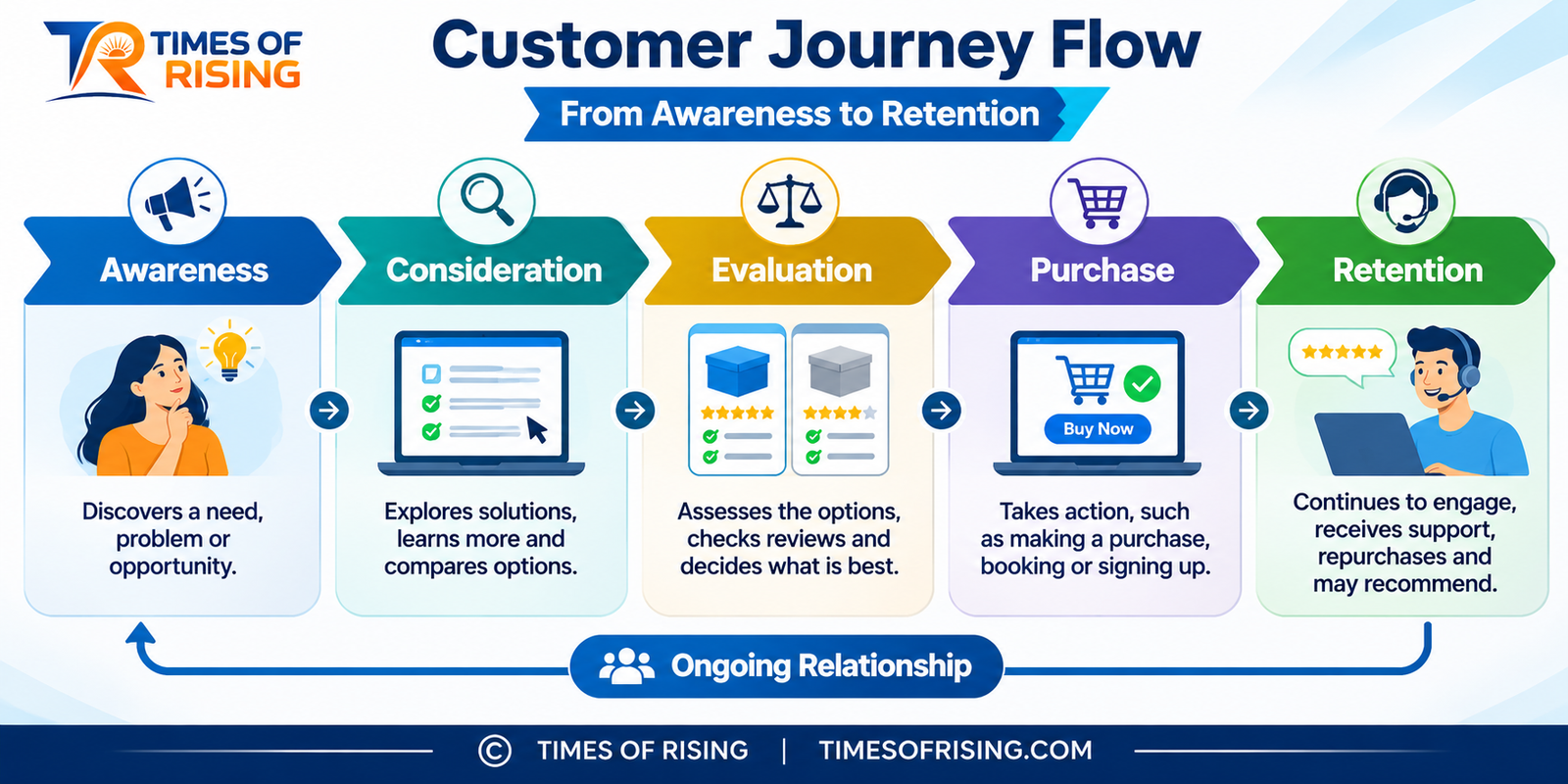
Once the audience and starting problem are clear, divide the journey into manageable stages.
A useful starting structure includes five stages:
- Awareness
- Consideration
- Evaluation and decision
- Purchase or conversion
- Retention and advocacy
These stages are a practical framework, not a rule that every customer must follow in the same order.
Some people move quickly from discovering a product to purchasing it. Others spend weeks researching. Existing customers may enter the journey at a completely different point.
The purpose is to organize customer needs, not force people into a perfectly linear funnel.
Stage 1: Awareness
At this stage, customers recognize a problem, need, or opportunity.
They may not know which company can help them, and they may not understand all the available solutions.
For example, someone struggling with low website traffic might search for:
- Why is my website not getting visitors?
- How can a small business attract more customers?
- What is SEO?
- How does digital marketing work?
The customer’s primary need is information.
The business should focus on explaining the problem, answering basic questions, and helping people understand their options.
Stage 2: Consideration
The customer now understands the problem and starts exploring possible solutions.
A business owner who has learned about SEO might begin researching different approaches, such as improving website content, fixing technical issues, or working with an SEO service provider.
Typical questions include:
- What are the best ways to improve website traffic?
- Is SEO suitable for a small business?
- Should I hire an SEO agency or manage it internally?
- How much time does SEO require?
At this stage, useful explanations, comparisons, educational resources, and transparent information can help customers make progress.
Stage 3: Evaluation and Decision
The customer has narrowed down the available options and is deciding which one is most suitable.
For a service business, this could involve reviewing portfolios, comparing quotations, checking customer feedback, and assessing the provider’s experience.
Questions may include:
- Which provider understands my industry?
- What is included in the service?
- How much will the project cost?
- What happens after I make payment?
- Can I see examples of previous work?
The business needs to provide clear information and credible reasons for customers to feel confident about their decision.
Stage 4: Purchase or Conversion
At this point, the customer is ready to take an action.
That action might be purchasing a product, requesting a quotation, booking an appointment, submitting an enquiry, or starting a subscription.
The business should make the next step easy to understand.
Unclear forms, unexpected charges, complicated checkout processes, and missing contact information can create unnecessary friction.
Stage 5: Retention and Advocacy
The customer has already completed the initial purchase or conversion.
However, the relationship can continue.
Customers may need onboarding guidance, product updates, technical assistance, answers to common questions, or recommendations for getting more value from their purchase.
A positive experience may also encourage them to return, renew, recommend the business, or share their experience with others.
This stage is especially important for subscription businesses, service providers, and companies that depend on repeat purchases.
Step 4: Write Down What Customers Do, Think, and Need at Each Stage
This is where the actual customer journey map starts taking shape.
For each stage, identify three basic elements:
What does the customer do?
Record the actions they may take, such as searching online, reading an article, asking a friend, visiting a store, or contacting a company.
What might the customer be thinking?
Identify the questions, concerns, and uncertainties that could influence their next decision.
What does the customer need?
Determine what information, assistance, or reassurance would help them move forward.
For example, a person researching website development services might behave as follows:
| Journey stage | Customer action | Possible thought | Customer need |
|---|---|---|---|
| Awareness | Searches for website solutions | Why does my business need a website? | Basic education |
| Consideration | Explores different website options | Which type of website is suitable? | Clear comparisons |
| Evaluation | Reviews service providers | Who can deliver reliable work? | Evidence and transparency |
| Conversion | Requests a quotation | What will this project cost? | Clear pricing and process |
| Retention | Uses the completed website | How can I maintain and improve it? | Ongoing guidance |
The thoughts in this table are hypotheses until confirmed through customer research.
That distinction matters. A business should not assume that every customer has the same concerns simply because they belong to the same audience group.
Step 5: Identify Customer Touchpoints
A touchpoint is any interaction through which a customer encounters or communicates with a business.
Some touchpoints are controlled directly by the company. Others happen independently of its marketing activities.
For example, a potential customer might:
- Discover a brand through a Google search.
- Read an article on its website.
- Watch a product demonstration.
- Ask a friend for a recommendation.
- Read customer reviews.
- Visit the company’s social media profile.
- Contact customer support.
- Receive a follow-up email.
- Visit a physical store.
These interactions may happen across different devices and at different times.
A useful journey map records the touch-points that matter rather than trying to document every possible interaction.
Separate discovery touch-points from decision touch-points
Discovery touch-points help people become aware of a problem, brand, product, or service.
Examples include educational articles, search results, social media discussions, recommendations, and informative videos.
Decision touch-points help people assess whether a particular option is suitable.
Examples include detailed product pages, pricing information, demonstrations, reviews, consultations, and customer testimonials.
Post-purchase touch-points include onboarding messages, support resources, service communications, and feedback requests.
This separation helps the business understand that different interactions serve different purposes.
A social media post might introduce a brand, but a detailed service page could provide the information needed to request a quotation.
Neither touchpoint needs to perform every job.
Step 6: Find Out Where Customers Experience Difficulty
A journey map should not only describe what works. It should also identify the points where customers become confused, uncertain, frustrated, or unable to continue.
These problems are commonly called pain points.
For example:
| Customer situation | Possible pain point |
|---|---|
| Searching for information | Too many conflicting explanations |
| Comparing products | Important specifications are missing |
| Evaluating a service | No clear pricing or service details |
| Making a purchase | Checkout requires too many steps |
| Using a product | Instructions are difficult to understand |
| Requesting support | No clear response or support process |
The business should then investigate which problems occur frequently and which have the greatest effect on customer decisions.
A useful question is:
What prevents the customer from taking the next reasonable step?
For someone researching a service, the obstacle might be a lack of trust.
For someone ready to purchase, it might be an unclear payment process.
For an existing customer, it might be difficulty finding support information.
These are different problems and require different solutions.
Use real customer information wherever possible
Businesses can collect useful insights from several sources:
- Conversations with existing customers.
- Questions received by sales teams.
- Customer support emails.
- Website enquiry forms.
- Product reviews and feedback.
- Website search queries.
- Search Console performance reports.
- Website analytics.
- Short customer interviews.
Small businesses do not need a large research department to begin.
Even a review of recent customer enquiries can reveal repeated questions that deserve attention.
Record where each observation came from and distinguish actual customer statements from internal interpretations.
Step 7: Create the Actual Customer Journey Map
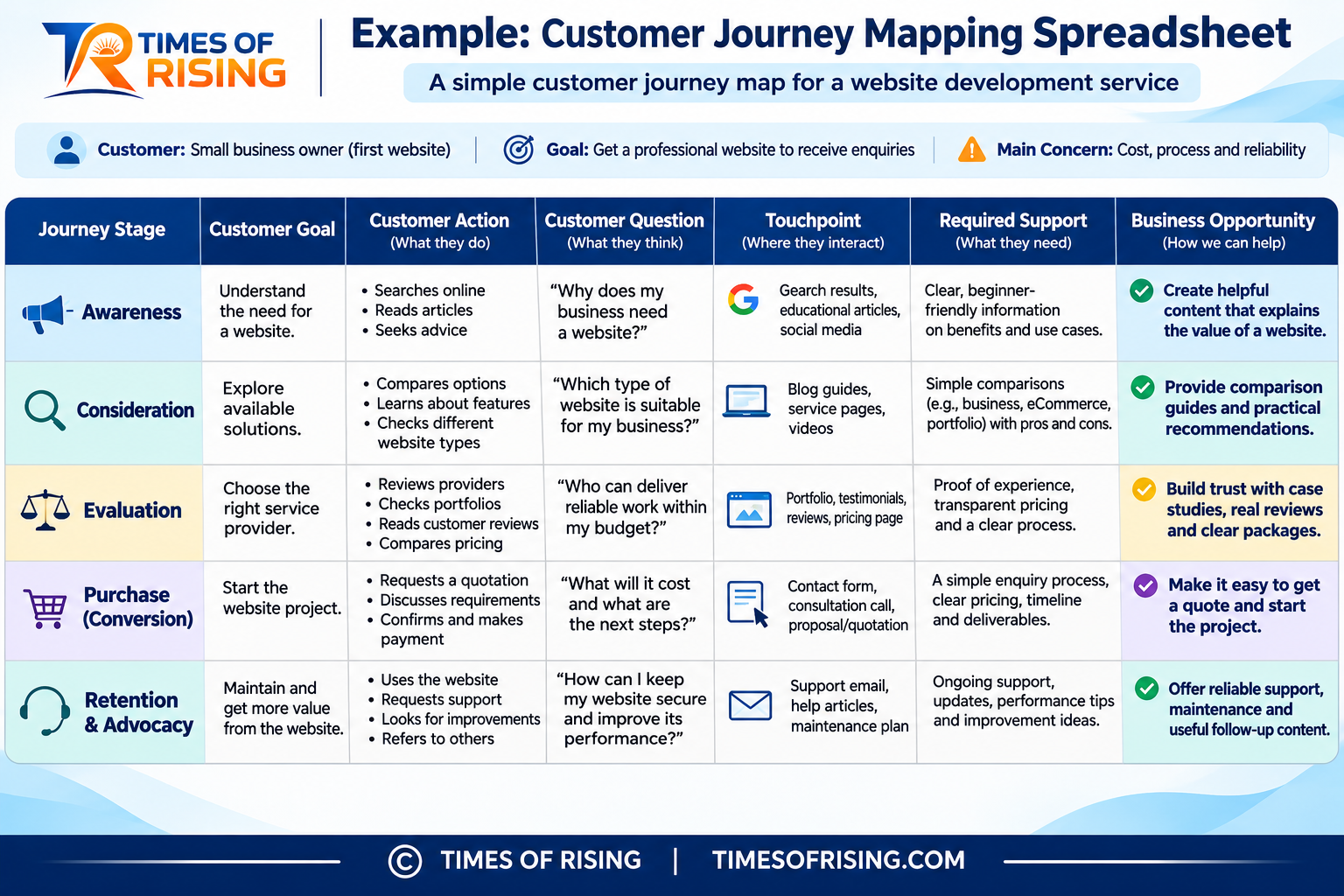
At this stage, bring the information together in one document.
A spreadsheet is usually sufficient for a small business.
The following example shows how a business offering website development services might map the journey of a first-time website buyer.
| Journey stage | Customer goal | Main question | Touchpoint | Opportunity |
|---|---|---|---|---|
| Awareness | Understand the need for a website | Why does my business need one? | Search results, educational articles | Explain website benefits |
| Consideration | Explore available solutions | Which type of website should I choose? | Website guides, videos | Compare website options |
| Evaluation | Select a provider | Who can deliver reliable work? | Portfolio, reviews, service pages | Demonstrate credibility |
| Conversion | Start the project | How much will it cost? | Contact form, consultation | Make enquiries simple |
| Retention | Maintain the website | How do I keep it working properly? | Email, help articles, support | Provide ongoing assistance |
Notice that the map does not begin by assigning a marketing channel to every stage.
It first explains the customer’s goal, question, and interaction.
The business can then decide which communication methods are appropriate.
For a first-time website buyer, educational search content may help address early questions. A portfolio page may support evaluation. A straightforward enquiry form may make conversion easier.
The map provides the reasoning behind these choices.
A simple template you can reuse
You can copy the following structure into a spreadsheet:
| Field | Information to record |
|---|---|
| Audience | Who is taking the journey? |
| Starting problem | What creates the need? |
| Journey stage | Where is the customer in the process? |
| Customer action | What are they doing? |
| Customer question | What are they trying to understand? |
| Customer concern | What might stop them? |
| Touchpoint | Where does the interaction happen? |
| Required support | What would help them? |
| Business opportunity | What can the company improve? |
| Evidence | Where did this insight come from? |
You can create a separate row for each important customer interaction.
There is no need to fill every field with lengthy descriptions. Short, specific observations are usually more useful than complicated explanations.
Step 8: Choose Marketing Channels Based on the Journey
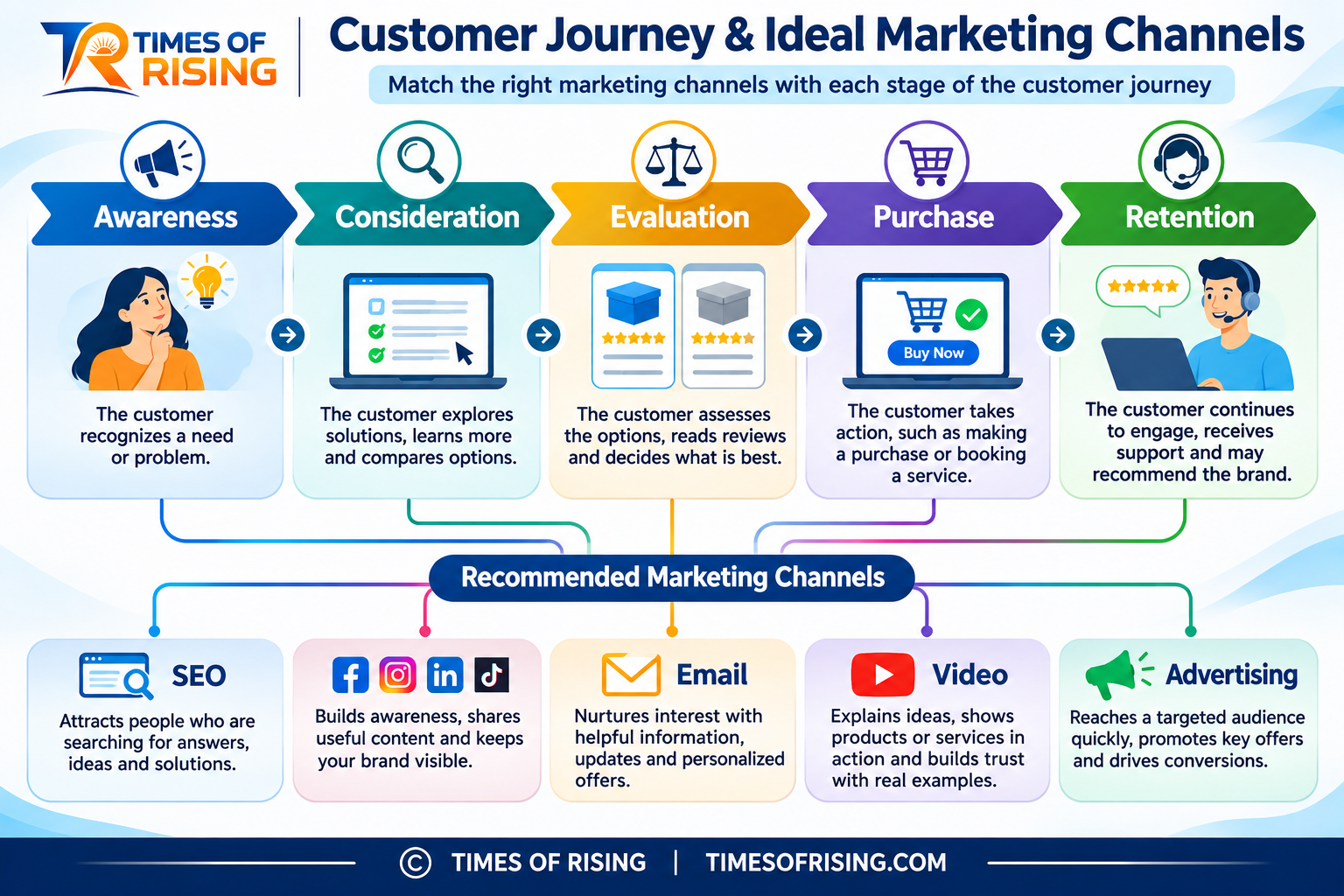
Now comes the decision that many businesses make too early.
Once you understand the customer journey, you can evaluate marketing channels according to the needs they can address.
The objective is not to select the largest number of channels. It is to identify the channels that can help customers at important moments in their decision-making process.
Consider the following examples.
Search engines and SEO
Search-focused content can be useful when customers actively look for explanations, solutions, comparisons, and service information.
A business might publish:
- Beginner’s guides.
- Frequently asked questions.
- Product comparisons.
- Detailed service pages.
- Troubleshooting articles.
- Practical tutorials.
For example, a website development company could publish an article explaining how to choose a website type for a small business.
This may help people who are researching their options before contacting a provider.
SEO is particularly worth considering when customers use search engines to investigate their problems and the business can provide genuinely useful answers.
Social media
Social platforms can support brand discovery, community engagement, product education, and ongoing communication.
They may be useful when the target audience actively uses those platforms and the business can create content suited to the way people consume information there.
A small clothing brand, for instance, might use visual content to introduce new collections, demonstrate product details, and answer common customer questions.
However, a business should not assume that every social platform is necessary.
The important question is whether the audience uses that platform and whether the business can communicate effectively there.
Email marketing
Email can be useful when people have already shown interest in a business and have voluntarily provided permission to receive communications.
It can support:
- Educational newsletters.
- Product updates.
- Helpful onboarding information.
- Service reminders.
- Relevant follow-up messages.
- Customer retention.
For example, someone who downloads a website planning checklist might appreciate a short series of educational emails explaining the next steps in building a website.
The communication should provide genuine value rather than repeatedly pushing promotional offers.
Paid advertising
Paid advertising can help businesses reach relevant audiences and generate traffic more quickly than waiting for organic discovery.
However, advertising should be connected to a clear customer need and a suitable landing page.
Sending visitors to a general homepage when they expect detailed information about a particular service can create a disconnected experience.
A more effective approach is to ensure that the advertisement, landing page, and next action communicate a consistent message.
Businesses should also consider their budget, conversion tracking, and the cost of acquiring customers before expanding advertising expenditure.
Video marketing
Videos can help explain products, demonstrate processes, answer questions, and make complicated information easier to understand.
For example, a company selling technical equipment might publish product demonstrations and setup tutorials.
A service provider could use explanatory videos to show how a particular process works.
Video is worth considering when customers benefit from seeing an explanation rather than only reading about it.
Referrals and recommendations
Recommendations from existing customers, colleagues, friends, and professional networks can influence decisions.
A customer may discover a business through a recommendation and then visit its website to verify its credibility.
This is why businesses should not treat referrals as an isolated activity. Their website, service information, and customer experience should support the trust created by the recommendation.
Step 9: Match the Message to the Customer’s Stage
Choosing the right channel is only part of the process.
The message also needs to match the customer’s current situation.
Consider a business selling accounting software.
| Journey stage | Suitable communication | Example message |
|---|---|---|
| Awareness | Educational article | Understanding common accounting problems in small businesses |
| Consideration | Comparison guide | Different types of accounting software explained |
| Evaluation | Product demonstration | See how the software handles everyday accounting tasks |
| Conversion | Clear offer and pricing | Explore plans and choose a suitable option |
| Retention | Onboarding and support | Learn how to use the software effectively |
The same principle applies to service businesses, online stores, educational websites, and subscription-based companies.
A person who is learning about a problem may appreciate a detailed explanation.
A person comparing alternatives may appreciate a transparent comparison.
A person who is ready to purchase may need a simple, clearly explained next step.
When the message matches the customer’s need, marketing becomes more useful and less dependent on repeated promotional communication.
Step 10: Test the Journey Map and Improve It
A customer journey map should not become a document that is created once and forgotten.
Customer behaviour changes. Products change. Competitors introduce alternatives. Websites are updated. New questions emerge.
The map should therefore be reviewed using real business information.
Start by identifying a few meaningful measurements for each stage.
Awareness measurements
- Relevant website visits.
- Search impressions and clicks.
- Reach among the intended audience.
- Visits to educational content.
Consideration measurements
- Visits to comparison and service pages.
- Engagement with product information.
- Downloads of useful resources.
- Requests for additional information.
Conversion measurements
- Qualified enquiries.
- Completed forms.
- Purchases.
- Booking completion rates.
Retention measurements
- Repeat purchases.
- Renewals.
- Customer support engagement.
- Relevant customer feedback.
These measurements should be selected according to the business model.
A local service provider may care more about qualified enquiries than total website traffic. An online store may focus on purchases and repeat orders. A subscription business may pay particular attention to renewals and customer retention.
Website analytics and Search Console can provide useful evidence about digital interactions, but they do not explain every customer motivation. Combine numerical information with direct feedback whenever possible.
What if the data does not match the original map?
That is not necessarily a problem.
Suppose the original map suggests that customers usually discover a business through social media.
After reviewing website analytics and speaking with customers, the business discovers that many people actually arrive through Google searches and personal recommendations.
The journey map should be updated.
Likewise, if customers frequently abandon an enquiry form, investigate whether the form is too long, asks unnecessary questions, or fails to explain what happens after submission.
The purpose of mapping is to improve understanding, not to prove that the original assumptions were correct.
A Practical Example: Mapping the Journey of a Small Online Store
Let’s bring everything together using a hypothetical online store selling home organization products.
The store has a limited marketing budget and wants to decide whether to prioritize SEO, social media, email, or paid advertising.
Instead of immediately distributing its budget across platforms, the owner studies the journey of a potential customer.
Target audience: People looking for practical ways to organize their homes.
Starting problem: They have limited storage space and want better organization.
Desired outcome: Find affordable products that make everyday storage easier.
The owner creates the following map:
| Stage | Customer behaviour | Main concern | Possible marketing support |
|---|---|---|---|
| Awareness | Searches for storage ideas | How can I organize a small room? | SEO articles and helpful videos |
| Consideration | Explores storage solutions | Which product type is suitable? | Product guides and social content |
| Evaluation | Compares different products | Will this fit my available space? | Dimensions, images and reviews |
| Conversion | Places an order | Is delivery reliable and payment secure? | Clear checkout and delivery details |
| Retention | Uses the purchased product | How can I get the best results? | Helpful emails and usage guides |
This simple exercise reveals several useful opportunities.
First, the store should create educational content that addresses common home organization problems.
Second, its product pages should include accurate measurements and clear photographs because customers need to understand whether products will fit their spaces.
Third, delivery information and payment details should be easy to find.
Finally, post-purchase guidance can help customers use their purchases effectively.
The business may decide to prioritize SEO articles and product-focused visual content, while using email for relevant post-purchase communication.
Paid advertising can then be tested for selected products or audiences where the business has a clear offer and a suitable landing page.
The final channel mix will depend on actual customer behaviour, available resources, and performance.
The important point is that the decisions now have a customer-focused reason behind them.
Common Mistakes to Avoid When Mapping a Customer Journey
Even a simple journey map can become less useful if it is built around assumptions or internal marketing preferences.
Watch out for these common mistakes.
1. Starting with marketing channels instead of customer needs
Writing down Instagram, Facebook, SEO, and email does not create a customer journey map.
Start with the customer’s problem and actions. Identify the relevant touchpoints afterwards.
2. Trying to map every possible customer
Different audiences have different needs.
Start with one meaningful customer group and expand the exercise when there is enough information.
3. Assuming every customer follows the same path
Customers can move between stages, return to previous questions, skip steps, or discover a business through unexpected touchpoints.
Treat the map as a practical representation of common experiences rather than a fixed sequence.
4. Ignoring the experience after purchase
The relationship does not automatically end when a customer completes a transaction.
Support, onboarding, communication, and product experience can influence future decisions.
5. Confusing website traffic with customer progress
More visitors do not automatically mean better marketing.
A business should understand whether the visitors are relevant and whether the website helps them accomplish their goals.
6. Creating an overly complicated document
A journey map should make decision-making easier.
If a small business needs several pages of explanations just to understand its basic customer journey, the process may have become unnecessarily complicated.
Begin with a simple table and add detail only when it improves a business decision.
7. Failing to validate assumptions
Internal teams may believe they understand their customers, but actual customer feedback can reveal unexpected problems.
Use interviews, enquiries, reviews, and analytics to improve the accuracy of the map.
A Simple Checklist Before Selecting Marketing Channels
Before investing in a new marketing platform or campaign, review the following questions:
- Have we identified the specific customer group?
- Do we understand the problem that starts the journey?
- Have we identified the customer’s main questions?
- Have we mapped the important journey stages?
- Do we know where customers interact with the business?
- Have we identified the biggest obstacles?
- Are our assumptions supported by customer evidence?
- Does the proposed marketing channel reach the intended audience?
- Can the channel address a specific customer need?
- Do we have a suitable page, message, or experience for the people we attract?
- Can we measure whether the activity is producing meaningful results?
If several of these questions remain unanswered, it may be worth improving the journey map before committing to a larger marketing campaign.
Final Thoughts: Let Customer Behaviour Guide Your Marketing Decisions
Choosing marketing channels should not be a guessing game.
A business does not need to be active on every platform to build a meaningful marketing presence. It needs to understand its audience, recognize the questions customers ask, and provide useful support at the moments when that support matters.
A simple customer journey map creates a practical connection between customer needs and marketing decisions.
It helps businesses understand why someone searches for information, what influences their comparisons, what creates hesitation, and what encourages them to take the next step.
It also highlights opportunities that may have nothing to do with advertising. Sometimes, clearer pricing, better website navigation, more useful product information, or stronger customer support can improve the experience more effectively than another promotional campaign.
Start with one customer group. Identify its starting problem. Divide the experience into manageable stages. Record actions, questions, touchpoints, and obstacles. Then choose marketing channels according to the needs you have identified.
Review the results and improve the map as you learn more.
The objective is not to create a perfect diagram. It is to make marketing decisions with a better understanding of the people those decisions are intended to serve.

Zoya Noor
Zoya Noor covers digital marketing and sustainable online business growth. Her editorial scope includes search engine optimization, content planning, email marketing, audience development, website analytics and conversion optimization. She focuses on practical strategies, measurable outcomes and responsible marketing practices rather than unsupported traffic or revenue promises.
Join the conversation
Share a thoughtful response, ask a question, or add something useful for other readers.
Be the first to add a helpful perspective.