
How to Build an Emergency Fund on an Irregular Income
Imagine earning $4,500 in one month, $2,800 the next, and barely $1,500 the month after that. Your income changes, but your rent, groceries, insurance, transportation, and other essential expenses continue to arrive on schedule.
This is the financial reality for many freelancers, independent contractors, seasonal workers, commission-based employees, gig workers, and self-employed professionals.
When your income is unpredictable, saving money can feel like a difficult balancing act. You may have enough money to save during a particularly good month, only to find yourself using those savings to cover ordinary expenses when work slows down.
The problem is not necessarily a lack of discipline. Traditional budgeting advice often assumes that people receive approximately the same amount of money every month. That approach does not always work when payments arrive at different times or fluctuate significantly.
An emergency fund can provide an important financial safety net. It gives you money to fall back on when unexpected expenses arise, work disappears, a client delays payment, or an unforeseen situation affects your ability to earn.
However, building that fund requires a slightly different approach when your income is irregular.
Instead of relying on a fixed monthly savings amount, you need a flexible system that adjusts to your actual earnings.
The good news is that you do not need to earn the same amount every month to build meaningful savings. You need a realistic target, a repeatable contribution strategy, and a way to protect the money you have already saved.
Here is how to get started.
1. Understand Why an Emergency Fund Matters More With Irregular Income
An emergency fund is money reserved for unexpected financial situations. It is not intended for everyday shopping, vacations, planned purchases, or expenses that you already know are coming.
For someone receiving a regular paycheck, an unexpected expense can sometimes be managed using the next paycheck.
For someone with irregular earnings, the same expense can create a much bigger problem.
Consider a freelance graphic designer who usually earns between $2,000 and $5,000 per month.
During a strong month, the designer may receive several client payments. But during a slow month, two projects might be postponed, and another client may delay an invoice.
If an unexpected car repair or medical expense occurs during that period, there may not be enough money available to cover it.
Without savings, the person might need to rely on a credit card, borrow money, or postpone another important payment.
An emergency fund helps reduce that pressure.
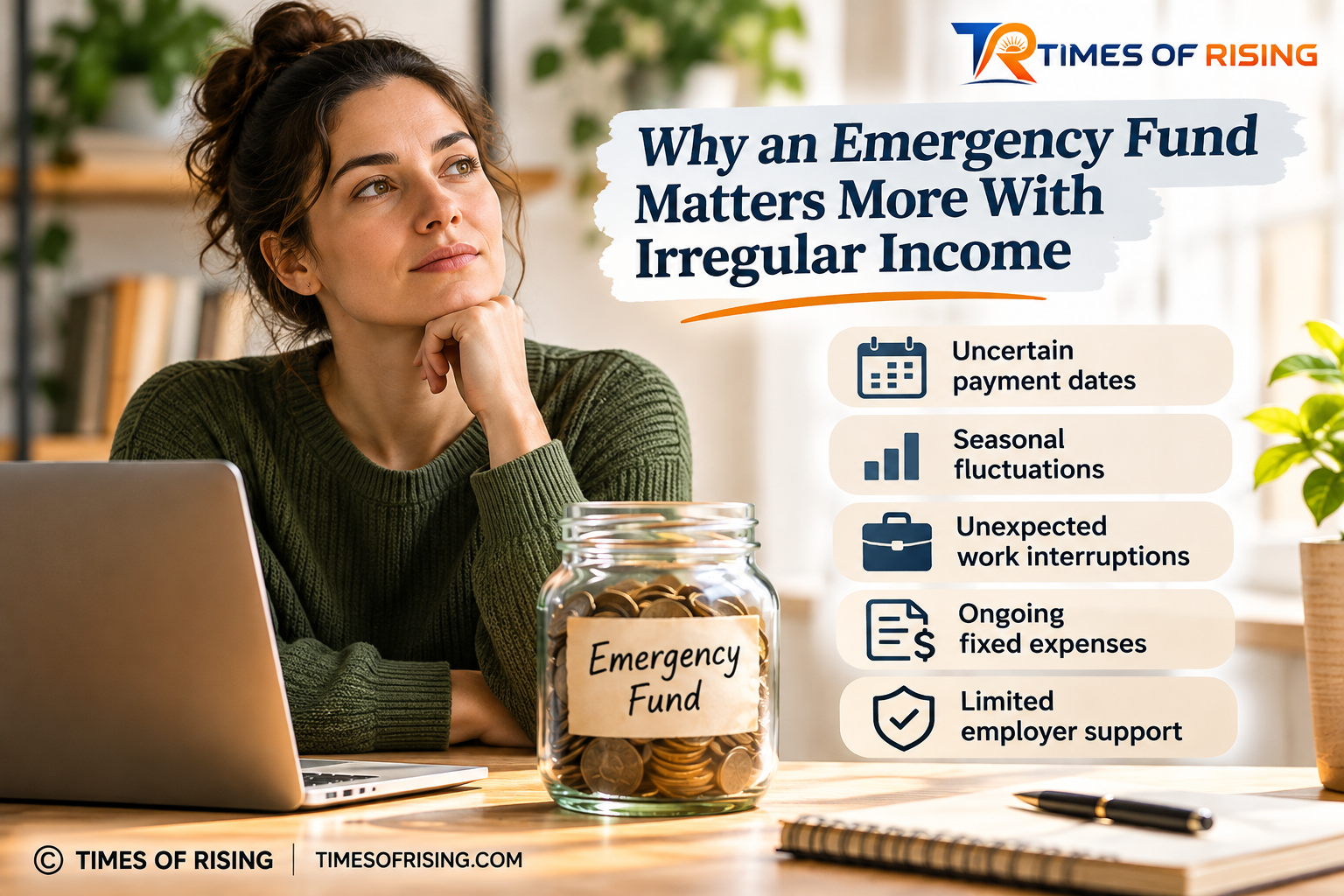
The financial challenges of unpredictable earnings
People with irregular income often face several overlapping challenges:
Uncertain payment dates: Freelancers and contractors may complete work on time but receive payment weeks later.
Seasonal fluctuations: Some businesses and professions experience predictable busy and slow periods.
Unexpected work interruptions: A client may cancel a contract, a project may end, or an opportunity may disappear.
Fixed financial obligations: Rent, utilities, insurance, loan payments, and groceries do not automatically become cheaper when earnings decline.
Limited employer support: Independent workers may not have access to paid sick leave, employer-sponsored benefits, or other workplace protections.
These challenges make emergency savings especially valuable.
An emergency fund cannot prevent income fluctuations, but it can give you more time to adjust without immediately turning to expensive borrowing.
2. Calculate Your Essential Monthly Expenses
Before deciding how much to save, determine how much money you actually need to cover your basic living expenses.
A common mistake is calculating an emergency fund using total monthly spending. This can produce an unnecessarily confusing target because ordinary spending includes both essential and optional expenses.
Instead, calculate your bare-bones monthly budget.
This represents the amount you would need to maintain your basic lifestyle if your income suddenly declined.
Start by listing your essential expenses.
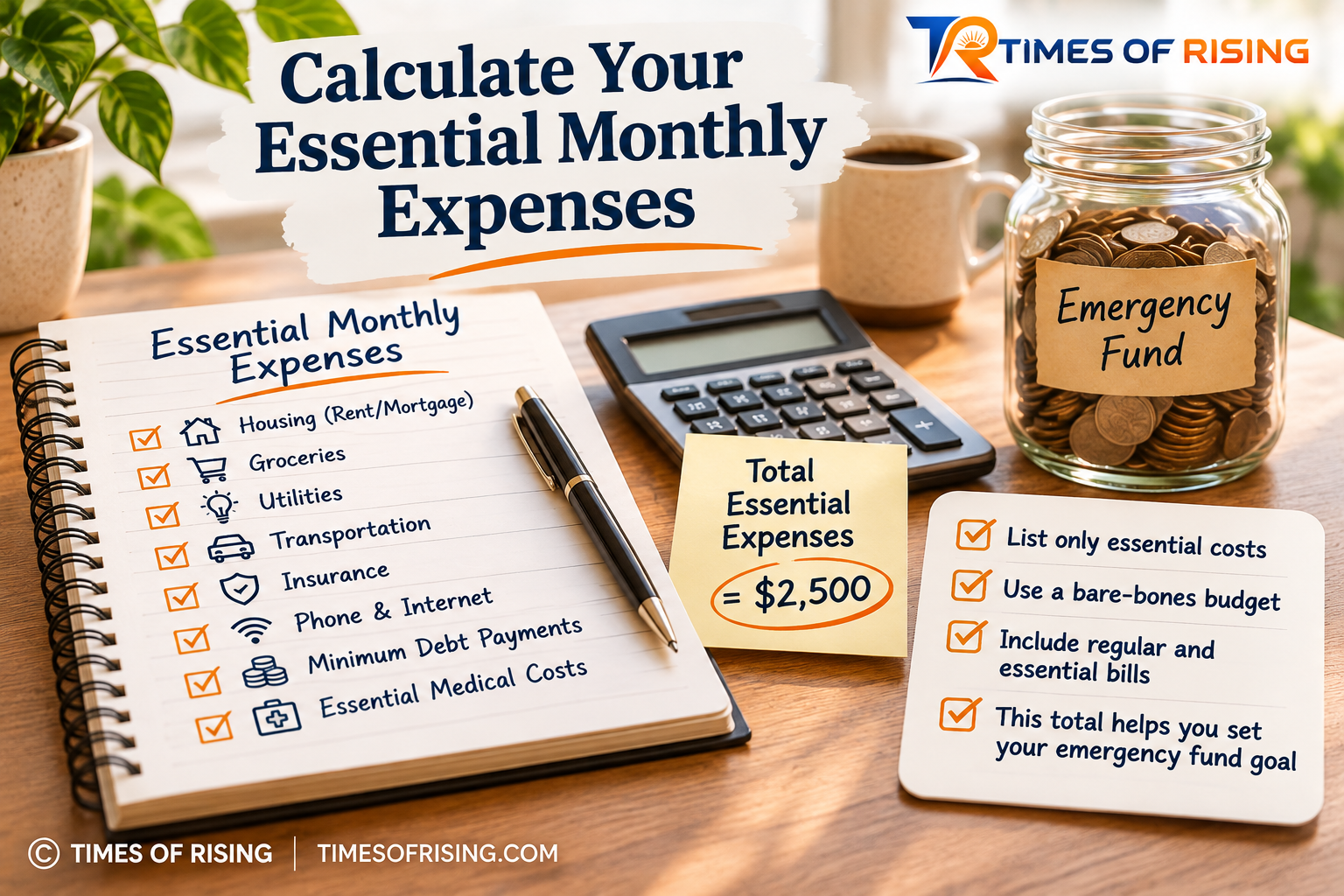
| Expense category | Example monthly cost |
|---|---|
| Rent or mortgage | $1,200 |
| Groceries | $400 |
| Utilities | $150 |
| Transportation | $180 |
| Insurance | $200 |
| Phone and internet | $100 |
| Minimum debt payments | $170 |
| Essential medical expenses | $100 |
| Total | $2,500 |
These are illustrative figures, not recommended spending amounts. Your actual expenses will depend on your location, household, obligations, and circumstances.
In this example, the person’s essential monthly expenses equal $2,500.
That figure becomes the foundation for calculating an emergency fund.
Separate essential expenses from optional spending
Your emergency budget should distinguish between expenses you must continue paying and those you could temporarily reduce.
Essential expenses may include:
- Housing payments
- Basic groceries
- Electricity, water, and heating
- Necessary transportation
- Health and other essential insurance
- Minimum required debt payments
- Necessary phone and internet services
- Essential medical expenses
- Childcare or dependent-care costs, where applicable
Optional expenses may include:
- Restaurant meals
- Entertainment subscriptions
- Nonessential shopping
- Vacations
- Premium memberships
- Expensive hobbies
You do not necessarily need to eliminate every optional expense from your normal budget. The purpose is to understand which expenses can be reduced if your income drops.
Remember annual and irregular bills
Some expenses do not arrive every month but are still predictable.
For example:
- Annual insurance premiums
- Vehicle registration
- Professional memberships
- Routine equipment maintenance
- Scheduled home maintenance
These expenses should generally have their own savings categories.
If you know a $600 bill is due every year, saving $50 per month can help you prepare for it.
This is important because an emergency fund should not become the account you regularly use for expenses that could have been anticipated.
3. Decide How Much Emergency Savings You Need
Once you know your essential monthly expenses, you can calculate a savings target.
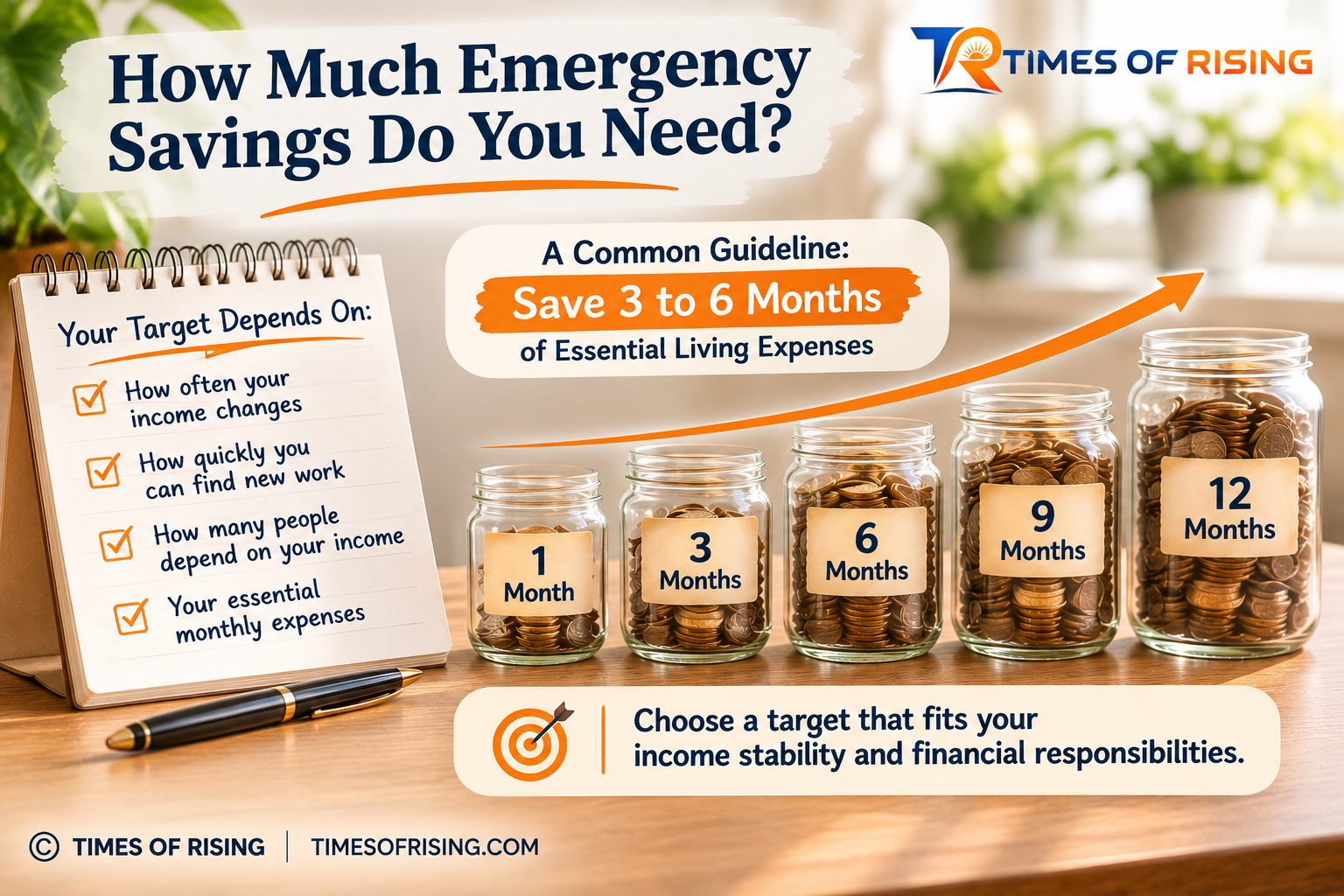
A commonly used guideline is to save three to six months of essential living expenses. However, people with highly variable income may need a larger cushion.
Freelancers, independent contractors, seasonal workers, and self-employed individuals may consider working toward six to twelve months of essential expenses, depending on their financial responsibilities and income stability.
There is no single target that fits everyone.
Your ideal amount depends on several factors:
- How frequently your income changes
- How long it typically takes to find new work
- Whether you have multiple clients or depend on one major client
- Whether other household members contribute financially
- How many people depend on your income
- Whether you have essential expenses that cannot easily be reduced
Example: Calculating a six-month emergency fund
Suppose your essential monthly expenses are $2,500.
Your emergency fund targets would look like this:
| Coverage period | Savings target |
|---|---|
| One month | $2,500 |
| Three months | $7,500 |
| Six months | $15,000 |
| Nine months | $22,500 |
| Twelve months | $30,000 |
If your income is relatively predictable despite being variable, six months might be a reasonable longer-term goal.
If you work in a highly seasonal industry, depend on a small number of clients, or support a household on one income, a larger target may be appropriate.
The important thing is to avoid treating a large savings goal as a reason not to begin.
You can build your emergency fund in stages.
4. Start With a Small, Achievable Savings Goal
One of the biggest obstacles to building an emergency fund is focusing too heavily on the final number.
If your target is $15,000 and you currently have nothing saved, the goal may feel unrealistic.
Instead, divide it into smaller milestones.
For example:
- Save your first $250.
- Increase the balance to $500.
- Build a $1,000 starter reserve.
- Save one month of essential expenses.
- Work toward three months.
- Continue until you reach your preferred six-to-twelve-month target.
These milestones make progress easier to measure.
They also give you some financial protection before the full emergency fund is complete.
Why a starter fund matters
Suppose your car needs an unexpected repair costing $450.
Without savings, you might need to put the expense on a credit card.
With a $1,000 starter emergency fund, you may be able to pay the bill without adding to your debt.
The starter fund is not a substitute for a complete emergency reserve. It is simply the first layer of protection.
If you have expensive debt, building a modest emergency reserve while prioritizing repayment of high-interest balances may be more practical than trying to save the entire emergency fund immediately.
Your approach should reflect your essential obligations and available cash flow.
5. Use a Percentage-Based Savings Strategy
This is one of the most useful changes you can make when earning an irregular income.
Traditional budgeting advice often recommends saving a fixed amount every month.
For example, someone might decide to save $300 each month.
But what happens when income falls from $4,000 to $1,700?
That fixed contribution may become difficult to maintain.
A percentage-based approach adjusts automatically to the amount you actually receive.
Instead of promising to save the same dollar amount every month, commit to saving a manageable percentage of each payment.
For example:
- Save 5% of every payment when cash flow is tight.
- Increase to 10% when your financial position allows.
- Consider contributing 15% or more during stronger earning periods if essential bills and other obligations are covered.
These are illustrative starting points, not universal rules.
Example of percentage-based savings
Suppose a freelance writer receives the following payments:
| Payment received | Savings rate | Emergency savings |
|---|---|---|
| $1,500 | 5% | $75 |
| $2,800 | 10% | $280 |
| $4,000 | 10% | $400 |
| $5,000 | 15% | $750 |
| $2,000 | 5% | $100 |
| Total | $1,605 |
The writer saves $1,605 across five payments.
Notice that the savings contribution changes with income.
A lower payment results in a smaller contribution, while a stronger payment creates an opportunity to save more.
This approach is often easier to maintain than a fixed monthly amount.
Save when the money actually arrives
Another important rule is to avoid saving money you have not received yet.
An invoice is not the same as available cash.
If a client promises to pay $2,000 next week, that money should not be treated as available for savings until the payment clears.
Once the payment arrives, account for taxes and essential business obligations before calculating the amount available for personal savings.
This reduces the risk of transferring money that you may need for immediate commitments.
6. Create Separate Accounts for Income, Expenses, Taxes, and Emergencies
When all your money is kept in one account, it becomes difficult to know how much is available to spend.
This is particularly challenging for freelancers and self-employed professionals who receive multiple payments throughout the month.
A simple account structure can make financial management easier.
Consider using separate accounts or clearly defined savings categories for:
Income account: Receives payments from clients, employers, customers, or platforms.
Tax account: Holds money reserved for tax obligations.
Spending account: Contains the amount available for regular personal expenses.
Emergency savings account: Holds money reserved for genuine financial emergencies.
Planned-expense savings: Covers predictable future expenses such as insurance renewals, annual subscriptions, and equipment replacement.
You do not necessarily need five separate bank accounts. Depending on your bank, savings goals or account subcategories may provide a similar level of organization.
Why tax savings must remain separate
People who work independently may be responsible for managing their own tax payments.
If you receive gross income, not all of it is necessarily available for personal spending.
Setting aside estimated taxes separately can prevent an unpleasant surprise when tax payments become due.
Tax requirements depend on your income, business structure, location, and circumstances. A qualified tax professional can help you determine an appropriate reserve.
Your emergency fund should not be used to pay a predictable tax bill.
Keeping these categories separate protects the money you have worked hard to save.
7. Pay Yourself a Consistent Monthly Amount
One of the most effective ways to manage irregular income is to create a personal salary system.
This means receiving payments whenever they arrive but transferring a relatively consistent amount into your spending account.
For example, suppose your freelance income varies between $2,000 and $6,000 per month.
Instead of spending more whenever you receive a larger payment, you could establish a monthly personal spending allowance based on your conservative income estimate and essential expenses.
During stronger months, the extra money remains in your income buffer.
During weaker months, the accumulated buffer can help cover your regular spending.
How the system works
Imagine you earn:
| Month | Income received |
|---|---|
| January | $5,000 |
| February | $2,500 |
| March | $4,500 |
| April | $1,800 |
| May | $5,500 |
Your income is clearly inconsistent.
If you transfer a fixed $3,000 to your spending account every month, the stronger months help support the weaker ones.
However, this only works if your income account has enough accumulated money and your average earnings can support that withdrawal over time.
Do not choose a monthly allowance simply because it sounds convenient.
Review at least six to twelve months of income history, identify your lower-earning periods, and choose an amount that is sustainable.
Keep your income buffer separate from your emergency fund
These two savings categories serve different purposes.
An income buffer helps smooth predictable differences between strong and weak earning months.
An emergency fund protects against unexpected financial events.
For example, a seasonal worker might use the income buffer to prepare for a regularly occurring winter slowdown.
If that worker suddenly faces an unexpected medical expense, the emergency fund may be the more appropriate source of money.
Separating the two helps prevent ordinary income fluctuations from consuming all your emergency savings.
8. Save More During High-Income Months
High-income months are valuable opportunities to strengthen your financial position.
However, they can also create a spending problem.
When a freelancer receives a large payment, it may be tempting to upgrade equipment, purchase expensive items, or increase regular spending.
The difficulty is that a strong month does not guarantee another strong month.
A more practical approach is to establish a rule for surplus income.
For example, after accounting for taxes, business expenses, essential bills, and planned obligations, you might divide available surplus among:
- Emergency savings
- Income-buffer savings
- Debt repayment
- Other important financial goals
You could also direct a larger proportion of exceptional payments toward emergency savings until you reach your target.
A practical windfall strategy
Suppose you normally receive $3,000 per month but earn $5,000 in a particularly successful month.
The additional $2,000 is not necessarily disposable income.
After considering outstanding obligations, you could use part of the surplus to increase emergency savings.
For example:
| Allocation | Amount |
|---|---|
| Additional emergency savings | $800 |
| Income buffer | $500 |
| Debt repayment | $400 |
| Other planned expenses | $300 |
| Total surplus | $2,000 |
This is an illustrative allocation. Your own priorities may be different.
The main principle is simple: avoid treating every unusually large payment as permission to increase your lifestyle permanently.
9. Choose the Right Place to Keep Your Emergency Fund
An emergency fund should be accessible when you need it.
This means it should generally not be placed in investments that could lose significant value or require you to wait a long time before accessing your money.
For many US households, an FDIC-insured bank savings account or an eligible federally insured credit union savings account can be a practical starting point.
A high-yield savings account may offer a competitive interest rate while keeping money relatively accessible.
When comparing accounts, consider:
- Whether the institution and account are covered by applicable deposit insurance
- Minimum balance requirements
- Monthly maintenance fees
- Withdrawal and transfer restrictions
- How quickly you can access the money
- Whether the interest rate can change
Should you use a high-yield savings account?
A high-yield savings account can be useful because it combines accessibility with the opportunity to earn interest.
However, compare the actual terms rather than choosing an account based only on its advertised annual percentage yield.
Interest rates can change, and some accounts have conditions that affect the rate.
What about certificates of deposit?
Certificates of deposit, commonly called CDs, can offer a fixed interest rate for an agreed period.
However, accessing the money before maturity may involve an early withdrawal penalty.
For that reason, money that might be needed immediately should not all be locked into a CD.
A reasonable approach is to keep the most immediately necessary portion in an accessible savings account and only consider less-accessible options for money you are confident you will not need right away.
Avoid taking unnecessary investment risks
An emergency fund has a different purpose from long-term investments.
Its main objective is availability and preservation, not maximum growth.
Keeping emergency savings in volatile investments can create problems if you need the money during a market downturn.
You should also avoid confusing retirement accounts with emergency savings. Withdrawals from retirement accounts can involve taxes, penalties, or lost long-term growth opportunities.
10. Automate Savings Without Creating Cash-Flow Problems
Automation can make saving easier, but people with irregular income need to approach it carefully.
A fixed automatic transfer scheduled for the first day of every month may not work if your payments arrive unpredictably.
Instead, connect your savings routine to the arrival of income.
For example:
- Transfer a percentage of each cleared payment.
- Set a weekly review day to move available savings.
- Use bank features that support scheduled or rule-based transfers.
- Review your account balance before making additional transfers.
If your bank does not support automatic percentage-based transfers, you can use a simple spreadsheet or budgeting application to calculate the amount manually.
Use a simple payment-day routine
Whenever money arrives:
- Confirm that the payment has cleared.
- Identify any taxes or business obligations that need to be covered.
- Check upcoming essential bills.
- Transfer your chosen savings percentage.
- Record the payment and savings contribution.
- Leave enough available cash for upcoming commitments.
This routine turns saving into a repeatable financial habit rather than a decision you have to make from scratch every time you get paid.
11. Build Your Emergency Fund Even During Low-Income Months
A common problem with irregular income is the tendency to stop saving completely during slow periods.
Sometimes that is unavoidable.
Essential bills and basic living expenses must come first.
However, when possible, maintaining even a small savings contribution can help preserve your habit.
Suppose you normally save $200 from a payment but receive only a small amount of income this month.
You might contribute $10 or $20 instead, provided doing so does not interfere with essential expenses.
There is no benefit in transferring money into savings if you immediately need to withdraw it to pay rent or buy groceries.
The objective is sustainable progress, not maintaining an arbitrary savings percentage at all costs.
Give yourself permission to adjust
Your savings strategy should change when your circumstances change.
For example:
- During strong earning periods, increase contributions.
- During slow periods, reduce them.
- When a major essential expense arises, prioritize immediate needs.
- When income becomes more stable, review your savings rate.
- After reaching your target, redirect some contributions toward other financial goals.
A flexible plan is more useful than a rigid plan that repeatedly fails when circumstances change.
12. Distinguish Between a Real Emergency and a Predictable Expense
An emergency fund can lose its effectiveness if it becomes a general-purpose spending account.
Not every unexpected-looking expense is a genuine emergency.
For example, an annual insurance premium may feel like a financial surprise if you have not planned for it.
But if the payment occurs every year, it is predictable.
Similarly, seasonal business expenses, routine vehicle maintenance, and scheduled equipment replacements should generally be planned separately.
Examples of genuine emergencies
Depending on your circumstances, these may include:
- Unexpected essential medical expenses
- Sudden loss of an important source of income
- Urgent home repairs
- Necessary vehicle repairs when transportation is essential for work
- An unexpected interruption to your ability to earn
Examples of planned expenses
These are generally better handled through separate savings categories:
- Annual insurance premiums
- Holiday spending
- Planned vacations
- Regular professional membership renewals
- Expected vehicle maintenance
- Planned technology upgrades
A useful question to ask before withdrawing money is:
Is this expense urgent, necessary, and genuinely unexpected?
If the answer is no, another savings category may be more appropriate.
13. What to Do If You Need to Use Your Emergency Fund
Using your emergency fund does not mean you have failed at saving.
That is exactly what the money is intended for.
The important thing is to use it carefully and establish a plan for rebuilding the balance afterward.
Before withdrawing money, determine how much is required to address the problem.
Avoid withdrawing more than necessary simply because the money is available.
After the emergency has been resolved:
- Review your remaining emergency savings.
- Recalculate your coverage in months of essential expenses.
- Adjust discretionary spending if necessary.
- Resume contributions when your cash flow allows.
- Rebuild the fund toward your previous target.
For example, suppose you had saved $8,000 and used $1,500 for an unexpected essential repair.
Your remaining balance is $6,500.
If your essential monthly expenses are $2,500, you now have approximately 2.6 months of coverage.
This gives you a clear picture of your current financial position and helps you prioritize replenishing your savings.
14. Common Mistakes to Avoid When Building an Emergency Fund
Even a good savings plan can become ineffective if it is built around unrealistic assumptions.
Watch out for these common mistakes.
Saving based on your best month
A strong earning month should not become the foundation of your regular spending plan.
Build your budget using conservative income estimates and treat unusually high payments as opportunities to strengthen your financial position.
Setting an unrealistic savings target
A $20,000 goal may be appropriate eventually, but it can be discouraging if you are starting with no savings.
Begin with smaller milestones and increase the target gradually.
Mixing emergency savings with everyday money
When emergency savings are held in the same account used for shopping and regular bills, it becomes easier to spend the money unintentionally.
Use a separate account or clearly identified savings category.
Ignoring taxes
Self-employed individuals and contractors may have tax obligations that need to be planned separately.
Do not treat all money received from a client as personal income.
Investing emergency money too aggressively
The money is intended to provide financial protection, not to maximize investment returns.
Avoid exposing essential emergency savings to unnecessary market risk.
Forgetting to replenish withdrawals
An emergency fund is not a one-time savings achievement.
After using it, make a realistic plan to restore the balance.
Comparing your savings progress with other people
Someone with a stable salary, low living expenses, and no dependents may find it easier to save than someone whose earnings change every month.
Your savings target should reflect your own essential expenses and financial responsibilities.
15. A Practical 90-Day Plan to Get Started
If you have not started an emergency fund yet, the first three months can be used to establish a workable system.
The objective is not necessarily to build a complete emergency fund in 90 days.
It is to understand your financial position, begin saving, and create a routine you can maintain.
Days 1–15: Understand your finances
Start by reviewing your recent bank statements and income records.
List your essential monthly expenses and identify predictable annual costs.
Calculate your bare-bones monthly spending figure.
If your income varies significantly, review as much as twelve months of records when available.
Days 16–30: Set up your savings system
Choose a suitable separate savings account.
Decide on a starter emergency fund target.
Select a realistic percentage of each payment that you can save without affecting essential obligations.
Create separate categories for taxes, planned expenses, and income-buffer savings if needed.
Days 31–60: Follow your payment-day routine
Every time a payment clears:
- Review immediate obligations.
- Set aside applicable tax money.
- Transfer your chosen savings contribution.
- Record the amount saved.
- Avoid unnecessary withdrawals.
At the end of each month, review whether your contribution was realistic.
Days 61–90: Review and improve
Compare your income, expenses, and savings contributions over the first two months.
If you are consistently meeting essential obligations and maintaining positive cash flow, consider increasing your savings percentage.
If you are struggling, adjust the amount rather than abandoning the plan.
At the end of 90 days, you should have a clearer picture of your income patterns, essential spending, and realistic savings capacity.
Continue using the same process as you work toward your longer-term target.
Frequently Asked Questions
1. How much should I save for an emergency fund if I have irregular income?
A common starting point is three months of essential living expenses. However, people with highly unpredictable income may want to work toward six to twelve months.
Your target should depend on income stability, household responsibilities, essential expenses, and how easily you can find replacement work.
2. What percentage of irregular income should I save?
There is no universal percentage.
Some people may begin with 5% of each payment, while others may comfortably save 10% or more.
The important thing is to choose an amount that remains manageable after accounting for taxes, business expenses, and essential bills.
3. Should I save money every month if my income changes?
You can, but your savings strategy does not need to depend on a fixed monthly contribution.
Saving a percentage of every payment may be more practical because the amount automatically adjusts to your income.
You can also review your savings balance weekly or monthly to make additional contributions when cash flow allows.
4. What is the best account for an emergency fund?
A separate, accessible savings account is a practical option for many people.
In the United States, compare eligible FDIC-insured bank savings accounts and federally insured credit union accounts. Consider fees, withdrawal access, minimum balances, and interest rates before choosing.
5. Should freelancers have a larger emergency fund?
Freelancers may benefit from a larger reserve because their work and payment schedules can be unpredictable.
Six to twelve months of essential expenses can be a useful planning range, particularly for people with limited client diversity or significant household responsibilities.
6. Is an income buffer the same as an emergency fund?
No.
An income buffer helps manage normal differences between high-earning and low-earning months.
An emergency fund is reserved for unexpected financial situations, such as an urgent repair or an unforeseen loss of income.
Keeping these categories separate can make your savings more effective.
7. Should I pay off debt or build an emergency fund first?
The answer depends on your debt, interest rates, essential expenses, and financial stability.
Building a modest starter reserve can help prevent an unexpected expense from creating additional borrowing.
After that, prioritizing expensive debt while continuing manageable emergency savings contributions may be appropriate.
Minimum required payments should remain part of your essential budget.
8. What if I cannot save anything during a slow month?
Prioritize essential expenses first.
If there is no money available for savings, do not force a contribution that creates another financial problem.
Resume saving when income improves, even if you need to start with a small amount.
Consistency over time matters more than maintaining a perfect monthly record.
9. Can I use my emergency fund for a period without freelance work?
Yes, if your income interruption creates a genuine financial need and the money is required for essential expenses.
However, a predictable seasonal slowdown is better managed through a separate income buffer whenever possible.
10. How often should I review my emergency fund?
Review it at least every three to six months.
You should also reconsider your target after significant changes in income, housing costs, household responsibilities, employment arrangements, or essential expenses.
Final Thoughts: Build a System That Works With Your Income
Building an emergency fund on an irregular income is not about saving the same amount every month.
It is about creating a financial system that adjusts to the money you actually receive.
Start by understanding your essential expenses. Set a realistic savings target, begin with manageable milestones, and save a percentage of every cleared payment when your cash flow allows.
Separate your emergency savings from taxes, everyday spending, and predictable future expenses. Build an income buffer to manage normal fluctuations, and use stronger earning periods to make additional progress.
Most importantly, do not let a slow month convince you that saving is impossible.
A smaller contribution is still progress when it is affordable, and temporarily pausing contributions when essential expenses demand it does not erase the work you have already done.
You may not be able to control when every client pays, how many projects arrive, or how much you earn each month. But you can build a financial routine that gives you more control over what happens to the money you receive.
An emergency fund is not built in one unusually successful month. It is built through practical decisions repeated over time.
Disclaimer: This article is for general educational purposes only and does not constitute individualized financial, tax, legal, or investment advice. Savings needs and suitable financial products vary by individual circumstances. Consult an appropriately qualified professional when making decisions about your finances.

Sofia Young
Sofia Young writes about personal finance, helping readers understand budgeting, saving, credit management, debt reduction and everyday financial decisions. Her articles focus on practical explanations, realistic examples and responsible money management. She aims to make complex financial concepts easier to understand while distinguishing general educational information from individualized financial advice.
Join the conversation
Share a thoughtful response, ask a question, or add something useful for other readers.
Be the first to add a helpful perspective.