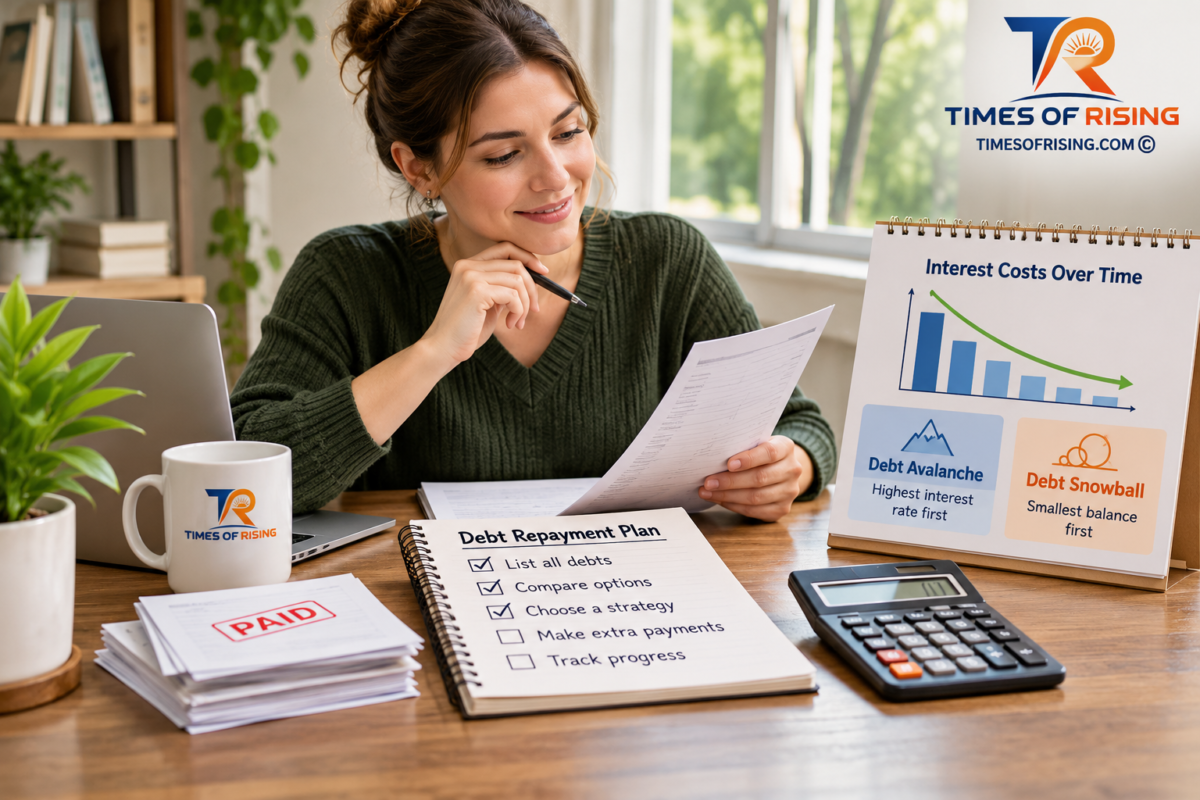
A Beginner-Friendly Way to Compare Debt Repayment Options
Debt can become difficult to manage when several payments compete for attention every month. A credit card balance, a personal loan, a student loan, and a vehicle loan may all have different interest rates, repayment periods, and monthly obligations.
The challenge is not always finding money to repay debt. Sometimes, the bigger challenge is deciding which debt deserves your extra attention first.
Should you pay off the smallest balance to experience an early win? Should you concentrate on the debt with the highest interest rate to reduce borrowing costs? Or should you consider combining several debts into one repayment arrangement?
Each approach has advantages and limitations. A strategy that works well for someone with a stable income may not be suitable for someone dealing with irregular earnings or several overdue payments.
Fortunately, comparing debt repayment options does not require complicated financial knowledge.
By understanding a few common repayment methods, organizing your outstanding balances, and comparing the costs of different approaches, you can make a more informed decision.
This guide explains how to evaluate common debt repayment strategies, what to consider before choosing one, and how to turn your preferred approach into a manageable repayment plan.
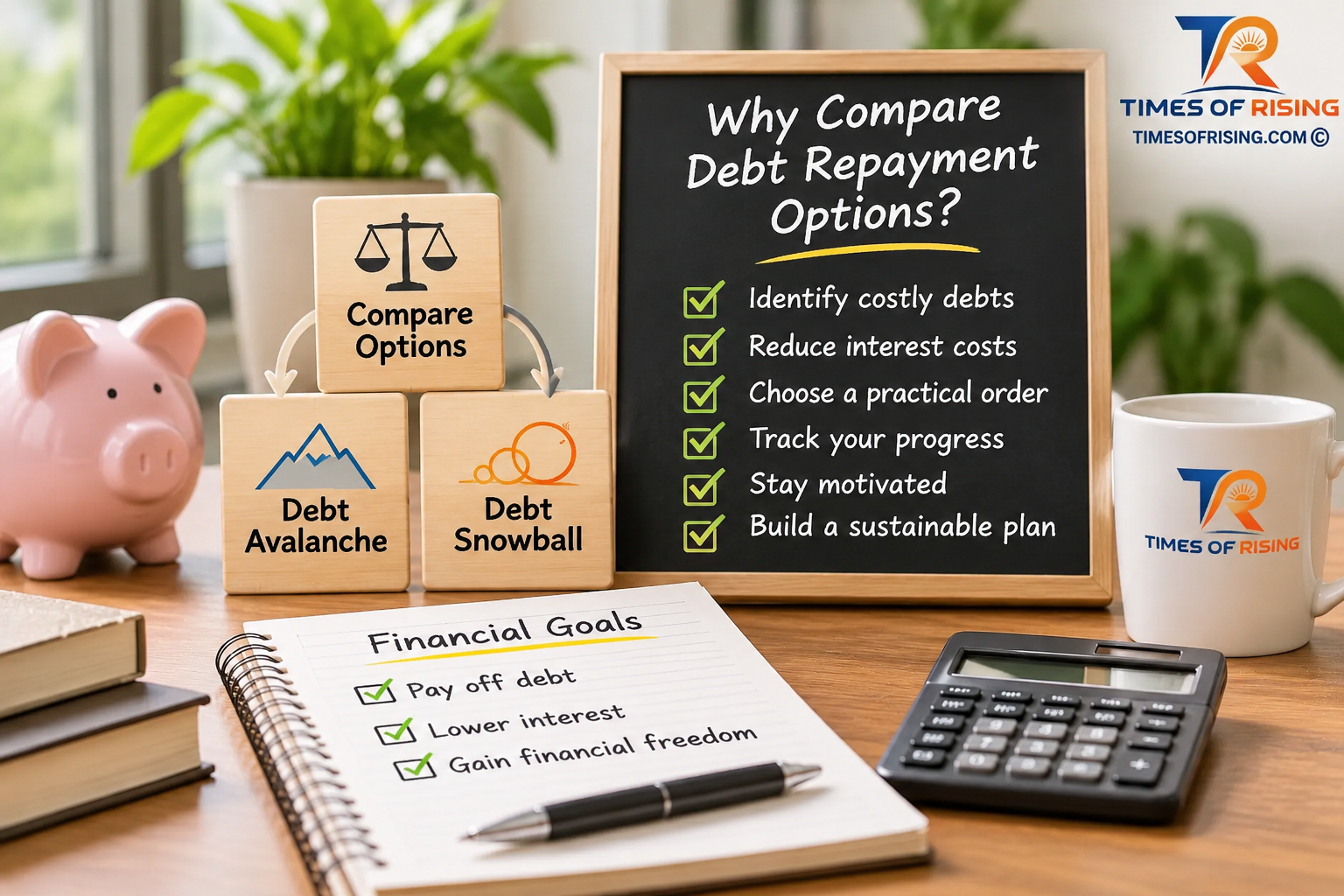
Why Comparing Debt Repayment Options Matters
When people have multiple debts, they sometimes make payments without following a particular strategy. They pay whichever bill feels most urgent, send extra money to the account that contacts them most frequently, or divide additional money equally between different debts.
Although making payments regularly is important, this approach may not always be the most efficient way to reduce debt.
Consider a simple example.
Imagine someone has three outstanding debts:
- Credit card balance: $4,000 at 24% annual interest.
- Personal loan: $2,500 at 12% annual interest.
- Small loan: $1,000 at 8% annual interest.
The person can afford all required minimum payments and has an additional $200 each month available for debt repayment.
Where should that extra $200 go?
Putting it toward the credit card could reduce expensive interest charges. Paying off the $1,000 loan first could eliminate one outstanding account relatively quickly. Dividing the money between all three debts might appear balanced, but it could delay the benefits of concentrating additional payments on a particular account.
This is why comparing repayment methods matters.
A suitable repayment strategy can help you:
- Understand which debts are costing you the most.
- Reduce unnecessary interest expenses.
- Establish a clear order for making additional payments.
- Monitor your progress more easily.
- Avoid making repayment decisions based entirely on emotion.
- Build a repayment routine that fits your available budget.
The goal is not simply to make every balance disappear as quickly as possible. It is to find an approach that balances borrowing costs, financial stability, and personal motivation.
Start by Understanding Your Current Debt Situation
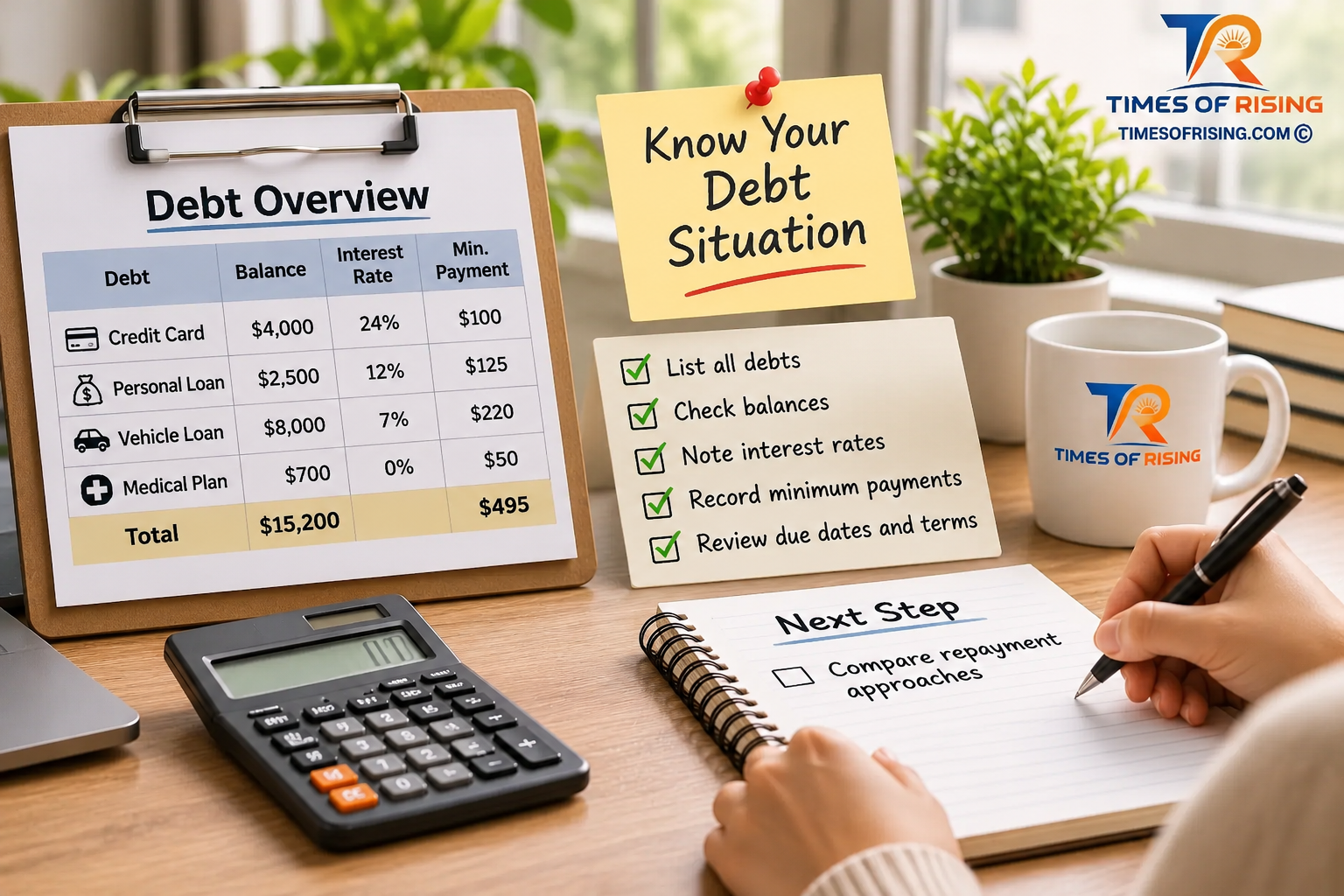
Before comparing repayment methods, collect information about every outstanding debt.
Choosing a strategy without knowing the details of your loans is like planning a journey without knowing your starting point.
You do not need complicated financial software. A spreadsheet, notebook, or simple table is enough.
1. List Every Outstanding Debt
Begin by identifying all your current debts.
Depending on your financial situation, this might include:
- Credit card balances.
- Personal loans.
- Student loans.
- Vehicle loans.
- Medical payment plans.
- Buy-now-pay-later balances.
- Other outstanding borrowing arrangements.
Do not leave out smaller balances simply because they seem insignificant.
A complete list helps you understand your overall repayment responsibilities.
2. Record the Outstanding Balance
The outstanding balance is the amount you still owe.
For example:
| Debt | Outstanding Balance |
|---|---|
| Credit card | $4,000 |
| Personal loan | $2,500 |
| Vehicle loan | $8,000 |
| Medical payment plan | $700 |
| Total | $15,200 |
This information shows the size of your overall debt.
However, the largest balance is not necessarily the most expensive debt. Interest rates and repayment terms also matter.
3. Check the Interest Rate
Interest is the cost of borrowing money.
Two loans with identical balances can create very different financial burdens if their interest rates differ.
For example:
- Debt A: $2,000 at 8% annual interest.
- Debt B: $2,000 at 22% annual interest.
Debt B generally becomes more expensive if both balances remain outstanding for comparable periods under otherwise similar conditions.
Record the applicable annual interest rate for each debt.
For credit cards, check how the issuer calculates interest and whether different balances have different rates. Promotional rates, cash advances, and regular purchases may not receive identical treatment.
4. Record Minimum Monthly Payments
The minimum payment is the amount you are required to pay to keep an account current under its repayment terms.
Write down the minimum payment for every debt.
For example:
| Debt | Monthly Minimum |
|---|---|
| Credit card | $100 |
| Personal loan | $125 |
| Vehicle loan | $220 |
| Medical payment plan | $50 |
| Total | $495 |
In this example, the borrower needs at least $495 each month for the listed payments.
The actual amount may change depending on outstanding balances, interest, fees, or lender terms.
5. Check Due Dates and Repayment Conditions
Interest rates and balances are important, but they are not the only factors worth considering.
Also record:
- Payment due dates.
- Whether payments are already overdue.
- Late-payment charges.
- Prepayment or early-closure charges.
- Promotional interest-rate expiration dates.
- Whether interest rates are fixed or variable.
- Rules governing additional payments.
These details can affect which repayment option is practical.
For example, paying an installment loan early may not provide the expected benefit if the agreement includes significant prepayment costs.
Similarly, missing a required payment on one account while making additional payments on another can create avoidable financial problems.
The first rule is simple: keep required payments current wherever possible before directing extra money toward a particular debt.
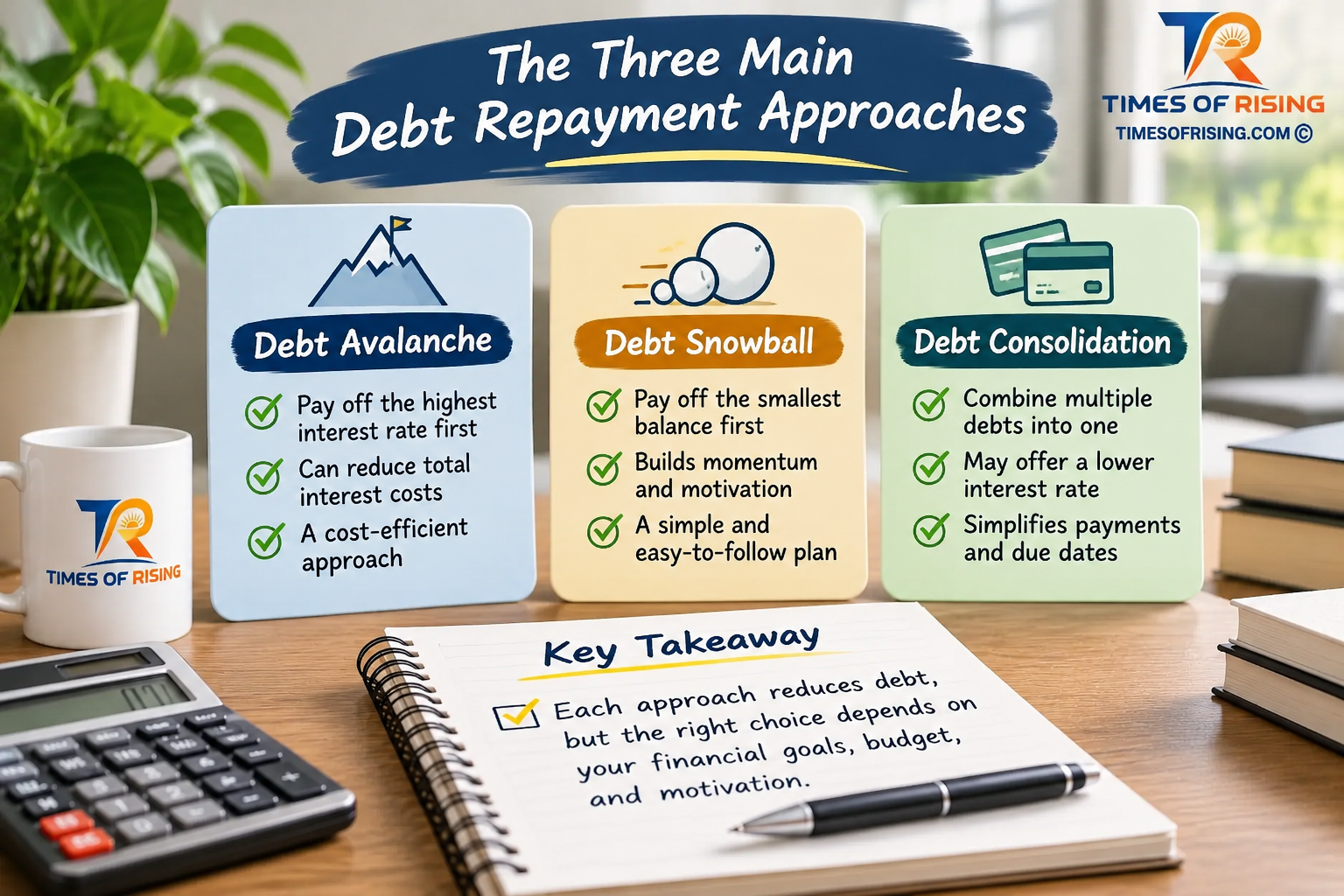
The Three Main Debt Repayment Approaches
Once you understand your debt situation, you can begin comparing different repayment approaches.
Three commonly discussed options are:
- Debt avalanche method.
- Debt snowball method.
- Debt consolidation.
The first two determine which existing debt receives extra payments. Consolidation works differently because it involves replacing or combining existing borrowing arrangements.
Let’s examine each option.
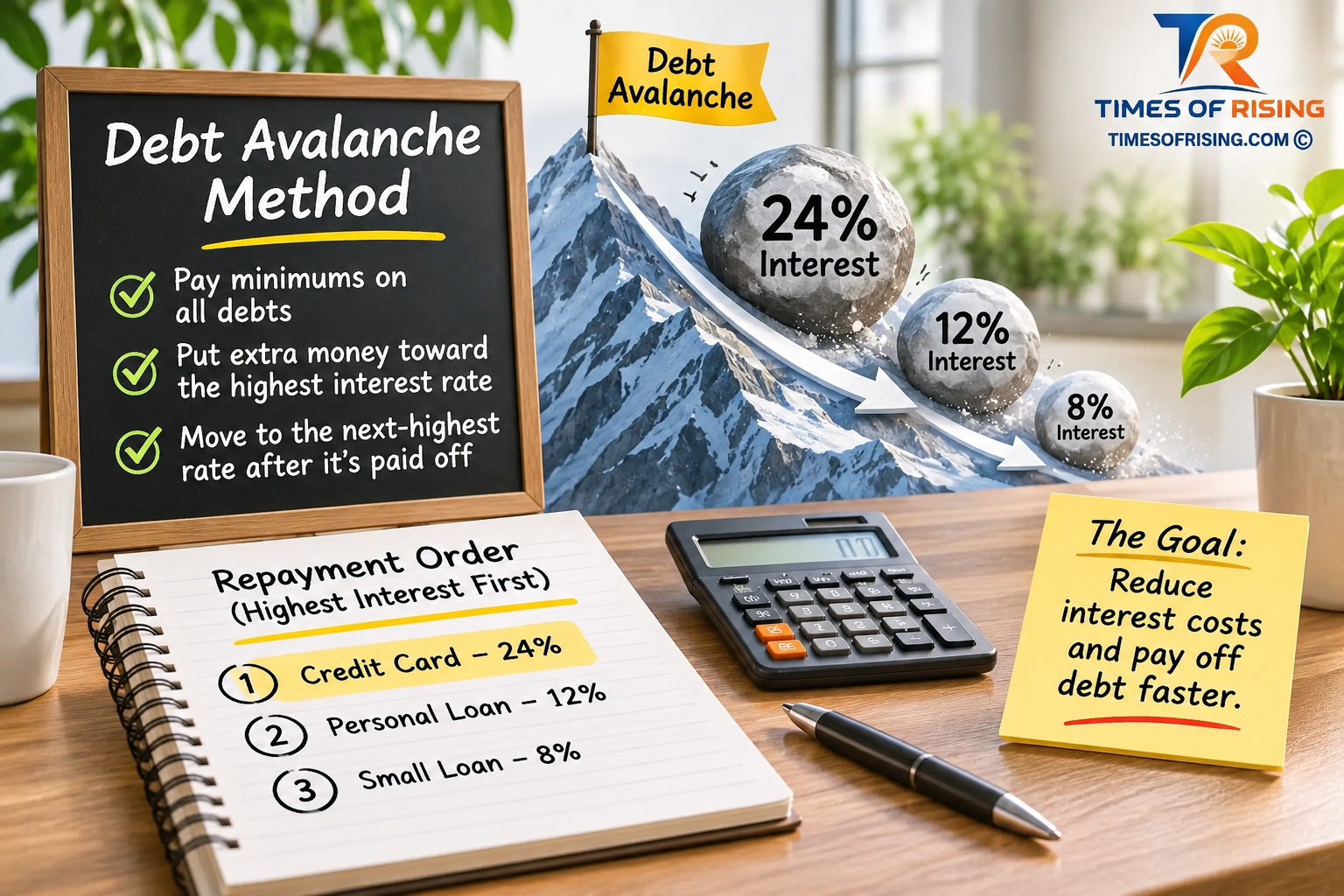
1. Debt Avalanche Method: Prioritize the Highest Interest Rate
The debt avalanche method focuses on reducing the most expensive debt first.
Under this approach, you:
- Make the required minimum payment on every debt.
- Identify the debt with the highest interest rate.
- Direct available extra repayment money toward that debt.
- Continue until the targeted balance is paid off.
- Redirect the money previously used for that debt toward the next-highest-interest debt.
You repeat the process until all debts have been repaid.
Example of the Debt Avalanche Method
Suppose someone has the following debts:
| Debt | Balance | Annual Interest |
|---|---|---|
| Credit card | $4,000 | 24% |
| Personal loan | $2,500 | 12% |
| Small loan | $1,000 | 8% |
The avalanche repayment order would be:
- Credit card at 24%.
- Personal loan at 12%.
- Small loan at 8%.
The borrower continues making required payments on all three accounts but directs extra money toward the credit card.
After clearing the credit card, the extra repayment amount moves to the personal loan. Once that is repaid, the borrower concentrates on the remaining small loan.
Advantages of the Avalanche Method
Potentially lower total interest costs
This is the biggest advantage.
When repayment conditions are otherwise comparable, directing extra payments toward the highest-interest debt reduces the amount of expensive borrowing that remains outstanding.
A financially efficient approach
The method prioritizes the debt that charges the most for every additional period it remains unpaid.
Useful when interest rates vary significantly
The difference between a credit card charging 24% and a loan charging 8% can be substantial.
Targeting the higher-rate debt first can make a meaningful difference over time.
Disadvantages of the Avalanche Method
Early progress may feel slow
The highest-interest debt may also have the largest balance.
If that account takes a long time to repay, you might not see an account disappear quickly.
Requires consistency
The financial advantage depends on continuing the repayment plan rather than frequently changing priorities.
Can feel less rewarding initially
Some people find it difficult to remain motivated when their first repayment target takes months or years to clear.
Who Might Prefer This Method?
The avalanche method may suit borrowers who:
- Want to minimize interest expenses.
- Can maintain a consistent repayment routine.
- Have several debts with significantly different interest rates.
- Feel motivated by financial savings rather than early account closures.
If reducing borrowing costs is your primary objective, the avalanche method is an important starting point for comparison.
2. Debt Snowball Method: Prioritize the Smallest Balance
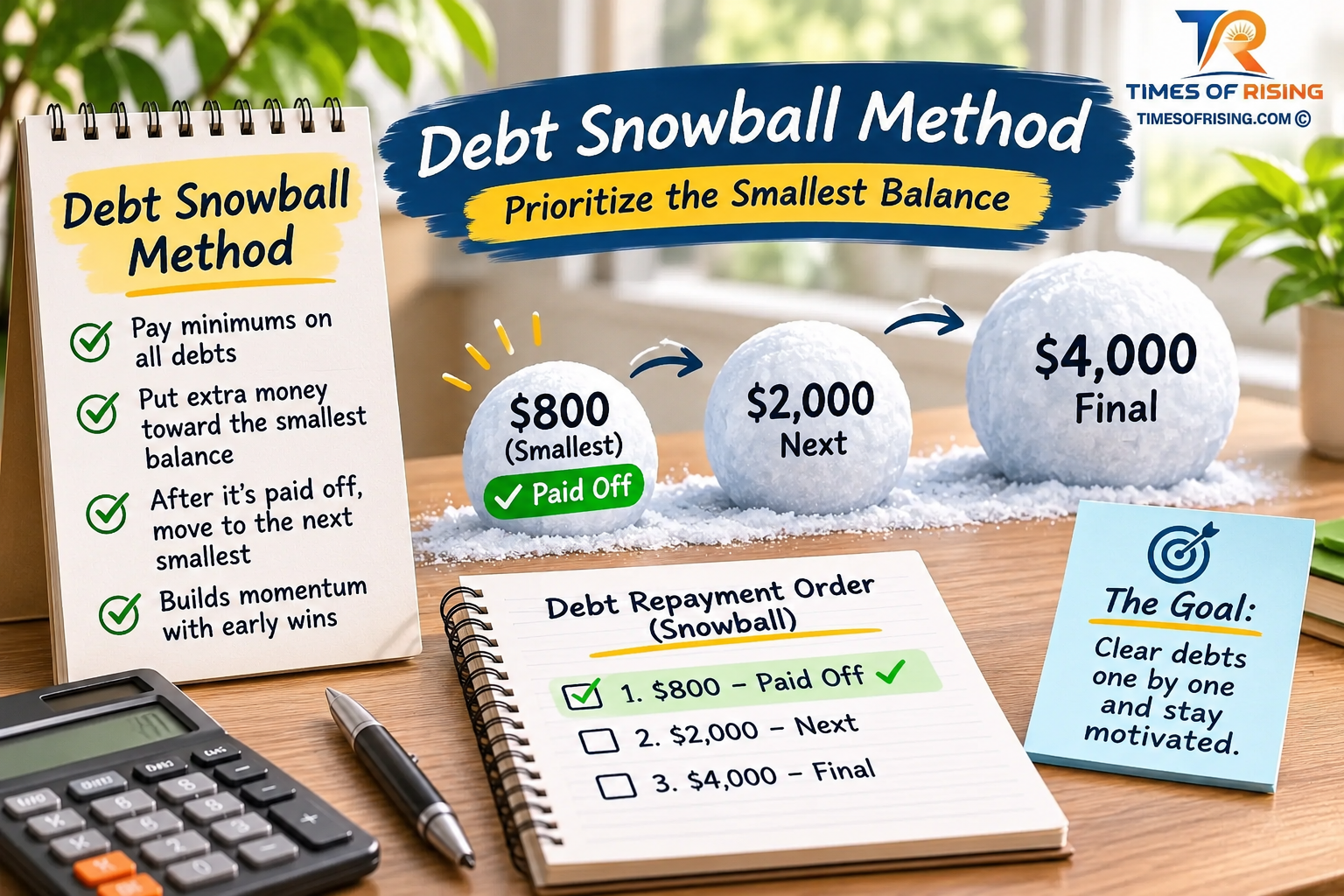
The debt snowball method follows a different principle.
Instead of prioritizing interest rates, it prioritizes the amount owed.
You begin with the smallest outstanding balance, regardless of its interest rate.
The basic process is:
- Make the required minimum payments on every debt.
- Arrange debts from the smallest balance to the largest.
- Direct available extra money toward the smallest debt.
- Once it is fully repaid, move to the next-smallest debt.
- Add the payment amount previously used for the cleared debt to the next repayment target.
The repayment amount gradually becomes larger as individual debts disappear.
Example of the Debt Snowball Method
Consider the same three debts:
| Debt | Balance | Annual Interest |
|---|---|---|
| Credit card | $4,000 | 24% |
| Personal loan | $2,500 | 12% |
| Small loan | $1,000 | 8% |
The snowball repayment order would be:
- Small loan of $1,000.
- Personal loan of $2,500.
- Credit card balance of $4,000.
Even though the credit card has the highest interest rate, the borrower initially concentrates on the smallest loan.
After clearing the $1,000 balance, the money previously allocated to that loan becomes available for the $2,500 personal loan.
Once the personal loan is cleared, the combined repayment amount moves toward the credit card.
Advantages of the Snowball Method
Visible progress
Clearing a smaller debt can provide a sense of accomplishment.
Instead of watching several balances remain outstanding, you can see individual accounts disappear.
Fewer outstanding accounts
Each cleared debt reduces the number of payments and accounts you need to monitor.
Potentially easier to maintain motivation
For people who feel overwhelmed by multiple balances, early progress can make the repayment process seem more manageable.
A straightforward repayment order
You do not need complicated interest calculations to determine which balance is smallest.
Disadvantages of the Snowball Method
Potentially higher interest costs
If your smallest debt carries a lower interest rate than another larger debt, postponing the higher-rate debt may increase total interest expenses.
The largest debt may remain for a long time
Some borrowers may clear several small balances before making significant progress on a much larger account.
Not always the least expensive option
The method prioritizes psychological momentum rather than mathematical interest savings.
Who Might Prefer This Method?
The snowball method may suit people who:
- Feel overwhelmed by several outstanding debts.
- Have struggled to follow repayment plans consistently.
- Need visible progress to maintain motivation.
- Prefer a simple balance-based repayment order.
The important consideration is whether the early progress helps you remain committed to repayment.
3. Debt Consolidation: Combine Multiple Debts Into One
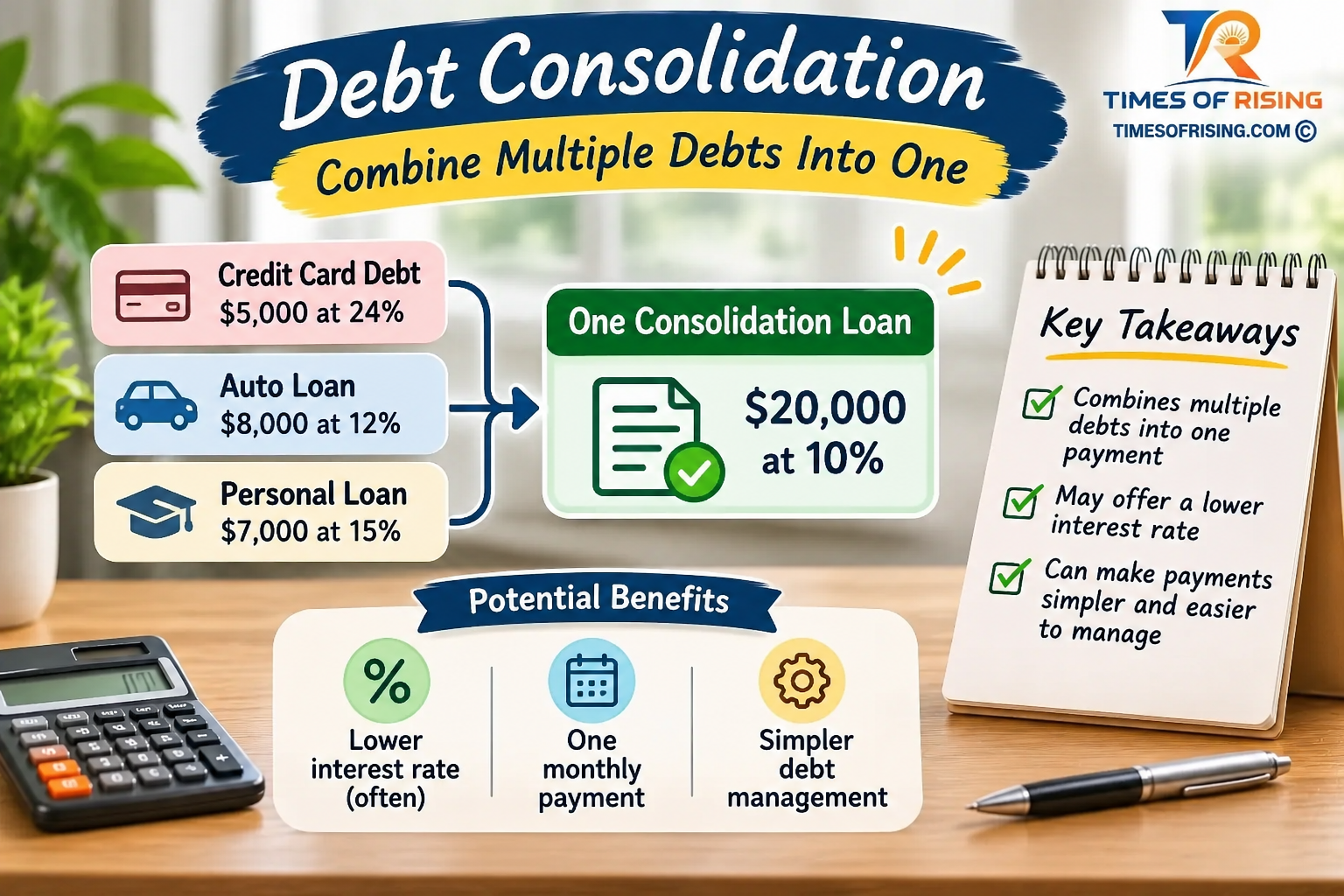
Debt consolidation is different from the snowball and avalanche approaches.
Instead of deciding which existing account should receive extra payments, consolidation involves combining multiple debts into a single new borrowing arrangement.
For example, someone with three outstanding debts might take out a new loan and use the proceeds to repay those balances.
Afterward, the borrower makes payments toward the new loan rather than managing the original accounts separately.
Some credit card balance-transfer arrangements also serve a similar purpose by moving eligible balances to another account.
Advantages of Debt Consolidation
Simplified payments
Managing one repayment schedule can be easier than remembering several due dates.
Potentially lower interest costs
If the new loan has a lower overall borrowing cost, consolidation may reduce interest expenses.
More predictable repayment
A fixed-rate consolidation loan with a clearly defined repayment schedule can make budgeting easier.
Reduced administrative complexity
Fewer accounts may mean fewer statements, payment reminders, and repayment deadlines.
Disadvantages of Debt Consolidation
Additional fees
Origination charges, balance-transfer fees, and other costs can reduce the financial benefit.
Longer repayment periods
A lower monthly payment does not automatically mean a cheaper loan.
If the repayment period becomes longer, the total interest paid may increase.
Risk of accumulating new debt
If someone consolidates credit card balances but continues spending on those cards without a repayment plan, the overall debt burden may grow again.
Approval requirements
Lenders may consider income, credit history, existing obligations, and other eligibility conditions.
Who Might Consider Debt Consolidation?
It may be worth evaluating when:
- Several debts have relatively high interest rates.
- A lower-cost borrowing arrangement is genuinely available.
- The total repayment cost is lower after fees.
- The new monthly payment fits the budget.
- The borrower can avoid accumulating additional debt.
Consolidation should not be judged by the number of payments alone. The complete financial cost matters more.
Debt Snowball vs. Debt Avalanche vs. Debt Consolidation
The three approaches serve different purposes.
| Factor | Snowball | Avalanche | Consolidation |
|---|---|---|---|
| Main priority | Smallest balance | Highest interest rate | Combine debts |
| Main benefit | Early progress | Potential interest savings | Simplified payments |
| Interest cost | May be higher | Usually lower among repayment orders | Depends on new terms |
| Number of accounts | Gradually decreases | Gradually decreases | May be combined |
| Requires a new loan? | No | No | Usually yes |
| Best suited to | Motivation | Cost efficiency | Suitable lower-cost refinancing |
One important distinction is that consolidation is not automatically a better alternative to the other methods.
A borrower could consolidate eligible debts and then use either the avalanche or snowball principle to repay the new borrowing arrangement, if multiple balances remain.
The approaches are not necessarily mutually exclusive.
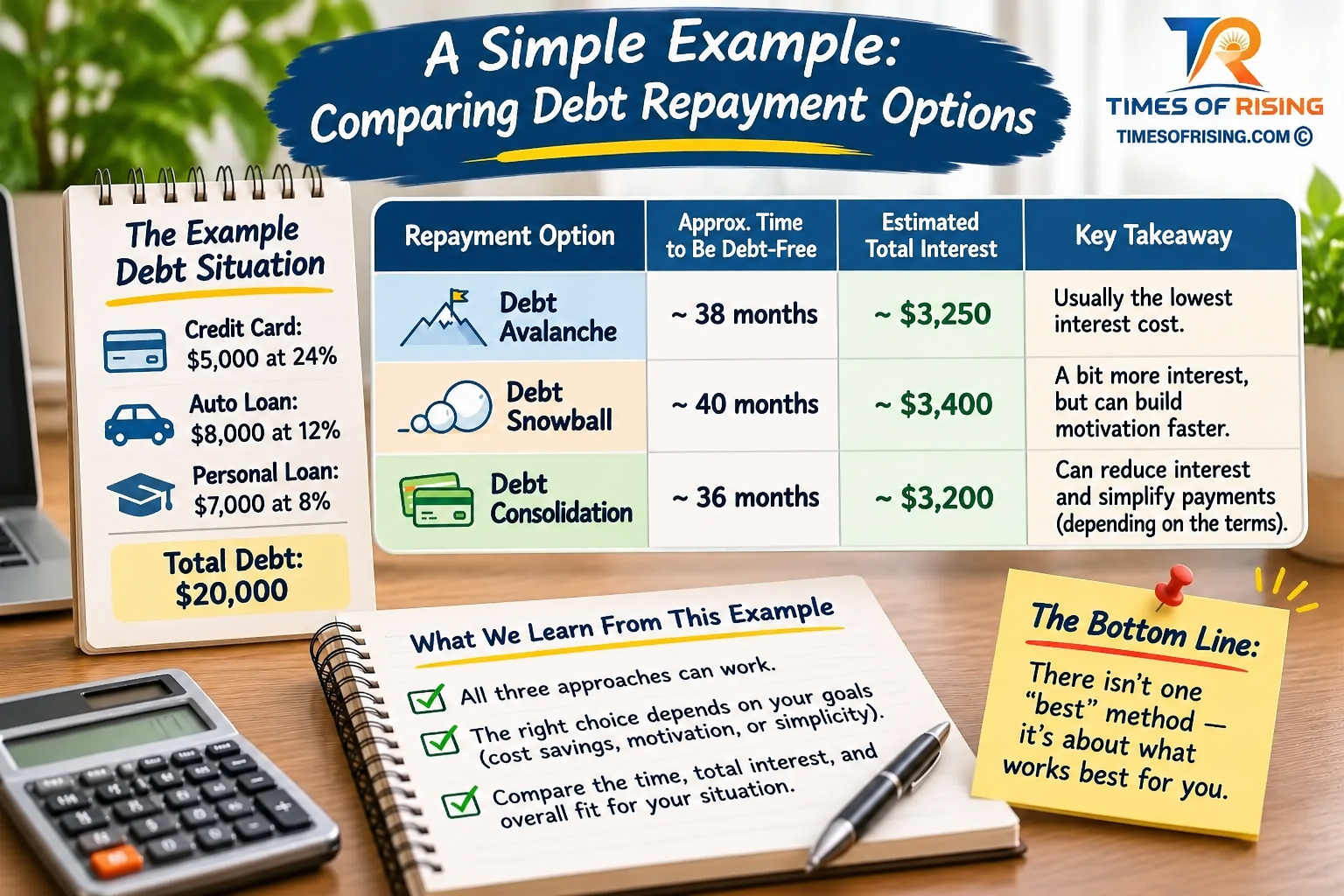
How to Compare Debt Repayment Options Using a Simple Example
Understanding definitions is useful, but seeing how different approaches affect the same debt situation makes the comparison much clearer.
Let’s use a hypothetical borrower named Alex.
Alex has three outstanding debts:
| Debt | Balance | Annual Interest |
|---|---|---|
| Credit card | $3,000 | 24% |
| Personal loan | $2,000 | 14% |
| Small loan | $800 | 9% |
| Total | $5,800 |
Suppose Alex can make all required minimum payments and has an additional $150 each month available for debt repayment.
Alex wants to compare the snowball and avalanche methods.
Option A: Follow the Avalanche Order
The repayment order is:
- Credit card: $3,000 at 24%.
- Personal loan: $2,000 at 14%.
- Small loan: $800 at 9%.
The extra $150 goes toward the credit card.
This approach targets the most expensive borrowing first.
Once the credit card is cleared, the extra money and its former required payment can be directed toward the personal loan.
Option B: Follow the Snowball Order
The repayment order becomes:
- Small loan: $800 at 9%.
- Personal loan: $2,000 at 14%.
- Credit card: $3,000 at 24%.
The additional $150 goes toward the smallest balance.
This approach aims to eliminate one account relatively early.
After the small loan is repaid, the available payment amount moves toward the personal loan.
What Is the Difference?
The avalanche method prioritizes reducing interest expenses.
The snowball method prioritizes eliminating smaller balances.
Alex cannot determine the exact difference in total interest or repayment time from the balances and rates alone.
To calculate those figures accurately, Alex would also need:
- Minimum payments for each account.
- Interest calculation methods.
- Payment dates.
- Any applicable fees.
- Whether interest rates can change.
- Rules governing additional payments.
This is an important lesson: a repayment strategy should not be selected using interest rates or outstanding balances in isolation.
The most useful comparison evaluates the entire repayment schedule, not just the first debt on the list.
Other Factors to Consider Before Choosing a Repayment Strategy
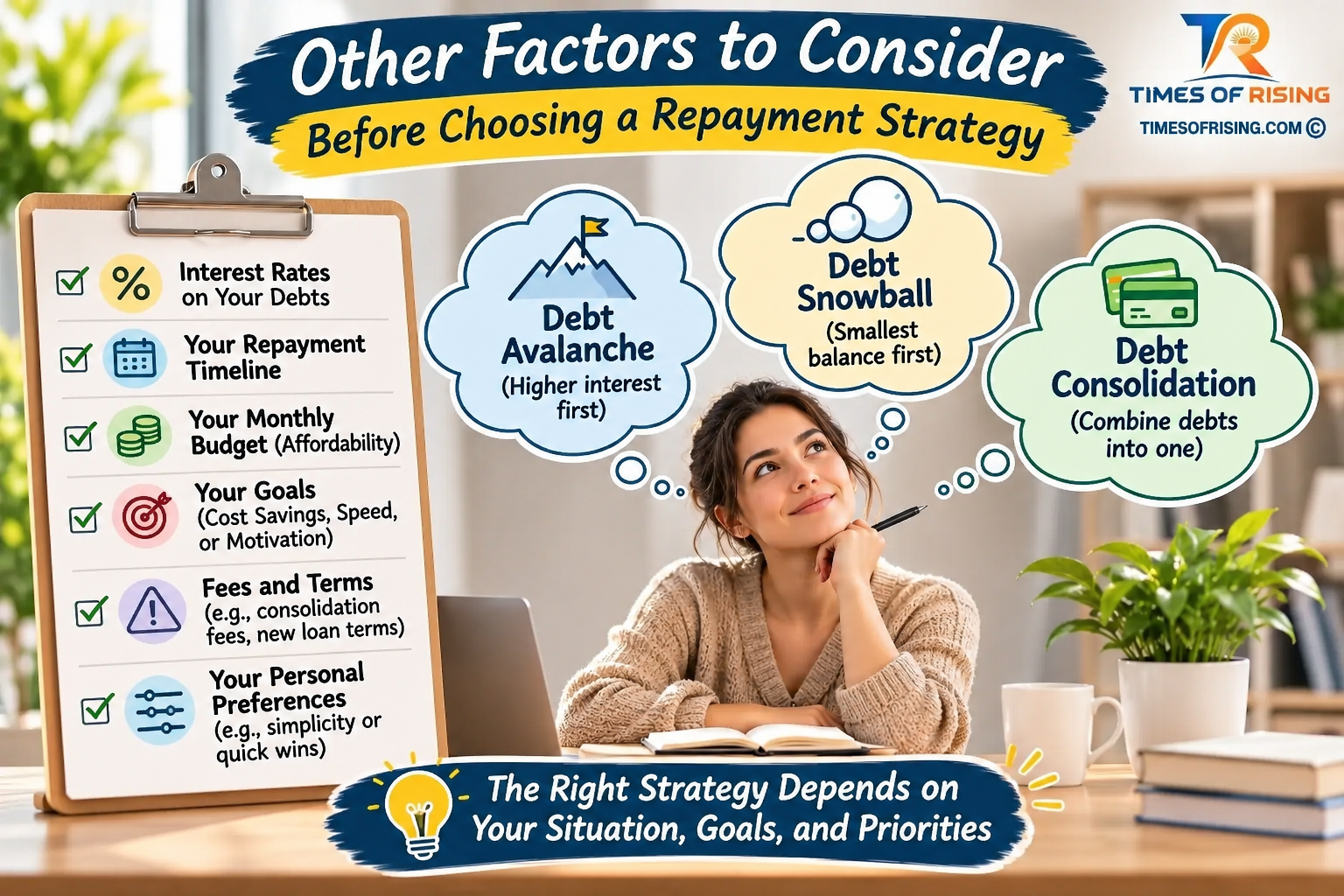
The avalanche and snowball methods are useful starting points, but your financial circumstances should influence the final decision.
A repayment strategy that looks excellent on paper may become difficult to maintain if it leaves too little money for essential expenses.
1. Your Monthly Cash Flow
Cash flow refers to the money coming into and going out of your household.
Before deciding how much extra money to put toward debt, calculate:
- Monthly take-home income.
- Housing and utility expenses.
- Food and transportation costs.
- Insurance and healthcare expenses.
- Required loan payments.
- Other essential financial obligations.
The amount remaining after these expenses determines how much additional repayment may be affordable.
Avoid committing every available dollar to debt repayment.
An unexpected expense could otherwise force you to borrow again, potentially undoing your progress.
2. Your Emergency Savings
Debt repayment and emergency savings should be considered together.
Although paying off high-interest debt is important, having no accessible savings can create another problem.
For example, an unexpected car repair or medical expense may force someone to use a credit card again.
A reasonable emergency savings buffer can reduce the likelihood of returning to borrowing whenever an unexpected expense occurs.
The appropriate amount depends on income stability, essential expenses, household responsibilities, and other circumstances.
There is no universal savings target that works for everyone.
3. Whether You Have Overdue Payments
If one or more accounts are already overdue, address that situation before following an ordinary snowball or avalanche sequence.
Late payments may result in additional charges, increased borrowing costs, collection activity, or negative credit-report information, depending on applicable reporting rules.
Contact the lender to understand available options if you cannot meet a required payment.
Do not assume that making an additional payment toward another account is more important than resolving an overdue obligation.
4. Early Repayment Charges
Some borrowing arrangements include conditions governing early repayment.
Before making a large additional payment, check whether the lender charges:
- Prepayment penalties.
- Early-closure fees.
- Administrative charges.
- Other repayment-related costs.
These charges can affect the actual financial benefit of paying a loan early.
Always compare the total cost rather than focusing on the interest rate alone.
5. Fixed and Variable Interest Rates
A fixed interest rate generally remains unchanged during the agreed period.
A variable interest rate can change according to the loan agreement and applicable benchmark or market conditions.
This distinction matters because a loan that appears inexpensive today may become more expensive later.
Review variable-rate debts regularly and update your repayment priorities when rates change.
6. Your Personal Motivation
Financial calculations are important, but the ability to follow a repayment plan matters too.
Imagine two borrowers:
- One prefers to save as much interest as possible and feels comfortable waiting longer for the first account closure.
- Another feels discouraged when several accounts remain open and finds it easier to continue after clearing a small balance.
The first person may naturally prefer the avalanche method.
The second may find the snowball method more manageable.
A repayment strategy only produces its intended benefits when you can follow it consistently.
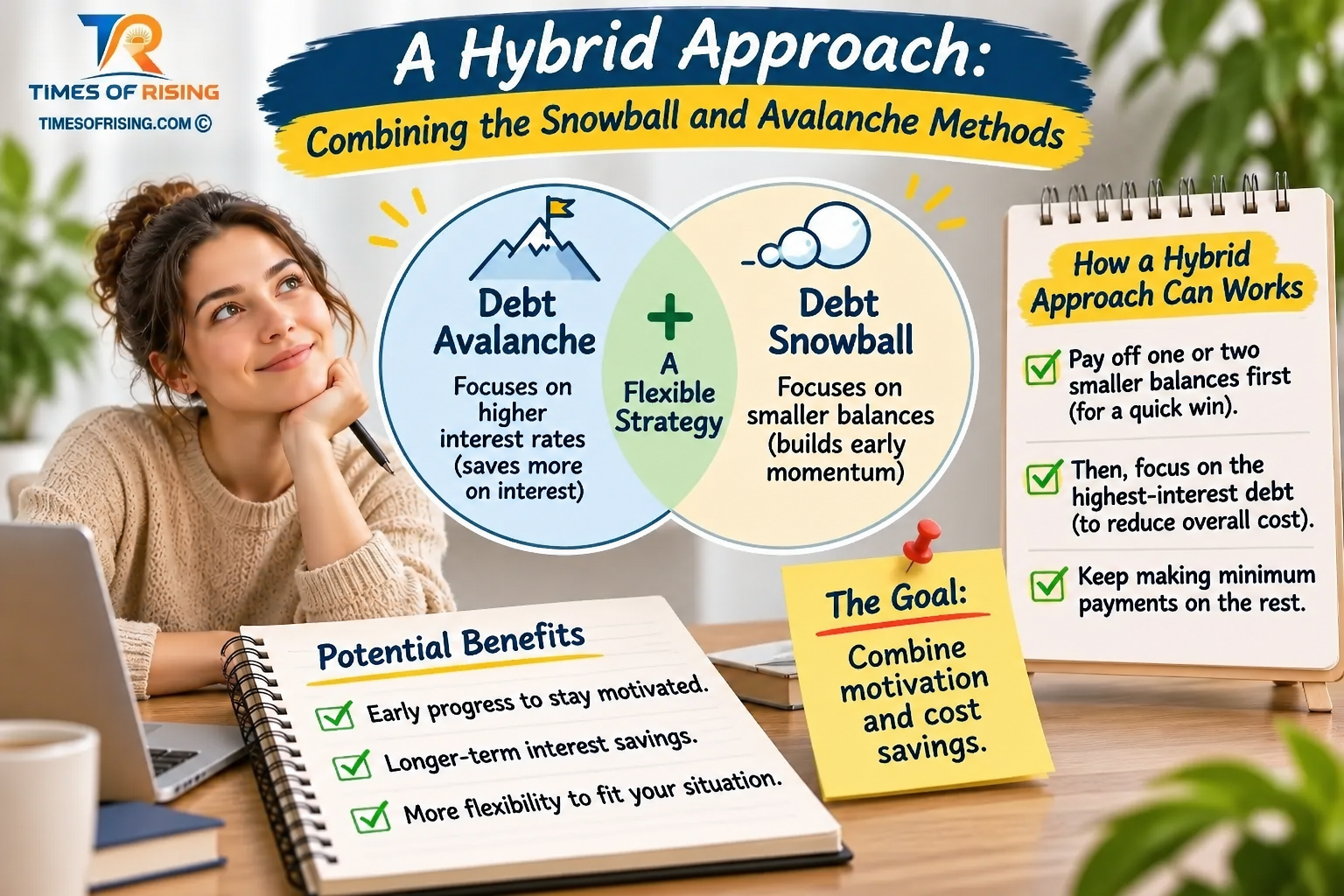
Can You Combine the Snowball and Avalanche Methods?
Yes. A hybrid approach can be a practical alternative for borrowers who want both early progress and lower interest costs.
Instead of following one method strictly, you can adjust the repayment order based on your circumstances.
For example, imagine you have:
- A $500 balance at 10%.
- A $1,500 balance at 14%.
- A $4,000 balance at 25%.
The credit card has the highest interest rate, so the avalanche method would normally prioritize it.
However, if the $500 balance can be cleared quickly without disrupting your essential expenses, you might decide to eliminate that small debt first.
Afterward, you could switch to the avalanche order.
This approach provides an early account closure while still directing subsequent extra payments toward the more expensive borrowing.
However, remember that the hybrid approach may cost more interest than following the avalanche method from the beginning.
The additional cost should be considered rather than assumed to be insignificant.
A hybrid strategy works best when the early win genuinely helps you maintain the repayment plan.
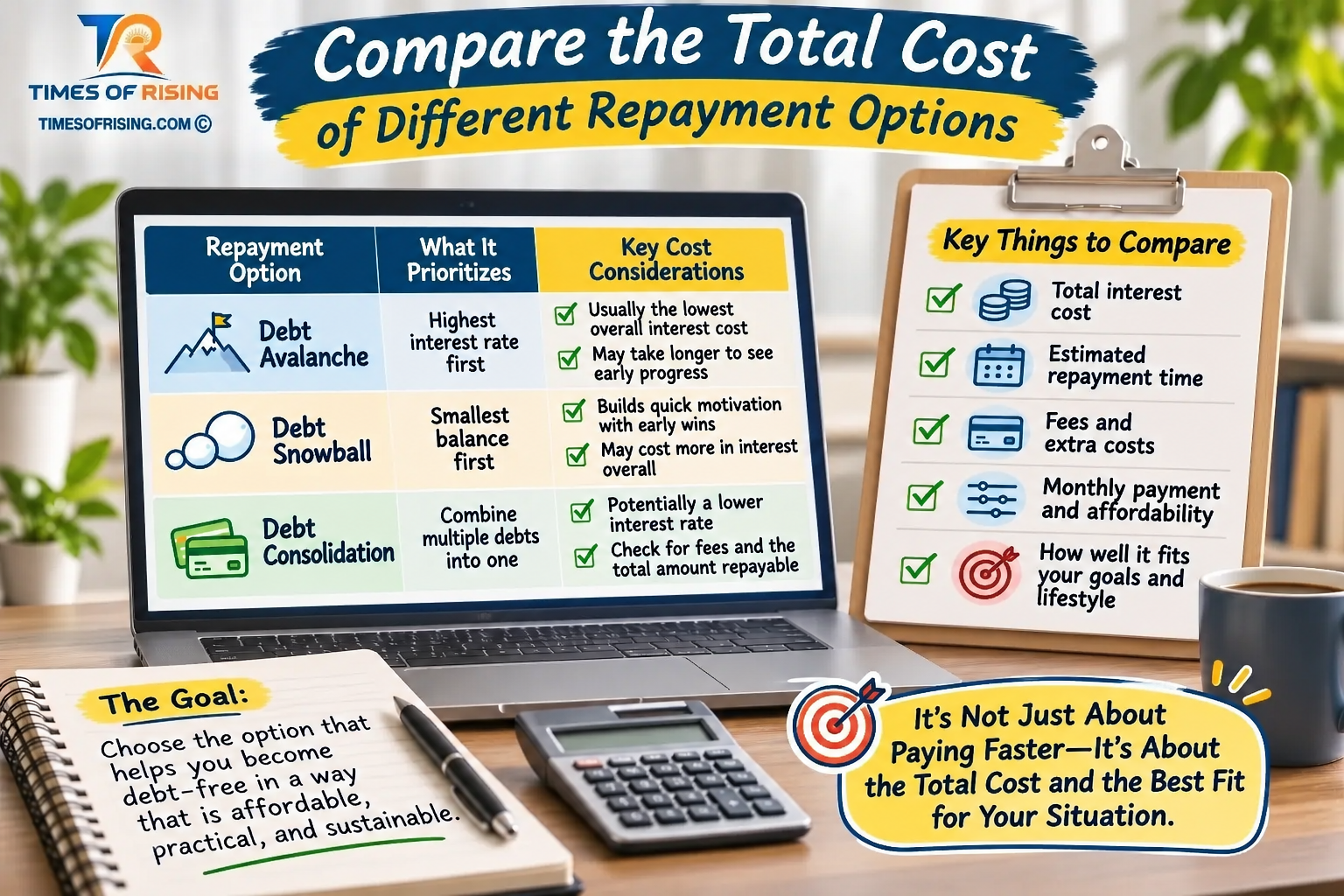
How to Compare the Total Cost of Different Repayment Options
One of the most common mistakes beginners make is comparing repayment methods based only on monthly payments.
A smaller monthly payment does not necessarily mean a cheaper repayment arrangement.
To compare options properly, focus on three main measurements.
1. Total Interest Paid
This is the total amount charged for borrowing money over the repayment period.
A repayment method that reduces interest charges can leave more money available for other financial priorities.
When comparing two strategies, estimate how much interest each one generates before the debts are fully repaid.
2. Total Repayment Amount
The total repayment amount includes the original principal, interest, and applicable charges.
For a meaningful comparison, include relevant fees rather than looking only at the advertised interest rate.
For consolidation, this measurement is particularly important.
A new loan may have a lower monthly payment but still cost more overall if it extends repayment considerably.
3. Time Required to Become Debt-Free
Your expected debt-free date is another useful measurement.
A strategy that saves interest but requires a longer period to eliminate the first account may feel less rewarding.
Meanwhile, a strategy that clears small debts quickly may not minimize total borrowing costs.
Compare the overall repayment timeline alongside the total interest and fees.
A Simple Comparison Worksheet
You can organize the information in a spreadsheet like this:
| Measurement | Snowball | Avalanche |
|---|---|---|
| First debt targeted | Smallest balance | Highest rate |
| Estimated first closure | Calculate | Calculate |
| Estimated debt-free date | Calculate | Calculate |
| Estimated total interest | Calculate | Calculate |
| Total fees | Calculate | Calculate |
| Monthly repayment budget | Same budget | Same budget |
The comparison becomes more useful when both methods use the same monthly repayment budget and the same assumptions.
That way, you are comparing the repayment order rather than accidentally comparing two different budgets.
A Step-by-Step Process for Choosing the Right Debt Repayment Option
You do not need to make the entire decision in one sitting.
The following process breaks the task into manageable steps.
Step 1: Calculate Your Total Outstanding Debt
Add together all your outstanding balances.
This gives you a starting figure and helps you understand the overall amount that needs to be repaid.
Keep this number separate from the total amount originally borrowed.
Your outstanding balance is what matters when planning future payments.
Step 2: Calculate Your Required Monthly Payments
Add together the minimum payments or required installments for every account.
Check whether these obligations fit comfortably within your monthly budget.
If they do not, contact your lenders promptly to discuss possible hardship arrangements rather than assuming a different repayment order will solve the problem.
Step 3: Identify Your Available Extra Payment Amount
After accounting for essential expenses and required debt payments, estimate how much additional money you can consistently allocate toward repayment.
For example:
| Monthly Budget Item | Amount |
|---|---|
| Take-home income | $3,500 |
| Essential expenses | $2,100 |
| Required debt payments | $700 |
| Other planned expenses | $400 |
| Potential extra repayment | $300 |
This is an illustrative budget, not a recommended allocation for every household.
The important point is to use a realistic amount.
A smaller payment that can be maintained regularly is often more useful than an ambitious payment that becomes impossible after a few months.
Step 4: Rank Your Debts Using Both Methods
Create two repayment lists.
For the snowball method, arrange debts from the smallest outstanding balance to the largest.
For the avalanche method, arrange debts from the highest interest rate to the lowest.
Compare the two lists.
If both methods identify the same first debt, the decision becomes easier.
If they produce different repayment orders, consider the difference in interest costs and the time needed to clear each account.
Step 5: Check the Terms of Every Debt
Review loan agreements and account statements.
Pay particular attention to prepayment charges, promotional rates, variable interest rates, and payment allocation rules.
If anything is unclear, contact the lender.
Do not assume that all additional payments automatically reduce the principal in the way you expect.
Step 6: Choose a Strategy You Can Maintain
After reviewing the numbers, choose an approach that fits your financial priorities and habits.
You might prefer:
- Avalanche for minimizing interest costs.
- Snowball for early progress.
- A hybrid for balancing motivation and cost.
- Consolidation if a genuinely beneficial offer is available.
The best option is not necessarily the one that looks most impressive in a spreadsheet.
It is the one that can realistically be maintained.
Step 7: Review Your Progress Regularly
Your financial circumstances may change.
You might receive a salary increase, experience an unexpected expense, or see a variable interest rate change.
Review your repayment plan periodically.
Update outstanding balances, check payment records, and adjust your extra payment allocation when necessary.
A repayment strategy should be flexible enough to accommodate real financial life.
Common Mistakes to Avoid When Comparing Debt Repayment Options
Even a well-designed repayment strategy can become less effective when important details are overlooked.
Mistake 1: Choosing Based Only on Monthly Payments
A lower monthly payment can make a loan appear more affordable.
However, a longer repayment period may increase the total amount of interest paid.
Always compare the total repayment cost and the time required to clear the debt.
Mistake 2: Ignoring Interest Rates
Some borrowers prioritize whichever debt has the largest balance.
Others concentrate entirely on the smallest balance.
Neither approach considers the complete cost of borrowing.
Interest rates should always be included in your comparison.
Mistake 3: Missing Minimum Payments
Directing extra money toward one account does not remove the responsibility to make required payments on other accounts.
Missing those payments may lead to additional charges and other consequences.
Maintain required payments before concentrating extra money on your chosen target.
Mistake 4: Using All Available Savings for Repayment
Paying down debt is important, but leaving yourself without accessible funds can create financial vulnerability.
Unexpected expenses can lead to additional borrowing.
Maintain an appropriate cash reserve based on your circumstances.
Mistake 5: Ignoring Consolidation Fees
A consolidation offer may advertise a lower interest rate without making all associated costs obvious.
Review the complete agreement, including fees, repayment duration, and any introductory-rate conditions.
Mistake 6: Continuing to Accumulate New Debt
A repayment plan becomes difficult to maintain when new borrowing continues to replace the balances being cleared.
Where possible, avoid unnecessary borrowing while following your repayment strategy.
For credit cards, review spending patterns and make sure new purchases do not undermine your progress.
Mistake 7: Giving Up After a Difficult Month
Financial circumstances are not always predictable.
An unexpected expense or temporary income reduction may require an adjustment to your repayment plan.
Rather than abandoning the entire strategy, review your budget and contact lenders if you anticipate payment difficulties.
Consistency matters, but a realistic plan should also allow for changing circumstances.
What If You Cannot Afford More Than the Minimum Payments?
Not everyone has extra money available for accelerated debt repayment.
If your income is already committed to essential expenses and required payments, forcing additional repayments may create more financial problems.
In this situation, focus on stabilizing your finances first.
Consider these steps:
- Review your essential expenses and identify realistic opportunities to reduce costs.
- Check whether your lender offers hardship assistance or temporary payment arrangements.
- Contact creditors before missing payments whenever possible.
- Review whether any available nonprofit credit counseling services can help you understand your options.
- Avoid taking on expensive new borrowing to cover existing payments without understanding the consequences.
If you are struggling with several overdue accounts, professional financial or legal guidance may be appropriate.
A debt repayment method is not a substitute for help with an unmanageable debt situation.
How to Track Your Debt Repayment Progress
Tracking progress helps you understand whether your repayment strategy is working as expected.
You do not need a complicated application.
A basic spreadsheet can record the information you need.
Consider including these columns:
| Information | What to Record |
|---|---|
| Lender | Name of the lender |
| Debt type | Credit card, personal loan, etc. |
| Starting balance | Balance when tracking begins |
| Current balance | Most recent outstanding amount |
| Interest rate | Applicable annual rate |
| Minimum payment | Required monthly payment |
| Extra payment | Additional amount allocated |
| Due date | Required payment date |
| Status | Current, overdue, or paid off |
Update the spreadsheet when you receive new statements or make significant payments.
It is also helpful to track your total outstanding debt separately.
For example, an illustrative six-month tracking record might look like this:
| Period | Outstanding Debt |
|---|---|
| Starting balance | $5,800 |
| Month 1 | $5,500 |
| Month 2 | $5,200 |
| Month 3 | $4,850 |
| Month 4 | $4,500 |
| Month 5 | $4,150 |
| Month 6 | $3,800 |
These figures are purely illustrative, not a repayment forecast.
Your actual progress will depend on payments, interest calculations, fees, and any changes in borrowing.
A tracking system is useful because it turns repayment from an unclear long-term responsibility into a series of measurable steps.
When Should You Consider Professional Debt Advice?
Sometimes, comparing repayment methods is not enough.
If you are experiencing persistent financial difficulties, professional assistance may help you understand options that are not available through ordinary repayment strategies.
Consider seeking guidance when:
- Your monthly debt obligations exceed your available income.
- You are regularly missing required payments.
- Collection agencies are contacting you.
- You are considering debt settlement or bankruptcy.
- You are unsure whether refinancing or consolidation is appropriate.
- You have received a repayment offer that you do not fully understand.
In the United States, nonprofit credit counseling organizations can help consumers review their budgets and understand available debt-management options.
Before working with any debt-relief company, understand its fees, services, risks, and promises.
Be particularly cautious about companies that guarantee to eliminate debt or encourage you to stop communicating with creditors without explaining the consequences.
Professional guidance should help you make informed decisions, not pressure you into another financial commitment.
Final Thoughts: Choose a Repayment Strategy That Works in Real Life
Comparing debt repayment options becomes easier when you understand what each method is designed to accomplish.
The debt avalanche method focuses on reducing interest costs by targeting the highest-interest debt first.
The debt snowball method focuses on clearing smaller balances to create visible progress and encourage consistency.
Debt consolidation may simplify repayment or reduce borrowing costs, but only when its complete terms make financial sense.
There is no universal strategy that suits every borrower.
Your decision should account for outstanding balances, interest rates, minimum payments, repayment conditions, available income, and personal motivation.
Start by organizing your debts. Compare the repayment orders. Calculate the potential costs and review your budget before committing to a particular approach.
Most importantly, do not confuse a complicated repayment plan with an effective one.
A straightforward strategy that you understand and can maintain is often more useful than an elaborate plan that becomes difficult to follow.
Financial progress is not about making every decision perfectly. It is about understanding your options, making informed choices, and consistently working toward a more manageable financial situation.
Frequently Asked Questions
1. What is the best debt repayment method for beginners?
The debt avalanche and debt snowball methods are two common starting points.
The avalanche method prioritizes the highest-interest debt and generally minimizes interest costs when repayment conditions are comparable.
The snowball method prioritizes the smallest balance and may help people stay motivated by providing early progress.
The better choice depends on your financial priorities and ability to maintain the plan.
2. Is the debt avalanche method better than the debt snowball method?
From a mathematical perspective, the avalanche method generally costs less in interest when extra payments are directed toward the highest-rate debt.
However, the snowball method may be more manageable for someone who needs early account closures to remain motivated.
The most suitable approach depends on whether minimizing borrowing costs or maintaining repayment consistency is the bigger priority.
3. Should I pay off my smallest debt first?
Paying the smallest debt first is the foundation of the debt snowball method.
It can help reduce the number of outstanding accounts and provide a sense of accomplishment.
However, if another debt has a considerably higher interest rate, postponing it may increase borrowing costs.
Compare both repayment orders before deciding.
4. Should I pay off high-interest debt first?
Generally, prioritizing high-interest debt can reduce the amount of interest you pay over time.
This is the principle behind the debt avalanche method.
However, you should continue making required payments on all other accounts and consider any repayment fees or special loan conditions.
5. Can I use both the debt snowball and avalanche methods?
Yes.
A hybrid approach allows you to clear a small balance first and then switch to the highest-interest-first repayment order.
This can provide an early achievement while keeping subsequent repayment focused on reducing expensive debt.
The trade-off is that the initial snowball payment may result in slightly higher interest costs than following the avalanche method from the beginning.
6. Does debt consolidation reduce the total amount I owe?
Not necessarily.
Debt consolidation combines existing debts into a new borrowing arrangement, but it does not automatically eliminate the principal you owe.
It may reduce interest costs or simplify payments if the new terms are favorable.
However, fees and longer repayment periods can increase the total cost.
7. Should I save money or pay off debt first?
This depends on your circumstances.
Paying down expensive debt can reduce interest costs, but having no emergency savings may leave you vulnerable to unexpected expenses.
Many households benefit from maintaining an appropriate cash buffer while continuing required debt payments.
The balance between savings and additional repayments depends on income stability, expenses, debt costs, and financial responsibilities.
8. Does paying off debt early improve your credit score?
It can influence your credit profile, but the effect is not always immediate or identical for every person.
For example, reducing credit card balances may improve credit utilization, which is one factor considered in many credit-scoring systems.
However, closing an account can have different effects depending on your credit history and the scoring model.
Paying debt responsibly is generally more important than making decisions solely to pursue a particular score.
9. How often should I review my debt repayment plan?
Review your plan at least monthly when checking your statements and payments.
You should also reassess it when your income, expenses, interest rates, or repayment terms change significantly.
Regular reviews help ensure that your strategy remains practical.
10. What should I do if I cannot afford my debt payments?
Contact your lenders as early as possible.
Ask whether hardship arrangements, modified payment schedules, or other assistance options are available.
You may also consider speaking with a reputable nonprofit credit counseling organization.
Avoid ignoring payment difficulties or taking on additional expensive borrowing without understanding the consequences.
References and Further Reading
The following resources provide additional consumer education about debt repayment and financial management:
- Consumer Financial Protection Bureau (CFPB): Reducing Debt Worksheet — a practical worksheet for organizing debts and comparing repayment approaches.
- Consumer Financial Protection Bureau: Your Money, Your Goals Toolkit — resources covering budgeting, financial goals, and debt management.
- Consumer Financial Protection Bureau: Debt Collection Resources — information about consumer rights and debt collection.
Editorial disclaimer: This article provides general educational information, not individualized financial, legal, or tax advice. Examples are illustrative and should not be interpreted as guaranteed repayment outcomes.

Sofia Young
Sofia Young writes about personal finance, helping readers understand budgeting, saving, credit management, debt reduction and everyday financial decisions. Her articles focus on practical explanations, realistic examples and responsible money management. She aims to make complex financial concepts easier to understand while distinguishing general educational information from individualized financial advice.
Join the conversation
Share a thoughtful response, ask a question, or add something useful for other readers.
Be the first to add a helpful perspective.