

What Diversification Can and Cannot Do for an Investment Portfolio
Diversification is one of the most frequently recommended principles in investing. Financial educators, investment professionals and market commentators often encourage investors to spread their money across different assets rather than concentrate everything in a single company, industry or investment category.
The underlying idea is straightforward: when one investment performs poorly, other investments may perform differently, potentially reducing the damage to the overall portfolio.
However, the principle is sometimes misunderstood. Investors may assume that owning more stocks, purchasing several mutual funds or adding different asset classes automatically makes their portfolios safer. Others believe that a sufficiently diversified portfolio can withstand almost any market downturn without significant losses.
Neither assumption is entirely correct.
Diversification can help manage certain investment risks, particularly those associated with individual companies, industries and concentrated exposures. It can also influence the overall volatility of a portfolio. However, it cannot eliminate market-wide uncertainty, guarantee positive returns or compensate for an unsuitable investment strategy.
Understanding these distinctions is important because diversification is not simply about owning a large number of investments. It is about understanding how different investments behave, identifying where their risks overlap and determining whether their combined characteristics support the portfolio’s objectives.
A portfolio containing twenty investments may be less diversified than one containing only a few carefully selected, broadly diversified funds. Similarly, adding an investment that appears different on the surface may contribute little protection if its performance depends on the same underlying economic factors as the rest of the portfolio.
This article examines what diversification can realistically accomplish, where its limitations begin and how investors can evaluate whether their portfolios are genuinely diversified.
1. What Does Diversification Actually Mean?
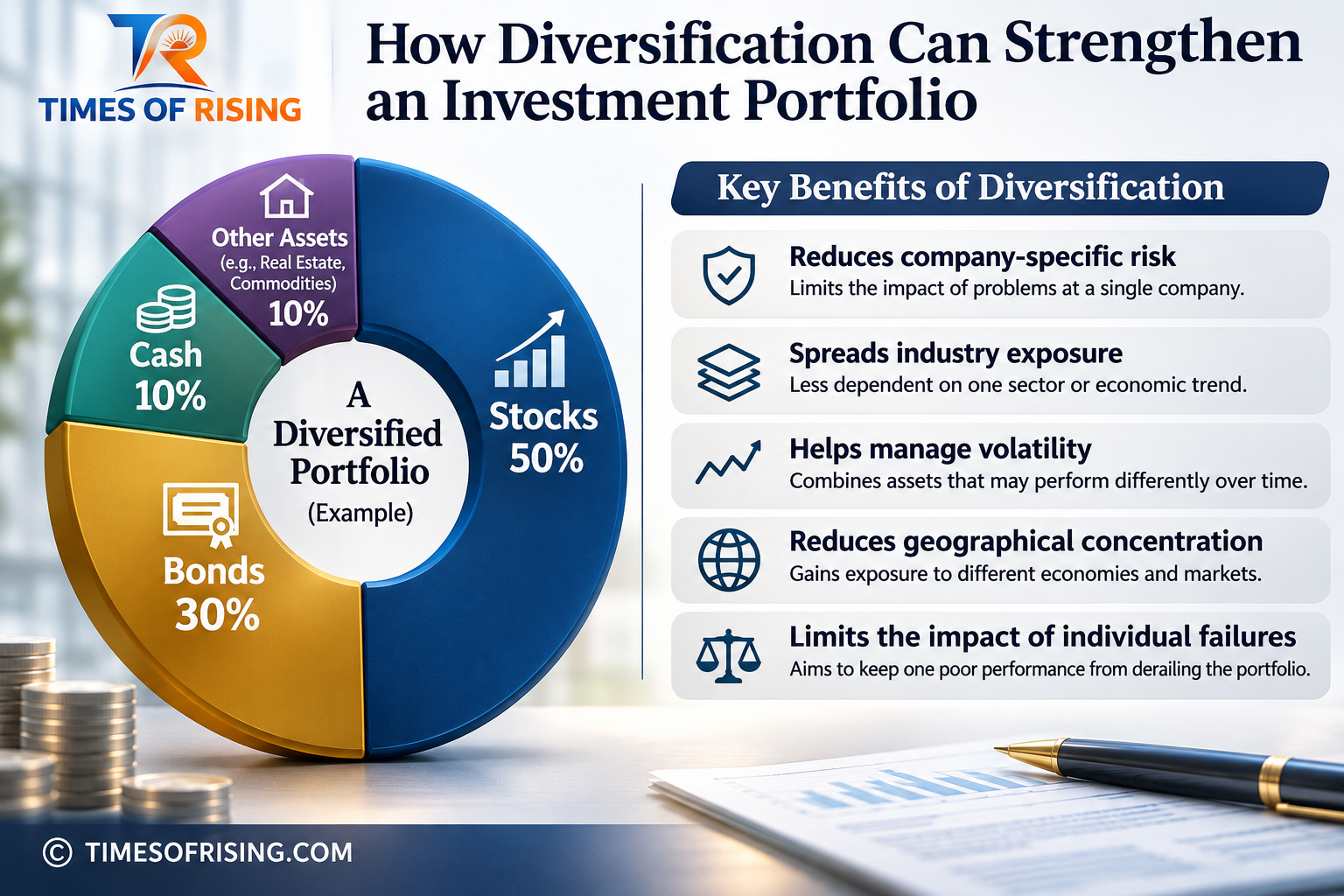
Portfolio diversification is the practice of distributing investments across different securities, asset classes, industries, geographical regions and other investment categories to reduce excessive dependence on any single source of risk.
The familiar expression about not putting all your eggs in one basket provides a useful starting point. If all investments depend on one company or industry, an adverse development affecting that company or industry could have a substantial impact on the entire portfolio.
Spreading investments across different exposures reduces this dependence.
For example, consider an investor whose entire equity portfolio consists of shares in technology companies. Even if the portfolio contains ten different technology businesses, it remains exposed to many of the same economic and industry-specific influences.
Changes in technology spending, industry regulation, competition, borrowing costs or investor expectations could affect several holdings simultaneously.
Now consider a portfolio containing investments across technology, healthcare, consumer goods, financial services and industrial businesses.
These industries do not necessarily respond identically to every economic development. Weakness in one sector may coincide with relatively stronger performance in another.
The second portfolio has a broader distribution of business-related risks.
Diversification can also extend beyond stocks. Investors may hold combinations of equities, bonds, cash equivalents and other asset categories, depending on their objectives and circumstances.
The purpose is not to ensure that every investment performs well at all times. Instead, it is to reduce the likelihood that a single investment, industry or market segment determines the entire portfolio’s outcome.
Diversification and asset allocation are related but different
These two concepts are often used together, but they describe different decisions.
Asset allocation determines how an investment portfolio is distributed among broad categories such as:
- Stocks and equity funds.
- Government and corporate bonds.
- Cash and cash equivalents.
- Real estate-related investments.
- Other eligible investment categories.
Diversification concerns how investments are distributed within and across those categories.
For example, an investor might allocate 70% of a portfolio to stocks and 30% to bonds. That describes the asset allocation.
However, if the entire stock allocation consists of one company’s shares and the bond allocation consists of one corporate bond, the portfolio still has substantial concentration risk.
A portfolio can therefore have multiple asset classes without being adequately diversified.
The distinction matters because choosing an asset allocation does not automatically solve every concentration problem. Investors must also examine what each category contains and how those holdings interact.
The SEC’s Investor.gov explains that asset allocation depends on an investor’s financial goals, time horizon and risk tolerance, while diversification involves spreading investments to manage risk within the portfolio.
2. What Diversification Can Do for an Investment Portfolio
Diversification offers several potential benefits. Its effectiveness depends on the investments involved, their underlying risks and the market environment.
A. Reduce company-specific risk
One of diversification’s most important functions is reducing exposure to individual-company problems.
Every business faces risks that may be specific to its operations.
These can include:
- Management failures.
- Product recalls.
- Legal disputes.
- Operational disruptions.
- Financial difficulties.
- Loss of important customers.
- Increased competition.
- Changes in business strategy.
Such events can significantly affect a company’s financial position and market valuation.
An investor holding shares in only one company is directly exposed to the consequences of those developments.
An investor holding shares in many unrelated companies spreads that exposure.
For example, imagine a hypothetical portfolio containing $10,000 invested entirely in one company. If that company’s shares decline by 40%, the portfolio falls by $4,000.
Now imagine a portfolio containing ten equally weighted companies, with the same initial total value. If one company declines by 40% while the other nine remain unchanged, the overall portfolio declines by approximately 4%.
The second portfolio is not guaranteed to avoid losses. Several companies may decline together. Nevertheless, the impact of one company’s difficulties is substantially reduced.
This is the basic mathematical advantage of spreading company-specific exposure.
B. Reduce dependence on a single industry
Industry concentration creates another source of portfolio risk.
Businesses operating in the same industry may depend on similar customers, suppliers, regulations, technologies and economic conditions.
Consequently, a problem affecting one industry can influence many companies simultaneously.
Consider an investor holding shares in several airline companies. Although these are separate businesses, they may all be affected by:
- Higher fuel prices.
- Changes in travel demand.
- Economic slowdowns.
- Aircraft supply disruptions.
- Regulatory developments.
- Increased operating costs.
Owning several airline stocks does not eliminate exposure to these common industry risks.
Adding investments in unrelated industries may reduce this concentration.
Healthcare, consumer staples, financial services, industrial businesses and technology companies can have different revenue structures and economic sensitivities.
Their performance is not guaranteed to differ, but the portfolio becomes less dependent on one industry’s circumstances.
The important point is that diversification should consider economic exposure rather than simply the number of company names appearing in an investment account.
C. Help manage portfolio volatility
Volatility describes the extent to which an investment’s value fluctuates over time.
Some investments experience relatively large price movements, while others generally have smaller fluctuations.
Combining investments with different return patterns may reduce the overall volatility of a portfolio.
For example, stocks and high-quality bonds have historically displayed different performance characteristics in various market environments. There have been periods when bonds provided some support as equity markets weakened.
However, this relationship is not permanent.
Changes in inflation expectations, interest rates, credit conditions and investor sentiment can cause different asset classes to move in the same direction.
The benefit comes from the relationship between investments, not simply from holding multiple categories.
A portfolio’s volatility depends on several factors:
- The volatility of its individual holdings.
- The proportion allocated to each holding.
- The degree to which investments move together.
- Changes in those relationships over time.
Diversification may therefore reduce the intensity of portfolio fluctuations without eliminating them.
D. Reduce dependence on one geographical market
Investing across geographical regions can reduce dependence on a single country’s economic and financial conditions.
Domestic companies may be exposed to similar national developments, including changes in interest rates, government policy, consumer spending and economic growth.
International investments provide exposure to businesses operating under different economic conditions.
For example, a portfolio containing domestic and international equities may have access to companies serving different consumer markets and operating under different regulatory systems.
This can help reduce country-specific concentration.
However, geographical diversification introduces additional considerations.
International investments may involve:
- Currency fluctuations.
- Political uncertainty.
- Different accounting standards.
- Foreign investment regulations.
- Differences in market liquidity.
- Tax and reporting complexities.
A decline in the domestic currency may increase the value of foreign investments when measured in domestic currency. Conversely, currency movements can reduce foreign investment returns.
Geographical diversification therefore changes the sources of risk rather than removing them.
E. Reduce reliance on a particular investment style
Investment styles also influence portfolio behaviour.
For example, growth-oriented companies are generally evaluated partly on their potential to expand future earnings. Value-oriented investments are often associated with companies whose market prices appear relatively low compared with selected financial measures.
These approaches can perform differently depending on economic conditions, interest rates, earnings expectations and investor sentiment.
A portfolio concentrated entirely in one investment style may experience prolonged periods of underperformance when that style becomes less favoured.
Holding exposure to different investment styles can reduce dependence on one particular market preference.
However, style diversification should have a clear purpose. Adding multiple funds with slightly different names does not necessarily provide meaningful exposure to different investment characteristics.
F. Reduce the consequences of individual investment failures
Not every investment succeeds.
Companies can lose market share, industries can decline and businesses can become financially unsustainable.
Diversification acknowledges this uncertainty.
Rather than assuming that every selected investment will perform as expected, it distributes exposure so that the failure of one holding does not automatically determine the entire portfolio’s outcome.
This is particularly relevant when investors cannot reliably predict which individual companies will become long-term winners.
Broadly diversified investment funds can provide exposure to numerous securities through a single investment vehicle.
That structure may reduce dependence on individual security selection, although the fund itself remains exposed to the risks of its underlying holdings.
3. What Diversification Cannot Do
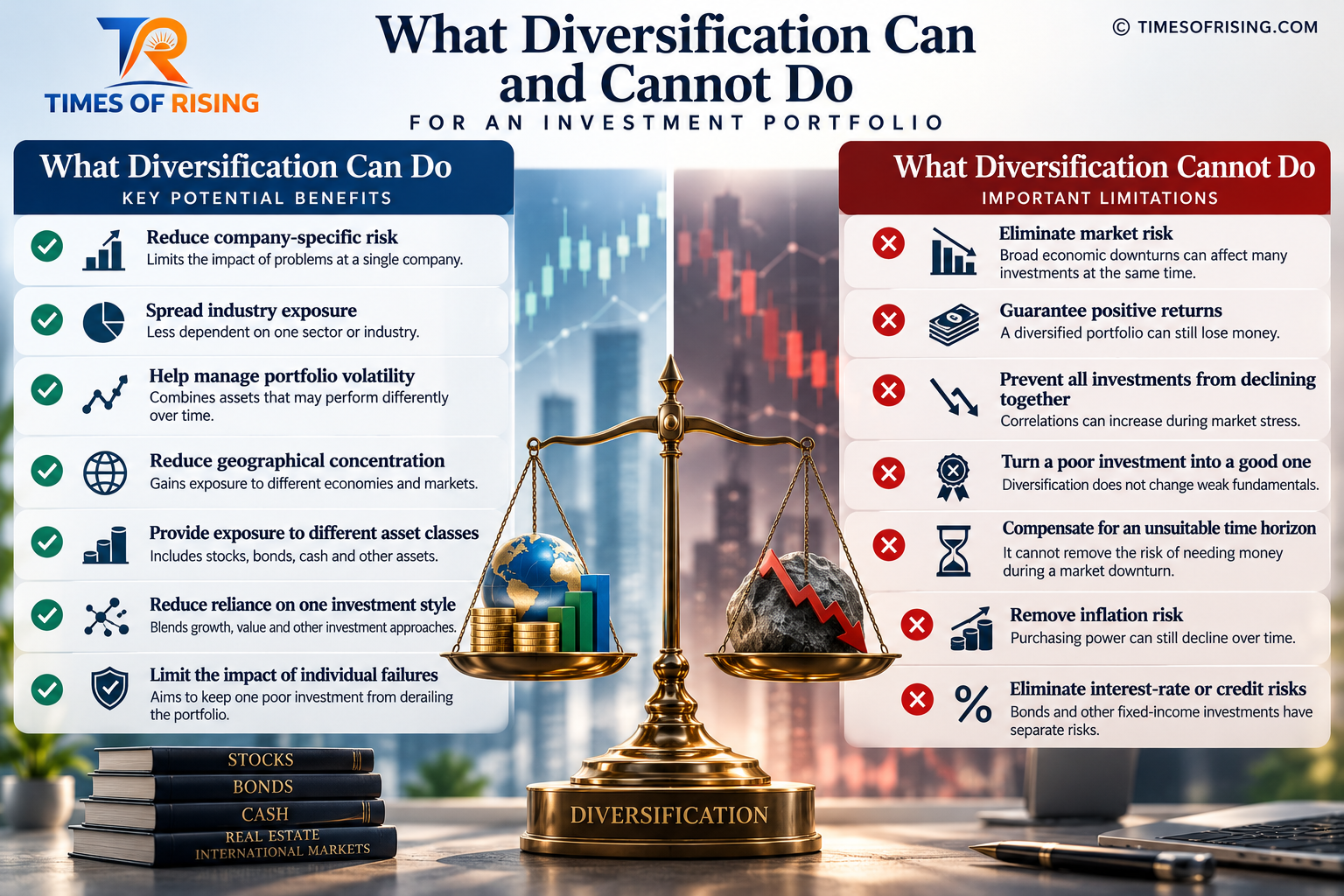
Understanding diversification’s limitations is just as important as understanding its benefits.
A diversified portfolio can still lose money. It can experience significant declines, unperformed relevant benchmarks and contain investments that fail to achieve their intended objectives.
Diversification is a risk-management approach, not a guarantee of investment success.
A. It cannot eliminate market risk
Market risk refers to the possibility that broad financial or economic developments will negatively affect many investments simultaneously.
Unlike company-specific risk, market risk cannot necessarily be reduced simply by holding more securities.
Examples include:
- Recessions.
- Unexpected inflation.
- Major interest-rate changes.
- Financial crises.
- Geopolitical instability.
- Broad declines in investor confidence.
- Systemic disruptions in financial markets.
During periods of widespread market stress, investors may sell different types of assets simultaneously.
Consequently, stocks from unrelated industries may decline together. International equities may also experience losses at the same time as domestic markets.
Diversification may still influence the extent of the decline, but it cannot guarantee that the portfolio will remain positive.
This is one of the most important distinctions investors should understand: diversification can reduce concentration risk, but broad economic risk remains.
B. It cannot guarantee positive returns
Owning many investments does not automatically make an investor profitable.
A diversified portfolio may contain securities that decline in value for different reasons.
For example, stocks may experience weak earnings growth, bonds may lose value when interest rates rise, and real estate investments may face higher financing costs.
If several categories perform poorly during the same period, the overall portfolio may decline.
Diversification does not create a guaranteed return.
It also does not guarantee that one successful investment will offset losses elsewhere.
The outcome depends on the size of each holding, the scale of its return and the relationship between the investments.
A portfolio can be well diversified and still deliver negative returns over a particular month, year or longer period.
C. It cannot prevent every investment from declining together
Investors sometimes assume that different asset categories always move independently.
That assumption is incorrect.
Relationships between investments change according to economic conditions and market behaviour.
For example, stocks and bonds may perform differently in some environments. However, when inflation rises unexpectedly and interest-rate expectations change rapidly, both categories may experience losses.
Similarly, international markets may decline alongside domestic markets during a global financial shock.
The existence of different investment categories does not mean their risks are completely independent.
The relevant question is not whether investments have different names or structures. It is whether their underlying return drivers are sufficiently different to provide meaningful diversification.
D. It cannot turn a poor investment into a good one
Diversification does not correct weak investment fundamentals.
A portfolio can hold dozens of companies with declining revenues, excessive debt, weak competitive positions or unsustainable business models.
Spreading money across poor-quality investments does not automatically produce a sound portfolio.
The same principle applies to investment funds.
A fund may contain hundreds of securities, but if its underlying investment approach is unsuitable or its holdings are excessively concentrated in a weak market segment, the number of securities alone does not make it an attractive investment.
Diversification and investment quality are separate considerations.
Investors should not use diversification as a substitute for understanding what they own.
E. It cannot compensate for an unsuitable investment time horizon
An investment portfolio should be evaluated in relation to the financial objective it is intended to support.
An investor saving for a goal in the near future has different requirements from someone investing for a goal several decades away.
Even a broadly diversified stock portfolio may be unsuitable for money that needs to be available within a short period.
This is because equity markets can experience substantial declines, and the time required for recovery is uncertain.
Diversification may reduce the impact of individual holdings, but it does not eliminate the possibility of a broad decline shortly before the money is needed.
The time horizon therefore remains a separate and essential consideration.
F. It cannot remove inflation risk
Inflation reduces the purchasing power of money over time.
A portfolio may show a positive nominal return while producing a much smaller real return after inflation.
For example, suppose an investment portfolio increases in value by 4% during a year while the relevant inflation rate is 3%.
The approximate real return before fees and taxes is only about 1%.
If inflation exceeds the portfolio’s return, purchasing power declines despite the positive nominal result.
Diversification does not automatically protect against this outcome.
Different assets respond differently to inflation. Some businesses may pass higher costs to customers, while others may experience reduced profit margins. Bonds with fixed payments may lose purchasing power when inflation rises.
Investors must therefore consider inflation alongside other portfolio risks.
G. It cannot eliminate interest-rate and credit risks
Different types of bonds have different risk characteristics.
Government bonds, investment-grade corporate bonds and lower-rated corporate bonds should not be treated as interchangeable.
Interest-rate movements can affect bond prices, particularly when investors hold longer-maturity securities.
Credit risk is another consideration. It refers to the possibility that a borrower may fail to make scheduled payments or repay principal as agreed.
A bond portfolio spread across several corporate issuers may still be exposed to a common deterioration in credit conditions.
Diversification can reduce exposure to an individual issuer, but it cannot eliminate interest-rate risk or broader credit-market stress.
4. Why Owning More Investments Does Not Always Mean Better Diversification
One of the most common misconceptions in portfolio management is that diversification improves automatically as the number of investments increases.
The reality is more complicated.
The value of an additional investment depends on what it contributes to the portfolio.
If it introduces a genuinely different source of return and risk, it may improve diversification.
If it closely resembles existing holdings, it may add little benefit.
Understanding overlapping investments
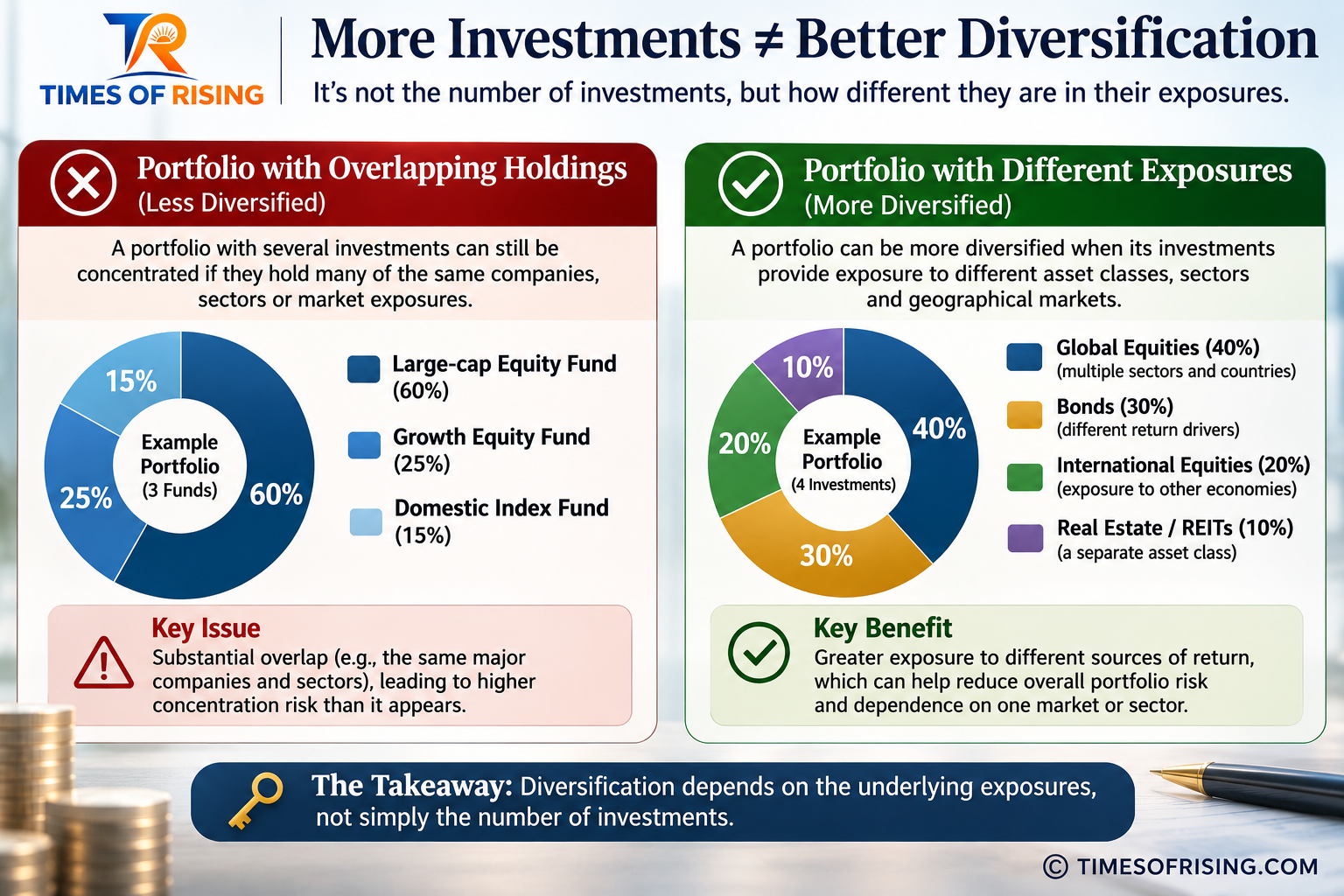
Consider an investor who owns three equity funds.
The first fund tracks a broad domestic stock market index.
The second focuses on large domestic companies.
The third invests in companies with a growth-oriented investment style.
Although the funds follow different strategies, they may own many of the same companies.
Their top holdings may overlap substantially.
The investor may believe that three separate funds provide three distinct sources of diversification. In reality, the portfolio could be heavily dependent on a relatively small group of large companies.
This is known as overlapping exposure.
It can create hidden concentration that is not immediately obvious from the number of investments.
Why fund names can be misleading
Investment fund names describe broad strategies, categories or objectives. They do not necessarily reveal every underlying exposure.
Two funds may have different labels but hold similar securities.
Similarly, funds tracking different indices may share substantial exposure to the same large companies or industries.
Investors evaluating diversification should therefore examine:
- The underlying securities.
- The largest holdings.
- Sector allocations.
- Geographical exposure.
- Market-capitalisation distribution.
- Investment style.
- Currency exposure.
The SEC’s Investor.gov specifically advises investors to check the top holdings of mutual funds and ETFs because owning several funds does not necessarily provide the diversification they expect.
When additional holdings provide diminishing benefits
The first few meaningful additions to a concentrated portfolio may substantially reduce dependence on individual investments.
As the number of holdings increases, however, the incremental benefit of adding another similar investment may become smaller.
This is sometimes described as diminishing diversification benefits.
For example, adding an international equity fund to a portfolio concentrated entirely in domestic equities may introduce a new geographical exposure.
Adding another domestic large-cap fund with nearly identical holdings may provide much less additional diversification.
The objective should not be to accumulate the largest possible number of investments.
It should be to build a portfolio in which each holding has a clearly understood role.
5. The Role of Correlation in Portfolio Diversification
Correlation is one of the most useful concepts for understanding why diversification works.
It describes how two investments move in relation to each other over a specified period.
Correlation is commonly expressed using a coefficient between -1 and +1.
The three broad relationships are:
Positive correlation (+1): Two investments move in the same direction in a perfectly consistent relationship.
Negative correlation (-1): Two investments move in opposite directions in a perfectly consistent relationship.
Zero correlation (0): There is no linear relationship between their movements over the measured period.
In real financial markets, correlations are rarely perfectly positive or negative over extended periods.
Most investments display changing relationships depending on the measurement period and market environment.
Why lower correlation can help
Suppose a portfolio contains two investments.
When the first investment declines, the second may remain relatively stable or increase in value.
This difference in behaviour can reduce the overall impact on the portfolio.
The benefit becomes more significant when the investments have meaningful weights and their returns are not strongly correlated.
However, correlation should not be interpreted as a permanent characteristic.
Two investments that historically moved differently may become more closely related during periods of financial stress.
For example, international stocks may provide geographical diversification during normal market conditions, but global economic shocks can affect several markets simultaneously.
Correlation is not the same as causation
Another important distinction is that correlation does not explain why investments move together.
Two assets may display similar price movements because they respond to the same underlying economic factors.
Alternatively, their relationship may be coincidental or influenced by conditions specific to the period being examined.
Investors should therefore avoid relying exclusively on historical correlation figures.
A useful assessment also considers the economic reasons behind the relationship.
Questions worth examining include:
- Do the investments depend on similar economic conditions?
- Are their revenues influenced by the same industry trends?
- Do they respond similarly to interest-rate changes?
- Are they exposed to the same currency?
- Could the same event negatively affect both holdings?
Understanding these factors provides more context than looking at correlation statistics alone.
Correlation can change over time
Historical relationships do not guarantee future behaviour.
Economic conditions change, financial markets evolve and investors respond differently to new information.
Consequently, an asset that historically provided diversification benefits may offer less protection in a different market environment.
This does not make correlation analysis useless. It means it should be treated as an analytical tool rather than a promise about future portfolio performance.
6. How Different Asset Classes Contribute to Diversification
Different asset classes have different financial characteristics.
Their potential contribution to diversification depends on their risks, expected returns, liquidity and relationship with other investments.
Stocks
Stocks represent ownership interests in companies.
They provide exposure to business growth, earnings, dividends and changes in market valuations.
However, stock prices can fluctuate considerably because of company performance, economic conditions and investor expectations.
Diversifying stock holdings across companies, sectors, market capitalisations and geographical regions can reduce dependence on individual businesses or markets.
Nevertheless, equity diversification does not eliminate the risk of a broad stock-market decline.
Bonds
Bonds are debt instruments issued by governments, municipalities and corporations.
They generally involve contractual payment obligations, although the extent of risk depends on the issuer and bond structure.
Bonds may contribute different return characteristics from equities.
However, they are exposed to interest-rate risk, credit risk, inflation risk and liquidity risk.
Not all bonds provide the same degree of stability.
A government bond and a lower-rated corporate bond may respond very differently to economic uncertainty.
Cash and cash equivalents
Cash and cash equivalents generally provide liquidity and relatively stable nominal values, depending on the instrument and applicable protections.
They can play an important role in meeting short-term financial requirements.
However, cash may lose purchasing power when inflation exceeds the interest earned.
Holding cash therefore introduces a different type of risk rather than providing complete protection against financial uncertainty.
Real estate-related investments
Real estate exposure may come through direct property ownership or publicly traded investment vehicles such as real estate investment trusts.
Property-related investments can provide exposure to rental income, property values and real estate market conditions.
However, they are not automatically independent of other financial assets.
Real estate investments may be affected by borrowing costs, economic growth, occupancy rates, property valuations and liquidity conditions.
Publicly traded real estate securities may also experience substantial market-price fluctuations.
Commodities
Commodities include resources such as energy products, industrial metals and agricultural goods.
Their prices can be influenced by supply disruptions, weather conditions, geopolitical developments, industrial demand and global economic activity.
Some commodity exposures may behave differently from traditional stock and bond investments.
However, commodity markets can be volatile, and their investment characteristics vary significantly.
They should not be assumed to provide reliable protection against every market decline or inflation episode.
International investments
International investments provide exposure to businesses and economies outside an investor’s domestic market.
They can help reduce dependence on one national economy.
However, they introduce currency, political, regulatory and geographical risks.
International diversification is most meaningful when investors understand the underlying markets and recognise that global financial systems remain interconnected.

7. The Hidden Risks of Over-Diversification
Diversification has potential benefits, but adding more holdings indefinitely is not necessarily useful.
There can be a point where additional investments introduce complexity without meaningfully improving the portfolio’s risk characteristics.
This is often referred to as over-diversification.
The term does not mean that a portfolio has a universally defined maximum number of holdings. There is no single number that separates a properly diversified portfolio from an excessively diversified one.
Instead, the concern is whether additional investments provide meaningful benefits relative to their costs and complexity.
A. Higher investment costs
Every investment may involve expenses.
These can include:
- Fund management fees.
- Trading commissions.
- Bid-ask spreads.
- Account maintenance charges.
- Advisory fees.
- Other transaction expenses.
Adding several similar funds may increase total costs without substantially improving diversification.
Over longer periods, even relatively small recurring expenses can affect investment results.
The relevant consideration is not simply the expense of an individual fund but the total cost of maintaining the portfolio.
B. Increased management complexity
A portfolio containing numerous investments may become difficult to monitor.
Investors may struggle to understand:
- Which holdings provide similar exposure.
- Whether asset allocation has changed.
- How much risk is concentrated in particular sectors.
- Whether individual investments still serve their intended purpose.
- How much the portfolio costs to maintain.
Complexity can make it harder to identify problems and maintain a consistent investment strategy.
C. Dilution of successful investments
A diversified portfolio may underperform a concentrated portfolio during periods when a particular company, sector or asset class performs exceptionally well.
This is not necessarily a failure.
Diversification deliberately reduces dependence on individual winners as well as individual losers.
When one investment performs extremely well, its contribution to a diversified portfolio may be smaller than it would have been in a concentrated portfolio.
Investors should understand this trade-off.
The objective of diversification is not to capture the maximum possible return from every successful investment.
It is to manage the overall distribution of risk and return.
D. False confidence
Perhaps the most concerning consequence of over-diversification is the belief that a large number of holdings automatically makes a portfolio safe.
An investor may own twenty funds and assume that risk is widely distributed.
But if most funds depend on the same companies, industries or economic factors, the underlying concentration may remain substantial.
A complicated portfolio can still have simple, concentrated risk.
8. A Practical Framework for Evaluating Portfolio Diversification
Investors do not need to begin by purchasing additional investments.
A more useful starting point is to understand what the existing portfolio already contains.
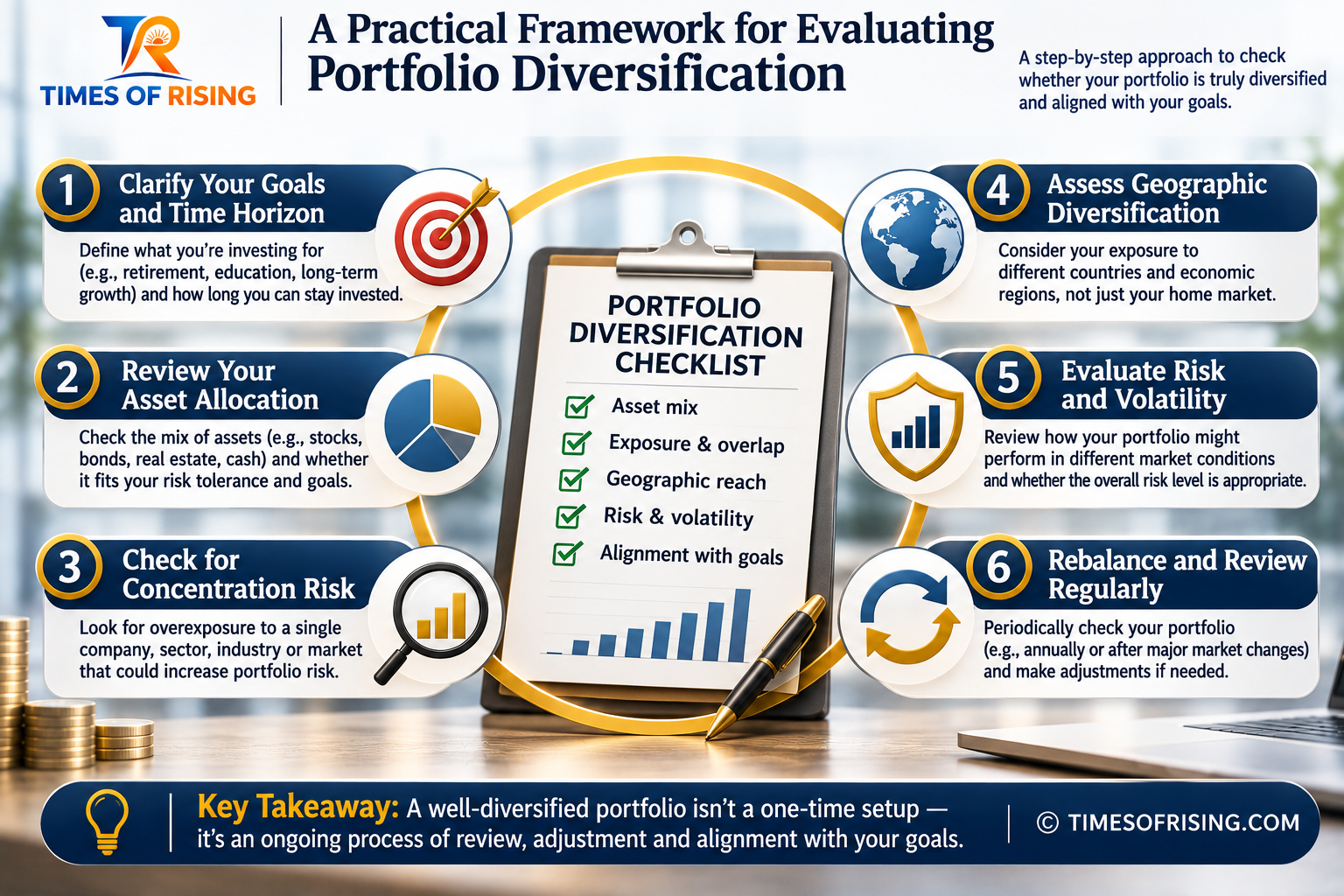
The following framework can help organise that assessment.
Step 1: Identify the purpose of the portfolio
Every investment portfolio should have an identifiable purpose.
It may be intended to support retirement, long-term wealth accumulation, education expenses or another financial objective.
The purpose matters because different goals have different time horizons and liquidity requirements.
A portfolio intended for a distant objective may be evaluated differently from one that needs to provide funds in the near future.
Diversification should support the objective rather than become an independent activity.
Step 2: Examine the overall asset allocation
Identify the percentage of the portfolio held in each broad asset category.
For example:
- Equities.
- Bonds.
- Cash equivalents.
- Real estate-related investments.
- Other asset categories.
The purpose is to understand where the portfolio’s main risks originate.
A portfolio that appears diversified at the fund level may still have an overwhelming exposure to one broad asset category.
Step 3: Look through funds to their underlying holdings
Investment funds should not be evaluated only by their names.
Review their fact sheets, portfolio disclosures and official documentation.
Identify:
- The largest holdings.
- Sector concentrations.
- Country exposure.
- Investment style.
- Overlapping securities.
If multiple funds own many of the same securities, the investor may have more concentration than expected.
Looking through the funds helps reveal the portfolio’s actual exposures.
Step 4: Evaluate industry and geographical concentration
Identify whether a significant portion of the portfolio depends on a particular industry or country.
A portfolio may contain many companies but remain heavily exposed to one sector.
Similarly, international investments may be concentrated in a small number of markets.
The objective is to understand whether one economic environment has disproportionate influence over the portfolio.
Step 5: Consider the underlying risk factors
Different investments may share similar sources of risk.
For example:
- Several companies may depend on the same interest-rate environment.
- Multiple funds may have substantial exposure to large growth-oriented companies.
- Different corporate bonds may be vulnerable to the same credit-market deterioration.
- International holdings may share significant currency exposure.
Thinking in terms of risk factors can reveal concentrations that are not obvious from asset categories alone.
Step 6: Evaluate liquidity requirements
Liquidity refers to how easily an investment can be converted into cash without significantly affecting its value.
A portfolio may be diversified across many assets but still contain holdings that are difficult to sell quickly.
Liquidity becomes particularly important when funds may be needed for planned expenses.
An investor should understand the liquidity characteristics of each investment rather than assuming that every holding can be converted into cash under all market conditions.
Step 7: Review investment costs
Calculate the combined expenses associated with maintaining the portfolio.
Consider both direct fund expenses and other transaction-related costs.
Compare the cost of additional investments with the diversification benefits they may provide.
An investment that substantially duplicates existing exposure may not justify additional expenses.
Step 8: Establish a review process
Portfolio composition changes as investments gain or lose value.
For example, an asset category that initially represented 40% of a portfolio may become 55% after a period of strong performance.
The portfolio’s risk profile may therefore change even if the investor has not purchased anything new.
A periodic review can help identify these changes.
The review should focus on whether the portfolio remains consistent with its objectives, rather than reacting to every short-term market movement.
9. Re-balancing: Maintaining the Intended Diversification
Diversification is not necessarily a permanent condition.
Market performance changes the relative weights of portfolio holdings.
Rebalancing is the process of bringing those weights back towards an intended allocation.
Consider a hypothetical portfolio that initially contains:
- 60% equities.
- 30% bonds.
- 10% cash.
After a period of strong equity-market performance, the allocation changes to:
- 75% equities.
- 20% bonds.
- 5% cash.
The portfolio now has a different risk distribution from the one originally established.
Rebalancing may involve reducing some holdings that have become overweight or adding to categories that have fallen below their intended allocation.
It can also be achieved by directing new contributions towards underweight categories, depending on the circumstances.
Why rebalancing matters
Without periodic reviews, successful investments can gradually become a larger proportion of the portfolio.
This may increase concentration and change the investor’s exposure to market fluctuations.
Rebalancing helps maintain the intended relationship between different asset categories.
However, it does not guarantee better returns.
It may involve transaction costs, tax consequences and the possibility of selling investments that subsequently perform well.
How often should a portfolio be rebalanced?
There is no universally appropriate rebalancing schedule.
Some investors review their allocations at predetermined intervals. Others use allocation thresholds to identify when a portfolio has moved sufficiently far from its intended structure.
The SEC’s Investor.gov discusses both approaches and notes that rebalancing generally works best when done relatively infrequently rather than through constant adjustments.
The appropriate review process depends on the investor’s circumstances, portfolio structure and applicable costs.
The important distinction is between disciplined portfolio maintenance and frequent trading based on short-term market predictions.
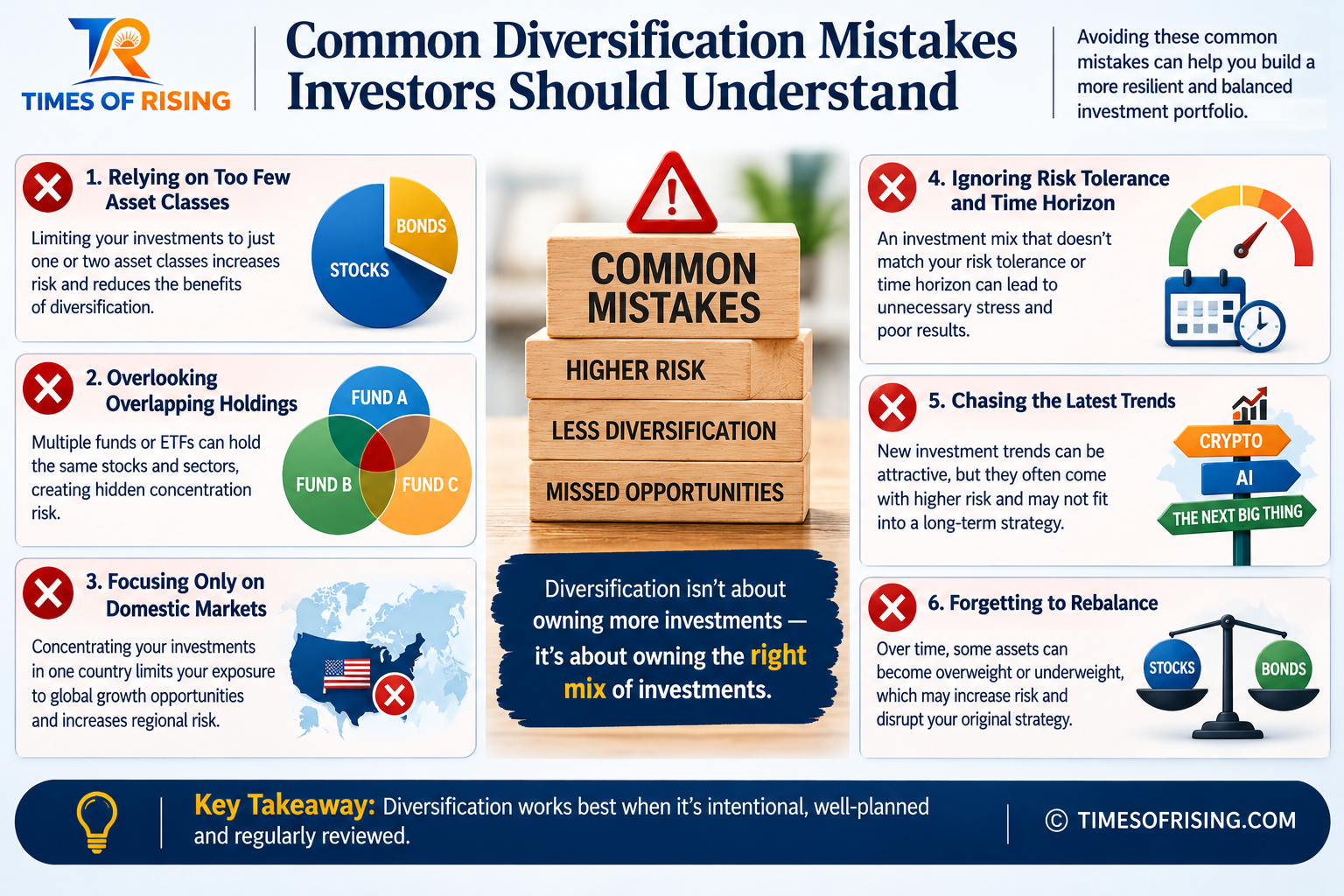
10. Common Diversification Mistakes Investors Should Understand
Even investors who understand the basic principle may make mistakes when applying it.
Recognizing these errors can help distinguish genuine diversification from the appearance of diversification.
Mistake 1: Buying multiple funds with similar holdings
Purchasing several funds does not automatically create different exposures.
If their underlying holdings overlap significantly, the portfolio may remain concentrated.
Investors should examine fund holdings rather than relying entirely on fund names.
Mistake 2: Treating every asset class as equally safe
Stocks, bonds, cash, commodities and real estate have different risk characteristics.
None should be treated as universally safe in every economic environment.
For example, longer-maturity bonds can experience price declines when interest rates rise. Real estate investments can be affected by financing conditions and property-market weakness.
Diversification works by distributing different risks, not by converting every asset into a low-risk investment.
Mistake 3: Assuming international investments always move independently
Global markets are interconnected.
International diversification may reduce dependence on one country’s economy, but it cannot guarantee protection against global financial shocks.
Mistake 4: Chasing recent performance
Investors sometimes add investments simply because a particular sector or asset class has recently performed well.
This can result in buying into an area that has already become a substantial part of the portfolio.
Diversification decisions should be based on the portfolio’s objectives and risk characteristics rather than recent performance alone.
Mistake 5: Ignoring fees and expenses
A portfolio can become more complicated and expensive without receiving meaningful diversification benefits.
Investors should understand the combined costs of their holdings.
Mistake 6: Forgetting about time horizon
A portfolio may be diversified across numerous assets but still be unsuitable for the period in which the money is needed.
Liquidity and time horizon should remain central considerations.
Mistake 7: Assuming historical relationships will continue
Past correlations and historical returns provide useful information, but they do not guarantee future outcomes.
Market relationships change, sometimes significantly.
Diversification should therefore be evaluated with an understanding of uncertainty.
11. Does Diversification Reduce Returns?
This question deserves careful consideration because diversification is sometimes presented as a way to improve returns.
That description can be misleading.
Diversification is primarily a method of managing risk. Its main objective is to reduce excessive dependence on individual investments or market segments.
It does not automatically increase the expected return of a portfolio.
In fact, a diversified portfolio may underperform a concentrated portfolio when one particular investment performs exceptionally well.
Consider a hypothetical situation.
Investor A holds a portfolio concentrated in one rapidly growing technology company.
Investor B holds investments across technology, healthcare, industrials, financial services and bonds.
If the technology company experiences exceptional growth, Investor A may achieve a much higher return.
However, if that company experiences serious difficulties, Investor A may also experience a much larger loss.
Investor B has reduced dependence on that single company, but may not capture the full benefit of its exceptional performance.
This illustrates the central trade-off.
Diversification can reduce the influence of individual winners and losers.
It may produce a more balanced distribution of outcomes, but it cannot ensure that the portfolio will outperform a concentrated investment strategy.
The importance of risk-adjusted performance
Investment performance should not be evaluated solely by looking at returns.
The level of risk required to achieve those returns also matters.
Two portfolios may generate similar returns while experiencing very different fluctuations.
A portfolio that achieves a particular return with lower volatility may offer a different risk-return experience from one that reaches the same result through substantial fluctuations.
Measures such as standard deviation and the Sharpe ratio are sometimes used to evaluate aspects of risk-adjusted performance.
However, no single measurement captures every type of investment risk.
Investors should consider the overall context rather than assuming that a higher return or a lower volatility statistic tells the complete story.
12. Is There Such a Thing as a Perfectly Diversified Portfolio?
There is no universally perfect diversified portfolio.
The appropriate combination of investments depends on several factors, including:
- Financial objectives.
- Investment time horizon.
- Risk tolerance.
- Financial capacity to withstand losses.
- Liquidity requirements.
- Investment costs.
- Tax considerations.
- Available investment opportunities.
Two investors with different objectives may reasonably require different portfolio structures.
A portfolio intended for long-term growth may have different characteristics from one designed around near-term spending requirements.
Similarly, an investor with substantial existing exposure to a particular industry through employment or business ownership may have different concentration considerations from someone without that exposure.
The idea of a perfect portfolio is therefore misleading.
A more useful question is whether the portfolio’s structure is appropriate for the purpose it is intended to serve.
Diversification is a process, not a product
Investors sometimes search for a single fund or financial product that promises complete diversification.
However, diversification is not a product label.
It is a characteristic of the combined portfolio.
A broadly diversified fund may provide extensive exposure within one asset category, but it may not address the investor’s overall allocation, liquidity requirements or exposure to other financial risks.
Similarly, owning several different investment products does not guarantee that their combined characteristics are suitable.
The entire portfolio must be evaluated as one interconnected structure.
13. A Balanced Way to Think About Diversification
The most useful way to understand diversification is to recognise both its capabilities and its limitations.
It can reduce the consequences of individual-company problems.
It can spread exposure across industries and geographical markets.
It can help manage portfolio volatility when investments respond differently to economic conditions.
It can also reduce dependence on a narrow group of securities.
However, diversification cannot remove broad market risk, guarantee returns, prevent all investments from declining together or make unsuitable investments appropriate.
It does not eliminate inflation, liquidity, interest-rate or credit risks.
Nor does it guarantee that a portfolio will recover within a particular period after a market decline.
These limitations do not make diversification less valuable.
They explain why it should be treated as one component of a broader investment framework rather than a complete investment solution.
Investors should understand the role of every major holding, examine overlapping exposures, consider costs and evaluate the portfolio against its financial objectives.
The number of investments is less important than the quality of the diversification they collectively provide.
A carefully structured portfolio does not need to contain every available asset class or investment product. It needs a coherent allocation in which different holdings serve identifiable purposes.
Ultimately, diversification is about managing uncertainty rather than eliminating it.
Investors cannot control every market development, but they can understand where their portfolios are concentrated and make more informed decisions about how those exposures are distributed.
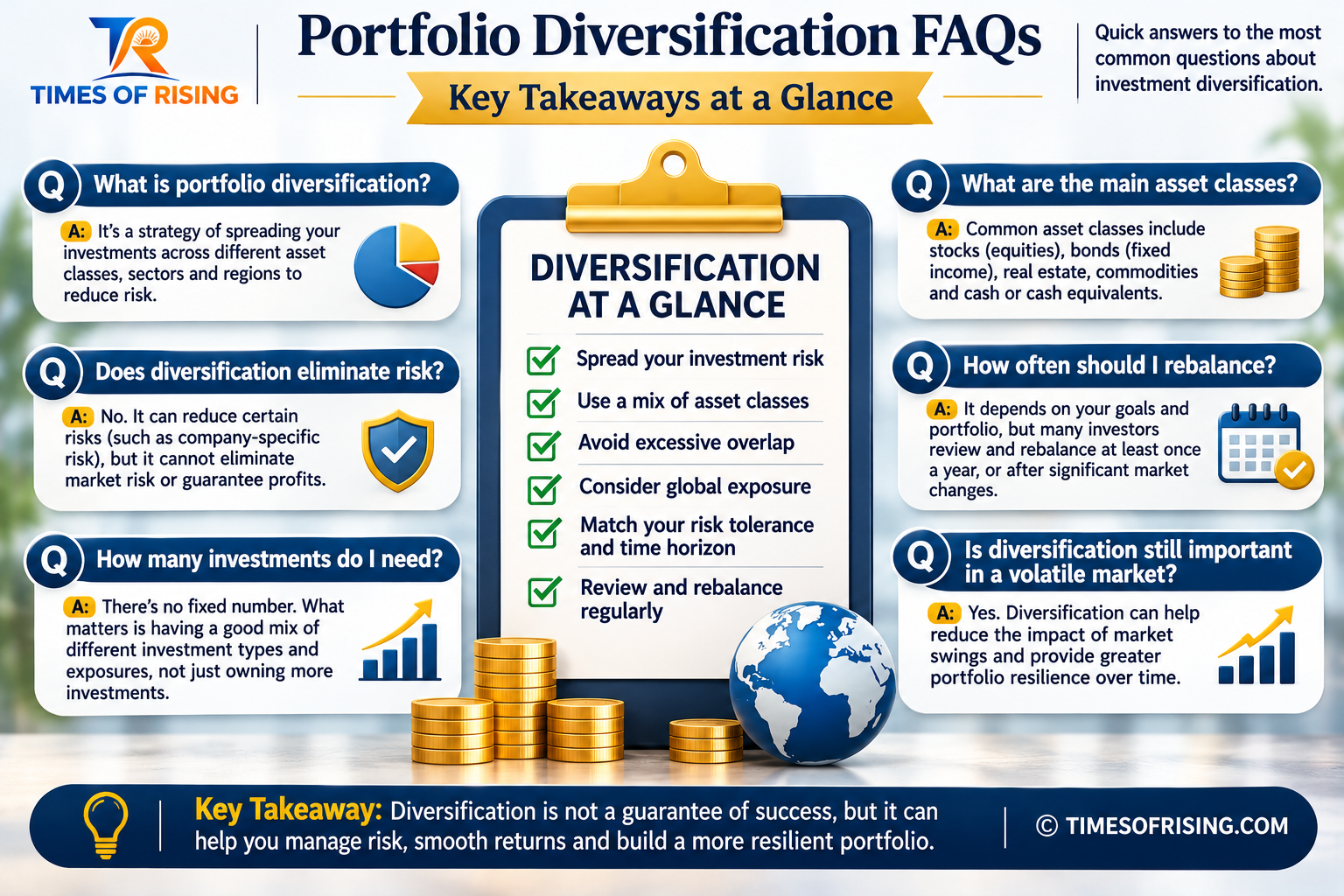
Frequently Asked Questions (FAQs)
1. What is the main purpose of diversification in an investment portfolio?
The main purpose of diversification is to reduce concentration risk by spreading investments across different securities, asset classes, industries and geographical markets. It helps limit the impact that a single investment or market segment can have on the overall portfolio. However, it does not eliminate all investment risks.
2. Can diversification prevent investment losses?
No. A diversified portfolio can still experience losses because several investments may decline simultaneously. Broad economic events, financial crises, inflation and changes in interest rates can affect multiple asset classes at the same time. Diversification can help manage certain risks, but it cannot guarantee protection from losses.
3. Does owning more stocks automatically make a portfolio diversified?
No. Owning more stocks does not necessarily create meaningful diversification if the companies operate in similar industries or depend on the same economic factors. The quality of diversification depends on how the investments differ in their underlying risks and return drivers.
4. Can mutual funds and ETFs provide diversification?
Yes. Broadly diversified mutual funds and exchange-traded funds can provide exposure to numerous securities through a single investment. However, not every fund is diversified. Sector-specific and narrowly focused funds may concentrate exposure in particular industries or market segments.
5. What is the difference between diversification and asset allocation?
Asset allocation determines how a portfolio is distributed among broad categories such as stocks, bonds and cash. Diversification involves spreading investments within and across those categories to reduce concentration risk. Both concepts are important, but they address different aspects of portfolio construction.
6. What is over-diversification?
Over-diversification generally refers to adding investments beyond the point where they provide meaningful additional diversification benefits. It may increase costs, create unnecessary complexity and dilute the influence of individual successful investments. There is no universally accepted number of holdings that defines over-diversification.
7. Why is correlation important in diversification?
Correlation describes how investments move in relation to one another. Combining investments with different return patterns may reduce overall portfolio volatility. However, correlations can change over time, particularly during periods of market stress. Historical correlation should not be treated as a guarantee of future behaviour.
8. Does geographical diversification eliminate country risk?
No. International investments can reduce dependence on a single national market, but they introduce other risks, including currency fluctuations, political uncertainty, regulatory differences and foreign-market liquidity conditions. Global markets can also decline together during widespread financial disruptions.
9. Can a diversified portfolio outperform a concentrated portfolio?
Yes, but it is not guaranteed. A diversified portfolio may perform better when the investments that are concentrated in another portfolio experience substantial losses. However, a concentrated portfolio may outperform when its selected investment or sector performs exceptionally well. Their relative performance depends on market conditions and the underlying holdings.
10. How often should investors review diversification?
Investors can review their portfolios periodically and when significant changes occur in their financial objectives, time horizons or circumstances. Rebalancing may be considered when asset allocations move away from intended levels. Constant adjustments based on short-term market movements are not necessary.
11. Does diversification guarantee better risk-adjusted returns?
No. Diversification may improve the relationship between risk and return in certain circumstances, but the outcome depends on investment selection, asset weights, costs and changing market relationships. It should not be viewed as a guarantee of better performance.
12. What is the biggest misconception about diversification?
One of the biggest misconceptions is that owning many different investments makes a portfolio safe. True diversification requires examining the underlying risks and relationships between holdings. A portfolio with numerous overlapping investments may still be highly concentrated.
Final Takeaway
Diversification is a valuable approach to investment risk management, but its benefits should not be exaggerated.
It can reduce dependence on individual investments, spread exposure across different economic activities and help manage portfolio fluctuations. What it cannot do is eliminate market uncertainty, guarantee positive returns or protect every holding from losses.
A genuinely diversified portfolio is not defined by how many investments it contains. It is defined by how effectively those investments distribute risk and support the portfolio’s intended objectives.
The most important principle is simple: diversification should be measured by the differences between investment exposures, not merely by the number of investments owned.

Tim Brook
Tim Brook covers investing fundamentals, financial markets and investment terminology. His subject area includes stocks, exchange-traded funds, bonds, diversification, market indicators and cryptocurrency as a related investment topic. His articles emphasize reliable financial sources, balanced explanations of risk and a clear distinction between established information and market speculation.
Join the conversation
Share a thoughtful response, ask a question, or add something useful for other readers.
Be the first to add a helpful perspective.