The guide outlines how credit scores are calculated, including payment history, utilization, account age, credit mix, and inquiries. It discusses potential 2026 changes involving FICO 10T, VantageScore 4.0, BNPL reporting, medical debt, and expanded use of trended data.
It provides steps for reviewing credit reports, disputing inaccurate information, rebuilding damaged credit, and preparing for goals such as homeownership. Recommendations include automating payments, reducing utilization, maintaining older accounts, limiting applications, and seeking nonprofit counseling when needed.
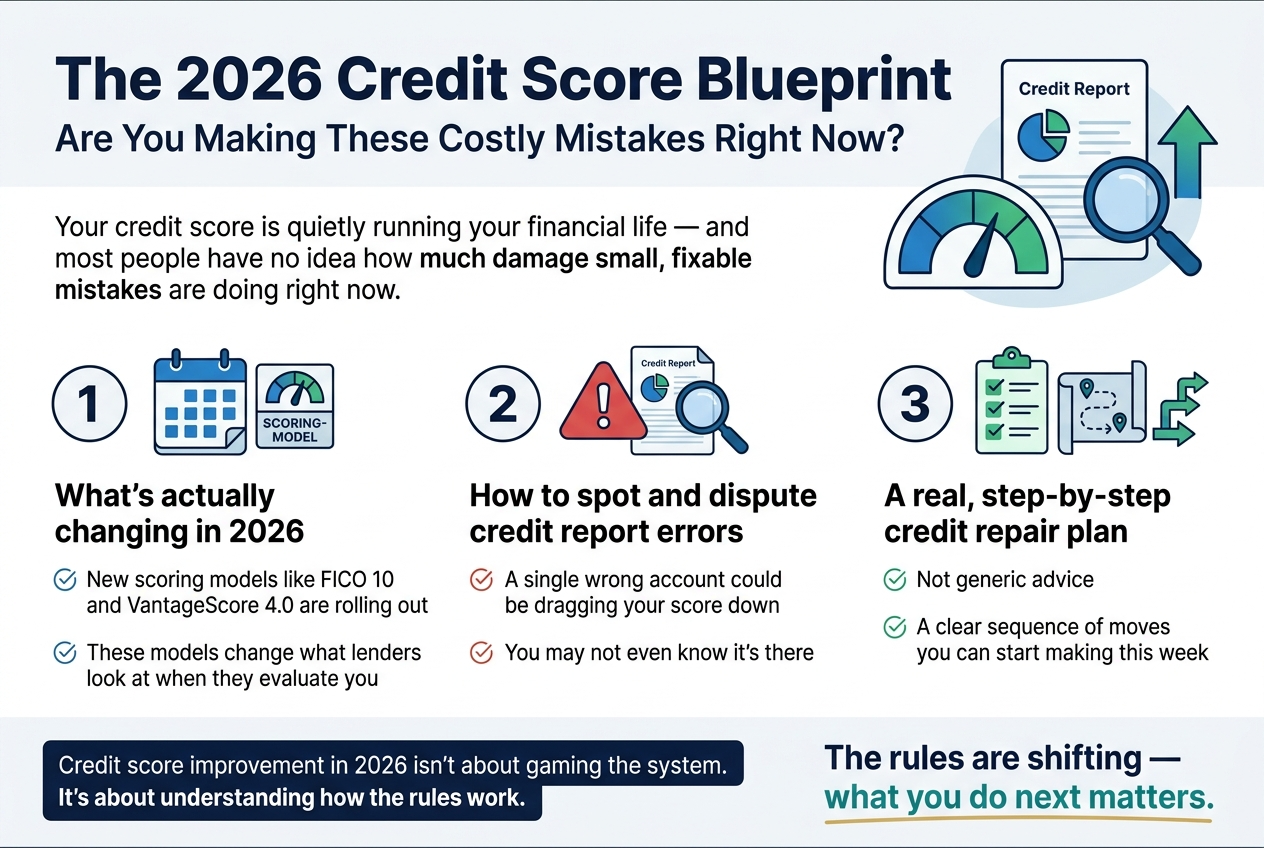
The 2026 Credit Score Blueprint: Are You Making These Costly Mistakes Right Now?
Your credit score is quietly running your financial life — and most people have no idea how much damage small, fixable mistakes are doing right now.
This guide is for anyone who’s been denied a loan, hit with a sky-high interest rate, or just feels completely lost every time they look at their credit report. If that’s you, you’re in the right place.
Here’s what we’re going to walk through together:
- What’s actually changing in 2026 — new scoring models like FICO 10 and VantageScore 4.0 are already rolling out, and they change what lenders look at when they evaluate you
- How to spot and dispute credit report errors — a single wrong account could be dragging your score down without you even knowing it
- A real, step-by-step credit repair plan — not generic advice, but a clear sequence of moves you can start making this week
Credit score improvement in 2026 isn’t about gaming the system. It’s about understanding how the rules work — and right now, the rules are shifting in ways that can either help or hurt you depending on what you do next.
Let’s get into it.
Understanding How Credit Scores Really Work
What a Credit Score Is and Why It Matters
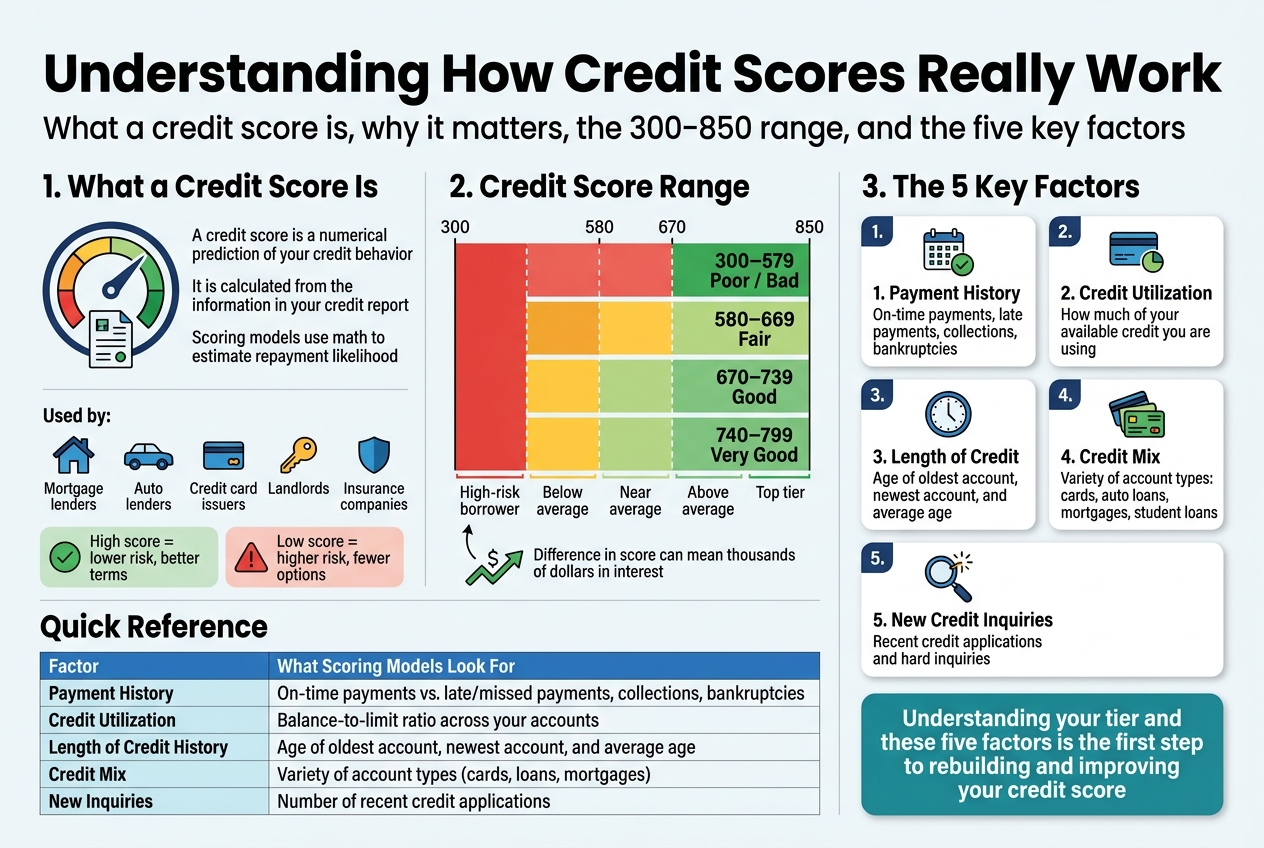
A credit score is a numerical prediction of your credit behavior — specifically, how likely you are to repay a loan and make payments on time. Generated by a mathematical formula called a scoring model, your score is calculated using the information found in your credit report.
Your credit score carries significant weight in everyday financial life. Lenders, landlords, and even insurance companies rely on it to make critical decisions, including:
- Whether to approve you for a mortgage, auto loan, or credit card
- What interest rate you’ll pay on borrowed money
- Your credit limit on new accounts
- Whether you qualify for tenant screening or insurance coverage
A high score signals to businesses that you’re a low financial risk, making it easier to access credit on favorable terms. A low score does the opposite — it limits your options and often results in higher interest rates when you do get approved. With credit score improvement in 2026 becoming a top financial priority for many Americans, understanding the foundation of how scores work is the essential first step.
It’s also important to note that you don’t have just one credit score. Your score can vary depending on the scoring model used, the source of the credit data, and even the specific date it’s calculated. Different lenders may use different models tailored to the type of credit product they’re offering.
The Range From 300 to 900 and What Each Level Means
Most credit scores fall within a range of 300 to 850, though some scoring models extend slightly higher. Within this range, your score places you into a general tier that reflects your creditworthiness in the eyes of lenders and creditors.
Here’s how the typical credit score tiers break down:
| Score Range | Credit Level | What It Means |
|---|---|---|
| 300 – 579 | Poor / Bad | High-risk borrower; very difficult to get approved; highest interest rates |
| 580 – 669 | Fair | Below average; some lenders will approve, but terms are unfavorable |
| 670 – 739 | Good | Near or at the average; most lenders consider this acceptable |
| 740 – 799 | Very Good | Above average; qualifies for better rates and terms |
| 800 – 850 | Exceptional | Top tier; best rates, easiest approvals, maximum lender confidence |
The difference between a “poor” and “exceptional” score isn’t just a number — it can translate into thousands of dollars in interest over the life of a mortgage or auto loan. For example, borrowers with bad credit are not only more likely to be denied but, when approved, consistently pay higher interest rates that cost significantly more over time.
Understanding where your score falls on this scale gives you a clear target. If you’re working to rebuild your credit score, knowing your current tier helps you set realistic milestones and measure progress over time.
Key Factors That Determine Your Score: Payments, Utilization, History, Mix, and Inquiries
Credit scoring models analyze several core factors from your credit report. While the exact weight each factor carries can vary by scoring model, these five elements are consistently central to how your score is calculated.
1. Payment History
This is the most heavily scrutinized factor. Scoring models look at whether you’ve paid your bills on time, consistently. Late payments, accounts sent to collections, foreclosures, and bankruptcies all negatively impact your score. A strong record of on-time payments, on the other hand, is one of the most powerful things you can do to maintain or boost your credit score.
2. Credit Utilization
Utilization refers to how much of your available credit you’re currently using. If your credit card balance is close to your credit limit, scoring models interpret that as a warning sign — even if you’re making minimum payments on time. Keeping your balances well below your credit limits is a proven strategy for maintaining a healthy score. Maxing out your cards is one of the most common credit score mistakes to avoid.
3. Length of Credit History
How long you’ve had your credit accounts open matters. A longer credit history generally works in your favor because it gives scoring models more data to evaluate your behavior. A short credit history may lower your score, but consistent on-time payments and low balances can help offset that disadvantage over time.
4. Credit Mix
The variety of credit accounts you carry — such as credit cards, auto loans, mortgages, and student loans — is also considered. Having a diverse mix of account types can work positively in your favor. However, this doesn’t mean you should open accounts you don’t need. Scoring models also flag situations where someone has an excessive number of credit card accounts, which can work against you.
5. New Credit Inquiries
Every time you apply for new credit, it triggers a “hard inquiry” on your credit report. Too many inquiries in a short period can signal financial stress and may lower your score. That said, not all inquiries count against you — for instance, inquiries from creditors monitoring existing accounts or making prescreened offers don’t affect your score. Additionally, multiple mortgage lender inquiries made within a short window are often counted as just one inquiry to protect consumers who are rate shopping.
Here’s a quick reference summary of the five key factors:
| Factor | What Scoring Models Look For |
|---|---|
| Payment History | On-time payments vs. late/missed payments, collections, bankruptcies |
| Credit Utilization | Balance-to-limit ratio across your accounts |
| Length of Credit History | Age of oldest account, newest account, and average age |
| Credit Mix | Variety of account types (cards, loans, mortgages) |
| New Inquiries | Number of recent credit applications |
With this in mind, next, we’ll explore the major credit score changes coming in 2026 and how they could directly affect the way these factors are calculated and reported going forward.
Major Credit Score Changes Coming in 2026
New Scoring Models: VantageScore 4.0 and FICO 10 Explained
The credit scoring landscape is undergoing its most significant transformation in decades, and understanding these major credit score changes in 2026 is essential if you want to protect and improve your financial standing.
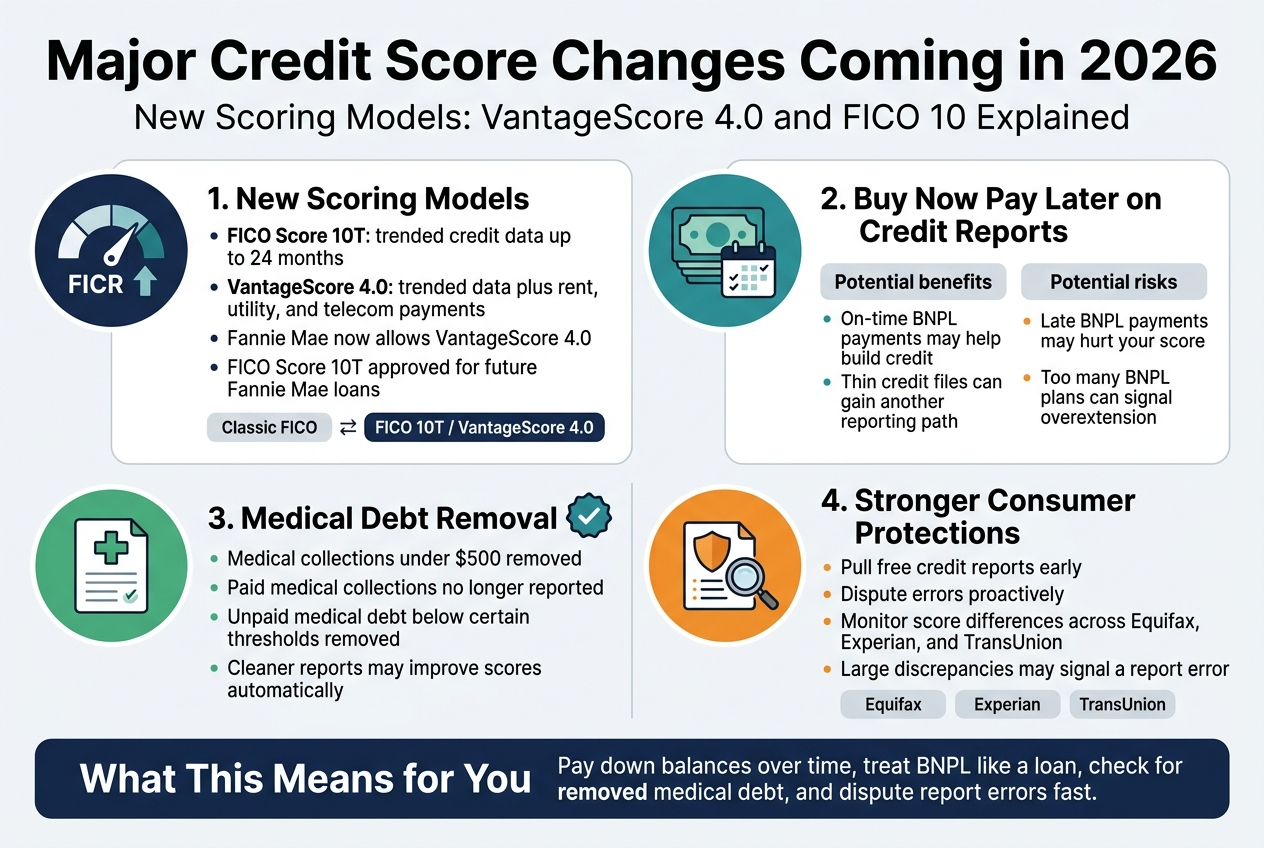
Two newer models are now at the center of this shift:
- FICO Score 10T – Uses trended credit data, reviewing up to 24 months of your payment and balance history rather than a single snapshot
- VantageScore 4.0 – Also incorporates trended data and can factor in rent, utility, and telecom payment history
Fannie Mae has already announced updates to its Selling Guide to allow lenders to use VantageScore 4.0 immediately, with FICO Score 10T also approved for future use on loans delivered to Fannie Mae. This change, led by the Federal Housing Finance Agency (FHFA), represents a multi-year effort to modernize credit scoring across the housing finance system.
Here is what makes these models fundamentally different from older scoring systems:
| Feature | Classic FICO | FICO 10T / VantageScore 4.0 |
|---|---|---|
| Data window | Single snapshot | Up to 24 months of history |
| Rent/utility payments | Not typically included | May be included |
| Trended balance data | No | Yes |
| Predictive accuracy | Standard | Higher, for more borrowers |
What this means for you: If you have been consistently paying down balances over time, the newer models will likely reward that behavior. On the other hand, carrying high balances month after month — even if you always pay on time — could now work against you in ways it did not before.
It is also worth noting that different lenders may use different models depending on the loan type. One lender might use FICO 10T for a mortgage while another relies on an older model for a credit card application. This is one reason your scores can vary across lenders, even for the same credit profile.
Buy Now Pay Later Plans Will Appear on Credit Reports
With this in mind, another significant development affecting your credit report in 2026 involves Buy Now Pay Later (BNPL) plans. These short-term installment arrangements — often used for retail purchases — have historically existed outside the traditional credit reporting system. That is changing.
As newer scoring models incorporate more comprehensive data, BNPL activity is increasingly being factored into credit profiles. This cuts both ways:
Potential benefits:
- Consumers who use BNPL responsibly and pay on time may see those positive payment records contribute to their credit history
- For borrowers with thin credit files, this creates another pathway to establish a stronger credit profile
Potential risks:
- Missed or late BNPL payments may now appear on your credit report and negatively impact your score
- Multiple BNPL plans running simultaneously could signal financial overextension to lenders
The practical takeaway here is straightforward: treat every BNPL arrangement with the same seriousness you would apply to a traditional loan or credit card payment. Since these plans are now entering the credit reporting ecosystem, late payments carry real consequences for your credit score improvement in 2026 efforts.
Medical Debt Removal and What It Means for Your Score
One of the most consumer-friendly developments in recent credit reporting history is the movement toward removing medical debt from credit reports. This shift has significant implications for millions of Americans who carry medical debt that has long suppressed their scores.
The credit bureaus — Equifax, Experian, and TransUnion — have made substantial moves in this area:
- Medical collection accounts under $500 have already been removed from credit reports by all three major bureaus
- Paid medical collection accounts are no longer reported
- Unpaid medical debt under a certain threshold has been eliminated from credit reports
Why this matters for your score: Medical debt has historically been a poor predictor of whether someone will repay other types of credit. Removing it from scoring models helps create a more accurate picture of true creditworthiness. If you previously had medical collections dragging down your score, you may already see improvement without taking any action at all.
For anyone working through a step-by-step credit repair plan, checking whether lingering medical debt has been properly removed from your reports is now a critical first step. If outdated or incorrectly reported medical accounts still appear on your file, you have grounds to dispute them — which we will cover in depth in a later section.
Stronger Consumer Protections and Faster Dispute Timelines
Now that we have covered the scoring model changes and debt reporting updates, it is equally important to understand how consumer protections are evolving alongside these technical changes.
The credit score modernization initiative is not only about new algorithms — it also emphasizes expanded accountability for accuracy in reporting. Newer models like VantageScore 4.0 and FICO 10T are designed to score a broader range of consumers more accurately, which inherently reduces the risk of creditworthy borrowers being misrepresented.
From a practical standpoint, here is what stronger consumer protections mean for you:
- Pull your free credit reports early. With multiple scoring models now in use, errors on your report can affect you differently across different lenders. Catching mistakes before they cascade across models is now more important than ever.
- Dispute errors proactively. Credit bureaus are required to investigate disputes, and the push toward modernization is accompanied by increased emphasis on report accuracy.
- Monitor score variations across bureaus. Because Equifax, Experian, and TransUnion may receive updated information at different times, minor score differences between bureaus are normal. Significant discrepancies, however, may signal a credit report error worth disputing.
The combination of more sophisticated scoring models and stronger consumer protections creates a system where accurate data matters more than ever before. For anyone focused on how to fix their credit score fast, this environment actually works in your favor — provided your credit report is clean and your financial behaviors align with what the newer models reward.
How to Read and Understand Your Credit Report
How to Access Your Free Reports From All Three Bureaus
Your credit report is the single most important document in your financial life, yet most people rarely look at it. Before you can fix anything, you need to know exactly what lenders are seeing when they pull your file.
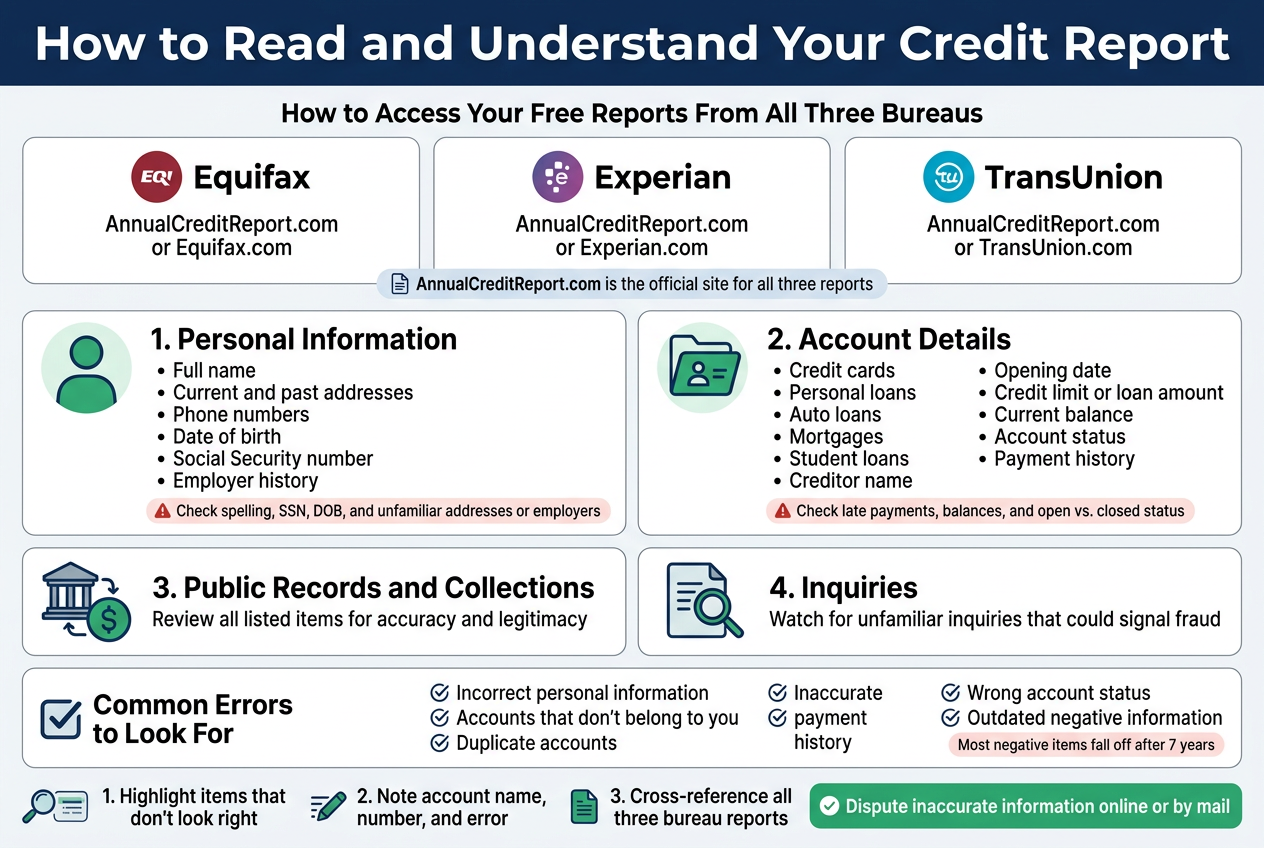
You are entitled to free credit reports from all three major bureaus — Equifax, Experian, and TransUnion. Each bureau maintains its own version of your credit history, and the information across them can differ. This means an error on one report may not appear on the others, making it essential to review all three separately.
Here’s a quick breakdown of how to access each:
| Bureau | How to Access |
|---|---|
| Equifax | AnnualCreditReport.com or directly through Equifax.com |
| Experian | AnnualCreditReport.com or directly through Experian.com |
| TransUnion | AnnualCreditReport.com or directly through TransUnion.com |
AnnualCreditReport.com is the official, federally authorized site where you can pull all three reports. Once you have your reports in hand, you’re ready to dig in. Don’t rush this process — a careful, line-by-line review is what separates people who catch damaging errors from those who unknowingly carry them for years.
Reading Your Report Line by Line to Spot Problems
Knowing how to read a credit report is a skill that pays dividends every time you use it. Each report is divided into distinct sections, and each one tells a different part of your financial story. Here’s what you’ll find and exactly what to scrutinize in each area.
Personal Information Section
This is the first section on any credit report, and while it doesn’t directly affect your credit score, it is critically important. It contains:
- Your full name (including any variations or former names)
- Current and past addresses
- Phone numbers
- Date of birth
- Social Security number
- Employer history
What to check here:
- Confirm your name is spelled correctly and matches your official records
- Verify your Social Security number and date of birth are accurate
- Scan for unfamiliar addresses, phone numbers, or employers — these can be early warning signs of identity theft or reporting mix-ups
Even a small error like a wrong address or a misspelled name can signal a deeper reporting problem. Errors in this section can also cause you to miss important communications from lenders or creditors.
Important: Changes to your name, date of birth, or Social Security number typically cannot be made online. You’ll need to mail supporting documents directly to the bureau.
Account Details Section
This section is the heart of your credit report. It lists all of your active and closed credit accounts, including:
- Credit cards
- Personal loans
- Auto loans
- Mortgages
- Student loans
For each account, you’ll see:
- The creditor’s name
- Account opening date
- Credit limit or loan amount
- Current balance
- Account status (open, closed, charged-off, etc.)
- Payment history, typically shown month by month
When reviewing this section, pay close attention to:
- Payment history — look for any late or missed payments that appear inaccurate
- Credit limits and balances — these affect your credit utilization ratio, a major scoring factor
- Account status — a closed account incorrectly listed as open (or vice versa) can cause scoring issues
Public Records and Collections
This section lists any public records or collection accounts that have been reported against you. These entries carry significant weight and can negatively affect your credit score. Make sure every entry here is legitimate and accurate.
Inquiries Section
The inquiries section shows who has recently accessed your credit report. Watch for any unfamiliar inquiries — these could indicate someone is attempting to open credit in your name without your knowledge.
Identifying Errors, Outdated Information, and Inaccurate Accounts
Now that we’ve covered how to read each section of your report, the next critical step is knowing exactly what constitutes a problem worth disputing. Not every imperfection on a credit report is an error, but many people are surprised by how often genuine mistakes appear.
Common Types of Errors to Look For
- Incorrect personal information — wrong name spelling, incorrect Social Security number, outdated address
- Accounts that don’t belong to you — a sign of possible identity theft or a mixed file (your information confused with someone else’s)
- Duplicate accounts — the same debt listed more than once
- Inaccurate payment history — payments marked late when they were made on time
- Wrong account status — a paid-off account still showing an outstanding balance, or a closed account listed as open
- Outdated negative information — most negative items, like late payments and collections, should fall off your report after seven years
How to Flag What You Find
As you review each section, take notes on any discrepancies or entries that look unfamiliar or inaccurate. A simple approach:
- Highlight or mark every item that doesn’t look right
- Note the specific account name, account number, and the nature of the error
- Cross-reference the same item across all three bureau reports to see if the error appears in multiple places
- Gather supporting documents — bank statements, payment confirmations, or correspondence that proves the error
With this in mind, once you’ve identified and documented potential errors, you’ll be in a strong position to take action. TransUnion, Equifax, and Experian all allow you to file disputes directly — either online or by mail — to correct or remove inaccurate information from your credit report.
Regularly monitoring your credit report is one of the most powerful, zero-cost strategies for maintaining strong credit health and catching problems before they escalate into serious damage.
Fixing Credit Report Errors and Disputing Mistakes
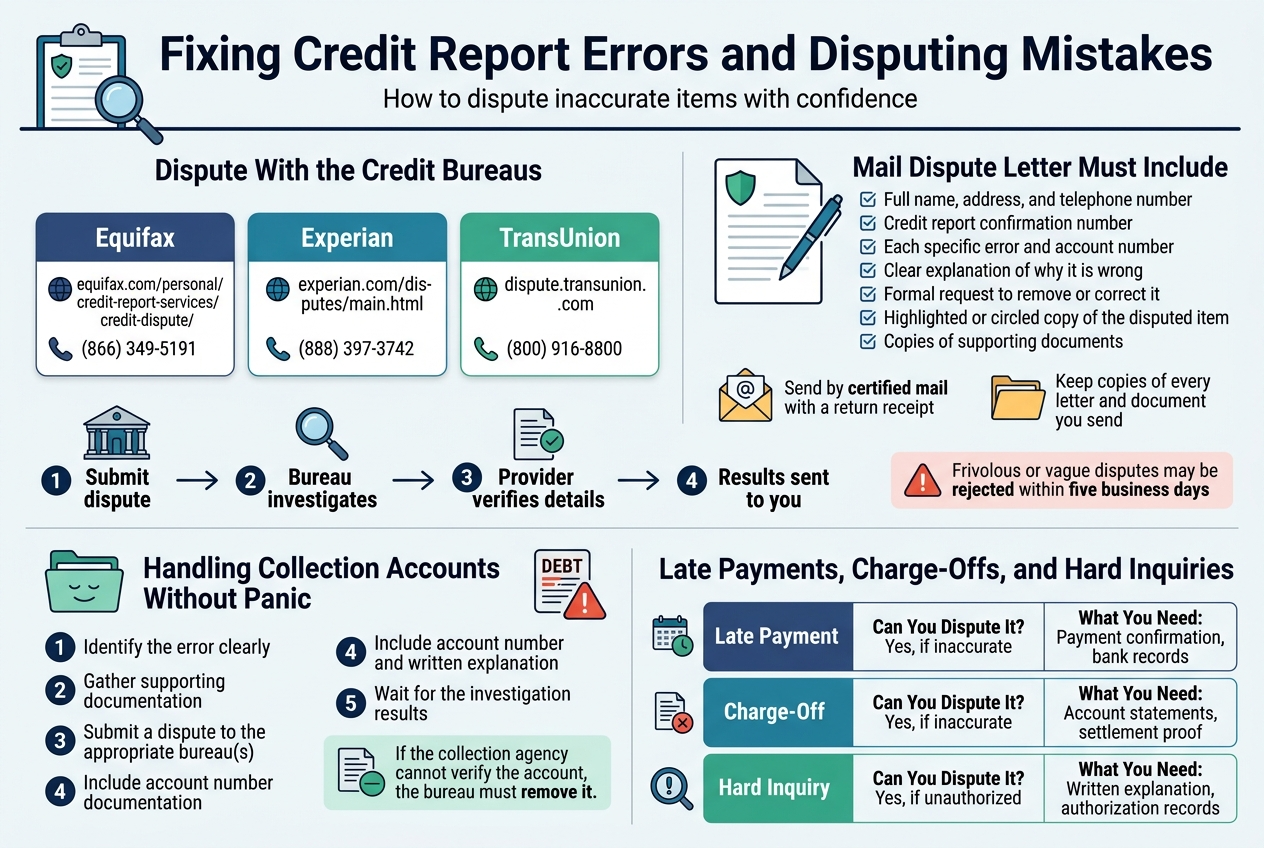
A. How to Dispute Inaccurate Items With Confidence
Now that we have covered how to read and understand your credit report, the next logical step is knowing what to do when you spot something wrong. Credit report errors are more common than most people realize, and disputing them is one of the most direct ways to support your credit score improvement in 2026.
The process begins by contacting the credit reporting company — Equifax, Experian, or TransUnion — where the error appears. You can dispute online, by phone, or by mail. Each bureau has dedicated dispute channels:
| Bureau | Online | Phone |
|---|---|---|
| Equifax | equifax.com/personal/credit-report-services/credit-dispute/ | (866) 349-5191 |
| Experian | experian.com/disputes/main.html | (888) 397-3742 |
| TransUnion | dispute.transunion.com | (800) 916-8800 |
If you choose to dispute by mail — which gives you a paper trail — your dispute letter must include the following:
- Your full name, address, and telephone number
- Your credit report confirmation number (if available)
- Each specific error you want corrected, along with the account number
- A clear explanation of why the information is wrong
- A formal request to have the item removed or corrected
- A highlighted or circled copy of the portion of your credit report showing the disputed item
- Copies (not originals) of any supporting documents
Sending your letter by certified mail with a return receipt is strongly recommended. This creates a timestamped record that the bureau received your dispute — a detail that matters if you need to escalate later.
Once your dispute is submitted, the credit reporting company is legally required to investigate, forward your dispute and all relevant documentation to the information provider, and report the results back to you. However, keep in mind that bureaus are not required to investigate disputes they determine to be frivolous — for example, if your dispute is vague or lacks enough identifying information. If a dispute is deemed frivolous, the bureau must notify you within five business days and explain why.
Pro tip: Keep copies of every letter and document you send. This documentation is your protection throughout the entire process.
B. Handling Collection Accounts Without Panic
Collection accounts are one of the most anxiety-inducing items people find on their credit reports — but they don’t have to be. With this in mind, the same dispute process that applies to general errors also applies to collection accounts that appear inaccurate, outdated, or unverifiable.
If you find a collection account on your report that you believe is incorrect — such as a debt that doesn’t belong to you, a balance that’s reported incorrectly, or an account that should have aged off — you have every right to dispute it. Here’s how to approach it methodically:
Steps for Disputing a Collection Account
- Identify the error clearly. Is the account not yours? Is the amount wrong? Is it listed as open when it was settled? Document the specific inaccuracy.
- Gather supporting documentation. Payment receipts, settlement letters, or identity verification documents can support your case.
- Submit a dispute to the appropriate bureau(s). If the same collection account appears on all three reports, file a separate dispute with each bureau.
- Include your account number and a written explanation of why the information is inaccurate.
- Wait for the investigation results. The bureau will contact the collection agency (the information provider) to verify the details.
If the collection agency cannot verify the account, the bureau must remove it — which can have a meaningful impact when you’re working to fix your credit score fast or rebuild credit score tips you’re following.
Staying calm and methodical is key. Disputing a collection account is a structured legal process, not a negotiation — and when done correctly, it works in your favor.
C. Dealing With Late Payments, Charge-Offs, and Hard Inquiries
Previously, I’ve outlined how to read your credit report and handle collection disputes. Now, let’s tackle three other damaging items that frequently appear on credit reports: late payments, charge-offs, and hard inquiries.
Late Payments
Late payments are one of the most common credit report errors people encounter — sometimes appearing as late when the payment was actually made on time. If you find a late payment that you believe is inaccurate:
- Gather your bank statements, payment confirmations, or any correspondence showing the payment was made on time
- Submit a dispute to the bureau(s) reporting the error with your documentation attached
- Clearly state the account number, the date of the payment in question, and why the late payment designation is incorrect
The bureau must investigate and report back. If the creditor cannot verify the late payment, it must be corrected or removed.
Charge-Offs
A charge-off appears when a creditor has written off a debt as a loss — typically after several months of non-payment. If a charge-off on your report is inaccurate (wrong amount, wrong account, or already resolved), you can dispute it using the same process: write to the bureau, explain the error, and provide documentation.
It’s important to dispute only what is genuinely inaccurate. The dispute process is designed to correct errors, not erase legitimately reported information.
Hard Inquiries
Hard inquiries appear when a lender checks your credit as part of an application. If you find a hard inquiry you didn’t authorize:
- This could be a sign of a data error or, in serious cases, potential fraud
- You can dispute unauthorized hard inquiries with the reporting bureau, explaining that you did not authorize the inquiry
- Include any documentation that supports your claim
| Item | Can You Dispute It? | What You Need |
|---|---|---|
| Late Payment | Yes, if inaccurate | Payment confirmation, bank records |
| Charge-Off | Yes, if inaccurate | Account statements, settlement proof |
| Hard Inquiry | Yes, if unauthorized | Written explanation, authorization records |
With this in mind, next, we’ll see how to go beyond fixing errors and start actively building or rebuilding your credit score with proven strategies.
Proven Strategies to Build or Rebuild Your Credit Score
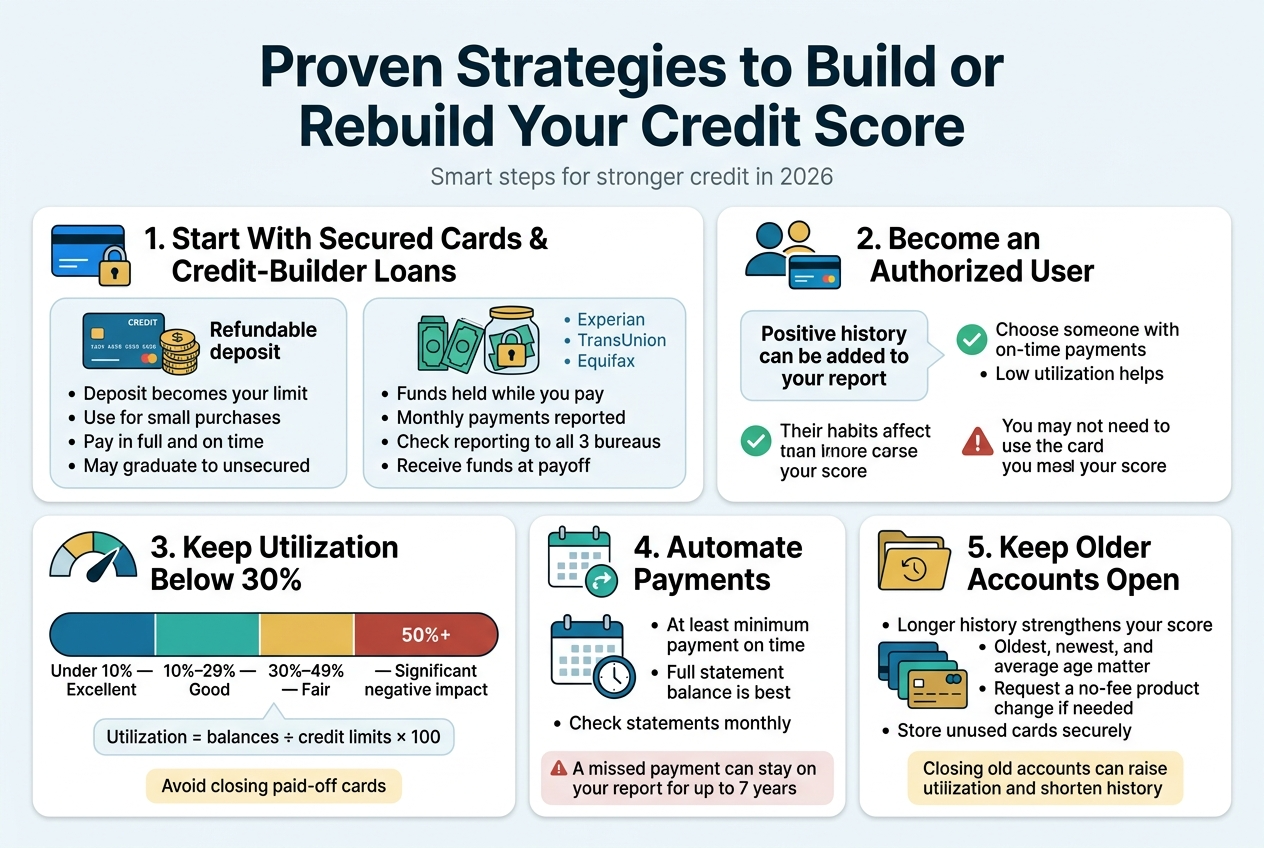
Starting From Scratch With Secured Cards and Credit-Builder Tools
When you have little to no credit history — or a damaged one — traditional lenders are rarely willing to take a chance on you. That’s where secured credit cards and credit-builder loans come in as two of the most reliable entry points for rebuilding your credit score in 2026.
A secured credit card functions exactly like a regular credit card, with one key difference: you provide a refundable security deposit upfront, typically a few hundred dollars, which usually becomes your credit limit. This deposit reduces the lender’s risk, making approval far more accessible even with poor or no credit. The strategy here is simple — use the card for small, manageable purchases, then pay the balance in full and on time each month. Over time, responsible use gets reported to the credit bureaus and gradually lifts your score. Many issuers will also allow you to graduate to an unsecured card once you’ve demonstrated consistent, responsible borrowing behavior.
A credit-builder loan takes a slightly different approach. Instead of receiving the loan funds upfront, the borrowed amount is held in a savings account or certificate of deposit while you make fixed monthly payments. As you repay the loan, your payment activity is reported to the three major credit bureaus — Experian, TransUnion, and Equifax. Once the loan is fully repaid, you receive the saved funds. One important caveat: confirm that your lender reports to all three bureaus, as not every lender does.
Becoming an Authorized User on a Responsible Person’s Account
One of the fastest and most underutilized boost credit score strategies is becoming an authorized user on someone else’s credit card account. When a family member or trusted friend adds you to their account, the positive history tied to that account — including on-time payments and low utilization — can be reflected on your credit report.
The key word here is responsible. The primary cardholder’s habits directly affect your credit profile. If they carry high balances or miss payments, that negative activity can work against you rather than for you. Before accepting this arrangement, make sure the account has a strong payment history and a low credit utilization rate. You don’t even need to use the card; simply being listed as an authorized user can be enough to benefit your score.
Keeping Credit Utilization Below 30 Percent
Credit utilization — the ratio of your credit card balances to your total credit limits — accounts for up to 30% of your credit score. It’s one of the most impactful levers you can pull when working on credit score improvement in 2026.
To calculate your utilization rate, divide your total credit card balances by your total credit limits, then multiply by 100. You should track this both per card and across all accounts combined.
Here’s a quick reference:
| Utilization Rate | Impact on Credit Score |
|---|---|
| Under 10% | Excellent |
| 10%–29% | Good |
| 30%–49% | Fair — begin reducing balances |
| 50% and above | Significant negative impact |
Keeping your utilization below 30% is the standard recommendation, but the lower, the better. If you’re currently above that threshold, pay down balances as aggressively as your budget allows. Avoid closing paid-off credit cards, since doing so reduces your total available credit and can instantly spike your utilization rate — even if your balances stay the same.
Automating Payments to Protect Your Payment History
Payment history is the single largest factor in your credit score, making up 35% of your FICO® Score. A single missed payment — reported once it’s 30 or more days overdue — can remain on your credit report for up to seven years. With stakes that high, automation isn’t just convenient; it’s a critical safeguard.
Setting up autopay directly through your lender or bank ensures your accounts are always paid on time, eliminating the risk of forgetting a due date. At minimum, automate the minimum payment required on each account to prevent late marks. Ideally, set autopay to cover the full statement balance each month to avoid accumulating interest.
A few things to keep in mind when automating payments:
- Ensure sufficient funds in your linked bank account before each payment date to avoid overdraft fees or returned payments.
- Review autopay settings periodically, especially if your minimum payment amount changes.
- Don’t rely solely on autopay — check your statements monthly to catch errors or unauthorized charges early.
If you’re already carrying past-due accounts, bring them current as quickly as possible. The longer an account remains delinquent, the greater the damage to your score.
Maintaining Older Accounts to Strengthen Credit History Length
Credit history length plays a meaningful role in your overall score. Lenders want to see a long track record of responsible borrowing, and the age of your oldest account, your newest account, and the average age of all your accounts all factor into this calculation.
With this in mind, one of the most common credit score mistakes to avoid is closing old credit accounts after paying them off. It may feel like financial housekeeping, but it can backfire by shortening your credit history and simultaneously increasing your credit utilization rate.
Even accounts you rarely use are worth keeping open. If an annual fee is the issue, contact your card issuer and request a product change to a no-fee version of the card. To reduce the temptation of overspending on cards you want to keep dormant, remove them from your online shopping accounts and store the physical cards securely at home.
The longer your accounts remain open and in good standing, the stronger the foundation your credit history provides — and that longevity becomes increasingly valuable as you prepare for major financial goals ahead.
Your Step-by-Step Credit Comeback Plan
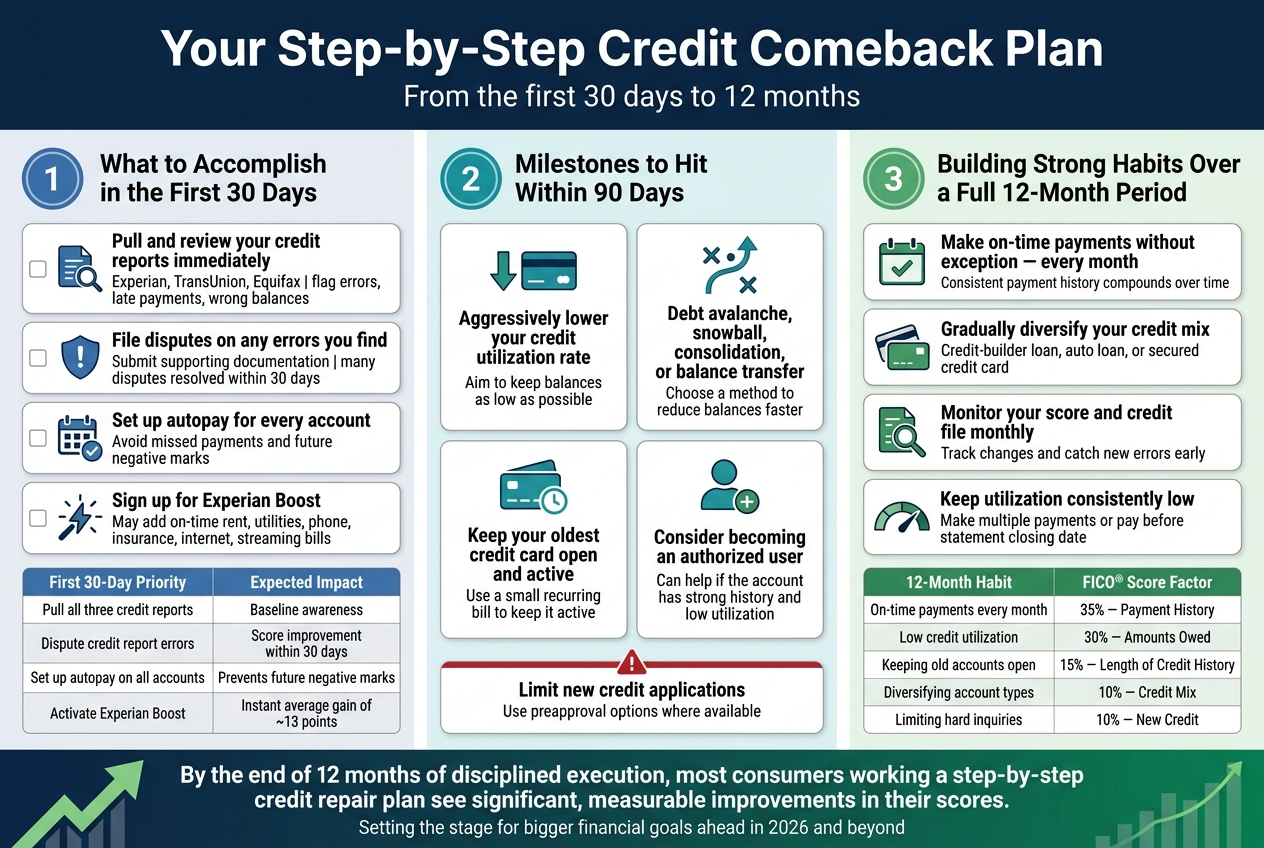
What to Accomplish in the First 30 Days
The first 30 days of your credit comeback plan are about building a solid foundation. Think of this phase as triage — you’re assessing the damage and putting the right systems in place before anything else.
Pull and review your credit reports immediately. Request your free weekly reports from all three bureaus — Experian, TransUnion, and Equifax — through AnnualCreditReport.com. Read every line carefully. Flag any accounts you don’t recognize, incorrect balances, or payment statuses that don’t match your records. Inaccurate information, especially something as serious as a falsely reported late payment, can significantly drag down your score.
File disputes on any errors you find. You have the legal right to dispute inaccurate information directly with each credit bureau. Submit your disputes with supporting documentation. Most credit disputes are resolved within 30 days, and if a bureau confirms your dispute is valid, the negative item will be corrected or removed — giving your score an immediate lift.
Set up autopay for every account. Payment history is the single most powerful factor in your FICO® Score, accounting for 35% of the total. A single missed payment reported after 30 days stays on your credit report for seven years. Eliminate that risk entirely by enabling autopay for at least the minimum due on every account.
Sign up for Experian Boost. This free tool lets you connect your bank accounts and get credit for on-time payments on bills that typically aren’t reported to the bureaus — including rent, utilities, cell phone, insurance, internet, and even eligible streaming services like Netflix or Hulu. Most users see an average increase of 13 points instantly, with no negative risk to your score from signing up.
| First 30-Day Priority | Expected Impact |
|---|---|
| Pull all three credit reports | Baseline awareness |
| Dispute credit report errors | Score improvement within 30 days |
| Set up autopay on all accounts | Prevents future negative marks |
| Activate Experian Boost | Instant average gain of ~13 points |
Milestones to Hit Within 90 Days
Now that we’ve covered the critical first steps, the 90-day window is where your habits begin to produce measurable results. This phase focuses on reducing what you owe and strategically managing your existing accounts.
Aggressively lower your credit utilization rate. Amounts owed make up 30% of your FICO® Score, and your credit utilization ratio — how much revolving credit you’re using compared to your total available credit — is a key element within that category. Aim to keep your utilization as low as possible. If you’re carrying high balances across one or more credit cards, make paying them down the top financial priority of this period.
Effective methods for knocking down balances include:
- Debt avalanche method — Pay minimums on all cards and put extra funds toward the highest-interest balance first
- Debt snowball method — Pay off the smallest balances first to build momentum
- Debt consolidation loan — Combine multiple balances into one lower-interest payment
- Balance transfer card — Move high-interest debt to a card with a 0% introductory APR
Credit card issuers typically report balance information to the bureaus once a month, so as your balances drop, score improvements often follow within a few billing cycles.
Keep your oldest credit card open and active. Length of credit history accounts for 15% of your FICO® Score, heavily influenced by the age of your oldest account. If you’re not using an older card, put a small recurring bill on it to keep it active. Closing it would eliminate that available credit immediately, which can spike your utilization ratio and hurt your score — even if your payment history on the card was spotless.
Consider becoming an authorized user. If you have a trusted family member or close friend with a strong credit history and a low-utilization credit card, ask them to add you as an authorized user. Once added, the full history of that account is typically reported to the bureaus within one to two months. This can provide a meaningful positive boost, especially if your credit profile is thin or recovering.
Limit new credit applications. Every hard inquiry from a new credit application can reduce your score by a few points, and multiple inquiries in a short window have a compounding effect. During this 90-day phase, only apply for new credit if it’s essential. Use preapproval options where available — these rely on soft inquiries that don’t affect your score.
Building Strong Habits Over a Full 12-Month Period
With this in mind, the 12-month phase is where real credit transformation happens. The moves you make here determine whether your improvement is temporary or becomes a permanent upward trajectory.
Make on-time payments without exception — every month. The positive impact of consistent, on-time payments compounds over time. While a past late payment can linger on your report for seven years, its negative influence weakens steadily as you build a longer streak of clean payment history. By month 12, a full year of perfect payments sends a powerful signal to scoring models.
Gradually diversify your credit mix. Credit mix accounts for 10% of your FICO® Score. Over a 12-month period, you may naturally add different account types — a credit-builder loan, an auto loan, or a secured credit card. Don’t take on debt you don’t need just to improve your mix, but as legitimate financial needs arise, diversifying thoughtfully works in your favor.
Monitor your score and credit file monthly. Use Experian’s free daily credit report and FICO® Score access to track changes and catch any new errors early. Staying engaged with your credit file keeps you aware of what’s working and allows you to course-correct quickly if something unexpected appears.
Keep utilization consistently low. If you pay your card in full each month but still see high utilization due to low credit limits, consider making multiple payments per month or paying down balances before your statement closing date, since that’s typically when issuers report your balance to the bureaus.
| 12-Month Habit | FICO® Score Factor |
|---|---|
| On-time payments every month | 35% — Payment History |
| Low credit utilization | 30% — Amounts Owed |
| Keeping old accounts open | 15% — Length of Credit History |
| Diversifying account types | 10% — Credit Mix |
| Limiting hard inquiries | 10% — New Credit |
By the end of 12 months of disciplined execution, most consumers working a step-by-step credit repair plan see significant, measurable improvements in their scores — setting the stage for the bigger financial goals ahead in 2026 and beyond.
Special Situations: Recovering From Serious Credit Damage
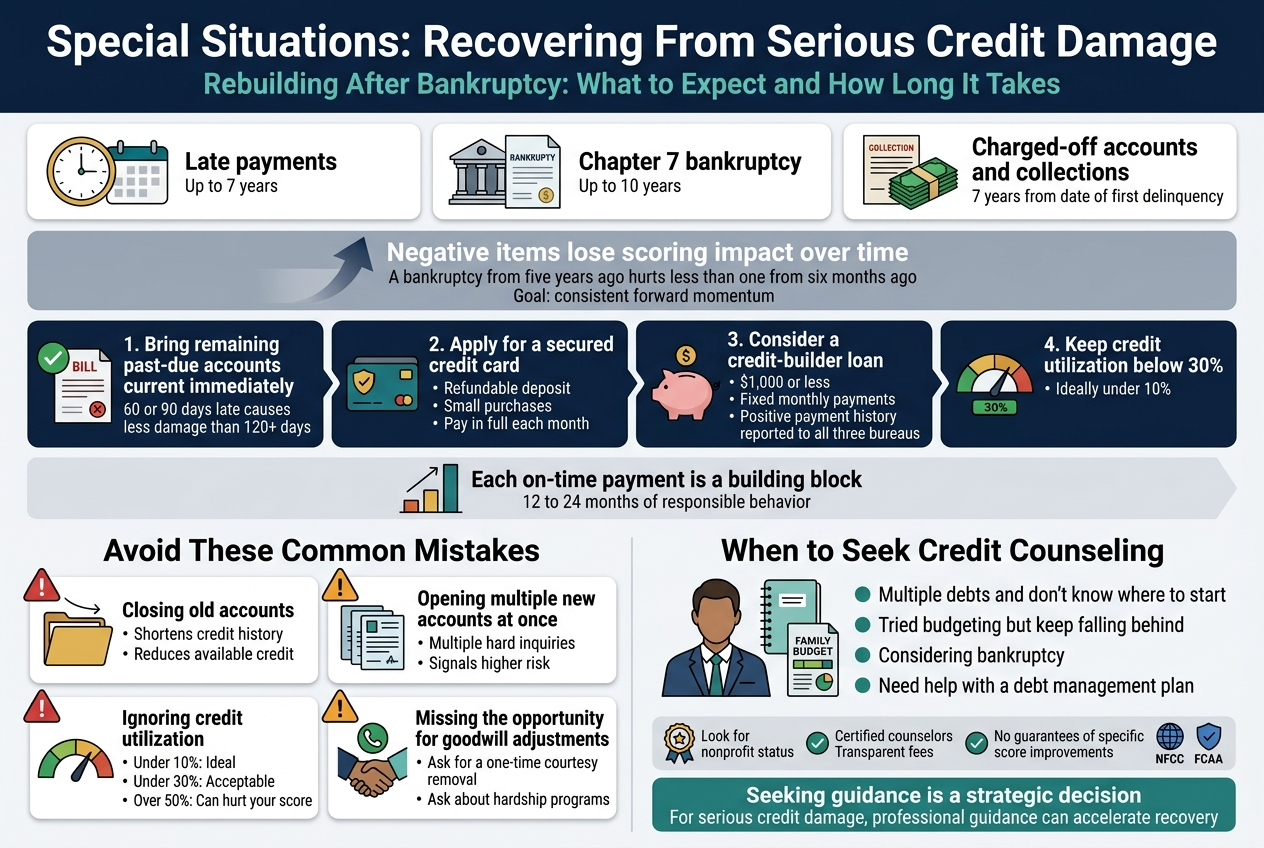
Rebuilding After Bankruptcy: What to Expect and How Long It Takes
Recovering from serious credit damage — whether from bankruptcy, foreclosure, or prolonged delinquency — is genuinely harder than recovering from a single missed payment, but it is far from impossible. The timeline is longer and the path requires more deliberate effort, but the same core principles of credit recovery still apply.
Here’s what you can realistically expect:
- Late payments stay on your credit report for up to seven years
- Bankruptcy (Chapter 7) remains on your report for up to 10 years
- Charged-off accounts and collections also linger for seven years from the date of first delinquency
The silver lining? Negative items lose their scoring impact over time, even before they fall off entirely. A bankruptcy from five years ago hurts your score far less than one from six months ago. Your goal in the early stages is not perfection — it’s consistent forward momentum.
To begin rebuilding after serious credit damage:
- Bring any remaining past-due accounts current immediately — even a payment that’s 60 or 90 days late causes less damage than one that reaches 120+ days
- Apply for a secured credit card — it requires a refundable security deposit that typically sets your credit limit, making approval accessible even with poor credit; use it for small purchases and pay the balance in full each month
- Consider a credit-builder loan — typically for $1,000 or less, these loans hold your borrowed funds in a savings account while you make fixed monthly payments; once repaid, you receive the funds and gain a positive payment history reported to all three credit bureaus
- Keep credit utilization below 30% — ideally under 10% — on any new accounts you open
Each on-time payment after a serious setback is a building block. Over 12 to 24 months of responsible behavior, lenders begin to see a pattern worth trusting again.
Avoiding Common Beginner Mistakes That Slow Down Recovery
With this in mind, one of the biggest obstacles people face when trying to recover from bad credit isn’t lack of effort — it’s well-intentioned moves that accidentally set them back. Here are the most damaging mistakes to avoid during your credit comeback:
Closing Old Accounts
After paying off a credit card, many people immediately close it. This feels responsible, but it works against you in two ways:
- It shortens your credit history, which accounts for 15% of your credit score
- It reduces your total available credit, which instantly raises your credit utilization ratio
Even if you rarely use an older account, keep it open. If you’re worried about overspending, remove the card details from online shopping accounts and leave the physical card at home.
Opening Multiple New Accounts at Once
Opening several new credit accounts in a short period triggers multiple hard inquiries on your credit report. Each hard inquiry can temporarily lower your score by a few points, and lenders may view a flurry of new accounts as a sign of financial desperation or higher risk.
Only apply for new credit when you genuinely need it — and when you do, research options you’re likely to qualify for before formally applying.
Ignoring Credit Utilization
Many people focus solely on making payments on time while letting their credit card balances creep up. Remember:
| Utilization Rate | Impact on Score |
|---|---|
| Under 10% | Ideal — helps optimize your score |
| Under 30% | Acceptable |
| Over 50% | Can significantly hurt your score |
To lower your utilization, you can make multiple payments throughout the month, request a credit limit increase (without increasing spending), or spread purchases across multiple cards.
Missing the Opportunity for Goodwill Adjustments
If you had a solid payment history before your setback, contact your creditor directly. Explain the situation and ask for a goodwill adjustment — a one-time courtesy removal of a late payment from your credit report. Many creditors will accommodate this request, especially for long-standing customers with otherwise clean records. They may also offer hardship programs, payment plans, or forbearance options you didn’t know existed.
When to Seek Credit Counseling or Professional Financial Guidance
Previously, this post has covered what you can do on your own to rebuild your credit — and the truth is, most credit repair steps are entirely DIY-friendly. Credit repair companies cannot do anything for you that you cannot do yourself, often for free. Be cautious of any company charging significant fees to dispute items on your behalf.
That said, there are situations where working with a nonprofit credit counseling agency is genuinely valuable:
- You’re overwhelmed by multiple debts and don’t know where to start
- You’ve tried budgeting but continue to fall behind
- You’re considering bankruptcy and want to explore all alternatives first
- You need help negotiating a debt management plan with creditors
Reputable nonprofit credit counselors review your full financial picture — income, expenses, debts, and goals — and help you build a realistic plan for budgeting, debt repayment, and long-term credit improvement. Look for certified counselors through organizations like the National Foundation for Credit Counseling (NFCC) or the Financial Counseling Association of America (FCAA).
A few things to look for when choosing a counselor:
- Nonprofit status — avoid for-profit “credit repair” companies
- Certified counselors — look for accreditation from recognized associations
- Transparent fees — reputable agencies offer free or low-cost initial consultations
- No guarantees of specific score improvements — any agency promising guaranteed results is a red flag
Seeking guidance is not a sign of failure. It’s a strategic decision that, for many people navigating serious credit damage, accelerates recovery and prevents costly missteps. If your situation involves bankruptcy, prolonged delinquency, or significant amounts of debt, professional guidance can be the difference between rebuilding in two years versus five.
Preparing for Big Financial Goals in 2026 and Beyond
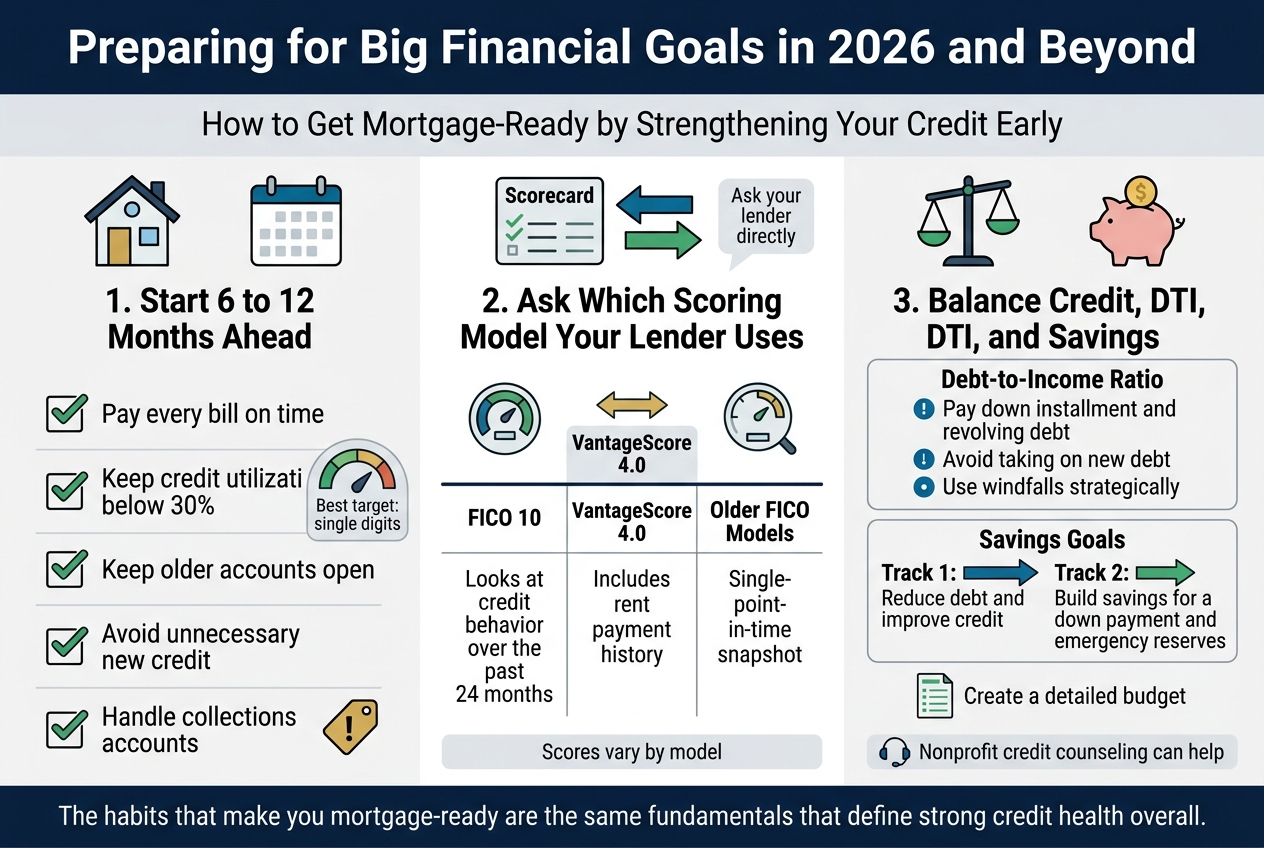
How to Get Mortgage-Ready by Strengthening Your Credit Early
Now that we’ve covered recovery strategies and special credit situations, it’s time to put everything into action for your biggest financial goals. If homeownership is on your radar for 2026 or beyond, understand this clearly: credit is only one piece of the mortgage puzzle. Lenders evaluate your full financial picture, and getting mortgage-ready means preparing all of it — not just your score.
Start your preparation 6 to 12 months ahead of when you plan to apply. This window gives you time to demonstrate the kind of stability lenders want to see — consistent on-time payments, manageable balances, and no sudden financial surprises. Here’s what to focus on during that runway:
- Pay every bill on time, every month. Payment history carries the most weight in virtually every scoring model. Set up autopay for at least the minimum payment on each account to eliminate the risk of a missed payment derailing your progress.
- Bring credit utilization below 30%. Lenders look closely at how much of your available revolving credit you’re using. Those with the strongest scores typically carry utilization in the single digits. Pay down high-interest balances first.
- Keep older accounts open. The length of your credit history matters. Closing long-standing accounts can shorten your average account age and immediately reduce your available credit limit — both of which can hurt your score right before a major application.
- Avoid applying for new credit unnecessarily. Each hard inquiry can cause a small, temporary dip. In the months leading up to a mortgage application, limit new credit activity so your score reflects stability, not urgency.
- Handle any collections accounts. Unpaid collections signal serious risk to mortgage lenders. Negotiate a payoff or settlement before you apply to reduce this red flag on your report.
The habits that make you mortgage-ready are the same fundamentals that define strong credit health overall — and the good news is they’re entirely within your control.
Confirming Which Scoring Model Your Lender Uses
With this in mind, one of the most important — and often overlooked — steps before applying for a mortgage is simply asking your lender which credit scoring model they use. This matters more in 2026 than it ever has before.
The mortgage industry is in the middle of a significant transition. Lenders can now use newer models like VantageScore 4.0 and FICO 10, alongside or instead of the older FICO models that have dominated lending decisions for decades. Each model weighs factors slightly differently, which means your score can vary depending on which model is being used.
Here’s a quick comparison of what these newer models emphasize:
| Scoring Model | Key Features Relevant to Borrowers |
|---|---|
| FICO 10 | Analyzes credit behavior patterns over the past 24 months, not just a single snapshot |
| VantageScore 4.0 | Incorporates rent payment history, helping borrowers with “thin” credit files |
| Older FICO Models | Single-point-in-time snapshot; do not factor in rent or trending data |
If your lender uses FICO 10, short-term fixes won’t move the needle as much — what matters is a consistent track record over two years. If they’re using VantageScore 4.0, adding documented rent payments to your credit report through services like Experian Boost could actually improve your standing.
The practical takeaway: ask your lender directly whether they use FICO, VantageScore, or both — and which version. Once you know that, you can align your credit improvement efforts with what that specific model rewards most. Scores vary by model, so working toward the wrong target wastes valuable time.
Balancing Credit Improvement With Debt-to-Income and Savings Goals
Previously, we’ve focused heavily on the credit score itself — but mortgage lenders don’t approve you on credit score alone. Your debt-to-income (DTI) ratio and your savings position carry equal, if not greater, weight in the final lending decision. Improving your credit score while neglecting these two factors can leave you unexpectedly disqualified even with a strong score.
Debt-to-Income Ratio
Your DTI measures how much of your monthly gross income goes toward debt payments. Mortgage lenders typically want this number to stay within acceptable limits, which means carrying high balances on auto loans, student loans, or credit cards can hurt your application — even if your credit score looks healthy.
To balance credit improvement with DTI goals:
- Prioritize paying down installment and revolving debt simultaneously, not just the accounts affecting your credit score most.
- Avoid taking on new debt in the lead-up to your application, even if it seems manageable. New loan payments increase your monthly obligations and push your DTI higher.
- Use windfalls strategically. Tax refunds, bonuses, or cash gifts are powerful tools — direct them toward high-interest balances to reduce both your utilization rate and your monthly debt load at the same time.
Savings Goals
A strong credit score won’t substitute for a down payment or cash reserves. Lenders want to see that you have funds available — not just creditworthiness. This means your financial plan needs to run two tracks simultaneously:
- Track 1: Reduce debt and improve credit
- Track 2: Build savings for a down payment and emergency reserves
Creating a detailed budget is the foundation for making both tracks work together. Knowing exactly what you earn, what you owe, and what you can save each month allows you to allocate resources strategically — paying down balances for credit improvement while consistently setting money aside for your down payment.
If balancing all of these priorities feels overwhelming, nonprofit credit counseling organizations offer free initial consultations with certified experts who can help you build a realistic plan that addresses credit, debt, and savings goals together — without sacrificing progress in any one area.
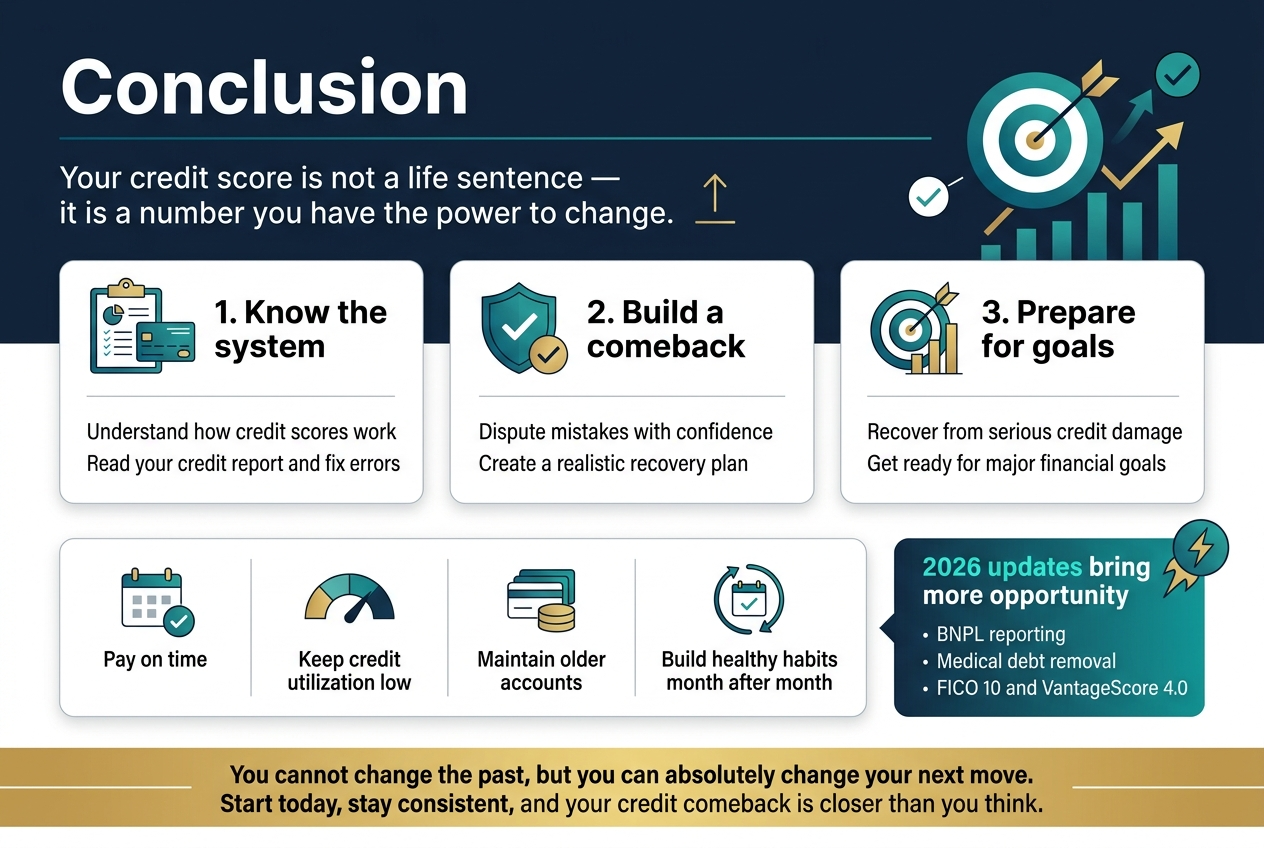
Your credit score is not a life sentence — it is a number you have the power to change. Throughout this blueprint, we have covered how credit scores really work, the major changes coming in 2026, how to read your credit report, fix errors, and dispute mistakes with confidence. We also walked through proven strategies to build or rebuild your score, create a realistic comeback plan, recover from serious credit damage, and prepare for the big financial goals you have ahead.
The good news is that the fundamentals have not changed. Paying on time, keeping your credit utilization low, maintaining older accounts, and building healthy credit habits month after month — these are still the moves that matter most, regardless of which scoring model your lender uses. The 2026 updates around BNPL reporting, medical debt removal, and new scoring models like FICO 10 and VantageScore 4.0 only create more opportunity for people willing to take action now. You cannot change the past, but you can absolutely change your next move. Start today, stay consistent, and your credit comeback is closer than you think.