

How Freelancers Can Estimate Project Time More Reliably
A practical guide to estimating project hours, setting realistic deadlines, managing client expectations, and improving freelance profitability.
Freelancing offers flexibility and independence, but managing time effectively is one of the skills that determines whether an independent business remains sustainable. Among the many responsibilities freelancers handle, estimating how long a project will take is particularly challenging.
A task that initially appears simple can become considerably more demanding once research, communication, revisions, testing, and unexpected problems are included.
For example, a freelance writer might agree to complete a website article in four hours. After starting the assignment, the writer discovers that the topic requires extensive research, competitor analysis, fact-checking, image selection, and multiple revisions. What seemed like a four-hour task eventually takes eight hours.
This creates problems beyond a delayed delivery. It can reduce effective hourly earnings, affect other commitments, and weaken the client’s confidence.
The solution is not simply to work faster or become better at guessing. Freelancers need a repeatable approach to project time estimation that considers the complete workload rather than just the main deliverable.
By understanding project requirements, breaking assignments into smaller activities, learning from previous projects, and accounting for uncertainty, freelancers can make more realistic commitments.
This guide explains how to do that through practical techniques, examples, and a reusable estimation framework.
Why Accurate Project Time Estimation Matters
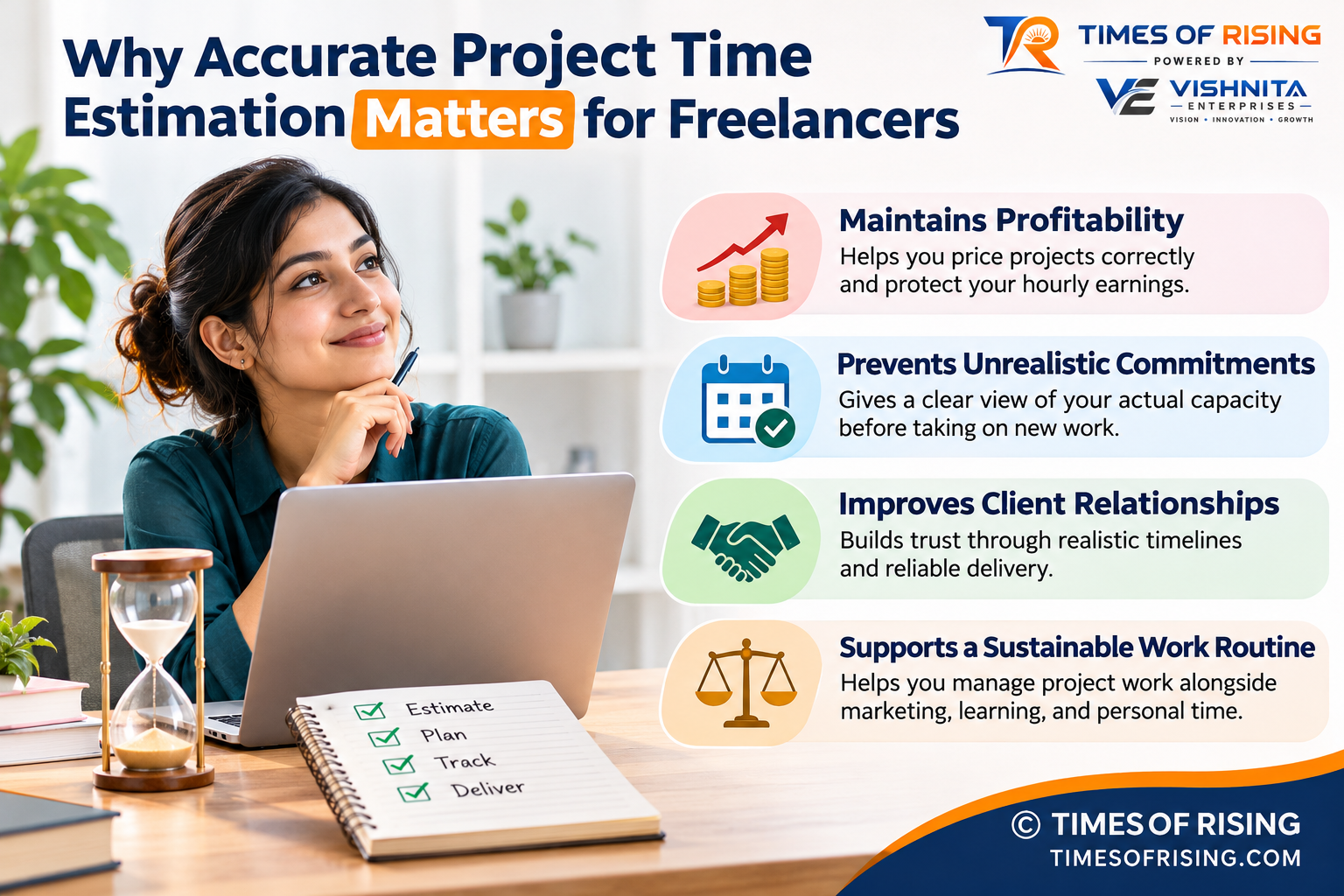
Time estimation is not just a scheduling exercise. It affects profitability, client relationships, workload management, and the ability to grow a freelance business.
1. It helps maintain profitability
Freelancers often charge a fixed project fee rather than billing for every hour worked. In this arrangement, underestimating the workload can directly reduce the amount earned for the time invested.
Consider a freelance graphic designer who quotes ₹12,000 for a branding project and expects to spend 20 hours completing it.
The expected hourly earnings are:
₹12,000 ÷ 20 = ₹600 per hour.
However, if the project takes 30 hours, the effective hourly earnings become:
₹12,000 ÷ 30 = ₹400 per hour.
The project fee has not changed, but the time required has increased by 50%.
This is why freelancers should understand the expected workload before quoting a price. A realistic estimate helps them determine whether the proposed fee adequately compensates them for their work.
2. It prevents unrealistic client commitments
Accepting several projects with overlapping deadlines can create unnecessary pressure.
Suppose a freelancer estimates that three assignments will each take one working day. In reality, the first assignment may require two days, leaving insufficient time for the remaining commitments.
Reliable estimates help freelancers understand their actual capacity before accepting new projects.
They can communicate delivery dates more confidently instead of repeatedly requesting extensions.
3. It improves client relationships
Clients appreciate predictable communication and realistic expectations.
When freelancers provide clear timelines, explain important project stages, and communicate potential delays early, clients have a better understanding of how the work will progress.
A realistic commitment is generally more valuable than an ambitious promise that cannot be fulfilled.
4. It supports a sustainable working routine
Freelancers manage several responsibilities beyond client assignments. These include marketing, preparing proposals, attending meetings, managing finances, and developing professional skills.
If every available hour is treated as billable project time, there is little room for these additional activities.
Accurate estimation makes it easier to reserve time for non-project responsibilities, personal commitments, and unexpected changes.
1. Understand the Complete Project Scope Before Estimating

One of the biggest mistakes freelancers make is estimating a project based on its main deliverable alone.
For example, a client requests a five-page business website. A freelancer might immediately estimate the time needed to design and develop those pages.
However, completing the project may also involve:
- Understanding the client’s business and requirements.
- Reviewing reference websites.
- Planning the website structure.
- Selecting or preparing visual assets.
- Writing or editing website content.
- Designing individual pages.
- Developing responsive layouts.
- Testing functionality across devices.
- Fixing technical issues.
- Collecting feedback.
- Making agreed revisions.
- Preparing the website for handover.
Ignoring these activities creates an incomplete estimate.
Before calculating project hours, freelancers should understand exactly what the client expects to receive.
A useful approach is to ask a few practical questions:
What is the final deliverable? Understand the exact output the client expects.
How many components are involved? Identify pages, sections, designs, features, documents, or other individual elements.
What resources will the client provide? Find out whether content, images, branding materials, research, or technical access are already available.
How many revision rounds are included? Establish the expected feedback and correction process.
Are there external dependencies? Identify approvals, third-party integrations, client decisions, and other factors that could affect delivery.
What does completion mean? Agree on the conditions that must be satisfied before the project is considered finished.
These questions turn a broad project description into something that can be estimated more objectively.
For example, instead of estimating a project described as “create a business website,” a freelancer can estimate a defined scope consisting of five pages, a contact form, mobile responsiveness, basic on-page SEO, and two revision rounds.
The second description provides a much stronger foundation for calculating time.
2. Break Large Projects Into Smaller Tasks
Once the project scope is clear, divide it into smaller activities.
This technique is commonly called bottom-up estimation. Instead of guessing how long the complete project will take, the freelancer estimates each component separately and adds the results together.
Consider a freelance content writer hired to produce a detailed blog article.
| Project activity | Estimated time |
|---|---|
| Understanding the brief | 20 minutes |
| Keyword and topic research | 45 minutes |
| Reviewing reliable sources | 40 minutes |
| Creating the outline | 25 minutes |
| Writing the first draft | 120 minutes |
| Editing and proofreading | 35 minutes |
| Formatting and SEO checks | 25 minutes |
| Final quality review | 20 minutes |
| Total | 330 minutes |
The estimated working time is 5.5 hours.
This estimate is more useful than the initial guess because it identifies where the time will actually be spent.
The same method works for other freelance services.
| Freelance service | Tasks to estimate |
|---|---|
| Graphic design | Research, concepts, design, revisions, export |
| Web development | Requirements, planning, coding, testing, deployment |
| Video editing | Footage review, editing, sound, effects, rendering |
| SEO services | Audit, keyword research, optimization, reporting |
| Virtual assistance | Task review, execution, communication, verification |
| Social media management | Planning, content creation, scheduling, reporting |
The important principle is to divide work into tasks that are specific enough to estimate independently.
If a task still feels too broad, break it down further.
3. Use Previous Project Data Instead of Relying on Memory
Experience is valuable, but memory is not always a reliable estimation tool.
A freelancer may remember completing a similar assignment quickly while overlooking the additional time spent communicating with the client, correcting mistakes, or resolving unexpected issues.
This is why recording actual working hours can improve future estimates.
After completing a project, compare the original estimate with the time actually spent.
| Activity | Estimated hours | Actual hours |
|---|---|---|
| Research | 1 | 1.5 |
| Drafting | 2 | 2.5 |
| Editing | 0.5 | 1 |
| Formatting | 0.5 | 0.75 |
| Client revisions | 0.5 | 1 |
| Total | 4.5 | 6.75 |
The freelancer initially expected the project to take 4.5 hours, but the actual workload was 6.75 hours.
This comparison reveals useful information.
Research, editing, formatting, and client revisions all took longer than expected. Instead of repeating the same mistake on the next assignment, the freelancer can adjust the estimates.
Build a simple project history
Maintain a spreadsheet containing:
- Project name or category.
- Type of service.
- Estimated hours.
- Actual hours.
- Number of revision rounds.
- Unexpected tasks.
- Major reasons for delays.
- Lessons for future estimates.
After completing several similar projects, patterns become easier to identify.
For example, a freelance designer might discover that creating an individual social media graphic consistently takes 45 minutes, while preparing a complete campaign with multiple formats requires considerably more time.
Historical information makes it possible to estimate future assignments using actual experience rather than assumptions.
This is known as analogous estimation: using the results of comparable previous projects as a starting point for a new estimate.
However, comparisons should account for differences in complexity, client requirements, and available resources.
4. Apply Three-Point Estimation to Uncertain Tasks
Not every freelance assignment has predictable requirements.
Some projects involve unfamiliar technologies, complicated research, unclear instructions, or dependencies outside the freelancer’s control.
In these situations, choosing a single estimated duration can create a false sense of certainty.
Three-point estimation offers a practical alternative.
It uses three possible time estimates:
- Optimistic estimate: How long the task might take if everything goes smoothly.
- Most likely estimate: How long it will probably take under normal working conditions.
- Pessimistic estimate: How long it might take if reasonable complications occur.
A commonly used weighted formula is:
Expected time = (O + 4M + P) ÷ 6
Where:
- O = Optimistic time.
- M = Most likely time.
- P = Pessimistic time.
Consider a freelance developer estimating a new website integration.
| Scenario | Estimated time |
|---|---|
| Optimistic | 3 hours |
| Most likely | 5 hours |
| Pessimistic | 9 hours |
Applying the formula:
Expected time = [3 + (4 × 5) + 9] ÷ 6
Expected time = 32 ÷ 6
Expected time ≈ 5.33 hours.
The expected working time is approximately 5 hours and 20 minutes.
This method is particularly useful when a freelancer understands the work but cannot predict every complication.
It also encourages better conversations with clients because the freelancer can explain why certain activities have a wider estimation range.
The three-point approach is not a guarantee of completion time. Its usefulness depends on how realistic the three scenarios are.
5. Separate Actual Working Time From Calendar Time
One important distinction freelancers should understand is the difference between effort and duration.
These two concepts are related, but they do not mean the same thing.
Effort refers to the amount of work required to complete a task.
Duration refers to the amount of elapsed time between starting and completing that task.
For example, a freelancer may need 12 hours to complete a website design.
If the freelancer can dedicate only three hours per day to the project, the work will require approximately four working days.
However, the actual delivery timeline may be longer if the project requires client approvals or feedback.
Consider the following example:
- Actual design work: 12 hours.
- Daily availability: 3 hours.
- Working days required: 4 days.
- Client feedback period: 2 calendar days.
- Final correction and handover: 1 working day.
The project could take seven calendar days or longer, depending on when the client responds and when the freelancer is available.
This distinction matters when communicating deadlines.
A freelancer should not tell a client that a project will be delivered in 12 hours simply because the estimated workload is 12 working hours.
Instead, communicate both the expected effort and the expected delivery date.
6. Include Communication, Revisions, and Administrative Work
Some activities do not directly produce the final deliverable, but they still consume valuable working time.
Freelancers frequently underestimate these activities because they focus primarily on the creative or technical portion of the assignment.
Consider what happens after a client accepts a proposal.
The freelancer may need to:
- Attend an introductory meeting.
- Review project documents.
- Clarify requirements.
- Respond to emails.
- Share progress updates.
- Explain design or technical decisions.
- Collect feedback.
- Prepare invoices.
- Organize final files.
- Complete the handover.
These activities should be included in the project estimate whenever they are part of the agreed service.
Estimate revision time separately
Revisions deserve particular attention.
A project that includes two rounds of revisions is different from one that includes unlimited changes.
For example, a freelance designer may estimate:
| Revision activity | Estimated time |
|---|---|
| Reviewing client feedback | 20 minutes |
| Implementing first-round changes | 45 minutes |
| Reviewing second-round feedback | 15 minutes |
| Implementing final changes | 40 minutes |
| Final quality check | 15 minutes |
| Total | 135 minutes |
This adds 2 hours and 15 minutes to the project.
The freelancer should clearly explain what constitutes a revision and what would count as additional work.
A change to the agreed design may be a revision, while requesting an entirely new design direction could represent a scope change.
Clear boundaries help prevent disagreements.
7. Add a Contingency Buffer Without Inflating Every Estimate
Even well-planned projects can encounter unexpected difficulties.
A client may provide incomplete information, a software integration may require troubleshooting, or a technical issue may take longer to resolve than anticipated.
A contingency buffer provides room for reasonable uncertainty.
However, freelancers should avoid adding an arbitrary amount of extra time to every task.
Instead, consider the project’s complexity and identify where uncertainty actually exists.
For example:
| Project component | Estimated time |
|---|---|
| Research | 2 hours |
| Planning | 1 hour |
| Main execution | 5 hours |
| Testing | 1 hour |
| Revisions | 1.5 hours |
| Base estimate | 10.5 hours |
Suppose the freelancer identifies additional uncertainty around technical implementation and client feedback.
An illustrative contingency allowance of 15% would be:
10.5 × 0.15 = 1.575 hours.
The adjusted estimate becomes:
10.5 + 1.575 = 12.075 hours.
The working estimate is approximately 12 hours.
The 15% figure is an example, not a universal industry standard. A familiar, repetitive task may need little additional allowance, while a complex or unfamiliar project may require a wider range.
The goal is to make uncertainty visible rather than pretending that every task will proceed perfectly.
8. Identify Tasks That Depend on Other People
A freelancer may control the quality and speed of their own work, but they cannot always control how quickly clients, suppliers, or external service providers respond.
This is an important source of scheduling errors.
For example, a website developer may finish the initial website structure but still need the client to provide:
- Final website content.
- Product photographs.
- Brand guidelines.
- Hosting credentials.
- Approval of the proposed design.
If these materials are delayed, the project may remain incomplete even when the developer has finished all the tasks currently available.
To avoid this problem, freelancers should identify dependencies before confirming delivery dates.
A practical approach is to divide project activities into three categories:
Tasks under your control: Research, writing, designing, coding, and testing.
Tasks requiring client input: Approvals, feedback, documents, content, and access credentials.
Tasks requiring external support: Third-party integrations, hosting providers, payment gateways, or specialist services.
This classification helps freelancers distinguish between working time and waiting time.
It also makes communication easier. Rather than promising an unconditional delivery date, explain which milestones depend on receiving specific information or approvals.
For instance:
“The initial design will be shared within three working days after receiving the required brand assets. The final delivery date will depend on the agreed feedback period.”
Such statements make expectations clearer without creating unnecessary complications.
9. Estimate Based on Your Actual Working Capacity
A freelancer’s total available time is not the same as the time available for client projects.
Running an independent business requires several activities that do not generate direct project deliverables.
These include:
- Finding new clients.
- Preparing proposals.
- Marketing services.
- Maintaining a portfolio.
- Learning new skills.
- Managing finances.
- Handling administrative work.
- Attending networking meetings.
If a freelancer considers eight hours every day available for client work, their schedule may quickly become unrealistic.
A better approach is to calculate actual project capacity.
Suppose a freelancer works approximately 40 hours per week.
| Activity | Weekly time |
|---|---|
| Client project work | 25 hours |
| Client communication | 4 hours |
| Marketing and proposals | 4 hours |
| Administration | 3 hours |
| Learning and professional development | 2 hours |
| Unallocated time | 2 hours |
| Total | 40 hours |
In this example, the freelancer has approximately 25 hours available for direct project execution.
This is the number that should guide project commitments, not the full 40-hour working week.
It is also sensible to avoid filling every available project hour. Leaving some capacity unallocated makes it easier to accommodate urgent requests, unexpected problems, and changes in priorities.
10. Avoid Common Time Estimation Mistakes
Even experienced freelancers can develop habits that lead to inaccurate estimates.
Recognizing these mistakes is an important step toward improving project planning.
Estimating based on the best-case scenario
Some freelancers calculate project time assuming that every task will go smoothly.
They overlook the possibility of technical difficulties, additional research, or unexpected client feedback.
A better approach is to use the most likely scenario as the starting point and separately consider realistic complications.
Forgetting small activities
A five-minute client call or a ten-minute file adjustment may seem insignificant.
However, several small activities across a project can add up to a substantial amount of time.
Include recurring communication and administrative tasks in your calculations.
Accepting unclear requirements
When clients provide incomplete instructions, freelancers sometimes begin work immediately to avoid losing the opportunity.
This can lead to repeated corrections and disagreements about what was originally expected.
Clarify important requirements before committing to a fixed timeline.
Treating every project as identical
Two assignments may have similar deliverables but different levels of difficulty.
For example, writing two 1,000-word articles does not necessarily require the same amount of time. One might involve general research, while the other requires reviewing technical documentation and verifying multiple sources.
Use previous projects as reference points, not unquestionable templates.
Ignoring interruptions
Freelancers rarely work in uninterrupted conditions throughout the day.
Emails, messages, meetings, technical problems, and personal responsibilities can affect productivity.
Estimate actual focused working time rather than assuming that every scheduled hour will be equally productive.
Failing to update estimates
An estimate created before a project starts should not remain unchanged when the requirements become significantly different.
If a client requests additional functionality or changes the agreed deliverables, reassess the workload and communicate the impact.
A reliable estimate is a working forecast, not an unchangeable promise.
11. Use Simple Tools to Improve Time Estimation
Freelancers do not necessarily need complicated project management software to estimate their work accurately.
A basic spreadsheet and a consistent time-tracking habit can provide substantial value.
The right tools depend on the type of work, number of clients, and complexity of projects.
Time-tracking tools: These help record how much time is spent on individual activities and projects.
Project management tools: These help organize tasks, deadlines, dependencies, and progress.
Spreadsheets: These are useful for calculating estimates, comparing planned and actual hours, and maintaining project history.
Calendar applications: These help freelancers reserve working periods and avoid scheduling overlapping commitments.
A practical combination might include a spreadsheet for estimation, a calendar for scheduling, and a time tracker for recording actual work.
The objective is not to spend more time managing tools than completing projects.
Choose a simple system that is easy to maintain consistently.
12. Create a Repeatable Project Time Estimation Process
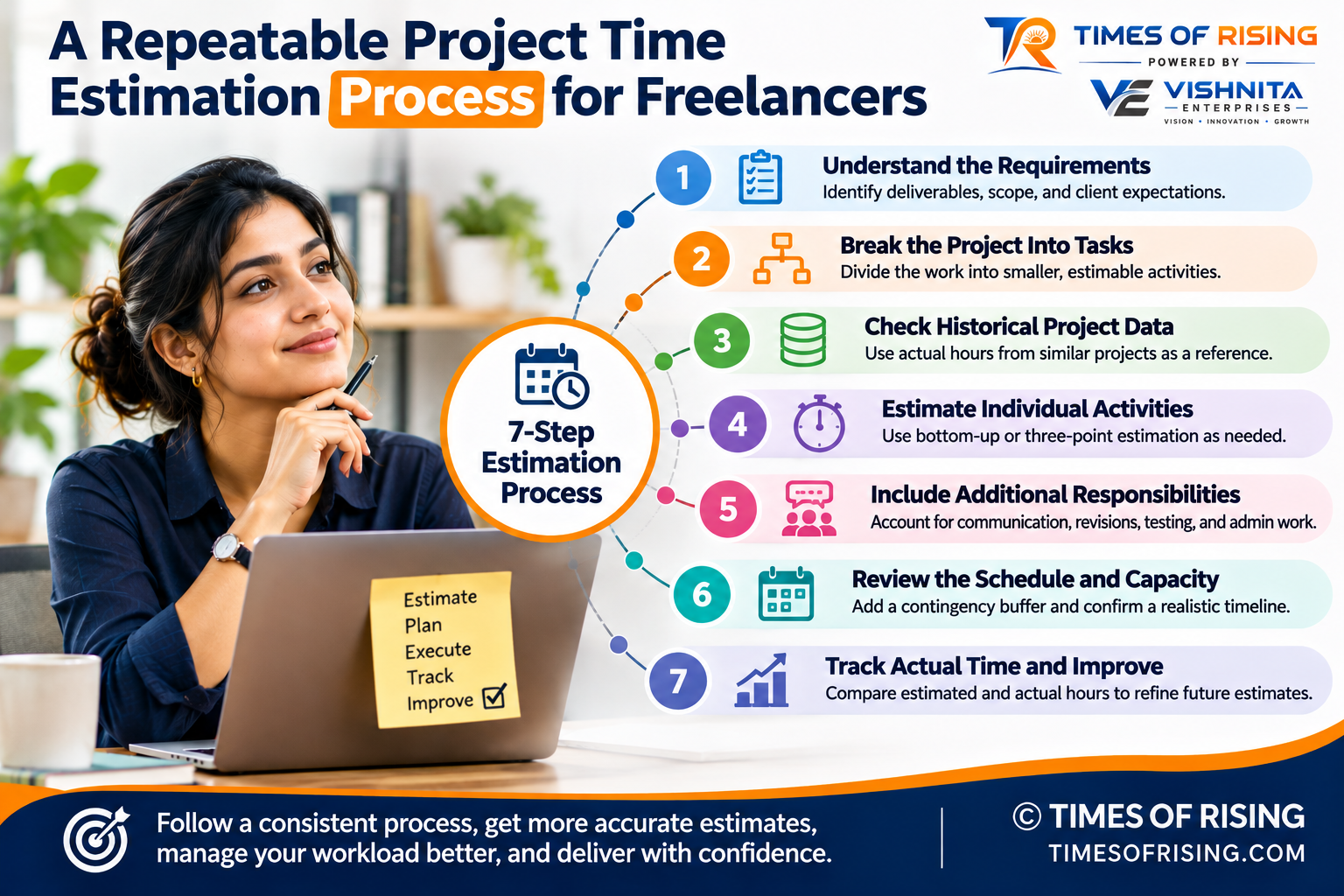
The techniques discussed above become more effective when combined into one standard workflow.
Freelancers can use the following process whenever they receive a new project inquiry.
Step 1: Understand the requirements
Identify deliverables, project boundaries, expected quality, and client expectations.
Step 2: Break the project into tasks
Divide the work into smaller activities that can be estimated independently.
Step 3: Check historical project data
Review actual hours from similar assignments to establish a realistic baseline.
Step 4: Estimate individual activities
Use bottom-up estimation for defined tasks and three-point estimation for uncertain activities.
Step 5: Include additional responsibilities
Account for communication, revisions, testing, administrative work, and dependencies.
Step 6: Review the schedule and capacity
Add an appropriate contingency allowance and check whether the delivery date is achievable.
Step 7: Track actual time and improve
Compare estimated and actual hours after delivery and use the findings for future projects.
This process creates a consistent foundation for project decisions. It also becomes faster as the freelancer develops a library of previous estimates and actual project results.
13. A Practical Project Time Estimation Template
A reusable template can make estimation easier, especially for freelancers who regularly accept similar assignments.
The following example can be adapted for writing, design, development, marketing, and other professional services.
| Estimation component | Example |
|---|---|
| Project name | Business website redesign |
| Main deliverable | Five redesigned website pages |
| Requirements review | 1 hour |
| Research and planning | 2 hours |
| Design work | 8 hours |
| Development | 12 hours |
| Testing | 2 hours |
| Revisions | 3 hours |
| Communication and handover | 1 hour |
| Base working estimate | 29 hours |
| Contingency allowance (15%) | 4.35 hours |
| Adjusted working estimate | 33.35 hours |
This gives the freelancer an estimated workload of approximately 33.5 hours.
However, the freelancer should still consider daily availability, client feedback, and external dependencies before confirming a calendar delivery date.
A template like this can be saved and reused whenever a similar project arrives.
Over time, estimated hours can be replaced or adjusted using actual historical data.
Compare estimates with actual results
After completing the project, calculate the difference between estimated and actual hours.
For example:
- Original estimate: 33.35 hours.
- Actual time: 36 hours.
- Difference: 2.65 hours.
The estimation variance can be calculated as:
Variance (%) = [(Actual hours − Estimated hours) ÷ Estimated hours] × 100
In this example, the positive variance is approximately 7.95%.
This indicates that the project took slightly longer than expected.
The freelancer can investigate which activities caused the difference and adjust future estimates accordingly.
Repeated comparisons gradually reveal whether estimates are consistently too optimistic, too conservative, or reasonably accurate.
14. How to Communicate Estimated Timelines to Clients
Even a well-calculated estimate can create problems if it is communicated poorly.
Clients need to understand what the estimated time includes, when they can expect important milestones, and what circumstances could change the delivery date.
Instead of providing a single deadline without explanation, freelancers should communicate the project schedule in a structured manner.
For example, a freelance designer might explain:
- Initial research and planning: First two working days.
- Design development: Next three working days.
- Initial presentation: End of the first project week.
- Client feedback: Within two agreed working days.
- Final adjustments and handover: After receiving consolidated feedback.
This approach gives the client a better understanding of the workflow.
Clearly communicate assumptions
A project estimate should state the conditions under which it remains valid.
These might include:
- The client supplies all required materials on time.
- The agreed number of revision rounds is followed.
- The project scope remains unchanged.
- Feedback is provided within the agreed period.
- Additional features are discussed and estimated separately.
If the requirements change significantly, the freelancer should review the original estimate and discuss the additional time before proceeding.
Avoid presenting estimates as guarantees
An estimate is a reasoned prediction, not a guarantee that every possible situation has been accounted for.
For complex projects, it may be more useful to communicate a delivery window than to promise an exact completion time.
For example, “The project is expected to take between seven and nine working days after all required materials are received” is often more realistic than promising completion in exactly seven days.
Transparency helps establish professional expectations and reduces the possibility of misunderstandings.
15. Improve Your Estimation Skills With Every Completed Project
Reliable time estimation is not something freelancers master after reading a single guide. It develops through repeated practice, observation, and adjustment.
Every completed assignment provides information about how work actually happens.
A freelancer should periodically review:
- Which activities consistently take longer than expected?
- Which types of projects are easiest to estimate?
- Are client revisions consuming more time than anticipated?
- Are certain projects associated with longer approval periods?
- Are deadlines realistic given the current workload?
- Which activities could be standardized or automated without reducing quality?
These questions help identify weaknesses in the estimation process.
For example, a freelance content writer might discover that outlining articles takes less time than expected, but verifying information and formatting content consistently require additional effort.
A developer might find that initial coding estimates are accurate, but testing and troubleshooting are regularly underestimated.
These observations should influence future calculations.
It is also useful to review estimation performance periodically rather than making adjustments after every minor difference. A few projects may contain unusual circumstances, whereas patterns across several assignments provide more meaningful information.
The long-term objective is to develop a reliable personal estimation system based on actual working habits, professional experience, and the types of projects regularly accepted.
Conclusion: Better Estimates Lead to Better Freelance Decisions
Estimating project time reliably is an essential business skill for freelancers. It affects profitability, client satisfaction, workload management, and the ability to deliver projects consistently.
The most effective approach is to stop relying on a single overall guess and start examining the complete workload.
Understand the client’s requirements, divide projects into smaller tasks, use historical data, account for uncertainty, and distinguish working hours from calendar delivery time. Communication, revisions, testing, and administrative responsibilities should also be included in the calculation.
Most importantly, compare estimated hours with actual working hours after every project.
Freelancers do not need to predict every complication perfectly. They need a practical system that helps them make informed decisions, recognize uncertainty, and adjust when circumstances change.
With consistent tracking and thoughtful planning, project estimation becomes more than a way to calculate deadlines. It becomes a valuable tool for building a sustainable freelance business and maintaining professional relationships over the long term.
Frequently Asked Questions
1. How do freelancers calculate project time?
Freelancers can calculate project time by identifying all project activities, estimating the hours required for each task, and adding the individual estimates together. They should also account for research, communication, revisions, testing, and reasonable contingency time.
2. What is the best method for estimating freelance project hours?
Bottom-up estimation is particularly useful when project requirements are clearly defined. It involves breaking the project into smaller tasks and estimating each one separately. Three-point estimation can be added when individual activities involve uncertainty.
3. How much extra time should freelancers add to project estimates?
There is no universal percentage that works for every project. A freelancer should consider project complexity, familiarity, client dependencies, and historical experience. A contingency allowance of 10–20% can serve as an illustrative starting point for some projects, but higher-risk assignments may require more.
4. Why do freelancers underestimate project time?
Common reasons include unclear requirements, overlooking communication and revisions, relying on optimistic assumptions, ignoring interruptions, and failing to consider previous project data.
5. How can freelancers track actual project hours?
Freelancers can use time-tracking applications, spreadsheets, or simple project logs. The important thing is to record time against individual activities so that future estimates can be based on actual working experience.
6. Should freelancers include client communication in project estimates?
Yes. Meetings, emails, requirement discussions, progress updates, and feedback reviews consume working time. These activities should be included when they form part of the agreed project responsibilities.
7. What is the difference between project effort and project duration?
Project effort refers to the total working hours required to complete an assignment. Project duration refers to the elapsed time between starting and completing it. A project requiring 20 working hours might take five working days if the freelancer can dedicate four hours per day.
8. How can freelancers estimate projects with unclear requirements?
They should first clarify the expected deliverables, identify missing information, and document assumptions. If uncertainty remains, they can provide a preliminary estimate or a time range and refine it once the scope becomes clearer.
9. Can time estimation improve freelance earnings?
Yes. More reliable estimates help freelancers understand the actual effort required for each assignment. This makes it easier to evaluate fixed project fees, identify underpriced services, and avoid spending excessive time on work that does not adequately compensate them.
10. How often should freelancers review their time estimates?
Ideally, freelancers should compare estimated and actual hours after every completed project. They can also review their overall estimation patterns monthly or quarterly to identify recurring problems and improve future projects.

Swati Sharma
Swati Sharma covers the practical business side of freelancing and independent work. Her articles address client acquisition, service pricing, proposals, project management, client relationships and sustainable work practices. She aims to make independent-work processes easier to understand through actionable frameworks, realistic examples and transparent explanations of relevant business considerations.
Join the conversation
Share a thoughtful response, ask a question, or add something useful for other readers.
Be the first to add a helpful perspective.