
How a Small Business Can Forecast Cash Flow When Sales Vary
Sales rarely follow a perfectly predictable pattern. A retail shop may experience a busy weekend followed by several quiet days. A freelance agency may receive three large projects in one month and very few in the next. A seasonal business may generate most of its annual revenue during a short selling period while continuing to pay rent, salaries, and supplier bills throughout the year.
These fluctuations make financial planning difficult, particularly for small businesses with limited cash reserves.
The challenge is not simply to estimate how much the business will sell. It is to determine when the money will actually arrive, which expenses must be paid, and how much cash will remain available after each transaction.
This is where cash flow forecasting becomes essential.
A practical cash flow forecast helps a business owner anticipate financial pressure before it becomes urgent. It can reveal that a profitable month is still likely to produce a cash shortage, identify how much money should be reserved during busy periods, and show whether the business can afford to hire employees, purchase inventory, or invest in growth.
The good news is that forecasting does not require expensive financial software or advanced accounting knowledge. A spreadsheet, accurate transaction records, and a consistent review routine are enough to create a useful starting point.
This guide explains how small businesses can forecast cash flow when sales vary, with a practical example, a reusable forecasting structure, scenario-planning methods, and steps for responding to potential cash shortages.
What Is Cash Flow Forecasting?
Cash flow forecasting is the process of estimating how much money will enter and leave a business during a future period.
A forecast considers expected customer payments, cash sales, operating expenses, supplier payments, payroll, taxes, loan repayments, equipment purchases, and other transactions that affect available cash.
The objective is to estimate the business’s cash balance at the end of each forecast period and identify when that balance could become too low.
A basic cash flow forecast follows this formula:
Closing cash = Opening cash + Expected cash inflows − Expected cash outflows
For example, suppose a small business starts a week with ₹1,20,000 in its bank account. It expects to receive ₹75,000 from customers and pay ₹90,000 in operating expenses and supplier bills.
Its projected closing cash balance would be:
₹1,20,000 + ₹75,000 − ₹90,000 = ₹1,05,000.
This calculation is straightforward. The real challenge is estimating the timing and amount of future transactions when sales are unpredictable.
A useful forecast does not pretend to know the future exactly. Instead, it makes assumptions visible, highlights potential risks, and gives the owner time to respond.
Why Variable Sales Make Cash Flow Difficult to Predict
When sales change frequently, business owners cannot always rely on the previous month’s revenue to estimate the next month’s cash position.
Several factors contribute to this uncertainty.
1. Sales fluctuate from one period to another
Customer demand may change because of seasonality, economic conditions, competition, marketing campaigns, weather, holidays, or changes in purchasing behaviour.
A business that normally collects ₹3 lakh per month may collect ₹4.5 lakh during a busy period and only ₹2 lakh during a slower month.
If the business plans expenses around its best-performing month, it may commit to costs that are difficult to support when sales decline.
2. Sales do not always become immediate cash
A sale and a cash receipt are not necessarily the same event.
Consider a service provider that completes ₹1 lakh worth of work in October but invoices the client with payment due in 30 days.
The business may record the revenue in October under its accounting method, but the cash may not arrive until November or later.
Meanwhile, the business still needs to pay salaries, rent, software subscriptions, and other expenses.
This timing difference is one of the main reasons a profitable business can experience cash shortages.
3. Expenses may remain stable when revenue falls
Some costs change with sales, but others must be paid regardless of how much the business earns.
Rent, insurance, essential salaries, loan instalments, and software subscriptions may continue at approximately the same level during slow periods.
If sales fall by 30% while fixed expenses remain unchanged, the business has less cash available to cover its obligations.
4. Suppliers may require payment before customers pay
A retailer may need to purchase stock before selling it. A manufacturer may need to pay for raw materials and labour before receiving payment for finished goods.
A growing business can therefore experience a cash shortage even when demand is strong.
More sales may require more inventory, more staff, and more working capital. If the cash arrives after these costs are due, growth can increase financial pressure.
5. Unexpected expenses can change the forecast
Equipment repairs, urgent stock purchases, tax payments, customer refunds, and delayed projects can all affect available cash.
A forecast that includes only routine expenses may look healthy but fail when an irregular payment arrives.
For these reasons, cash flow projections should account for uncertainty rather than assume that every month will resemble the last one.
Cash Flow Forecasting vs. Sales Forecasting vs. Profit Forecasting
These three concepts are related, but each answers a different question.
| Type of forecast | Main question | What it helps you understand |
|---|---|---|
| Sales forecast | How much might we sell? | Expected demand and revenue |
| Profit forecast | How much might we earn after expenses? | Expected financial performance |
| Cash flow forecast | How much cash will be available, and when? | Ability to pay upcoming obligations |
Suppose a business sells products worth ₹5 lakh in a month. Its cost of goods sold and operating expenses may leave it with a positive accounting profit.
However, if customers have paid only ₹2 lakh by month-end while supplier bills and payroll total ₹2.5 lakh, the business could face a cash shortage.
The profit forecast may look encouraging, but the cash flow forecast exposes the timing problem.
This distinction matters because business owners make different decisions based on each forecast. A sales forecast helps plan demand. A profit forecast helps evaluate margins. A cash flow forecast helps determine whether the business can meet its payments when they fall due.
Step 1: Choose the Right Forecasting Period
The first decision is how far ahead to forecast.
A business with unpredictable sales should usually maintain a short-term forecast for immediate cash management and a longer-term forecast for seasonal planning.
Use a weekly forecast for immediate cash control
A rolling 13-week cash flow forecast is a practical starting point for businesses experiencing frequent sales fluctuations or tight cash reserves.
It shows expected receipts and payments week by week, making it easier to identify a difficult week before it arrives.
For example, the forecast may show that payroll is due on Friday, a major customer payment is not expected until the following Wednesday, and a supplier requires payment on Monday.
The problem becomes visible early enough to explore solutions.
Use a monthly forecast for broader planning
A rolling 12-month forecast helps business owners identify seasonal patterns and plan for larger decisions.
It can help answer questions such as:
- Will the business have enough cash during the off-season?
- Can it afford to hire another employee?
- When should it purchase additional inventory?
- Will upcoming tax payments create a cash shortage?
- Can it afford to replace equipment without putting routine payments at risk?
The weekly and monthly forecasts should support each other. The monthly version provides the broader picture, while the weekly version offers more detail about near-term obligations.
New businesses without much historical data can begin with shorter estimates and refine them as real transaction data becomes available.
Step 2: Collect the Right Information Before Forecasting
A forecast is only as useful as the information behind it.
Before building a spreadsheet, collect the following records:
Cash position
- Current bank balances.
- Business cash on hand.
- Any restricted balances that cannot be used for routine expenses.
- Payments already initiated but not yet reflected in the bank balance.
Expected customer receipts
- Confirmed cash sales.
- Outstanding invoices.
- Contracted payments and retainers.
- Expected payment dates.
- Historical customer payment delays.
Expected payments
- Supplier invoices and purchase orders.
- Payroll and contractor payments.
- Rent, utilities, and recurring subscriptions.
- Taxes and statutory obligations.
- Loan principal and interest payments.
- Planned equipment purchases.
- Insurance, maintenance, and other irregular costs.
Also review previous bank statements, sales records, invoices, and accounting reports.
Ideally, compare at least 12 months of historical information when seasonal patterns matter. If that information is unavailable, use the records you have and mark uncertain estimates clearly.
Separate confirmed transactions from estimates. A signed contract with an agreed payment date is stronger evidence than a sales lead that may or may not convert.
This simple distinction prevents an optimistic sales pipeline from being mistaken for money that is almost certain to arrive.
Step 3: Forecast Cash Receipts Instead of Simply Forecasting Sales
This is the most important adjustment for a business with variable sales.
Do not automatically enter expected sales as cash inflows for the same month. Estimate when the business will actually receive the money.
Separate sales by payment method
A retailer may receive payments through cash, cards, bank transfers, and online marketplaces. A service provider may depend on deposits, milestone payments, and invoices.
Each payment method can have a different collection timeline.
For example:
- Cash sales may be available immediately.
- Card receipts may arrive after the payment processor’s settlement period.
- Marketplace payments may be released after an order is delivered.
- Credit sales may be collected several weeks after invoicing.
- Project payments may depend on approval of specific milestones.
Your forecast should reflect these differences.
Use actual payment behaviour to estimate collections
Suppose a business expects to invoice customers ₹2,00,000 in November. Based on previous experience, it expects ₹1,40,000 to be collected in November and ₹60,000 in December.
The forecast should reflect those expected collection dates rather than assume the full ₹2,00,000 will arrive in November.
For repeat customers, review their actual payment history. If a client regularly pays a week after the stated due date, use a realistic collection estimate instead of relying solely on the invoice date.
This does not mean assuming every customer will pay late. It means using evidence to avoid overstating near-term cash inflows.
Separate confirmed and uncertain sales
A practical way to handle variable sales is to divide expected receipts into three categories:
- Confirmed receipts: Money already received or supported by reliable payment commitments.
- Probable receipts: Expected payments based on established customer relationships, recurring sales, or a credible sales pipeline.
- Possible receipts: Sales opportunities that depend on new customer decisions or uncertain future demand.
Use confirmed receipts as the foundation of the forecast. Include probable receipts according to their expected timing and confidence. Treat possible receipts cautiously, particularly when deciding whether the business can afford an unavoidable payment.
For example, an unsigned proposal worth ₹1 lakh should not be treated as equivalent to a confirmed customer payment of ₹1 lakh.
The goal is to create a forecast that supports decisions, not one that makes the business appear healthier than it is.
Step 4: Forecast Expenses in Fixed and Variable Categories
Once expected receipts are estimated, list the payments the business will need to make.
Classifying expenses makes it easier to understand how spending changes when sales fluctuate.
Fixed expenses
Fixed expenses generally remain stable over a relevant period, although they may change when contracts are renewed or staffing levels change.
Examples include:
- Rent.
- Insurance premiums.
- Essential salaries.
- Software subscriptions.
- Loan repayments.
- Certain professional service fees.
These payments should be included in the forecast on their expected payment dates.
Variable expenses
Variable expenses tend to rise or fall with business activity.
Examples include:
- Inventory purchases.
- Packaging and shipping.
- Sales commissions.
- Transaction fees.
- Production materials.
- Some advertising costs.
Do not assume every variable expense changes in direct proportion to sales. A business may receive bulk discounts, pay suppliers in advance, or purchase stock several weeks before a seasonal sales increase.
Estimate these expenses based on the way the business actually operates.
Irregular and discretionary expenses
Include expenses that do not occur every month, such as annual insurance payments, equipment maintenance, licence renewals, and planned upgrades.
Discretionary expenses may include nonessential equipment, optional subscriptions, or campaigns that can be rescheduled.
Identify which payments are contractually required, which are operationally important, and which could be delayed without creating a larger problem.
This distinction will be useful if the forecast reveals a potential shortfall.
Step 5: Build a Simple Cash Flow Forecast
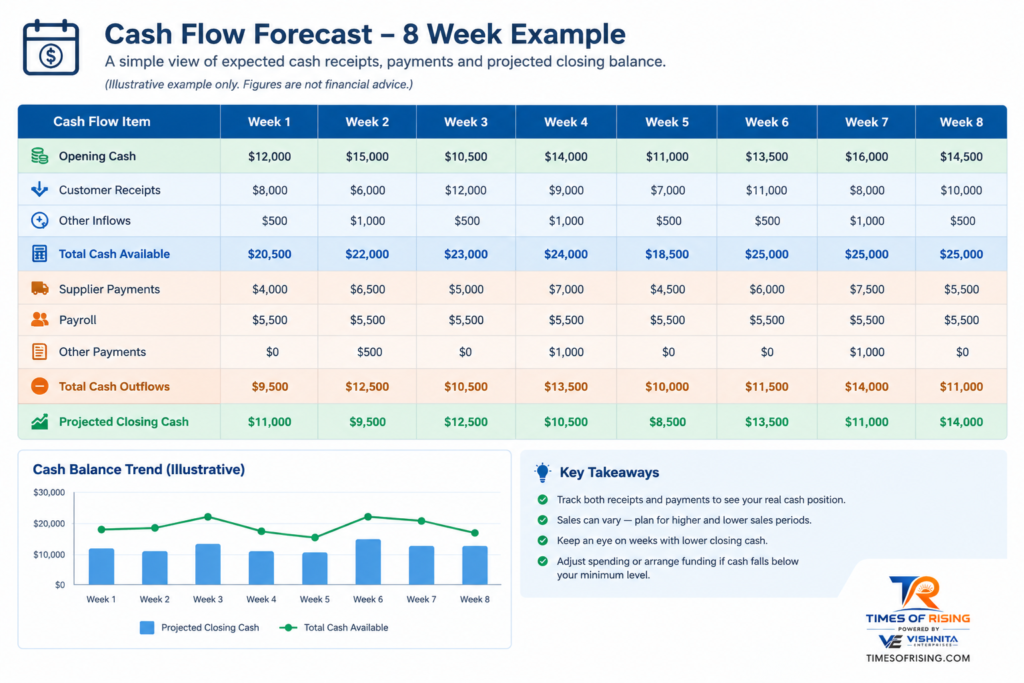
A spreadsheet is sufficient for many small businesses.
Create one column for each week if you are managing immediate cash risk, or each month if you are preparing a broader operating plan.
Use the following structure.
| Cash flow item | Week 1 | Week 2 | Week 3 | Week 4 |
|---|---|---|---|---|
| Opening cash | ₹1,20,000 | ₹1,05,000 | ₹95,000 | ₹1,10,000 |
| Customer receipts | ₹75,000 | ₹80,000 | ₹1,10,000 | ₹70,000 |
| Other cash inflows | ₹0 | ₹0 | ₹0 | ₹0 |
| Total cash available | ₹1,95,000 | ₹1,85,000 | ₹2,05,000 | ₹1,80,000 |
| Operating payments | ₹50,000 | ₹55,000 | ₹60,000 | ₹50,000 |
| Supplier payments | ₹40,000 | ₹35,000 | ₹25,000 | ₹30,000 |
| Other payments | ₹0 | ₹0 | ₹10,000 | ₹5,000 |
| Total cash outflows | ₹90,000 | ₹90,000 | ₹95,000 | ₹85,000 |
| Closing cash | ₹1,05,000 | ₹95,000 | ₹1,10,000 | ₹95,000 |
Illustrative example only. Figures are in Indian rupees and are not intended as financial benchmarks.
The closing balance becomes the opening balance for the next period.
For example, Week 2 begins with ₹1,05,000 because that is the projected closing balance for Week 1.
The key formulas are:
Total cash available = Opening cash + Total cash inflows
Closing cash = Total cash available − Total cash outflows
In a spreadsheet, if opening cash is in cell B2, receipts are in B3, other inflows are in B4, and total outflows are in B8, the calculations can be written as:
- Total cash available:
=B2+B3+B4 - Closing cash:
=B5-B8 - Next period’s opening cash:
=B9
Adjust the cell references to match your actual spreadsheet.
The example shows how to structure a forecast, but the amounts must be replaced with your own expected transactions. For a business with fluctuating sales, the forecast should also include a low-sales scenario rather than relying only on one estimate.
Step 6: Estimate Sales Using Historical Patterns
When sales vary, forecasting based on a single average can be misleading.
A business that sells more during festivals, weekends, tourist seasons, or annual contract-renewal periods needs to account for those patterns.
Start by reviewing sales by week or month, depending on how quickly demand changes.
Look for:
- Recurring seasonal peaks and declines.
- Differences between weekdays and weekends.
- Changes in average order value.
- Customer retention and repeat purchases.
- Dependence on a small number of large customers.
- Marketing campaigns that influence sales.
- Changes in pricing or product availability.
For example, a shop may generate higher sales in October and November but experience a decline in January. Using the average of its two busiest months to forecast January could produce an unrealistic cash estimate.
Use a driver-based sales forecast
Instead of entering one unexplained revenue number, identify the factors that generate sales.
A service business might estimate sales using:
Expected sales = Expected number of projects × Average project value
A retailer might use:
Expected sales = Expected number of orders × Average order value
Suppose a retailer expects 180 orders next month and its average order value is ₹1,500.
Its estimated sales would be:
180 × ₹1,500 = ₹2,70,000.
If demand is uncertain, prepare a lower estimate using fewer orders and a higher estimate using a stronger sales outcome.
This approach makes the forecast easier to update. If the number of orders changes, you can revise the estimate without rebuilding the entire model.
Historical averages are useful, but they should be adjusted for known changes such as a price increase, a new competitor, a large confirmed contract, or a seasonal slowdown.
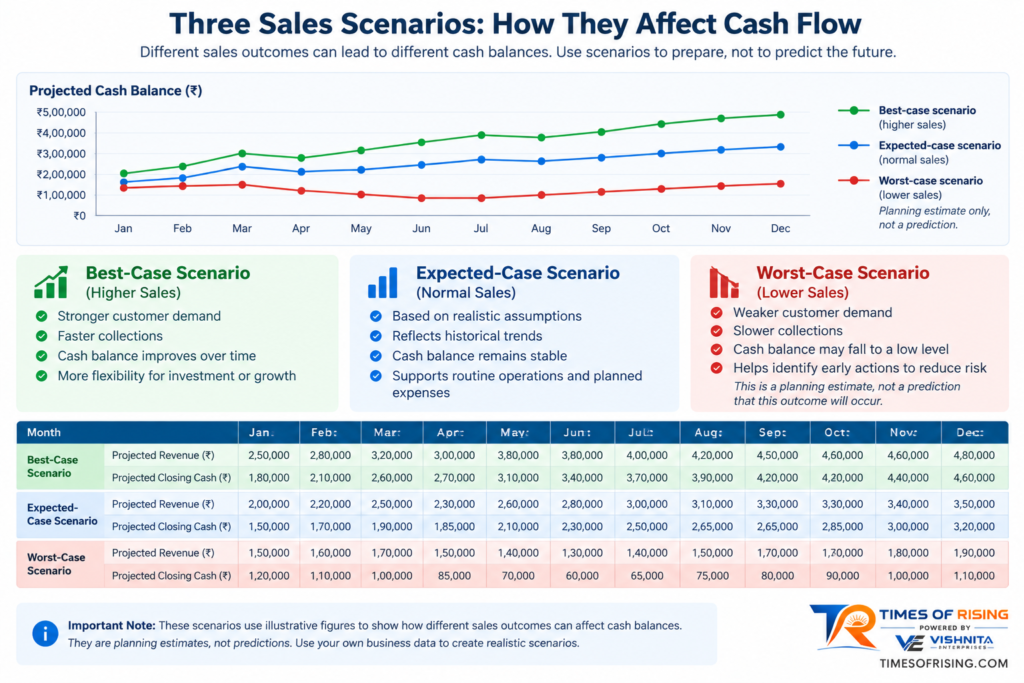
Step 7: Create Best-Case, Expected-Case, and Worst-Case Scenarios
A single forecast is not enough when sales vary significantly.
Scenario planning allows the business owner to understand how different sales outcomes could affect cash availability.
Best-case scenario
This scenario assumes that sales perform better than expected and customer payments arrive broadly on schedule.
It can help determine whether the business might have additional cash available for inventory, investment, debt repayment, or other planned spending.
Do not commit to additional fixed expenses solely because the best-case scenario looks attractive.
Expected-case scenario
This scenario uses the most reasonable assumptions based on historical data, confirmed orders, expected customer payments, and known expenses.
It is the main forecast used for routine planning.
Worst-case scenario
This scenario assumes a meaningful decline in sales, delayed customer receipts, or a combination of adverse events.
The purpose is not to predict a disaster. It is to identify what the business would need to do if cash inflows were weaker than expected.
Consider the following simplified monthly example.
| Item | Best case | Expected case | Worst case |
|---|---|---|---|
| Opening cash | ₹1,50,000 | ₹1,50,000 | ₹1,50,000 |
| Customer receipts | ₹3,00,000 | ₹2,40,000 | ₹1,70,000 |
| Total cash outflows | ₹2,40,000 | ₹2,40,000 | ₹2,30,000 |
| Closing cash | ₹2,10,000 | ₹1,50,000 | ₹90,000 |
Illustrative figures. The worst-case scenario assumes that some costs can be adjusted, but most obligations still need to be paid.
The expected case leaves ₹1,50,000 in cash. The worst case leaves ₹90,000.
Whether that lower balance is safe depends on the business’s upcoming obligations, minimum operating cash needs, and access to reliable funding.
The owner should therefore ask:
- Can the business cover its next payroll?
- Are supplier payments due before the next receipts?
- Is a major tax or loan payment approaching?
- Which costs can be postponed safely?
- What action should begin if cash falls below the required minimum?
Write down the actions associated with each scenario before the problem occurs.
For example, if the forecast falls below the minimum cash threshold, the business might accelerate collection efforts, postpone a nonessential purchase, or arrange appropriate financing in advance.
Step 8: Calculate Your Minimum Required Cash Balance
A positive closing balance does not automatically mean the business is financially safe.
Suppose a business expects to finish the month with ₹80,000. That sounds reasonable until the owner discovers that payroll of ₹50,000 and a supplier payment of ₹40,000 are due before the next expected customer receipt.
The business has a timing problem even though its forecasted month-end balance is positive.
Set a minimum operating cash threshold based on the actual obligations and risks of the business.
Consider:
- Essential operating payments.
- The timing of the next reliable customer receipts.
- Payroll and supplier commitments.
- Tax and loan payment dates.
- The possibility of delayed collections.
- The availability and cost of emergency funding.
There is no universal minimum balance suitable for every small business.
A company with daily cash sales and low fixed expenses may have a different cash requirement from a contractor who waits 45 days for client payments.
The minimum should be based on the amount of cash required to keep the business operating through a realistic disruption.
Calculate a practical cash runway
A simple cash runway estimate can help show how long existing cash might cover essential spending if receipts stop temporarily.
Cash runway in weeks = Available cash ÷ Average weekly net cash requirement during a no-receipts scenario
Suppose the business has ₹2,00,000 in available cash and estimates that essential weekly outflows would exceed non-sales inflows by ₹40,000.
Its estimated runway would be:
₹2,00,000 ÷ ₹40,000 = 5 weeks.
This is a simplified stress-test measure, not a guarantee that the business can operate safely for five weeks. Actual timing, unavoidable payments, and changes in expenses may shorten or extend the period.
The calculation is useful because it turns a general concern about cash into a more concrete planning question.
Step 9: Manage Seasonal Sales and Uneven Revenue
Some businesses experience predictable fluctuations rather than entirely random sales.
A wedding supplier may earn more during certain months. A school-related retailer may depend on the academic calendar. A tourism business may experience strong seasonal demand, while a manufacturer may depend on periodic bulk orders.
In these situations, forecasting should reflect the entire business cycle.
Use historical monthly patterns
Review sales and cash receipts for previous years when reliable data is available.
Identify months when demand typically rises or falls. Then compare those patterns with current conditions rather than assuming the next season will exactly repeat the last one.
A previous year’s figures can provide a useful starting point, but changes in customer demand, pricing, competition, or operating costs may require adjustments.
Build cash reserves during stronger periods
When the business receives more cash than it needs for immediate obligations, consider reserving a portion for the slower months.
The amount depends on the length and severity of the seasonal decline, the business’s fixed costs, and the reliability of future receipts.
Do not treat a temporary increase in cash as permission to increase recurring expenses immediately.
A business that uses every strong month to expand its regular spending may struggle when revenue returns to normal.
Plan inventory purchases carefully
Seasonal businesses often need to buy inventory before demand reaches its peak.
Forecast both the expected sales period and the date on which stock payments must be made.
For example, a retailer preparing for a festive season may need to pay suppliers in September even though a substantial portion of sales will occur in October and November.
The forecast should reveal whether the business can fund that inventory without jeopardising payroll, rent, or other essential payments.
Step 10: Improve Cash Flow Without Depending on Higher Sales
Increasing sales is not always the fastest way to improve cash availability.
A business can sometimes strengthen cash flow by collecting money sooner, reducing avoidable delays, and coordinating expenses more carefully.
Improve invoicing and collection
Send invoices promptly after delivering goods or completing agreed milestones.
Make payment terms clear, monitor overdue accounts, and follow up before invoices become seriously overdue.
For larger projects, consider whether commercially reasonable deposits or milestone payments can reduce the amount of cash the business must fund in advance.
Review customer payment patterns regularly. If a customer repeatedly pays late, account for that behaviour in future forecasts and consider whether the payment terms remain appropriate.
Review inventory purchasing
Excess inventory can tie up cash that could otherwise be used for essential expenses.
Review how quickly different products sell, identify slow-moving stock, and coordinate purchases with realistic demand forecasts.
Avoid cutting inventory so aggressively that the business cannot fulfil profitable orders. The objective is to balance stock availability with cash requirements.
Review supplier payment timing
Discuss payment terms with suppliers where appropriate.
A longer payment term may help the business align outgoing payments with customer receipts, provided the arrangement is agreed upon and does not damage the relationship or incur excessive charges.
Never assume a supplier will accept a delay simply because the forecast shows a shortage.
Examine discretionary spending
Review optional expenses such as nonessential equipment upgrades, unused subscriptions, and campaigns that are not producing sufficient results.
Distinguish between spending that can be postponed and spending that is necessary to maintain sales, fulfil commitments, or protect the business.
Cutting an expense that generates valuable repeat business may worsen the financial position rather than improve it.
Consider financing before a shortage becomes urgent
If the forecast shows a recurring working-capital gap, investigate suitable funding options early.
Compare the total cost, repayment schedule, eligibility requirements, and effect on future cash flow before committing.
Debt should not be used automatically to cover a business model that consistently loses money. Financing may help bridge a temporary timing gap, but it does not replace sustainable margins, reliable collections, or appropriate spending decisions.
Step 11: Update the Forecast Every Week
A forecast becomes less useful when it is treated as a document that is prepared once and forgotten.
For businesses with volatile sales, a weekly review is often a sensible routine.
At the end of each week:
- Replace estimated opening cash with the actual bank and cash balances.
- Record customer receipts that actually arrived.
- Record payments that were made.
- Update outstanding invoices and their expected collection dates.
- Add new orders, supplier commitments, and unexpected expenses.
- Revise the following weeks using the latest information.
- Identify any period in which cash may fall below the required minimum.
Compare actual results with the forecast and investigate meaningful differences.
If expected customer receipts were ₹1 lakh but only ₹60,000 arrived, determine whether the difference resulted from lower sales, late payments, cancellations, or another factor.
Each cause requires a different response.
Lower sales may require revised demand estimates. Delayed payments may require stronger collection procedures. Unexpected supplier costs may require adjustments to purchasing assumptions.
The purpose is not to criticise earlier estimates. It is to use new information to make the next forecast more realistic.
A forecast that changes with the business is more valuable than one that looks precise but no longer reflects actual conditions.
Step 12: Use Simple Tools That Match Your Business
You do not need complex software to start forecasting cash flow.
Spreadsheet-based forecasting
A spreadsheet works well for businesses with relatively straightforward transactions.
It allows you to customise categories, add formulas, compare scenarios, and highlight periods when the projected cash balance falls below the minimum requirement.
Its main limitation is that it depends on accurate manual updates unless connected to other systems.
Accounting software
Accounting software can help centralise invoices, expenses, bank transactions, and payment records.
Depending on the system, it may provide cash flow reports or forecasting features that reduce repetitive data entry.
However, an automated forecast still depends on the accuracy of its assumptions. An unpaid invoice should not be treated as guaranteed cash merely because it appears in the accounting system.
A practical starting approach
Begin with a spreadsheet if your business is small and your transactions are manageable.
Once the process becomes consistent, decide whether automation would save enough time or improve visibility enough to justify its cost.
Whatever tool you choose, make sure the forecast distinguishes between actual cash, expected receipts, committed payments, and uncertain estimates.
A Practical Cash Flow Forecasting Routine for Small Businesses
The following routine brings the process together into a manageable operating system.
Every week
- Check bank balances and available cash.
- Update the next 13 weeks of expected receipts and payments.
- Follow up on overdue invoices.
- Identify upcoming obligations that may exceed available cash.
- Record material changes in sales or expenses.
Every month
- Compare actual sales and cash receipts with the forecast.
- Review profit margins and variable costs.
- Update the next 12 months of seasonal assumptions.
- Review the best-case, expected-case, and worst-case scenarios.
- Reassess the minimum cash threshold.
Every quarter
- Review customer concentration and payment reliability.
- Examine recurring expenses and supplier terms.
- Assess inventory and working-capital requirements.
- Review major spending plans and financing needs.
- Check whether the forecasting method still fits the business.
The routine does not need to be complicated. Consistency matters more than building a highly detailed spreadsheet that nobody has time to maintain.
Common Cash Flow Forecasting Mistakes to Avoid
Treating every sale as immediate cash
A completed sale may not result in a bank receipt for days or weeks. Forecast the expected collection date rather than relying solely on the sale date.
Assuming last month’s sales will repeat
Historical sales provide useful information, but demand can change. Adjust estimates for seasonality, customer behaviour, pricing, and current order information.
Ignoring irregular expenses
Annual premiums, tax payments, maintenance, and equipment purchases can create substantial cash pressure. Include them in the periods when they are expected to be paid.
Relying only on the expected scenario
Even a reasonable forecast can be wrong. A downside scenario helps identify whether the business could cope with weaker sales or delayed collections.
Confusing profit with available cash
A profitable business can still struggle to pay bills when receipts arrive too late. Monitor actual cash balances and the timing of obligations.
Failing to update the forecast
Old assumptions become unreliable as orders, payment dates, and expenses change. Revise the forecast regularly.
Cutting costs without considering their effect
Reducing spending indiscriminately may damage customer service, fulfilment, or sales. Prioritise expenses based on their importance and expected return.
Borrowing without understanding repayment pressure
Additional financing may provide temporary liquidity, but repayment obligations can create further cash strain. Evaluate funding against realistic future cash receipts, not optimistic sales projections.
Frequently Asked Questions
How often should a small business forecast cash flow?
A business with variable sales should generally review its short-term forecast weekly. Monthly reviews are useful for broader planning, and a rolling 12-month forecast can help identify seasonal cash requirements.
The right frequency depends on how quickly the business’s cash position changes.
Can a small business forecast cash flow without historical data?
Yes. Start with confirmed orders, existing invoices, known payment dates, contractual expenses, and reasonable sales assumptions. Separate uncertain estimates from confirmed transactions and update the forecast as real data becomes available.
What is the difference between a cash flow forecast and a cash flow statement?
A cash flow forecast estimates future receipts and payments. A cash flow statement records cash movements that have already occurred during a reporting period.
The statement helps explain past performance, while the forecast supports future planning.
What should a business do if its forecast shows a cash shortage?
First, identify when the shortage will occur and which payments create it. Then review expected customer collections, discuss appropriate payment arrangements, postpone nonessential spending where possible, and evaluate suitable financing if necessary.
Act before the shortage becomes urgent. Avoid assuming that unconfirmed sales or unapproved borrowing will solve the problem.
Is a cash flow forecast useful for a seasonal business?
Yes. Seasonal businesses can use historical sales patterns, expected inventory purchases, and payment schedules to estimate how much cash they will need during slower periods.
A monthly forecast covering the full year is particularly useful, supported by a weekly forecast when payment timing becomes critical.
How much cash should a small business keep in reserve?
There is no universal amount. The appropriate reserve depends on fixed expenses, collection delays, seasonality, supplier commitments, and the reliability of future receipts.
Use the forecast to identify the minimum cash required to cover essential payments during a realistic period of weaker receipts.
Can cash flow forecasting prevent business failure?
Forecasting cannot eliminate every risk, but it can reveal potential liquidity problems earlier and give owners more time to respond. Its value comes from combining realistic assumptions, regular reviews, and timely decisions.
Final Thoughts
Unpredictable sales do not have to result in unpredictable cash management.
A small business can build a useful cash flow forecast by starting with its actual cash balance, estimating when customers will pay, listing the expenses that must be covered, and calculating the expected closing balance for each week or month.
The most important step is to make the forecast part of regular business management.
Use historical information to estimate demand, create multiple sales scenarios, maintain an appropriate cash reserve, and update the numbers as new information arrives. When a possible shortage appears, investigate the cause and respond while there is still time to act.
A forecast will never be perfectly accurate. It does not need to be. Its purpose is to replace avoidable surprises with informed decisions.
For a small business, that visibility can make the difference between reacting to a cash shortage at the last moment and preparing for it before it affects operations.

Benzamin LA
Benzamin LA covers competitor research and business intelligence for digital businesses and entrepreneurs. His editorial focus includes competitor benchmarking, market positioning, content-gap analysis, audience research and the interpretation of publicly available business data. His articles aim to turn research into practical insights while explaining methodologies, limitations and the difference between verified facts and estimates.
Join the conversation
Share a thoughtful response, ask a question, or add something useful for other readers.
Be the first to add a helpful perspective.
Share to join the conversation
Use a sharing option here or in the article share panel to start a 120-second countdown. The comment form opens when the timer finishes.
Social networks do not tell this website whether a share was finally published. This is a sharing prompt, not proof of a completed share or a spam-security measure.
Waiting period: 120 seconds after opening a sharing option. Completed shares cannot be verified by this website.