
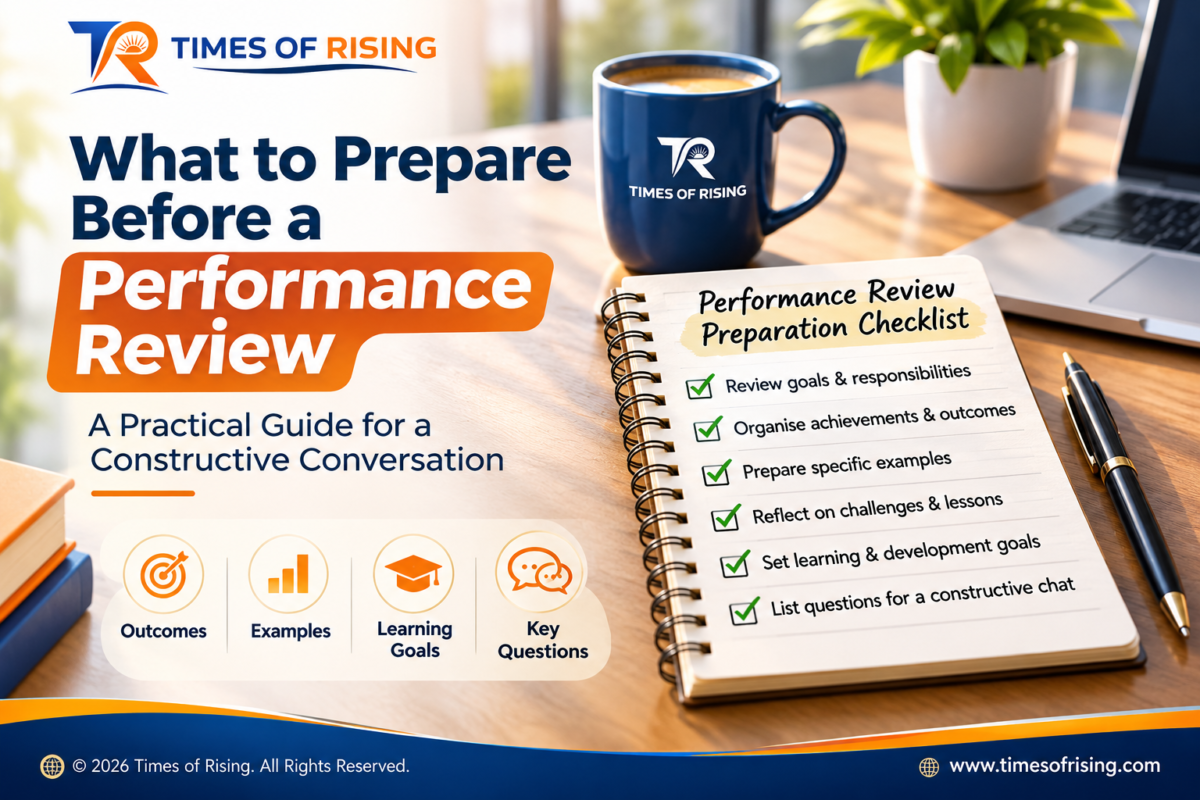
A performance review can be an important opportunity to reflect on your work, recognise your achievements, discuss challenges, and plan your professional development. However, the conversation’s quality often depends on how well you prepare.
Walking into a review without reviewing your progress, collecting examples, or thinking about your future goals can make it difficult to explain your contributions clearly. You may forget important achievements, struggle to respond to feedback, or leave the meeting without understanding what your manager expects next.
Preparing in advance helps you approach the discussion with greater clarity. Instead of relying on general statements such as “I have worked hard this year” or “I want to improve my skills,” you can explain what you accomplished, how your work contributed to the team, what you learned, and where you need additional support.
A productive performance review should not simply be a discussion about what went well or poorly in the past. It should also help establish clear expectations and identify practical ways to improve in the future.
This guide explains what to prepare before a performance review, how to organise your achievements and supporting examples, which learning goals to consider, and what questions to ask your manager to make the conversation more useful.
Why Preparing Before a Performance Review Matters
A performance review is generally a structured discussion between an employee and their manager about work performance, responsibilities, achievements, challenges, and future development.
Depending on the organisation, it may happen annually, twice a year, quarterly, or as part of a more continuous performance management process.
Regardless of its frequency, preparation helps you make better use of the available discussion time.
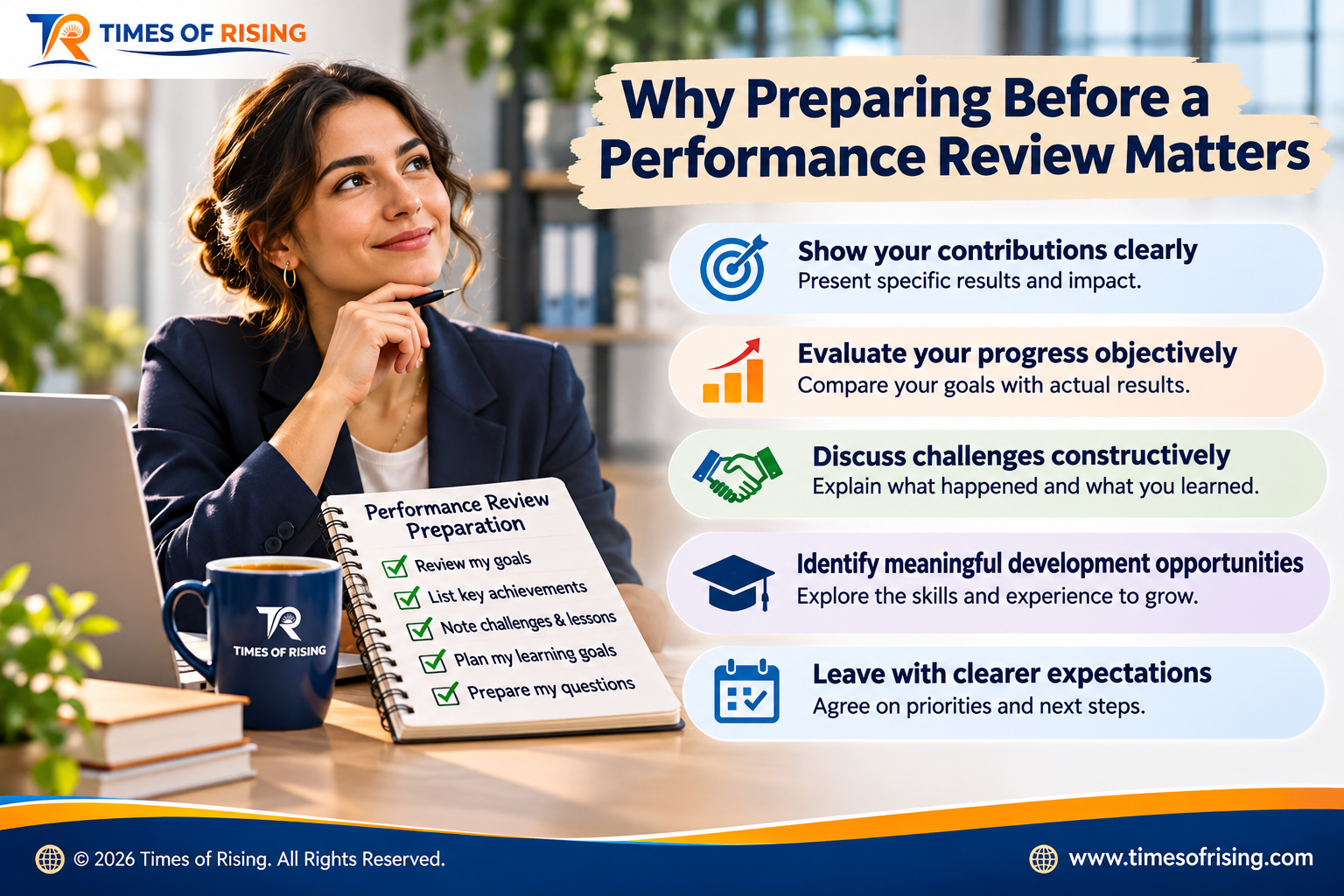
There are several reasons to prepare before the meeting.
1. You can explain your contributions more clearly.
Your manager may understand your main responsibilities, but they might not know every task you have completed, problem you have solved, or improvement you have introduced.
Preparing specific examples helps you explain your contribution rather than assuming that all your work has been noticed.
2. You can evaluate your progress objectively.
Reviewing your previous goals and comparing them with your actual results helps you identify where you made progress and where you encountered difficulties.
It also gives you an opportunity to recognise achievements that may otherwise be overlooked.
3. You can discuss challenges constructively.
Not every project or responsibility produces the expected outcome. Deadlines may change, resources may be limited, priorities may shift, or additional responsibilities may affect your workload.
Thinking about these circumstances beforehand helps you explain what happened, what you learned, and what could be improved.
4. You can identify meaningful development opportunities.
A performance review is also an opportunity to discuss the skills, experience, training, and responsibilities that could help you progress professionally.
Rather than simply saying that you want career growth, you can explain what you want to learn and how it connects with your current role or future direction.
5. You can leave with clearer expectations.
Preparing questions helps you understand how your manager evaluates your performance and what they expect during the next review period.
The objective is not to prepare a speech that you must deliver word for word. It is to organised your thoughts so that you can participate confidently in a two-way conversation.
1. Review Your Previous Performance Goals and Responsibilities
Start by reviewing the expectations established during your previous performance review or when you started your current position.
These expectations provide a useful starting point for evaluating your progress.
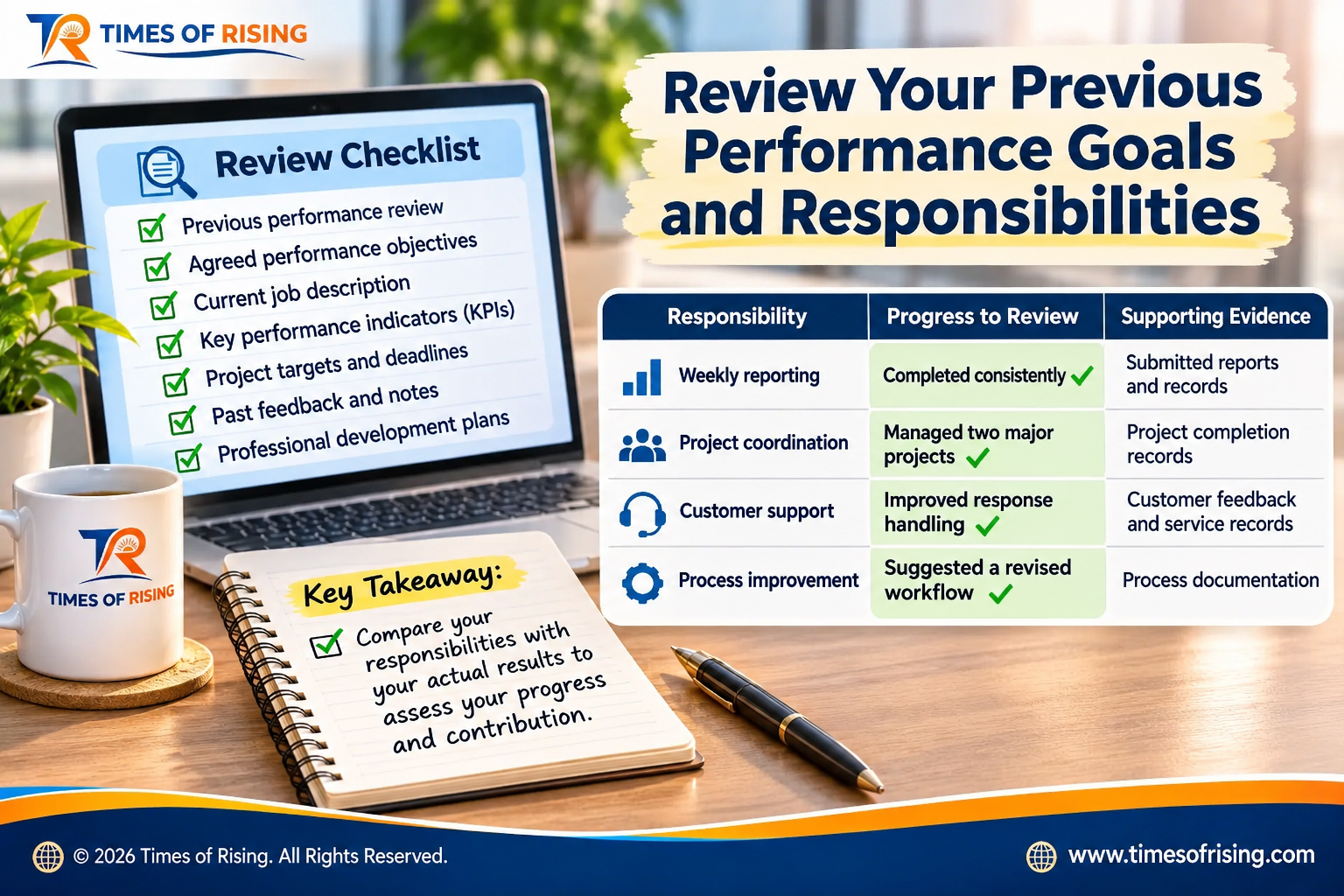
Look for documents such as:
- Your previous performance review.
- Agreed performance objectives.
- Your current job description.
- Key performance indicators (KPIs), where applicable.
- Project targets and deadlines.
- Feedback received during previous meetings.
- Any professional development plans.
Create a simple list of your main responsibilities and compare them with the work you actually completed.
For example, suppose your responsibilities included:
- Preparing weekly performance reports.
- Coordinating with other departments.
- Completing assigned projects within agreed deadlines.
- Responding to customer inquiries.
- Identifying opportunities to improve internal processes.
For each responsibility, consider whether you met the expected standard, exceeded it, or experienced difficulties.
A simple comparison can help:
| Responsibility | Progress to review | Supporting evidence |
|---|---|---|
| Weekly reporting | Completed consistently | Submitted reports and records |
| Project coordination | Managed two major projects | Project completion records |
| Customer support | Improved response handling | Customer feedback and service records |
| Process improvement | Suggested a revised workflow | Process documentation |
Do not focus only on completed targets. Also consider whether your responsibilities changed during the review period.
For example, you may have taken on additional work, supported a new team member, learned a new system, or handled tasks that were not originally part of your role.
These changes can provide important context when discussing your overall performance.
A useful question to ask yourself: Have I been evaluated against the responsibilities and expectations I actually had during this period, or have those expectations changed?
2. Organise Your Achievements and Measurable Outcomes
One of the most important things to prepare before a performance review is a record of your achievements.
Many employees remember their daily responsibilities but struggle to identify the outcomes their work produced.
Instead of preparing a long list of completed tasks, focus on what changed because of your contribution.
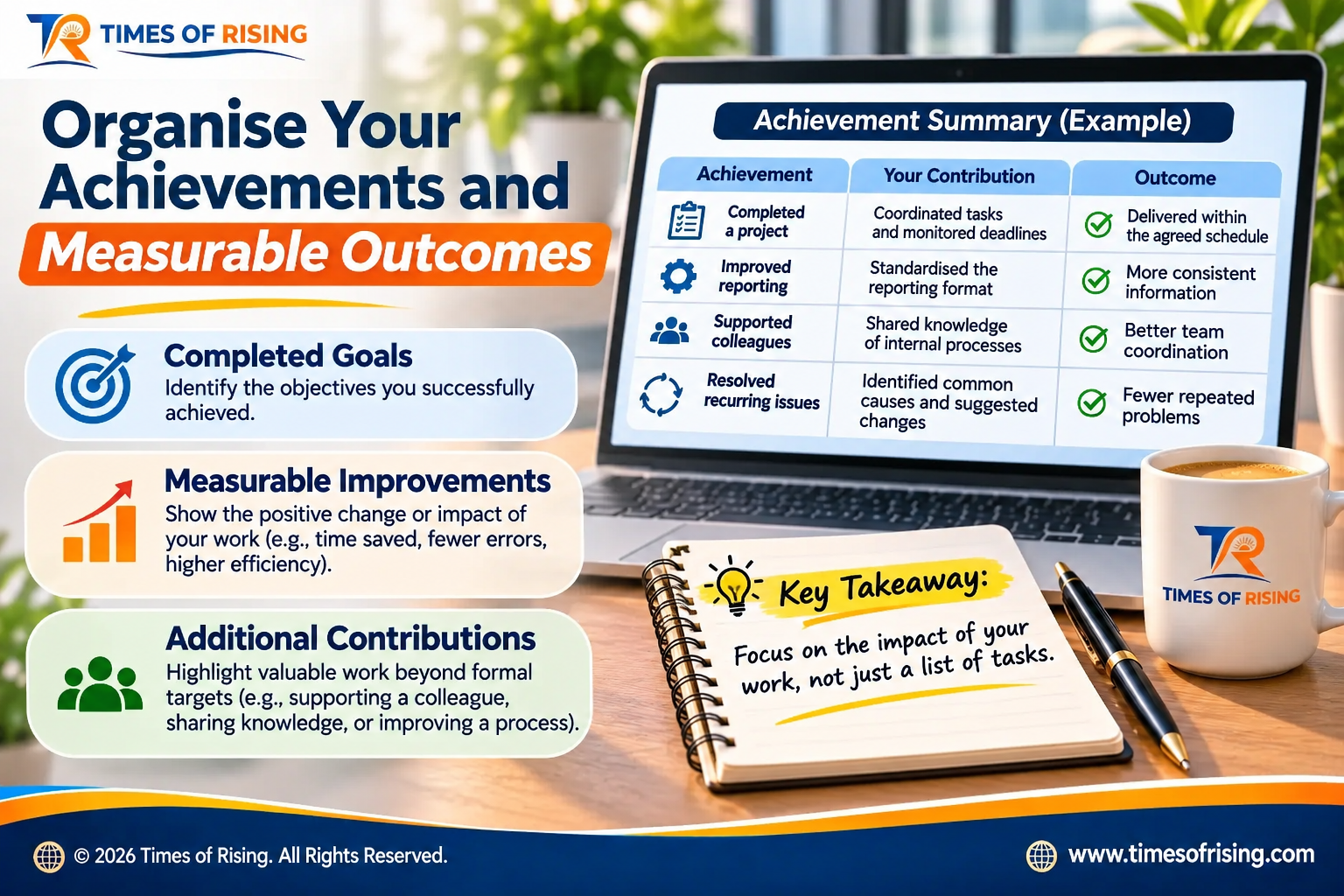
Consider three categories.
A. Completed goals
Identify the objectives you successfully achieved.
Examples include:
- Completing an important project within the agreed timeline.
- Meeting monthly reporting requirements.
- Delivering a presentation to stakeholders.
- Completing professional training.
- Taking responsibility for a new business process.
Explain the importance of each achievement rather than simply listing it.
For example:
Instead of saying:
“I completed the monthly reporting work.”
You could explain:
“I completed the monthly reporting process consistently and improved the organisation of supporting information, making it easier for the team to review results.”
B. Measurable improvements
Whenever reliable information is available, include measurable outcomes.
These may include:
- Projects completed.
- Customer enquiries resolved.
- Reports delivered on time.
- Errors identified and corrected.
- Processing time reduced.
- Tasks completed within agreed deadlines.
- New responsibilities successfully handled.
For example, consider an employee who redesigned a weekly reporting process.
A general statement might be:
“I improved the reporting process.”
A more useful explanation would be:
“I reorganised the reporting template and standardised the information collected from different departments. This made the weekly reporting process more consistent and reduced the need for repeated clarification.”
If you have verified figures, include them. If you do not have reliable measurements, describe the observable improvement without inventing numbers.
C. Additional contributions
Some valuable contributions do not appear in formal performance targets.
You may have:
- Helped a colleague understand a new system.
- Supported a team member during a busy period.
- Shared knowledge with other departments.
- Identified a problem before it affected a project.
- Suggested an improvement to an existing process.
- Taken responsibility for an urgent task.
These contributions can demonstrate collaboration, initiative, adaptability, and professional responsibility.
However, be clear about your individual role. If a result was achieved by a team, explain how you contributed rather than claiming responsibility for the entire outcome.
Create an achievement summary
A useful way to organise your achievements is to prepare a short table.
| Achievement | Your contribution | Outcome |
|---|---|---|
| Completed a project | Coordinated tasks and monitored deadlines | Project delivered within the agreed schedule |
| Improved reporting | Standardised the reporting format | More consistent information |
| Supported colleagues | Shared knowledge of internal processes | Better team coordination |
| Resolved recurring issues | Identified common causes and suggested changes | Fewer repeated problems |
Choose three to five important achievements that best represent your work during the review period.
This is generally more useful than presenting an unorganised list of every task you completed.
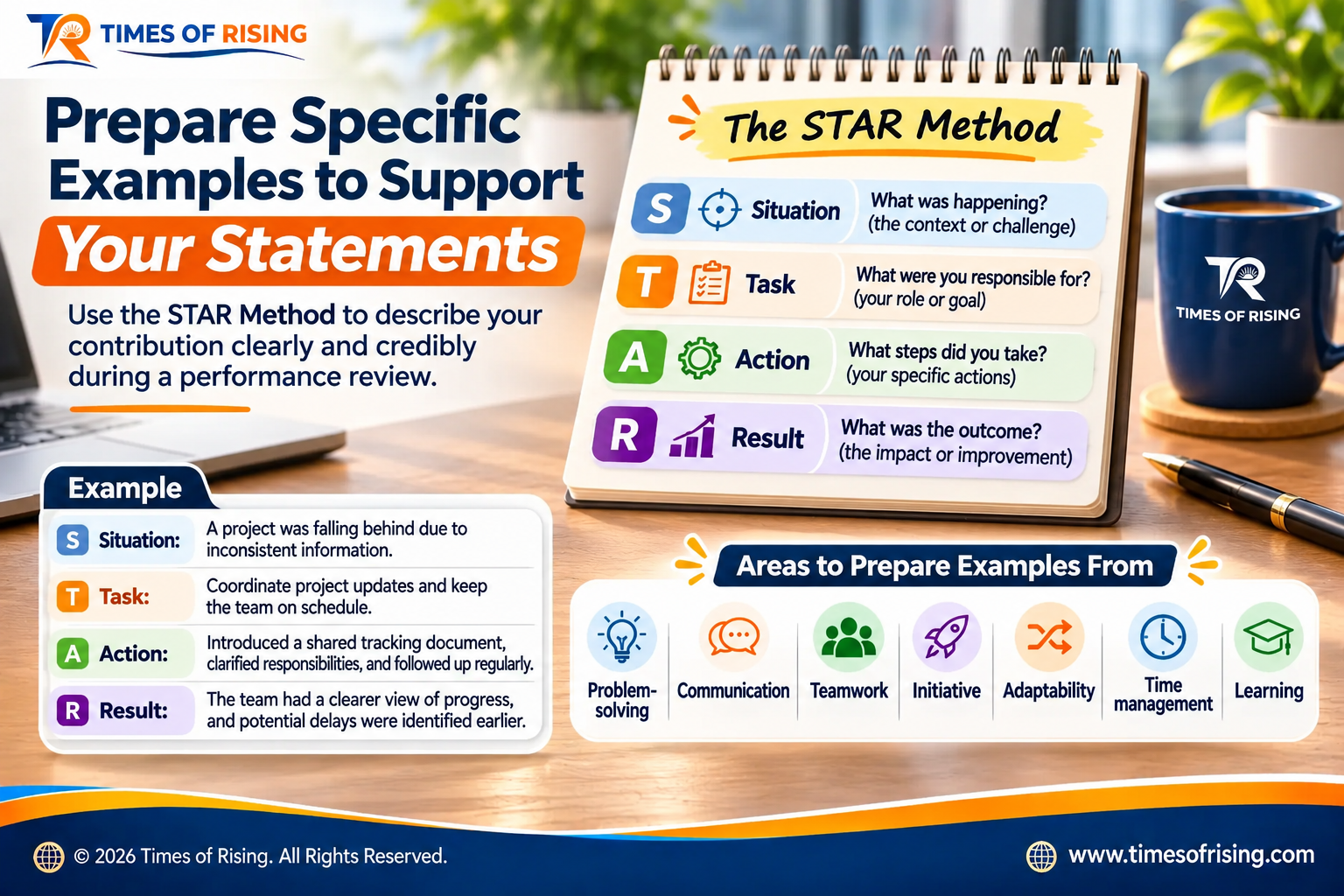
3. Prepare Specific Examples to Support Your Statements
Achievements explain what you accomplished. Examples explain how you accomplished it.
A performance review becomes more meaningful when you can support your statements with real situations, actions, and outcomes.
One useful approach is the STAR method.
STAR stands for:
- Situation: What was happening?
- Task: What were you responsible for?
- Action: What steps did you personally take?
- Result: What happened as a consequence?
Consider this example.
Situation: A project was falling behind because different team members were using inconsistent information.
Task: You were responsible for coordinating project updates and helping the team maintain an agreed schedule.
Action: You introduced a shared tracking document, clarified reporting responsibilities, and followed up on outstanding updates.
Result: The team had a clearer view of project progress and could identify delays earlier.
This structure helps you explain your contribution without exaggerating your responsibilities.
Prepare examples from different areas of your work
Try to select examples that demonstrate different professional strengths.
| Area | Example to prepare |
|---|---|
| Problem-solving | A difficult issue you identified and helped resolve |
| Communication | A situation where clear communication improved coordination |
| Teamwork | How you supported a shared project or colleague |
| Initiative | An improvement you suggested without being asked |
| Adaptability | How you handled a change in priorities or responsibilities |
| Time management | How you managed competing deadlines |
| Learning | A new skill or system you learned and applied |
You should also prepare an example of something that did not go according to plan.
A balanced review does not require you to present every experience as a success. It requires you to demonstrate that you can evaluate your work honestly and learn from it.
For example:
“I underestimated the time required to complete the initial analysis for a project. I recognised the issue, discussed the revised timeline with the relevant team members, and adjusted my planning approach. For future projects, I intend to identify dependencies and allow more time for unexpected delays.”
This communicates accountability while showing that you have considered how to improve.
4. Identify Challenges, Missed Targets, and Lessons Learned
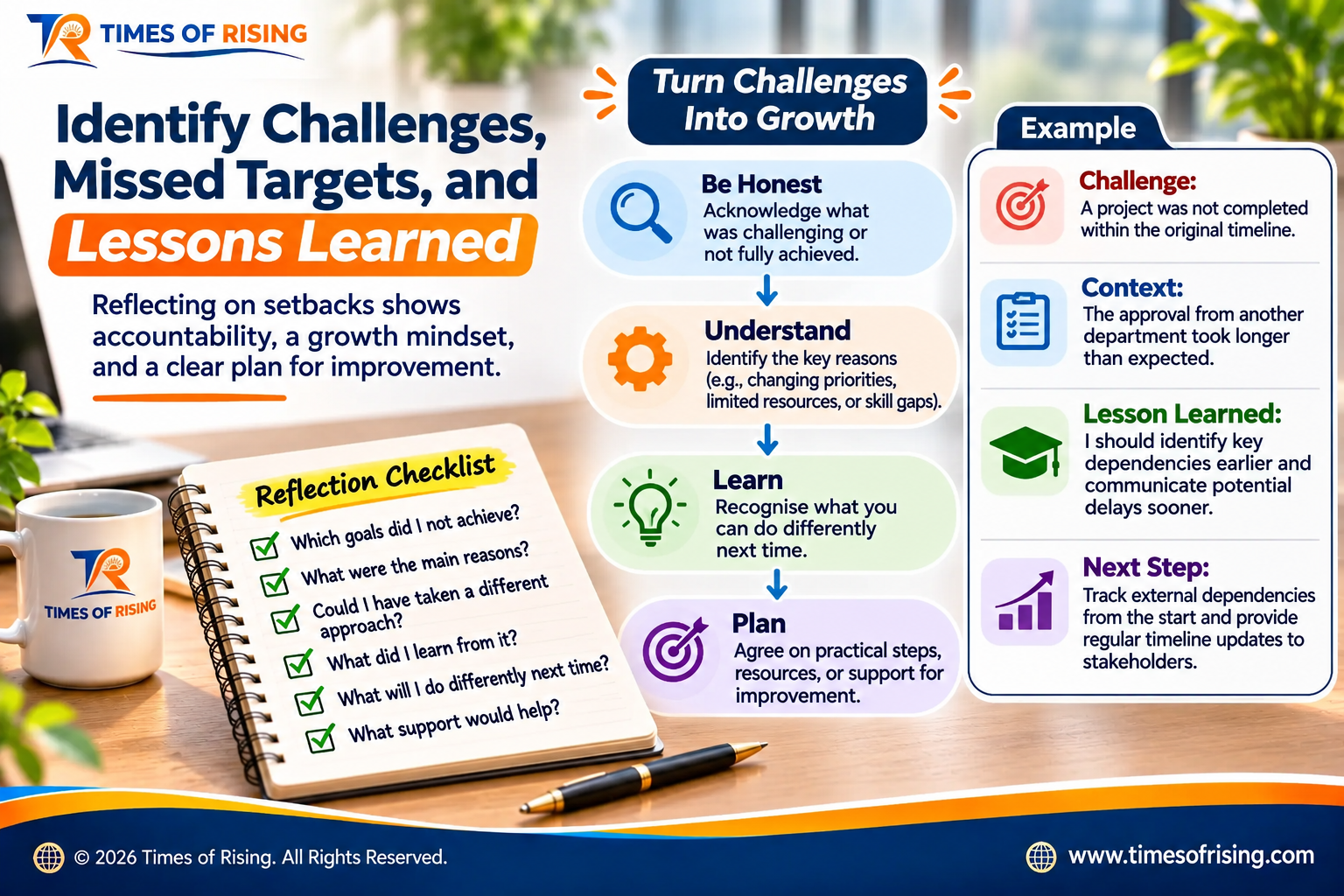
Preparing only your achievements can leave you unprepared for questions about incomplete goals or areas where your performance could improve.
Review the objectives you did not fully achieve and identify the reasons.
Not every missed target has the same explanation.
Possible factors include:
- Unclear expectations.
- Changes in project priorities.
- Limited resources.
- Unexpected technical problems.
- Dependencies on other departments.
- Insufficient training.
- Workload changes.
- Personal mistakes or gaps in knowledge.
Separate the circumstances that were outside your control from the actions you could have handled differently.
For example, imagine that you were unable to complete a project within the original timeline because another department delayed an essential approval.
A constructive explanation would be:
“The project was delayed because the required approval took longer than expected. I could have identified this dependency earlier and communicated the possible impact on the timeline sooner. In future projects, I plan to track external dependencies more closely and raise potential delays earlier.”
This approach is more useful than blaming another person or accepting responsibility for circumstances you could not reasonably control.
Use these reflection questions
Before the meeting, consider:
- Which goals did I not achieve?
- What were the main reasons?
- Could I have taken a different approach?
- What did I learn from the experience?
- What support would help me avoid similar difficulties?
- What changes should be made to the process or expectations?
Be honest without being unnecessarily negative about your performance.
The purpose is to understand what happened and identify practical improvements.
5. Collect Feedback and Recognition From Relevant Sources
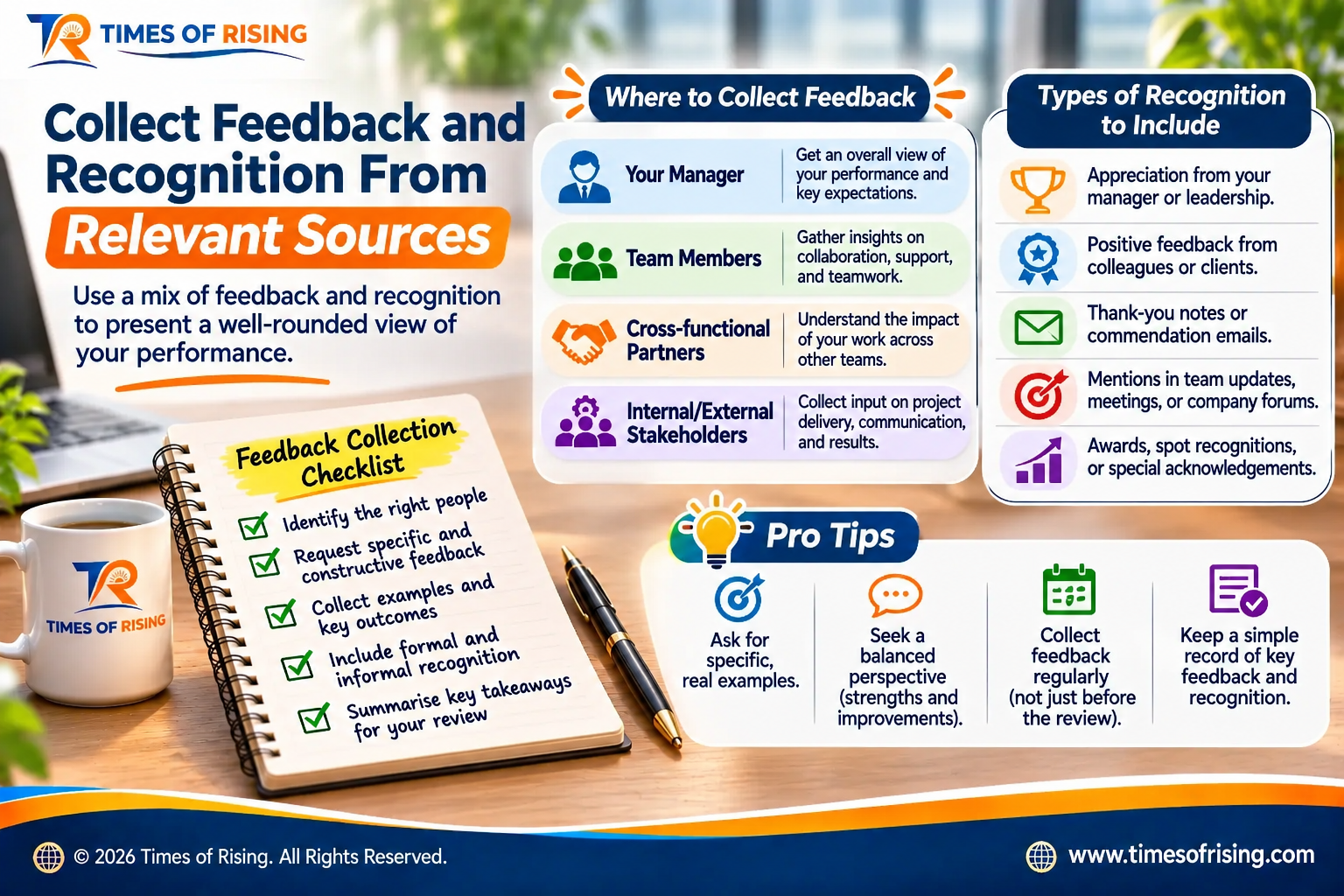
Your own assessment is important, but it may not represent the entire picture of your performance.
Think about feedback you have received from:
- Your manager.
- Colleagues.
- Project leaders.
- Customers or clients.
- Other departments.
- People you have supported or trained.
Look for recurring comments rather than relying on a single compliment or criticism.
For example, if several colleagues have appreciated your ability to explain complicated processes, that may indicate a strength in communication and knowledge sharing.
Similarly, if you have repeatedly received feedback about improving documentation, it may be worth including this in your development plan.
Useful supporting material may include:
- Written feedback.
- Customer appreciation messages.
- Project completion records.
- Relevant performance reports.
- Training certificates.
- Examples of work.
- Records of previously agreed improvements.
Use only relevant and appropriate information. Avoid bringing confidential company data or another person’s private information into the discussion without permission.
You do not need to collect every email or document from the review period. Select a few reliable examples that support the points you intend to discuss.
6. Prepare Your Learning and Development Goals
A performance review should not focus exclusively on evaluating past work.
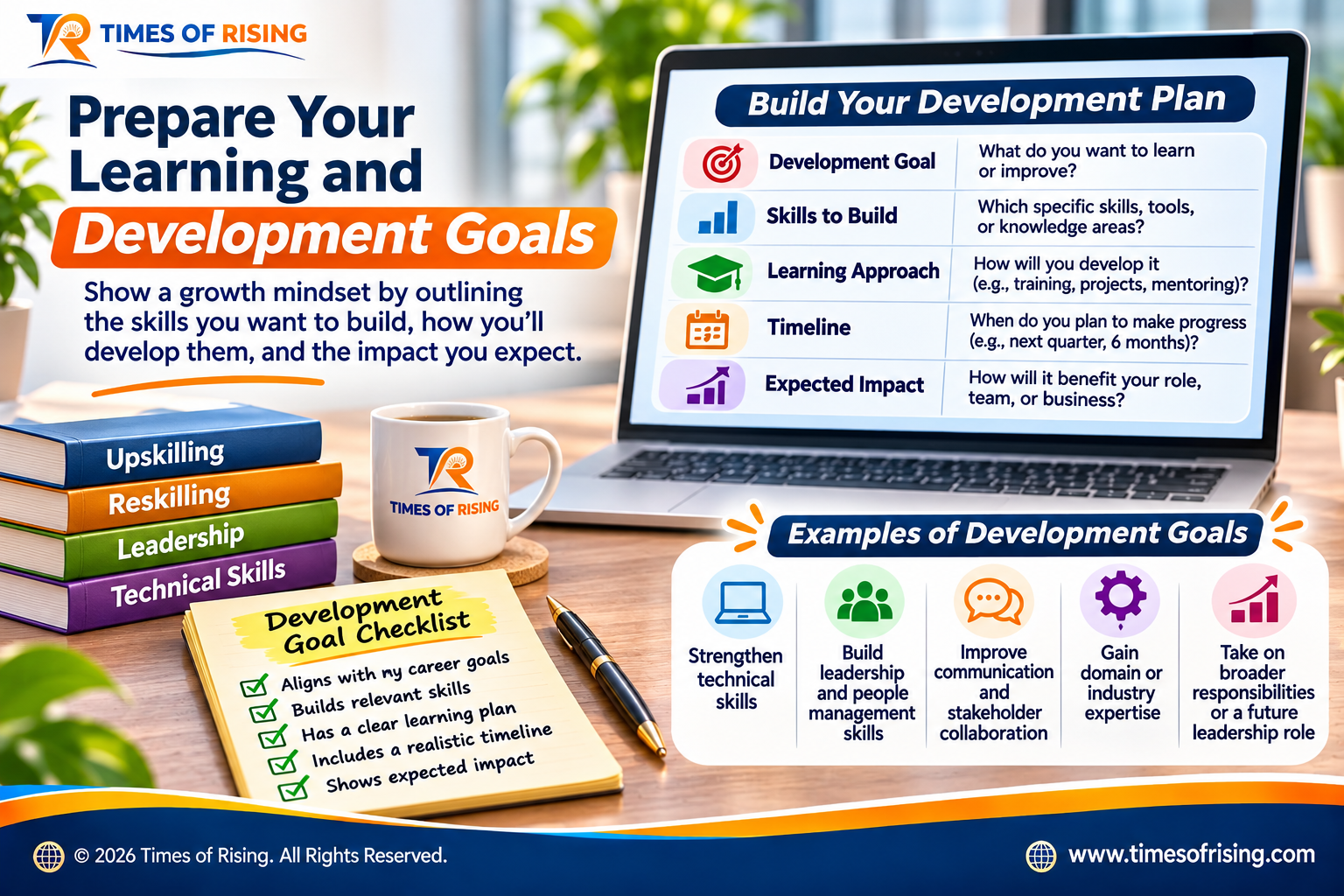
It should also help you identify what you want to learn and how you can become more effective in your role.
Before the meeting, think about the skills that would make the greatest difference to your current responsibilities or future career direction.
Consider three areas.
A. Skills needed in your current role
These are abilities that could help you perform your existing responsibilities more effectively.
For example:
- Improving written communication.
- Learning a new software system.
- Developing better data analysis skills.
- Improving project planning.
- Strengthening presentation skills.
- Managing competing priorities more effectively.
B. Skills needed for future opportunities
Think about the responsibilities you may want to take on in the future.
For example, someone interested in becoming a project manager might benefit from developing:
- Project planning and coordination.
- Stakeholder communication.
- Risk identification.
- Resource management.
- Leadership and decision-making.
You do not need to request a promotion during every performance review. However, discussing your interests can help your manager understand the direction in which you want to develop.
C. Skills needed to address performance gaps
If your review identifies an area that requires improvement, consider what learning or support would help.
For example:
If you need to improve report accuracy, you might benefit from additional training in data validation or spreadsheet management.
If you struggle with presenting information, you could request opportunities to deliver short team presentations and receive feedback.
The important point is to connect a development goal with a practical action.
Turn learning goals into actionable plans
Avoid vague goals such as:
“I want to improve my communication skills.”
Instead, make the objective more specific:
“I want to improve my presentation skills by preparing and delivering at least two team presentations during the next review period and requesting feedback after each one.”
You can use the SMART framework to structure appropriate goals:
- Specific: Clearly describe what you want to achieve.
- Measurable: Identify how progress will be assessed.
- Achievable: Make sure the objective is realistic.
- Relevant: Connect it with your responsibilities or development needs.
- Time-bound: Establish a reasonable timeframe.
For complex responsibilities where learning is more important than achieving a fixed numerical target, use learning-focused objectives instead.
For example, rather than promising to master a complicated new system within a short period, agree on completing relevant training, practising key tasks, and demonstrating progress through regular check-ins.
A development plan might look like this:
| Development area | Planned action | How progress will be assessed |
|---|---|---|
| Data analysis | Complete relevant training | Apply techniques in a work report |
| Communication | Lead team presentations | Feedback from manager and colleagues |
| Project planning | Coordinate a smaller project | Review planning and delivery |
| Technical skills | Learn a new internal tool | Complete agreed practical tasks |
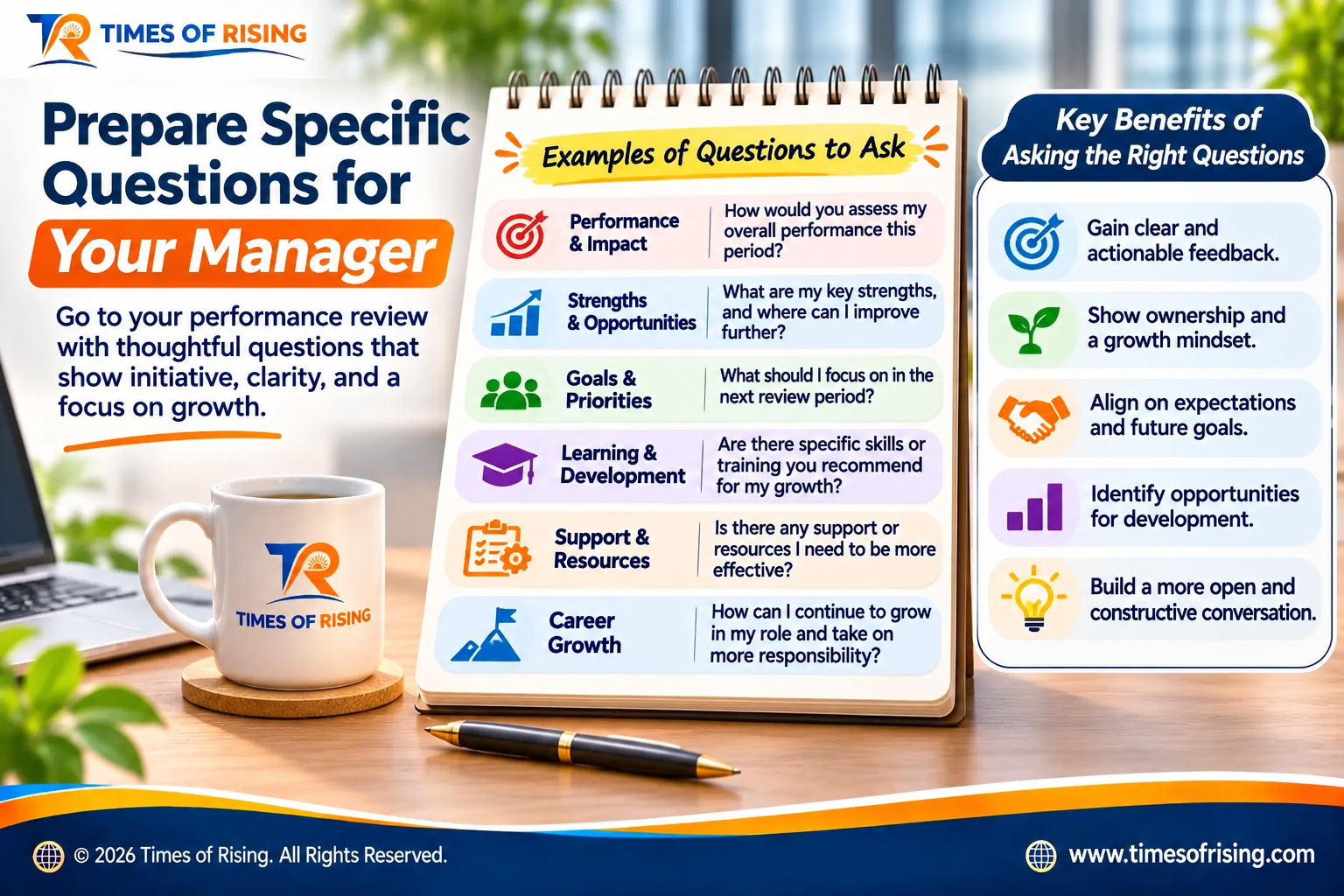
7. Prepare Specific Questions for Your Manager
A performance review should be a two-way discussion.
You should not leave the entire conversation to your manager or simply wait for feedback.
Preparing questions helps you clarify expectations, understand your strengths, and identify opportunities for improvement.
It is useful to organise your questions into four categories.
Questions about your performance
These questions help you understand how your manager evaluates your work.
- What do you consider my strongest contributions during this review period?
- Which responsibilities have I handled particularly well?
- Are there any areas where my performance has not met expectations?
- How does my work compare with the objectives agreed at the beginning of the period?
- Is there anything important about my contribution that you think I have overlooked?
Questions about improvement
These questions help turn feedback into practical action.
- What is the most important area I should focus on improving?
- Can you share a specific example of where I could have handled something differently?
- What would better performance look like in that situation?
- Are there any recurring issues I should address?
- How can I measure whether I am making progress?
Questions about learning and career development
Use these questions to understand possible development opportunities.
- Which skills would make me more effective in my current role?
- Are there opportunities to take responsibility for more challenging projects?
- What training or learning resources would you recommend?
- What experience should I develop if I want to progress into a different role?
- Could we discuss a development plan with clear milestones?
Questions about expectations and support
Sometimes performance challenges are connected to unclear priorities, limited resources, or competing responsibilities.
Consider asking:
- What are the most important priorities for the next review period?
- Have expectations for my role changed?
- Are there any responsibilities I should prioritise differently?
- What resources or support would help me work more effectively?
- How can we communicate more regularly about progress and challenges?
You do not need to ask every question.
Choose the ones that are most relevant to your situation. A few thoughtful questions are more useful than reading through a long list without allowing time for discussion.
8. Understand the Performance Review Criteria
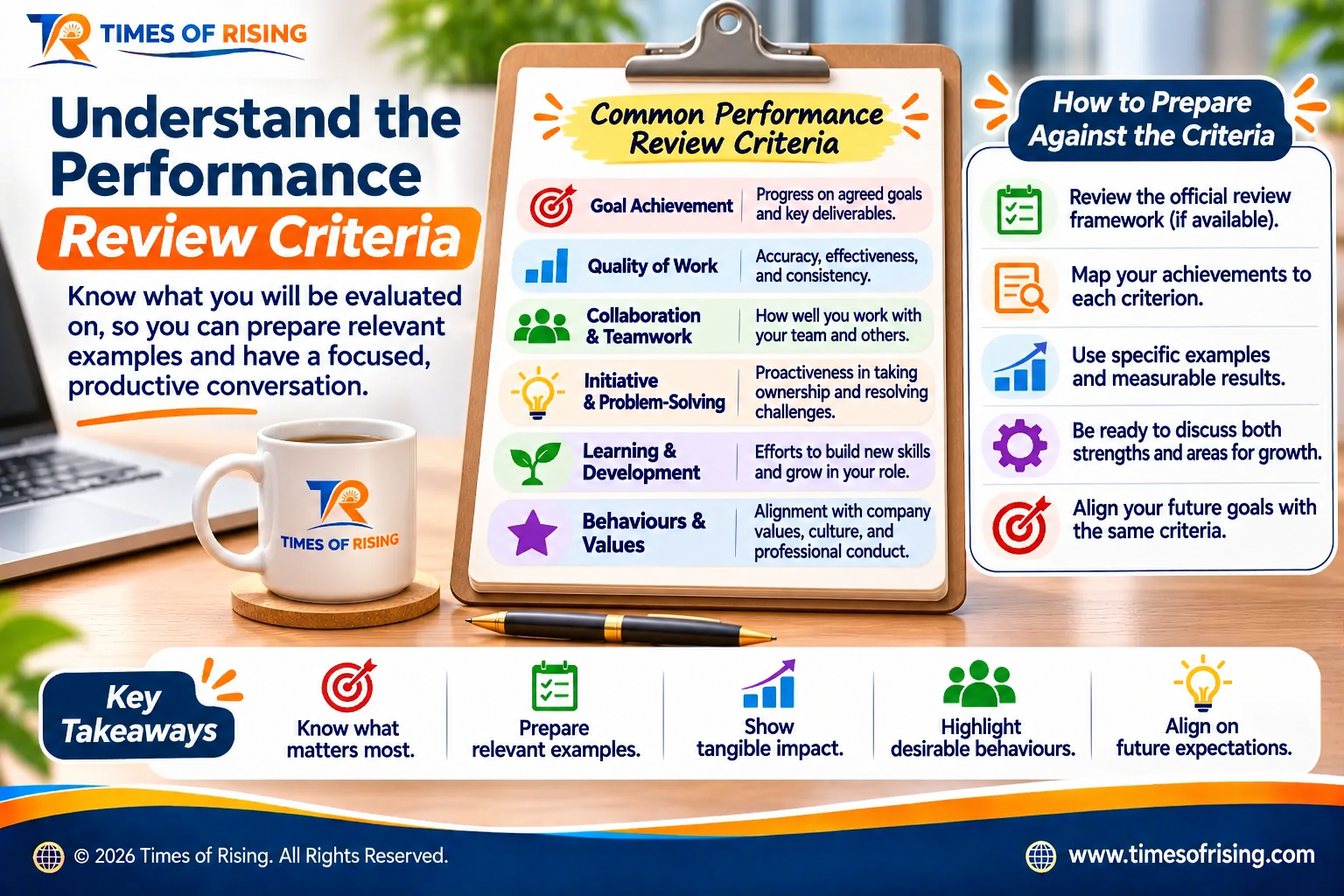
Before attending the meeting, find out how your organisation evaluates employee performance.
Different workplaces use different assessment systems.
Some consider:
- Achievement of individual targets.
- Quality and accuracy of work.
- Productivity and efficiency.
- Communication and teamwork.
- Problem-solving abilities.
- Professional conduct.
- Leadership and initiative.
- Progress against development objectives.
Others use rating scales, competency frameworks, behavioural standards, or a combination of these approaches.
If your organisation uses a formal rating system, understand what each rating means.
For example, a rating of “meets expectations” may indicate that you consistently perform the responsibilities associated with your position. It does not necessarily mean that your contribution is unimportant.
Similarly, an area identified for improvement does not automatically mean that your overall performance is poor.
If you are uncertain about an assessment, ask your manager to explain the criteria and provide specific examples.
You can also ask how individual achievements, changing responsibilities, and circumstances affecting your work were considered.
Understanding the evaluation framework makes it easier to discuss the assessment constructively.
9. Prepare to Discuss Feedback Without Becoming Defensive
Receiving feedback can sometimes be uncomfortable, particularly when it concerns an area where you have invested considerable effort.
However, preparing your response can help you remain focused on understanding the feedback rather than reacting immediately.
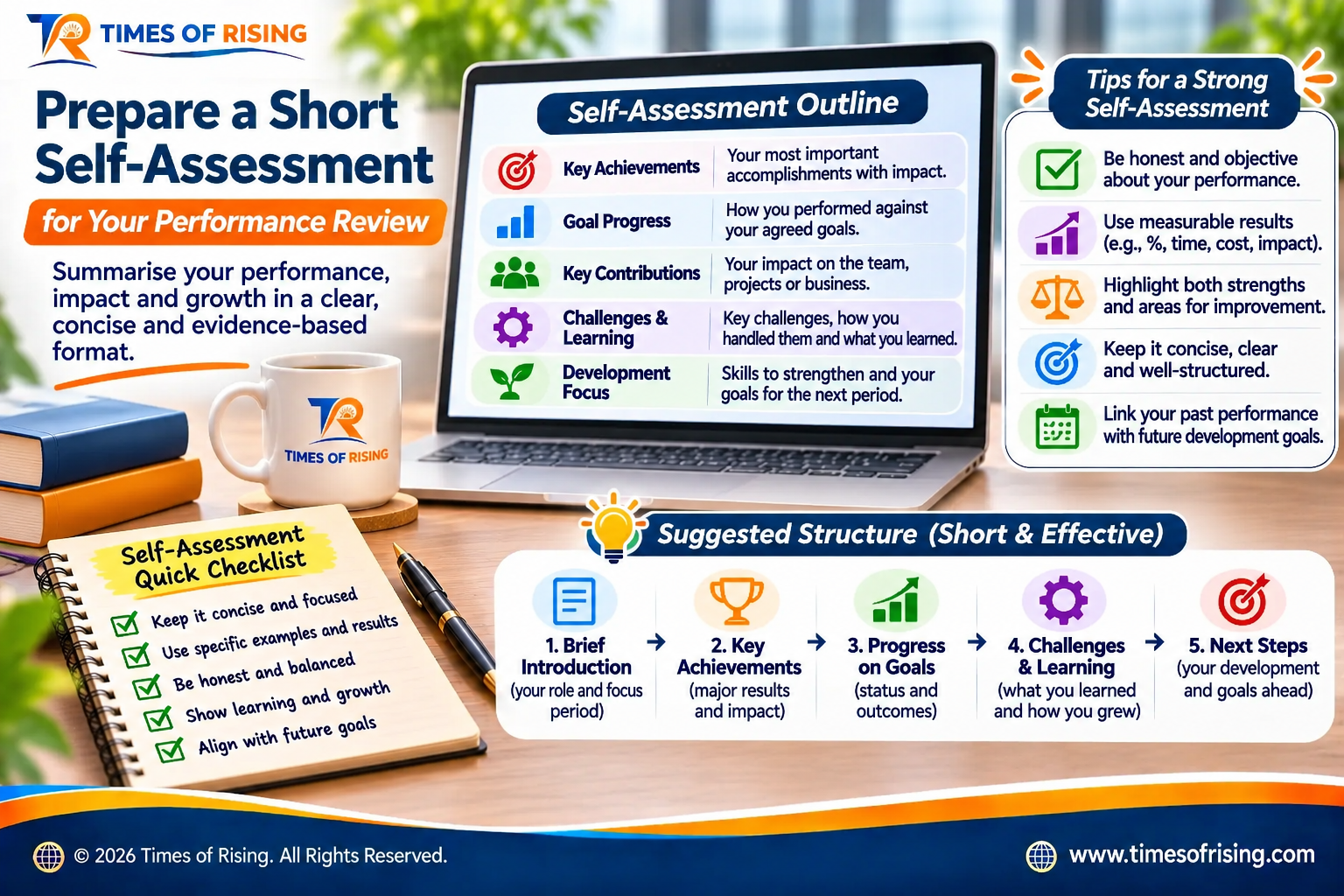
When your manager identifies an area for improvement, consider the following approach:
Listen carefully. Allow your manager to explain the concern before responding.
Ask for an example. Specific situations make feedback easier to understand and evaluate.
Clarify expectations. Find out what a better outcome would have looked like.
Share relevant context. If there were circumstances that affected the result, explain them calmly.
Discuss next steps. Identify what you can change and what support may be needed.
For example, if your manager says that project updates have not been sufficiently clear, you could respond:
“Thank you for highlighting that. Could you share an example of an update that did not provide enough information? I would like to understand what was missing so I can improve the way I communicate project progress.”
This response keeps the conversation focused on improvement.
You should also feel able to raise concerns if you believe an assessment does not accurately reflect your work.
If you disagree with a particular point, explain your perspective respectfully and refer to relevant evidence.
A constructive discussion does not require you to agree with every comment immediately. It requires both sides to understand the issue and consider a reasonable way forward.
10. Prepare a Short Self-Assessment
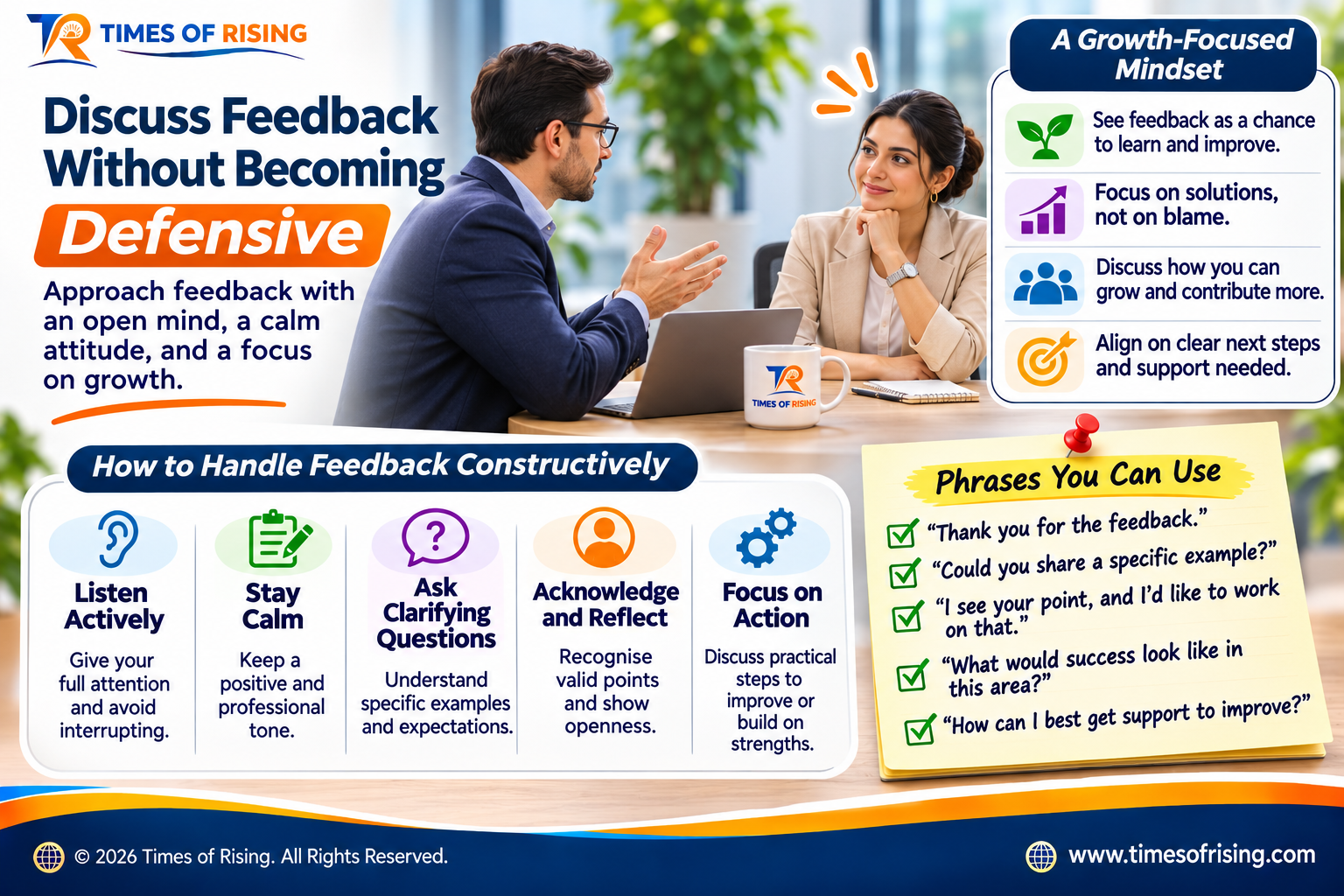
Many organisations ask employees to complete a self-assessment before the formal performance review.
Even when this is not required, preparing one can help organise your thoughts.
Your self-assessment should cover five areas:
- Major achievements.
- Progress against previous goals.
- Challenges and areas for improvement.
- Skills developed and learning completed.
- Priorities and development goals for the next review period.
Keep your explanations clear and evidence-based.
For example:
Achievement: Coordinated the preparation of monthly departmental reports.
Contribution: Standardised the information received from different team members and improved the organisation of supporting documents.
Outcome: Made the reporting process more consistent and easier to review.
Learning: Developed a better understanding of data validation and cross-departmental coordination.
Future goal: Improve reporting efficiency by developing more advanced spreadsheet and data analysis skills.
This structure helps you communicate your work without making the self-assessment unnecessarily long.
If your employer provides a specific template, use that format rather than creating a competing document.
11. Think About What You Want From the Conversation
It is possible to prepare every achievement and question but still leave a performance review without achieving anything meaningful.
To avoid this, identify the most important outcomes you want from the meeting.
For example, you may want to:
- Understand how your manager views your performance.
- Receive clarification about a particular assessment.
- Discuss additional responsibilities.
- Identify opportunities for professional development.
- Agree on priorities for the next review period.
- Request support for a recurring workplace challenge.
- Understand what is required to progress into another role.
Choose two or three priorities.
This does not mean that you should ignore other topics. It simply helps you focus on the discussions that matter most.
If you have several concerns, organise them in order of importance and leave enough time for your manager to respond.

12. Prepare a Practical Document Checklist
Once you have reviewed your performance, achievements, examples, and goals, organise the relevant information in one place.
You may want to prepare:
- Your previous performance review.
- Your current job description.
- A copy of your agreed objectives.
- Your achievement summary.
- Supporting examples and relevant results.
- Feedback received during the review period.
- Notes about challenges and lessons learned.
- Your proposed learning and development goals.
- Questions for your manager.
- Any self-assessment form required by your organisation.
You do not need to bring a large collection of documents to the meeting.
A short, organised summary is often sufficient. Keep detailed supporting evidence available in case your manager asks for clarification.
Also check whether your organisation requires the self-assessment or other documents to be submitted before the meeting.
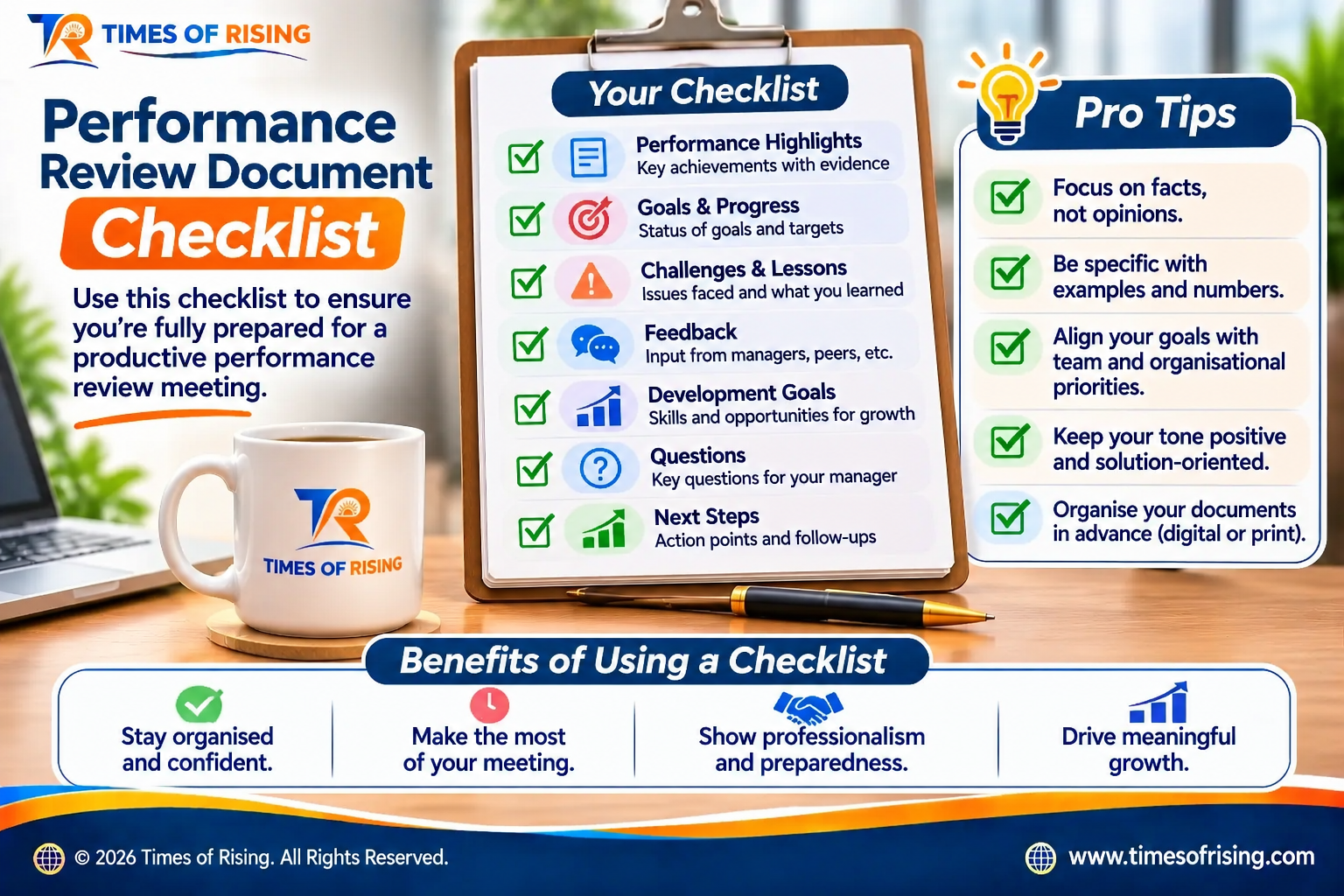
A Performance Review Preparation Worksheet
The following worksheet brings the preparation process together. You can copy it into a document or notebook and complete it before your meeting.
| Preparation area | Questions to answer | Your notes |
|---|---|---|
| Main responsibilities | What were my most important responsibilities? | |
| Previous goals | Which goals did I achieve? | |
| Achievements | What are my three to five strongest contributions? | |
| Evidence | What examples or results support these achievements? | |
| Challenges | Which goals were difficult to achieve, and why? | |
| Learning | What skills or knowledge have I developed? | |
| Improvement | What should I do differently next time? | |
| Development | Which skills do I want to develop? | |
| Future priorities | What should I focus on during the next review period? | |
| Questions | What do I need to clarify with my manager? |
A simple example of a completed preparation summary
Imagine an employee working as a project coordinator.
Their preparation might look like this:
Main achievement: Successfully coordinated two departmental projects.
Evidence: Both projects were completed within the agreed timelines, with regular progress updates shared with relevant stakeholders.
Additional contribution: Helped a new colleague understand the project tracking process.
Challenge: One project experienced delays because important information was received later than expected.
Lesson learned: Identify information dependencies earlier and communicate potential delays more quickly.
Development goal: Improve project risk management and stakeholder communication.
Question for manager: Which additional responsibilities could help me develop my project coordination skills?
This example is deliberately straightforward. The purpose of preparation is to make your actual contribution easier to explain, not to create an exaggerated account of your performance.
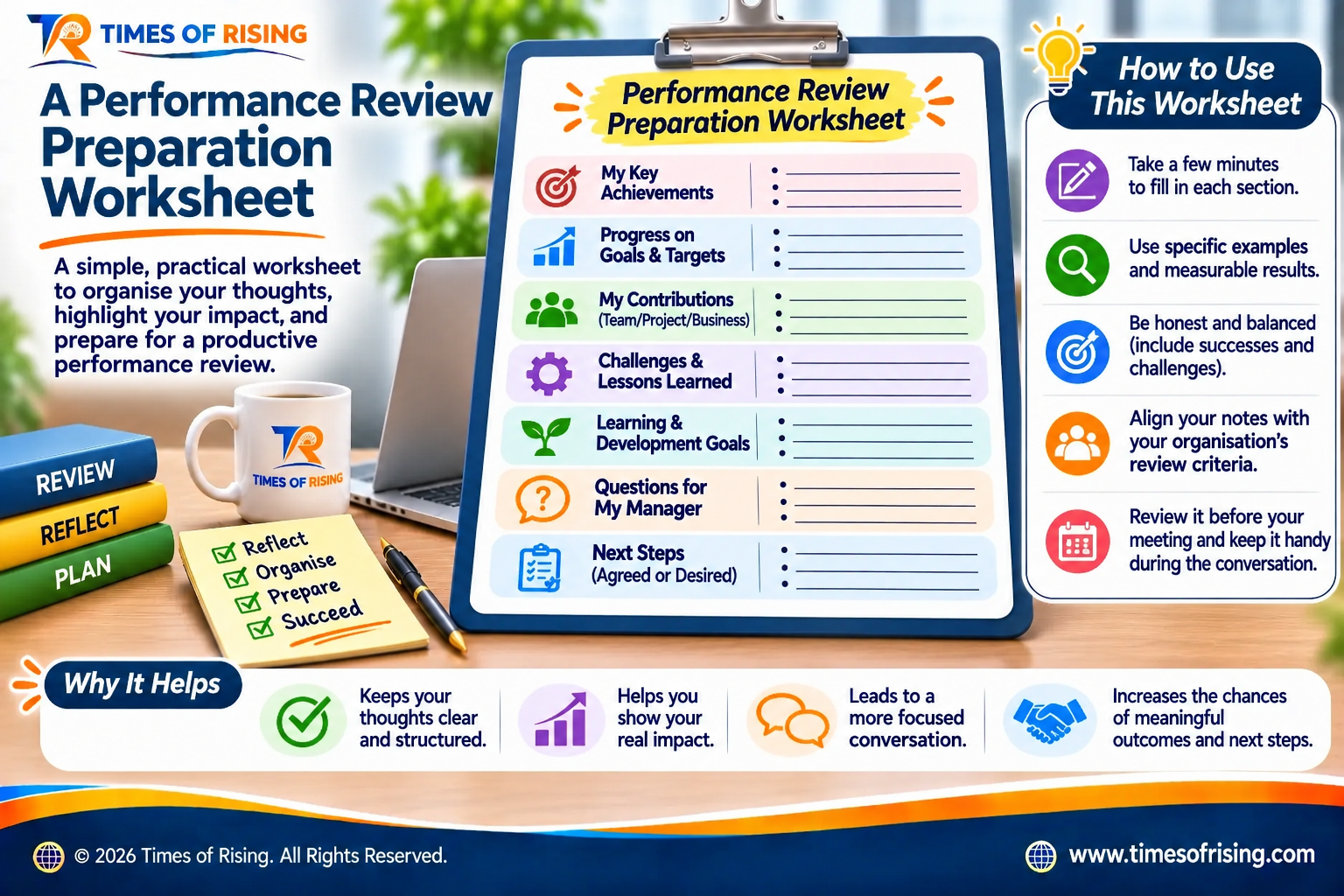
Common Mistakes to Avoid Before a Performance Review
Even when employees understand the importance of preparation, certain mistakes can reduce the usefulness of the discussion.
1. Preparing only recent achievements
People often remember their latest projects more clearly than work completed several months earlier.
This can result in an incomplete picture of the review period.
Better approach: Review the entire period, including earlier projects, milestones, and feedback.
2. Listing activities instead of outcomes
A list of completed tasks does not always explain the value of your contribution.
Better approach: Explain what you did, why it mattered, and what changed as a result.
3. Making unsupported claims
Statements such as “I improved team productivity significantly” are difficult to evaluate without supporting evidence.
Better approach: Use reliable figures or describe observable improvements. Never invent results.
4. Ignoring incomplete goals
Avoiding difficult topics may make it harder to identify the reasons behind missed targets.
Better approach: Prepare an honest explanation, recognise your own responsibilities, and identify possible improvements.
5. Setting vague development goals
Saying that you want to become better at your job does not provide a clear direction.
Better approach: Identify a specific skill, a practical learning activity, and a way to evaluate progress.
6. Preparing a long speech
A performance review should be a conversation, not a presentation in which you read every point from a document.
Better approach: Prepare short notes and allow enough time for questions, feedback, and discussion.
7. Focusing only on promotion or salary
Compensation and career progression may be legitimate topics, depending on the review process. However, they should not replace discussions about performance, responsibilities, development, and future expectations.
Better approach: Understand the purpose of the meeting and prepare the relevant questions for each topic.
8. Leaving without agreed next steps
A discussion can feel productive but still produce little practical change if nobody knows what should happen afterwards.
Better approach: Clarify responsibilities, timelines, support requirements, and follow-up arrangements before the meeting ends.
Frequently Asked Questions
What should I prepare before a performance review?
Prepare a summary of your achievements, progress against previous goals, supporting examples, challenges, learning experiences, and future development objectives. Review your job description and previous feedback, and write down questions you want to discuss with your manager.
How many achievements should I mention in a performance review?
There is no fixed number, but three to five meaningful achievements can provide a useful starting point. Choose examples that demonstrate different strengths, responsibilities, and outcomes. Prioritise relevance and evidence over the number of achievements.
Should I mention mistakes during a performance review?
Yes, when they are relevant to your performance or development. Explain what happened, what you learned, and what you have changed or plan to change. Avoid hiding genuine problems, but also distinguish between personal mistakes and circumstances outside your control.
What questions should I ask during a performance review?
Useful questions include:
- What are my strongest contributions?
- Which areas should I improve?
- What would better performance look like?
- Which skills should I develop?
- What are your priorities for my role in the next review period?
- What support would help me achieve those expectations?
Choose questions based on your actual responsibilities and career interests.
How do I prepare if I have not achieved all my targets?
Review each incomplete objective and identify the reasons. Consider whether the issue involved changing priorities, limited resources, unclear expectations, external dependencies, or something you could have handled differently.
Prepare a realistic improvement plan rather than trying to justify every missed target.
What if I disagree with my performance review?
Ask your manager to explain the assessment and provide specific examples. Share relevant evidence and explain your perspective calmly. If you remain concerned, ask about your organisation’s formal review, appeal, or grievance procedure.
Should I ask for a promotion during a performance review?
You can discuss career progression if it is relevant to the meeting. Prepare evidence of your responsibilities, achievements, and readiness for additional work. Ask what skills, experience, or results would be expected before moving into the next role.
What should I do after a performance review?
Review your notes and record the agreed actions, goals, responsibilities, and timelines. Identify any training or support that was promised and arrange follow-up discussions where necessary.
A performance review becomes more valuable when the agreed actions are followed throughout the next review period.
Final Thoughts
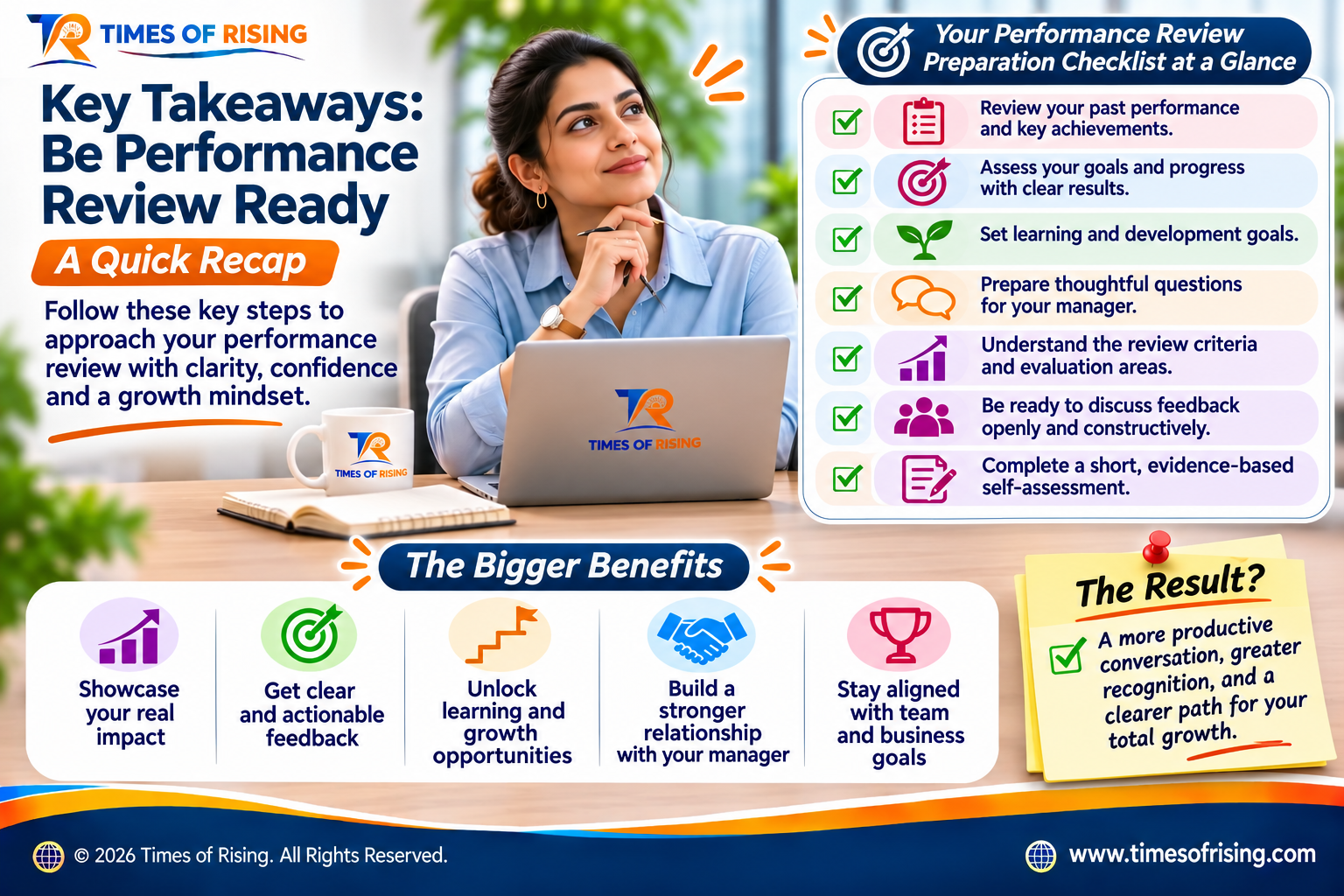
Preparing before a performance review is about more than collecting achievements or completing an employee self-assessment form. It is about understanding your contribution, recognizing where you can improve, and knowing what you want to achieve next.
Start by reviewing your responsibilities and previous goals. Organise your achievements, support important statements with specific examples, and think honestly about challenges. Identify learning opportunities and prepare questions that help clarify expectations.
Most importantly, approach the meeting as a two-way conversation.
Your manager should have an opportunity to explain their assessment, while you should be able to discuss your work, provide relevant context, ask questions, and express your professional development interests.
A useful performance review should leave you with a clearer understanding of your strengths, areas for improvement, and priorities for the future.
You do not need to have every answer before entering the meeting. You simply need to be prepared to discuss your work honestly and turn the conversation into practical next steps.
Prepare your evidence, understand your goals, and make sure you leave with a clear plan for what comes next.

Emily Smith
Emily Smith writes about career development and workplace skills. Her coverage includes resume preparation, job interviews, professional communication, career transitions, remote work and workplace productivity. She focuses on actionable guidance and clear examples that help readers navigate employment decisions and develop practical professional skills.

Join the conversation
Share a thoughtful response, ask a question, or add something useful for other readers.
Be the first to add a helpful perspective.