
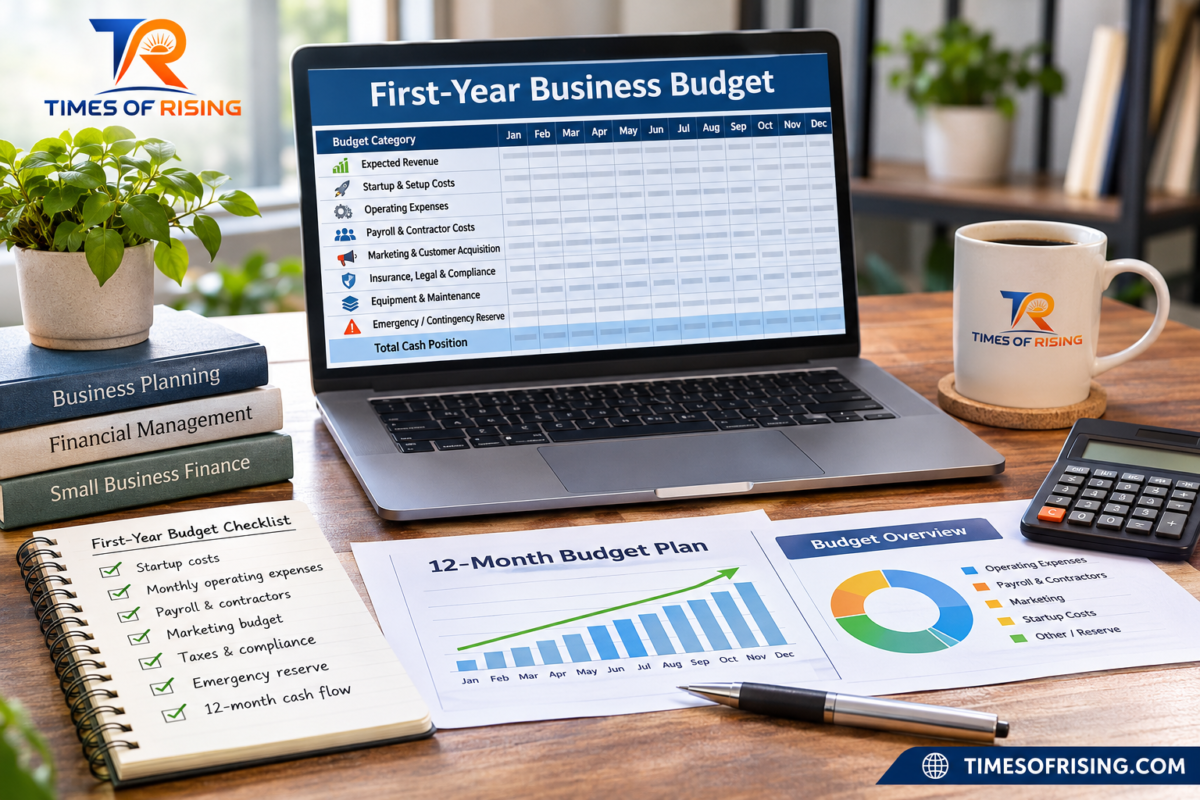
What to Include in a Simple First-Year Business Budget
Starting a business is often associated with finding customers, developing products, building a brand, and generating sales. But there is another responsibility that deserves attention from the beginning: understanding how much money the business will need to operate during its first year.
A business can have a promising product, a clear target audience, and encouraging early sales while still experiencing financial difficulties. This can happen when the owner underestimates operating expenses, forgets annual payments, spends too much on setup, or assumes that revenue will arrive sooner than it actually does.
A first-year business budget helps prevent these problems by turning an idea into a practical financial plan. It gives the owner a clearer picture of expected income, startup costs, monthly expenses, and the cash needed to keep operations running.
The good news is that a useful budget does not have to be complicated. A small business does not necessarily need expensive financial software, a large accounting department, or an advanced forecasting model. A well-organised spreadsheet with realistic estimates can provide a strong starting point.
The important part is knowing what to include.
This guide explains the essential components of a simple first-year business budget, how to estimate each category, and how to organise the figures into a practical 12-month plan. It also includes an illustrative example and a checklist that new business owners can use when preparing their own budgets.
What Is a First-Year Business Budget?
A first-year business budget is a financial plan that estimates how much money a business expects to receive and spend during its first 12 months of operation.
It normally includes:
-
Expected sales and other income.
-
Initial startup and setup expenses.
-
Regular operating costs.
-
Employee and contractor payments.
-
Inventory or production expenses.
-
Marketing and customer acquisition costs.
-
Taxes, licences, insurance, and professional fees.
-
Equipment purchases and maintenance.
-
Debt repayments, where applicable.
-
Emergency and contingency reserves.
-
Expected monthly cash balances.
The budget should show more than a single annual spending total. Ideally, it should divide income and expenses into individual months so the owner can understand when money is expected to arrive and when payments will become due.
For example, a business might expect to generate a reasonable amount of revenue across the year but still experience difficult months because customer payments arrive after rent, payroll, and supplier invoices are due.
That is why a first-year business budget should be connected to cash flow planning rather than treated as an isolated expense list.
A useful distinction is that a budget is primarily a forward-looking plan, while actual financial records show what has already happened. Comparing the two helps business owners understand whether their assumptions were realistic and where adjustments are necessary.
Why Does a New Business Need a Budget?
A first-year budget is not simply a document prepared for investors or lenders. It is a practical management tool that helps owners make decisions before committing money.
There are several reasons it matters.
1. It reveals the real cost of starting a business
Many new entrepreneurs focus on the obvious expenses, such as purchasing equipment, creating a website, or registering a company.
However, the actual cost of operating a business extends beyond its initial launch.
A business may also need to pay for subscriptions, maintenance, professional services, utilities, customer support, packaging, insurance, and recurring compliance requirements.
Listing these expenses before launch helps identify the total financial commitment rather than focusing only on the initial investment.
2. It helps prevent unnecessary spending
A new business often has more spending opportunities than available resources.
An owner might want a premium website, expensive office furniture, several software subscriptions, professional photography, additional equipment, and a large advertising campaign.
Some of these purchases may be useful, but not all are essential immediately.
A budget creates a way to compare each proposed expense with the business’s actual priorities. It helps distinguish between something required to serve customers and something that can wait.
3. It supports better pricing decisions
Understanding expenses is necessary when deciding how much to charge for a product or service.
Suppose a business sells a product for 100 currency units. The product costs 45 units to purchase, while packaging, payment processing, and delivery add another 15 units.
The business has 40 units remaining before accounting for broader operating expenses, taxes, and other costs.
Without understanding these expenses, an owner might mistake a positive difference between selling price and purchase price for actual profit.
A budget makes the full cost structure more visible.
4. It helps prepare for uneven revenue
New businesses rarely have perfectly predictable income.
Sales may increase gradually, fluctuate with seasonal demand, or depend on a small number of customers. Some clients may also pay later than expected.
A monthly budget helps owners recognise periods when expenses could exceed incoming cash.
For a more detailed explanation of this issue, readers can also explore the Times of Rising guide, How to Forecast Cash Flow When Sales Are Unpredictable.
5. It creates a basis for measuring performance
A budget provides a reference point against which actual results can be compared.
If the business planned to spend 2,000 units on marketing but actually spent 3,000, the difference deserves investigation.
Perhaps advertising costs increased. Perhaps the owner tested additional campaigns. Or perhaps the original estimate was too low.
The same process applies to sales, payroll, inventory, and other expenses.
The purpose is not to make every month match the original forecast perfectly. It is to understand differences and improve future decisions.
1. Include One-Time Startup and Setup Costs
The first category in a first-year business budget should cover the expenses required to establish the business and prepare it to serve customers.
These are generally costs that occur before launch or during the initial setup period rather than every month.
However, some setup expenses may happen several months after launch, so the budget should include their expected payment dates.
Business registration and formation
Depending on the business structure and jurisdiction, registration and formation costs may include:
-
Business registration fees.
-
Company incorporation charges.
-
Name registration.
-
Required permits and licences.
-
Trademark or intellectual property expenses.
-
Initial legal documentation.
-
Registered office or agent charges, where applicable.
Not every business needs every item.
A freelancer operating independently may have a much simpler setup process than a company opening a physical retail location.
The important thing is to identify the actual legal and administrative requirements before estimating the cost.
Registration requirements and fees can vary considerably by location and business activity. Owners should confirm them with the relevant official authorities rather than relying on figures from another country.
Equipment and initial assets
A business may need equipment before it can begin delivering products or services.
Examples include:
-
Computers and laptops.
-
Printers and scanners.
-
Furniture.
-
Production equipment.
-
Tools and machinery.
-
Storage equipment.
-
Point-of-sale systems.
-
Cameras and recording equipment.
-
Delivery or operational equipment.
List each major item separately instead of combining everything under a broad equipment heading.
For example, a small design agency may need computers, monitors, storage devices, and office furniture. A food production business may require specialised machinery, refrigeration, preparation equipment, and safety-related installations.
Consider whether an item should be purchased, leased, rented, or replaced with an existing resource.
The cheapest option is not always the most economical over time. Compare the total cost, maintenance requirements, expected useful life, and impact on daily operations.
Website and digital setup
Even a small business operating primarily offline may benefit from a basic online presence.
Possible initial expenses include:
-
Domain registration.
-
Website development.
-
Website design.
-
Initial hosting setup.
-
Brand identity and logo design.
-
Business email configuration.
-
Online booking or ordering setup.
-
Product photography.
-
Initial website content.
A digital business may also need application development, platform configuration, or technical integration.
Separate initial development costs from recurring website and hosting expenses. This prevents the same item from being counted twice.
Initial inventory and supplies
Product-based businesses should include the cost of purchasing or producing their initial inventory.
This may cover:
-
Raw materials.
-
Finished products.
-
Packaging.
-
Labels.
-
Product samples.
-
Storage containers.
-
Initial shipping supplies.
-
Quality-control materials.
A business should estimate how much inventory it needs to begin selling without committing more money than necessary.
Too little inventory can result in missed sales. Too much can tie up cash in products that may take months to sell.
For a service business, the equivalent category may include initial materials, work supplies, or specialised tools needed to deliver the first projects.
Initial professional services
A new business may need external assistance before it starts operating.
This can include legal consultation, accounting setup, bookkeeping configuration, tax registration assistance, and professional advice related to its industry.
These costs should be estimated separately from ongoing professional fees.
Practical tip: Create a launch-cost checklist and assign an expected payment date to each item. A cost that is due before the first customer payment should be treated differently from one that can be paid after operations begin.
2. Include Regular Fixed Operating Expenses
Fixed expenses are costs that generally remain stable over a period, even when sales increase or decrease.
They are especially important during the first year because the business may have to pay them even when revenue is low.
Rent and workspace
If the business operates from a commercial location, include:
-
Monthly rent.
-
Security deposits, where relevant.
-
Building maintenance charges.
-
Workspace service fees.
-
Storage or warehouse rent.
-
Property-related service charges.
For a home-based or remote business, these costs may be considerably lower.
However, working from home does not necessarily mean that all workspace-related expenses disappear. Business owners may still need dedicated equipment, internet access, storage, or occasional meeting facilities.
Utilities and communication
Budget for the services required to keep the business operational.
These may include:
-
Electricity.
-
Water.
-
Internet.
-
Business telephone services.
-
Mobile communication.
-
Heating or cooling.
-
Cloud connectivity and essential infrastructure.
Some utility expenses may vary with usage, so avoid treating every bill as perfectly fixed.
Use recent provider quotations or reasonable estimates based on the expected level of activity.
Software and subscriptions
Software expenses are easy to underestimate because individual subscriptions can appear inexpensive.
However, several small monthly charges can become a meaningful annual expense.
Common examples include:
-
Accounting software.
-
Project management tools.
-
Design applications.
-
Website hosting.
-
Cloud storage.
-
Customer relationship management systems.
-
Email services.
-
Security software.
-
Communication platforms.
-
Industry-specific software.
For every subscription, record its monthly or annual price, renewal date, number of users, and business purpose.
Avoid purchasing multiple tools that perform essentially the same function.
Insurance
Depending on the business activity and jurisdiction, insurance may include:
-
General liability coverage.
-
Professional liability coverage.
-
Commercial property insurance.
-
Equipment insurance.
-
Product liability coverage.
-
Cyber insurance.
-
Employee-related insurance requirements.
Insurance requirements differ by location, industry, and legal structure.
The budget should use actual quotations and advice from an appropriately qualified insurance professional rather than assuming that every business needs the same policies.
Loan and financing payments
If the business has borrowed money, include scheduled repayments.
Separate the principal repayment from interest when preparing detailed financial records, and make sure the cash budget reflects the complete payment amount and its due date.
Also include any applicable account fees, financing charges, or other contractual costs.
Do not assume that a business loan is revenue. Borrowed funds create repayment obligations and should be recorded separately from money earned through sales.
3. Include Employee and Contractor Costs
People-related expenses can become one of the largest parts of a business budget, particularly when the business plans to hire employees during its first year.
The mistake many new owners make is budgeting only for the basic salary.
The actual cost of employing someone may include additional expenses.
Employee salaries and wages
List the expected payments for every planned position.
For example:
| Position | Monthly cost | Annual cost |
|---|---|---|
| Business assistant | 1,500 | 18,000 |
| Sales representative | 1,800 | 21,600 |
| Operations employee | 1,700 | 20,400 |
| Total | 5,000 | 60,000 |
Illustrative figures in unspecified currency units, not salary benchmarks.
If the business does not plan to hire immediately, do not include unnecessary positions simply because they might eventually become useful.
Instead, identify the month when each position may become necessary and include its cost from that point onwards.
Employer-related expenses
Depending on local regulations and employment arrangements, additional expenses may include:
-
Employer payroll contributions and taxes.
-
Employee benefits.
-
Paid leave obligations.
-
Health-related benefits.
-
Retirement contributions.
-
Workers’ compensation requirements.
-
Payroll administration.
These expenses should be checked against the rules applicable to the business’s location.
Recruitment and training
Hiring someone also involves costs before that person becomes fully productive.
Include reasonable estimates for:
-
Job advertisements.
-
Recruitment services.
-
Background or reference checks where appropriate.
-
Onboarding.
-
Training materials.
-
Initial equipment.
-
Work-related software access.
Contractors and freelancers
A new business may not need permanent employees for every function.
It might use external professionals for website development, graphic design, bookkeeping, content creation, legal work, or technical support.
List these expenses separately.
For example, a business may spend 800 units on website maintenance in one month and nothing on that service in the next month.
That is different from a recurring employee salary and should be budgeted accordingly.
Founder compensation
Business owners should also consider whether they will receive compensation.
Some founders choose to delay taking a salary, but this should be a conscious financial decision rather than an assumption that their time has no cost.
If the owner needs money to support personal living expenses, that requirement should be considered separately when assessing the amount of capital available to the business.
Keeping personal and business finances separate makes the budget easier to understand and reduces confusion when reviewing actual performance.
4. Include Product, Inventory, and Direct Service Costs
This category covers the costs directly associated with producing goods or delivering services.
It is particularly important because these expenses often increase as sales increase.
For a product-based business, they may include:
-
Raw materials.
-
Wholesale purchases.
-
Manufacturing charges.
-
Packaging.
-
Product assembly.
-
Shipping and fulfilment.
-
Quality testing.
-
Storage directly related to inventory.
For a service-based business, direct costs may include:
-
Freelancers hired for specific projects.
-
Materials used during client work.
-
Project-specific software.
-
Travel required to deliver a service.
-
External specialist services.
-
Other costs directly associated with completing a contract.
Understand the difference between direct and general expenses
Consider a small business that sells handmade products.
It purchases materials for 20 units, spends 5 units on packaging, and incurs 5 units in delivery and transaction costs.
Its direct cost is 30 units before broader operating expenses.
The business may also pay rent, internet charges, accounting fees, and marketing expenses.
Those additional costs are part of running the business but are not necessarily direct costs of producing each item.
Separating these categories makes it easier to understand product profitability.
Estimate inventory requirements realistically
Do not prepare the first-year budget by assuming that every month will have the same inventory requirement.
Instead, consider:
-
Expected sales volume.
-
Average quantity of materials required per sale.
-
Supplier prices.
-
Minimum order quantities.
-
Supplier payment terms.
-
Expected delivery times.
-
Seasonal demand.
-
Storage and spoilage risks, where applicable.
A business selling seasonal products may need to purchase inventory well before the expected sales period.
That means the cash outflow may occur in one month while the corresponding sales revenue arrives in another.
The budget should reflect this timing difference.
5. Include Marketing and Customer Acquisition Costs
A business needs customers to generate revenue, and finding those customers usually requires some level of marketing investment.
However, new businesses should avoid treating marketing as an unlimited spending category.
The objective is to allocate money to activities that help the intended audience discover, understand, and purchase the business’s products or services.
Website and content marketing
Potential expenses include:
-
Website maintenance.
-
Blog content production.
-
Search engine optimisation services.
-
Product photography.
-
Video production.
-
Email marketing.
-
Website analytics tools.
-
Landing page development.
Some of these costs may overlap with the initial website setup category.
For example, building a website is generally a setup expense, while maintaining it and producing new content may be recurring operating expenses.
Record each cost once in the appropriate category.
Paid advertising
If the business intends to use paid advertising, include a realistic monthly allowance.
Possible channels include search advertising, social media advertising, local advertising, and industry-specific publications.
Do not assume that spending more automatically produces more customers.
The budget should be supported by a clear marketing objective and a way to evaluate performance.
For example, a business might allocate 500 units to a campaign designed to generate qualified enquiries.
After the campaign, it can review:
-
How many enquiries were received?
-
How many became paying customers?
-
What was the average acquisition cost?
-
Did the customers generate enough revenue to justify the campaign?
-
Did the campaign attract the intended audience?
This approach makes marketing expenditure easier to evaluate.
Branding and promotional materials
A business may also need:
-
Business cards.
-
Brochures.
-
Product catalogues.
-
Signage.
-
Promotional photography.
-
Packaging design.
-
Event materials.
-
Launch promotions.
Not every business needs every item.
Prioritise the materials that help customers recognise the business or make purchasing decisions.
Sales-related expenses
Marketing and sales are closely connected, but they should be distinguishable in the budget.
Sales-related expenses may include:
-
Customer relationship management software.
-
Sales commissions.
-
Demonstrations.
-
Samples.
-
Sales travel.
-
Trade events.
-
Proposal preparation.
This separation can help owners understand whether the cost of generating a customer is increasing.
A useful budgeting principle: Do not allocate money to a marketing activity simply because competitors are using it. Estimate its likely cost, identify the intended result, and review actual performance before expanding the spending.
6. Include Legal, Accounting, Tax, and Compliance Expenses
Administrative and compliance costs are easy to overlook because they may not directly generate sales.
However, they are essential parts of operating a legitimate and properly managed business.
Accounting and bookkeeping
Possible expenses include:
-
Bookkeeping services.
-
Accounting software.
-
Financial statement preparation.
-
Payroll administration.
-
Annual accounting support.
-
Professional consultations.
Even a small business should maintain organised records from the beginning.
Recording transactions regularly is generally easier than attempting to reconstruct several months of activity later.
Tax obligations
The budget should include estimates for relevant business taxes and statutory payments.
Depending on the jurisdiction and business structure, these might include:
-
Income or corporate taxes.
-
Sales taxes.
-
Value-added taxes.
-
Payroll-related taxes.
-
Property-related taxes.
-
Industry-specific charges.
The actual requirements vary considerably.
For example, a business operating in one country may have different filing obligations from a business selling internationally.
It is important to distinguish between tax collected on behalf of a government and income that belongs to the business.
Also, do not treat all money remaining in the bank account as available for spending. Some of it may be needed for future tax payments.
Licences and regulatory compliance
Some businesses must renew licences or pay compliance-related charges during the year.
Examples may include:
-
Annual business licence renewals.
-
Industry permits.
-
Health and safety inspections.
-
Environmental compliance.
-
Professional registration.
-
Data protection requirements.
-
Product certification.
Identify the actual requirements that apply to the business and record their renewal dates.
Legal services
Legal support may be needed for:
-
Customer agreements.
-
Supplier contracts.
-
Employment agreements.
-
Privacy policies.
-
Intellectual property matters.
-
Dispute resolution.
-
Regulatory questions.
A new business may not require continuous legal support, but it should not assume that legal expenses will never arise.
A reasonable estimate based on expected needs is more useful than leaving the category blank.
7. Include Equipment Maintenance, Repairs, and Replacement Costs
Buying equipment is only part of the financial commitment.
Most equipment requires maintenance, and some items may need repairs or replacement during the first year.
Consider the following examples:
| Business type | Possible maintenance expenses |
|---|---|
| Retail shop | Point-of-sale equipment, security systems, refrigeration |
| Digital agency | Computers, monitors, networking equipment |
| Restaurant | Kitchen equipment, refrigeration, ventilation |
| Delivery business | Vehicle maintenance and operational equipment |
| Manufacturing business | Machinery servicing and replacement components |
These costs may not occur every month, but they should still be included in the annual budget.
Plan for equipment replacement
Some equipment purchases can be postponed, while others are necessary to maintain operations.
Identify critical assets and consider what would happen if an important item stopped working.
For example, an online business may depend on reliable computer equipment, while a retail business may depend on its payment system.
The budget should recognise these operational dependencies.
Distinguish maintenance from new investment
Routine repairs and servicing should be tracked separately from major equipment purchases.
This distinction helps owners understand the difference between maintaining existing operations and investing in additional capacity.
A major upgrade should have a clear business reason rather than being treated as an automatic annual expense.
8. Include Delivery, Logistics, and Customer Support Costs
These expenses can be significant for businesses that sell physical products, serve customers across different locations, or handle a high volume of orders.
Depending on the business model, include:
-
Courier charges.
-
Packaging and shipping.
-
Warehousing.
-
Inventory handling.
-
Returns and exchanges.
-
Payment processing fees.
-
Customer support services.
-
Order management tools.
-
Delivery-related insurance, where applicable.
Budget for returns and refunds
Not every sale will necessarily remain a completed sale.
Customers may return products, cancel orders, request refunds, or report delivery problems.
The business should estimate these costs using available industry information or its own early sales data.
For a new business without historical records, the initial estimate should be clearly identified as an assumption and reviewed as real transaction information becomes available.
Include payment processing fees
Online and card-based payments may involve transaction charges.
These fees can depend on the payment method, transaction size, provider, and agreement.
Rather than treating them as an unexplained miscellaneous expense, estimate them using the business’s expected transaction volume and actual provider pricing.
Consider customer support
As sales increase, customer enquiries may also increase.
The business may need to budget for:
-
Support staff.
-
Communication tools.
-
Helpdesk software.
-
Knowledge-base development.
-
Returns administration.
-
After-sales service.
Customer support should not be viewed only as a cost. Reliable service can help protect customer relationships and encourage repeat purchases.
9. Include an Emergency and Contingency Reserve
A first-year business budget should not allocate every available unit of money to planned expenses.
Unexpected costs are a normal part of operating a business.
Examples include:
-
Equipment breakdowns.
-
Unexpected repairs.
-
Supplier price increases.
-
Delayed customer payments.
-
Product returns.
-
Temporary sales declines.
-
Urgent professional services.
-
Unplanned operational requirements.
A contingency reserve provides some flexibility when actual expenses differ from the original estimates.
How much should a business reserve?
There is no single reserve amount suitable for every business.
The appropriate amount depends on:
-
Monthly operating expenses.
-
Revenue reliability.
-
Seasonal demand.
-
Customer payment behaviour.
-
Supplier payment terms.
-
Industry risks.
-
Access to reliable funding.
-
The time needed to reduce expenses if sales decline.
Stripe’s startup cost guidance discusses a contingency allocation of approximately 10%–20% of estimated costs as a planning approach. This can be a useful starting reference, but it should not be treated as a universal rule.
Stripe
A business with low fixed costs and predictable customer payments may have different requirements from one with substantial rent, payroll, and inventory commitments.
Keep the reserve separate in the budget
For clarity, record the contingency reserve as a planned allocation rather than hiding it inside miscellaneous expenses.
For example:
| Budget item | Illustrative amount |
|---|---|
| Estimated operating expenses | 100,000 |
| Planned contingency allocation | 10,000 |
| Total planned allocation | 110,000 |
Illustrative example only. The 10% allocation is not a recommended amount for every business.
The reserve should be accessible when genuinely needed, but it should not become an additional spending allowance for optional purchases.
10. Include Expected Revenue and Other Cash Inflows
A business budget should not focus exclusively on spending.
It must also estimate how much money the business expects to receive during the first year.
Without an income estimate, it is difficult to understand whether the planned spending is financially sustainable.
Estimate sales by month
Start by identifying the products or services the business expects to sell.
For each revenue stream, estimate:
-
Expected number of customers.
-
Expected number of transactions.
-
Average selling price.
-
Expected sales volume.
-
Likely seasonal changes.
-
Customer payment terms.
A simple sales estimate for a product business is:
Suppose a small online shop expects 80 orders in a month, with an average order value of 50 currency units.
Its estimated monthly sales would be:
This is an estimate, not a guaranteed result.
For a service business, the calculation might instead use the expected number of projects multiplied by the average project fee.
Separate different revenue sources
Some businesses receive money from more than one activity.
For example:
-
Product sales.
-
Service fees.
-
Subscription income.
-
Maintenance contracts.
-
Licensing income.
-
Consulting projects.
-
Other legitimate operating revenue.
Record each revenue source separately.
This helps identify which activities are generating income and whether the business is becoming too dependent on one customer or product.
Distinguish revenue from cash received
This is particularly important when customers purchase on credit or pay after receiving an invoice.
Suppose a business completes work worth 2,000 units in March but expects the customer to pay in April.
The March sales budget may include the revenue, but the cash flow plan should show the expected receipt in April.
This distinction prevents the business from assuming that every completed sale immediately increases its available bank balance.
Keep uncertain income separate
Do not build the first-year budget around sales that have not been confirmed.
A useful classification is:
-
Confirmed income: Orders or payments supported by reliable commitments.
-
Probable income: Expected sales based on credible customer interest or recurring demand.
-
Possible income: Opportunities that may or may not become actual sales.
This method provides a more realistic foundation for spending decisions.
11. Include Taxes, Debt, and Other Financial Commitments in the Cash Plan
Although taxes and financing costs may already appear in the expense categories, they deserve additional attention when building the monthly budget.
The reason is simple: these payments can have specific due dates, and missing them may create financial or legal problems.
Plan for tax payment dates
Do not simply estimate an annual tax amount and divide it equally across 12 months without checking the actual payment schedule.
Some taxes may be payable monthly, quarterly, or annually.
The budget should show:
-
Expected tax liability.
-
Relevant payment dates.
-
Filing-related professional fees.
-
Any required tax deposits or instalments.
-
Expected tax-related adjustments.
Where tax treatment is complicated, obtain advice from a qualified tax professional.
Include existing debt obligations
If the business has financing arrangements, record:
-
Monthly loan instalments.
-
Interest payments.
-
Scheduled principal repayments.
-
Financing fees.
-
Other contractual payment obligations.
The business should also consider whether it can meet these payments under a lower-sales scenario.
Do not confuse funding with revenue
Suppose an owner invests 20,000 units into the business.
That amount increases the money available to establish and operate the business, but it is not sales revenue.
Similarly, a business loan provides financing but creates an obligation that must be repaid.
Keep the following categories separate:
| Money received | How to classify it |
|---|---|
| Customer payments | Operating revenue or customer receipts |
| Owner contribution | Owner funding or capital contribution |
| Business loan | Borrowed financing |
| Investor funding | Investment or capital funding |
| Refund received from a supplier | Refund or adjustment |
Correct classification makes financial reporting more meaningful and prevents an inaccurate picture of business performance.
12. Include a Monthly Cash Flow Plan
A first-year budget becomes much more useful when it shows how money is expected to move through the business each month.
An annual total cannot always reveal a cash shortage.
For example, a business may expect to receive 120,000 units during the year and spend 110,000 units.
At first glance, the budget suggests a positive difference of 10,000 units.
However, if the business must pay 15,000 units in expenses before receiving its first significant customer payment, it may need additional starting capital.
This is why monthly cash planning matters.
What should a monthly cash flow plan include?
At a minimum, include:
-
Opening cash balance.
-
Customer payments received.
-
Other expected cash inflows.
-
Total available cash.
-
Supplier payments.
-
Salaries and contractor payments.
-
Rent and utilities.
-
Marketing and operating expenses.
-
Taxes and financing payments.
-
Other planned payments.
-
Closing cash balance.
The basic calculation is:
The closing balance of one month becomes the opening balance of the next month.
A business should also identify its minimum required operating cash balance. A positive closing balance does not necessarily mean the business has enough money if substantial payments are due immediately afterwards.
For a more detailed approach, use the cash flow forecasting method explained in the previously mentioned Times of Rising article.
How to Create a Simple First-Year Business Budget: A Step-by-Step Method
Knowing the expense categories is only the first part of the process.
The next step is organising them into a working budget.
A straightforward spreadsheet can be enough for a new business with relatively simple transactions.
The following method provides a practical starting point.
Step 1: Define the business model
Begin by describing how the business will generate income.
Is it:
-
A service-based business?
-
A physical retail business?
-
An online store?
-
A manufacturing business?
-
A subscription-based business?
-
A consultancy?
-
A combination of different activities?
The answer will determine which expense categories require the most attention.
A service business may have relatively low inventory costs but significant labour expenses.
A retail business may require substantial working capital for inventory, storage, and delivery.
A digital business may have lower physical infrastructure requirements but ongoing technology and customer acquisition costs.
Do not copy another company’s budget without adjusting it to the actual business model.
Step 2: Prepare a complete expense list
Write down every expense that may occur during the first year.
Start with the categories discussed in this guide:
-
Startup and registration.
-
Equipment and technology.
-
Workspace and utilities.
-
Salaries and contractors.
-
Inventory and direct costs.
-
Marketing and sales.
-
Professional services.
-
Insurance.
-
Logistics and customer support.
-
Taxes and compliance.
-
Maintenance and repairs.
-
Debt repayments.
-
Contingency reserve.
Then add any expenses specific to the industry.
The objective is to create a complete list before assigning amounts.
Step 3: Separate one-time, recurring, and variable costs
This classification makes the budget easier to manage.
| Expense type | Meaning | Examples |
|---|---|---|
| One-time | Usually paid once during setup or a specific project | Registration, initial equipment |
| Fixed recurring | Generally remains stable over a period | Rent, basic subscriptions |
| Variable recurring | Changes with business activity | Materials, delivery, commissions |
| Irregular | Occurs occasionally rather than monthly | Repairs, annual renewals |
Some costs can belong to more than one practical category.
For example, electricity is recurring but may vary with usage.
The important thing is to classify expenses consistently and estimate them realistically.
Step 4: Collect actual cost information
Avoid guessing whenever better information is available.
For each expense, try to obtain:
-
Supplier quotations.
-
Published service prices.
-
Rental agreements.
-
Insurance quotations.
-
Payroll estimates.
-
Government fee schedules.
-
Historical transaction records, where available.
Stripe recommends researching costs, comparing providers, and obtaining professional input when preparing startup estimates.
Stripe
If a cost cannot be confirmed, record it as an estimate and add a note explaining the assumption.
This is particularly important for businesses without previous financial records.
Step 5: Estimate monthly revenue
Prepare a separate revenue forecast.
Avoid entering the same sales figure for every month unless the business has a genuine reason to expect stable monthly demand.
Consider:
-
The expected launch date.
-
How quickly customers may discover the business.
-
The sales cycle.
-
Seasonal demand.
-
Average transaction value.
-
Repeat purchases.
-
Customer payment delays.
If the business is entirely new, use cautious assumptions and update them as real sales information becomes available.
Step 6: Assign expenses to the correct months
Not every expense should be divided equally across the year.
For example:
-
Initial registration may be paid before launch.
-
Equipment may be purchased in the first month.
-
Marketing may increase during launch.
-
Inventory may rise before a seasonal sales period.
-
Insurance may be paid annually.
-
Recruitment costs may occur when hiring begins.
Enter the expected amount in the month when payment is likely to occur.
This makes the budget more useful for planning cash requirements.
Step 7: Calculate the expected funding requirement
Once the income and expense estimates are ready, calculate the amount of money needed to establish and operate the business.
A simplified approach is:
Then compare the requirement with available owner funding, confirmed investment, and appropriate financing.
Do not automatically assume that a projected future loan or unconfirmed investment will be available.
Step 8: Prepare alternative scenarios
The expected budget is only one possible outcome.
Prepare at least three versions:
Expected scenario: Uses the most reasonable assumptions based on available information.
Lower-sales scenario: Assumes fewer customers, lower order values, or slower payment collections.
Higher-sales scenario: Assumes stronger sales or faster growth, together with any additional expenses required to support it.
This is important because higher sales can also create additional costs.
A business that receives more orders may need additional inventory, packaging, labour, and delivery capacity.
A realistic scenario should include these changes rather than simply increasing revenue.
Step 9: Review the budget regularly
The budget should be updated when the business receives new information.
At the end of each month:
-
Enter actual income.
-
Record actual expenses.
-
Compare actual figures with the budget.
-
Investigate significant differences.
-
Update remaining monthly estimates.
-
Review upcoming payment commitments.
-
Adjust spending plans where necessary.
A budget is not a promise that every estimate will be correct. It is a tool for making better decisions as conditions change.
Illustrative Example: A Simple First-Year Business Budget
To understand how these categories work together, consider a fictional small service business.
The business provides digital services to small companies. It operates remotely, has one owner, uses a few external contractors, and expects to acquire customers gradually.
The following example uses illustrative currency units rather than representing a real business or industry benchmark.
A. Initial startup budget
| Startup expense | Estimated amount |
|---|---|
| Business registration and administration | 500 |
| Computer and equipment | 1,500 |
| Website and initial branding | 800 |
| Initial software setup | 300 |
| Professional assistance | 400 |
| Initial marketing | 500 |
| Total startup costs | 4,000 |
B. Estimated monthly operating expenses
| Monthly expense | Estimated amount |
|---|---|
| Owner compensation | 1,500 |
| Contractor support | 600 |
| Software and subscriptions | 150 |
| Internet and communication | 100 |
| Marketing | 250 |
| Accounting and administration | 100 |
| Insurance and other operating costs | 100 |
| Total monthly expenses | 2,800 |
All figures are hypothetical and are not recommendations or typical cost estimates.
The business’s estimated recurring operating expenses are 2,800 units per month.
Across 12 months:
Adding the initial setup expenses:
This gives the business an initial first-year expense estimate of 37,600 units before any additional variable costs, tax adjustments, or contingency allocation.
The actual budget would need to reflect changes in monthly contractor requirements, marketing activity, taxes, and other costs.
C. Illustrative monthly revenue forecast
Suppose the business expects to acquire customers gradually.
| Period | Expected monthly revenue |
|---|---|
| Month 1 | 800 |
| Month 2 | 1,200 |
| Month 3 | 1,600 |
| Month 4 | 2,000 |
| Month 5 | 2,300 |
| Month 6 | 2,500 |
| Month 7 | 2,800 |
| Month 8 | 3,000 |
| Month 9 | 3,200 |
| Month 10 | 3,400 |
| Month 11 | 3,600 |
| Month 12 | 3,800 |
| Total | 30,200 |
These figures represent a planning assumption, not a prediction of what a new service business will earn.
D. What does this example reveal?
The business expects revenue of 30,200 units but has estimated first-year expenses of 37,600 units.
The difference is:
This indicates a projected shortfall of 7,400 units before other adjustments.
That does not automatically mean the business should abandon the plan.
It means the owner needs to understand the funding requirement and assess whether the expected revenue and expenses are realistic.
Possible questions include:
-
Can the business reduce unnecessary setup expenses?
-
Are all contractor costs necessary from the first month?
-
Is the owner compensation estimate realistic and sustainable?
-
Could the business secure more confirmed customer contracts?
-
Are the marketing assumptions supported by research?
-
Does the business have sufficient starting capital?
-
Are there tax or other obligations not yet included?
The example illustrates why a budget should be prepared before the business commits to its spending plan.
A simple annual total can reveal a funding gap that might otherwise remain unnoticed.
A Simple First-Year Business Budget Template
A new business owner can use the following structure as a starting point for a spreadsheet.
| Budget category | Budgeted amount | Actual amount | Difference |
|---|---|---|---|
| Startup and registration | |||
| Equipment and technology | |||
| Rent and workspace | |||
| Salaries and contractors | |||
| Inventory and materials | |||
| Software and subscriptions | |||
| Marketing and sales | |||
| Utilities and communication | |||
| Insurance | |||
| Legal and accounting | |||
| Taxes and compliance | |||
| Logistics and delivery | |||
| Maintenance and repairs | |||
| Loan repayments | |||
| Other operating expenses | |||
| Contingency allocation | |||
| Total |
For better financial control, add separate worksheets for:
-
Monthly revenue projections.
-
Monthly operating expenses.
-
Initial startup expenses.
-
Monthly cash flow.
-
Actual-versus-budget comparisons.
-
Financial assumptions and supporting quotations.
A particularly useful column is Notes and assumptions. It allows the owner to explain why a particular amount was included and whether it is confirmed or estimated.
For example, an estimated monthly marketing expense might be based on a proposed advertising campaign, while a rent expense may be supported by an existing lease agreement.
This additional information makes future budget reviews more meaningful.
Common First-Year Business Budgeting Mistakes to Avoid
Even a well-organised budget can become ineffective when the underlying assumptions are unrealistic.
Here are some common mistakes new business owners should watch for.
1. Budgeting only for the launch
Some owners carefully calculate the cost of opening their business but give little attention to the following months.
A business needs money to continue operating after its initial launch.
Include the complete first-year operating plan rather than focusing exclusively on setup expenses.
2. Overestimating sales
Optimistic sales assumptions can make an otherwise expensive business appear financially attractive.
However, expected customer interest is not the same as confirmed revenue.
Use market research, customer enquiries, realistic conversion assumptions, and available sales evidence to estimate income.
3. Forgetting small recurring expenses
A few inexpensive subscriptions may seem insignificant individually.
Together, however, they can become a substantial annual expense.
Review recurring payments and include renewal dates, annual charges, and additional user fees.
4. Ignoring the owner’s compensation
A business may appear profitable because the owner has not included compensation for their work.
If the business requires the owner to work full-time, their financial needs should be considered when assessing the business’s sustainability.
5. Treating revenue as available cash
A completed sale does not always mean the money has arrived.
Delayed invoices, payment processing times, and customer credit terms can create differences between reported sales and available cash.
Budget for expected collection dates rather than assuming immediate payment.
6. Forgetting taxes and compliance
Tax payments and licence renewals can create substantial financial commitments.
Identify relevant obligations early and record their expected payment dates.
7. Spending too much before validating demand
A new business may be tempted to purchase premium equipment, rent a large office, or invest heavily in advertising before confirming that customers actually want its products.
Start with the requirements needed to deliver a reliable product or service.
Expand spending when evidence supports the decision.
8. Having no contingency allocation
A budget that assumes everything will happen exactly as planned is fragile.
Include an appropriate reserve and avoid committing every available resource to planned purchases.
9. Failing to compare actual results with estimates
A budget prepared at the beginning of the year becomes less useful when nobody checks whether its assumptions remain valid.
Review actual income and expenses every month.
Identify the reasons for significant differences and update the remaining forecast.
10. Using a complicated system too early
A small business may not need advanced financial modelling software.
An overly complicated system can become difficult to maintain, particularly when the owner is responsible for several operational tasks.
Begin with a spreadsheet and introduce additional tools when the complexity of the business justifies them.
How Often Should a New Business Review Its Budget?
The first-year budget should be reviewed regularly, but the frequency can depend on the size and complexity of the business.
A practical schedule looks like this:
| Review frequency | What to examine |
|---|---|
| Weekly | Upcoming payments, available cash, overdue invoices |
| Monthly | Revenue, expenses, budget differences, closing cash |
| Quarterly | Pricing, operating costs, marketing performance, hiring plans |
| Annually | Overall business performance and next year’s financial plan |
Monthly reviews are particularly important because the first year involves considerable uncertainty.
The owner may discover that some expenses are higher than expected, certain services are unnecessary, or customer acquisition is taking longer than planned.
These findings should lead to adjustments rather than being ignored.
Questions to ask during a monthly review
-
Did the business generate the expected revenue?
-
Were customer payments received on time?
-
Which expenses exceeded their budgets?
-
Were any planned expenses unnecessary?
-
Is the business maintaining an adequate cash balance?
-
Are supplier and payroll payments covered?
-
Are marketing activities producing useful results?
-
Have any new financial commitments emerged?
-
Does the remaining annual budget still reflect current conditions?
The answers can help determine whether the business should maintain its current spending plan or revise it.
Frequently Asked Questions
1. What should be included in a first-year business budget?
A first-year business budget should include startup costs, equipment, inventory, salaries, contractor payments, rent, utilities, software, marketing, insurance, taxes, legal and accounting fees, maintenance, debt repayments, expected revenue, and a contingency reserve.
It should also include monthly cash flow projections so the owner can understand when money is expected to arrive and when payments are due.
2. How much money should a new business allocate to startup expenses?
There is no universal startup budget.
The amount depends on the business model, industry, location, equipment requirements, staffing plans, and operating arrangements.
A home-based consultancy may require relatively little initial investment, while a manufacturing business may need substantial equipment, inventory, and premises.
The best approach is to identify the actual requirements, obtain quotations, and prepare a cost estimate based on the intended scale of operations.
3. Should a business include the owner’s salary in its budget?
Yes, where the business plans to pay the owner.
Owner compensation should be included in the financial plan so that the business’s operating requirements are not understated.
If the owner decides to defer compensation, that decision should be recorded as a specific assumption rather than treating the owner’s work as permanently cost-free.
4. What is the difference between a startup budget and an operating budget?
A startup budget focuses on the costs required to establish the business and prepare it for operation.
An operating budget focuses on the recurring income and expenses associated with running the business.
A first-year business budget should include both because the owner needs to understand the total financial commitment from setup through the end of the first year.
5. Should a small business prepare a monthly or annual budget?
Ideally, both.
An annual budget provides a broad financial plan for the entire first year, while a monthly budget shows how income and expenses are expected to change over time.
Monthly estimates are particularly useful for businesses with seasonal demand, gradual customer acquisition, or irregular payment schedules.
6. How much contingency money should a new business keep?
The appropriate amount depends on the business’s operating expenses, revenue stability, supplier arrangements, and exposure to unexpected costs.
A contingency allocation of 10%–20% of estimated costs is sometimes used as an initial planning reference, but it should be adjusted to the actual circumstances.
The reserve should be based on identified risks rather than an arbitrary percentage alone.
7. Can a business prepare its first-year budget without historical financial data?
Yes.
A new business can prepare an initial budget using supplier quotations, published fees, market research, expected customer demand, planned staffing, and other available information.
However, estimates should be labelled clearly.
As the business begins operating, actual sales and expense records should replace assumptions wherever possible.
8. What happens if actual expenses exceed the budget?
First, identify why the difference occurred.
An expense may have increased because of higher demand, an unexpected repair, supplier price changes, or an inaccurate original estimate.
Then determine whether the additional spending is necessary, whether other expenses can be adjusted, and whether the remaining cash is sufficient.
Do not automatically cut every expense. Some additional spending may be necessary to maintain service quality or fulfil customer commitments.
9. Is a business budget the same as a cash flow forecast?
No.
A business budget estimates income and expenses over a period. A cash flow forecast focuses on the timing of actual money entering and leaving the business.
They are closely connected, but they answer different financial questions.
A business can show a positive projected profit while experiencing a temporary cash shortage because customers have not yet paid their invoices.
10. Can a spreadsheet be used to prepare a first-year business budget?
Yes.
A spreadsheet is often sufficient for a small business with relatively straightforward financial activity.
It can contain monthly income projections, startup costs, recurring expenses, actual payments, cash balances, and budget comparisons.
More advanced accounting or forecasting software may become useful as transaction volume and reporting requirements increase.
11. Should marketing expenses be included in the first-year budget?
Yes.
Marketing expenses should be included because attracting customers is an important part of establishing a new business.
However, the amount should reflect the business’s target audience, marketing strategy, available resources, and expected results.
Separate marketing activities into identifiable categories so their performance can be evaluated.
12. When should a business prepare its next annual budget?
The next annual budget should ideally be prepared before the current financial year ends.
The owner can use actual sales, expenses, customer behaviour, and operating experience from the first year to create more realistic estimates.
The next budget should also reflect changes in pricing, staffing, market conditions, and business priorities.
Final Thoughts: Keep the First-Year Business Budget Practical and Flexible
A first-year business budget does not need to predict every financial event perfectly.
Its purpose is to help the owner understand the costs of operating the business, estimate realistic income, identify potential funding gaps, and make informed spending decisions.
The most useful budget includes more than obvious expenses such as rent, equipment, and salaries. It also accounts for taxes, professional services, software renewals, inventory, marketing, customer support, maintenance, financing commitments, and unexpected costs.
Equally important, it separates one-time setup expenses from recurring operating costs and connects annual estimates to a monthly cash flow plan.
New business owners should avoid copying financial assumptions from unrelated companies. A budget that works for a small online consultancy may be unsuitable for a retail shop or manufacturing operation.
Instead, build the plan around the actual business model, use quotations and research wherever possible, and clearly identify estimates that still need validation.
Most importantly, treat the budget as a working document.
Review it monthly, compare actual results with expectations, and adjust the remaining plan when new information becomes available.
A realistic first-year budget cannot eliminate business uncertainty. It can, however, make that uncertainty easier to understand and manage.
For a new business, that is an important foundation for making better financial decisions and building a more sustainable operation.

Benzamin LA
Benzamin LA covers competitor research and business intelligence for digital businesses and entrepreneurs. His editorial focus includes competitor benchmarking, market positioning, content-gap analysis, audience research and the interpretation of publicly available business data. His articles aim to turn research into practical insights while explaining methodologies, limitations and the difference between verified facts and estimates.
Join the conversation
Share a thoughtful response, ask a question, or add something useful for other readers.
Be the first to add a helpful perspective.