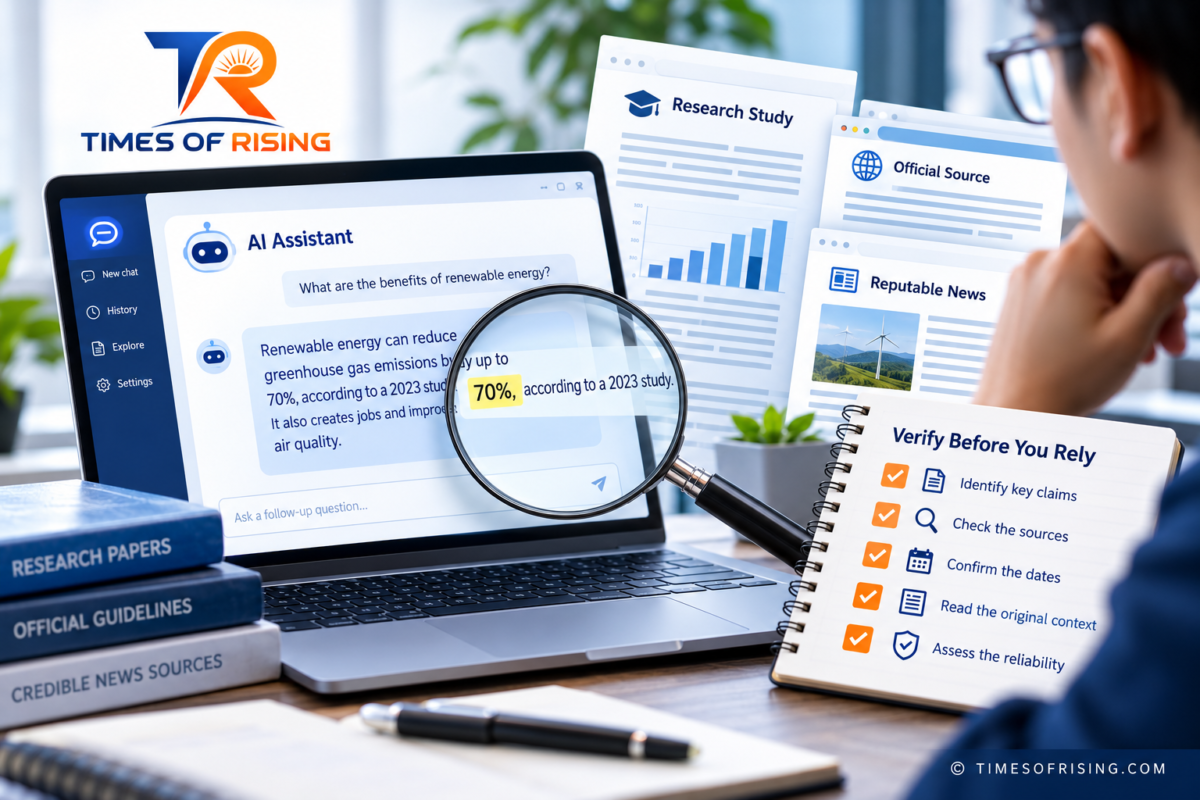
How to Check an AI-Generated Answer Before Relying on It
Artificial intelligence has made finding information easier than ever. You can ask an AI chatbot to explain a complicated topic, summarise a long document, compare two products, help with homework, or suggest a solution to a problem. Within seconds, it can produce an answer that looks organised, detailed, and convincing.
However, there is an important difference between an answer that sounds correct and one that has been verified.
An AI-generated response can contain incorrect facts, outdated information, misleading explanations, or references to sources that do not exist. Sometimes, the answer is mostly accurate but leaves out an important qualification. In other cases, it may confidently present an assumption as an established fact.
This creates a practical problem: how can you know whether an AI-generated answer deserves your trust?
The solution is not to avoid AI altogether. Instead, learn how to evaluate its answers before using them. By checking important claims, following the evidence, reviewing original sources, and considering the consequences of a possible mistake, you can use AI more responsibly.
This guide explains how to check an AI-generated answer step by step, how to recognise common warning signs, which sources to trust, and what to do when you cannot verify a claim.
Why Should You Check an AI-Generated Answer?
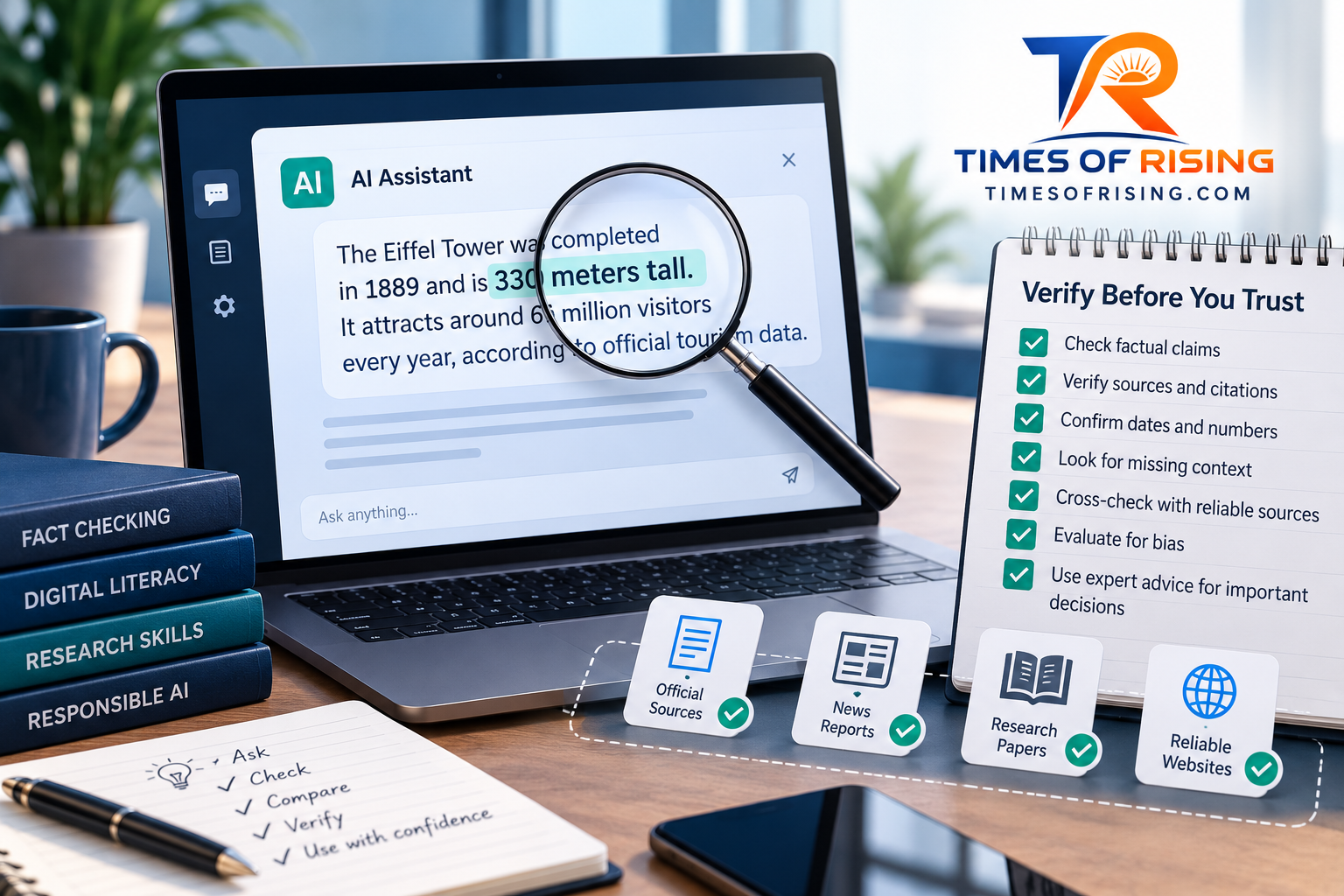
AI tools are useful for explaining concepts, organising ideas, summarising information, and helping users explore unfamiliar subjects. But their responses are not automatically reliable just because they are fluent or detailed.
Generative AI systems produce responses using patterns learned from data and, depending on the tool, information retrieved through search or other connected features. They do not guarantee that every statement they generate is factually correct.
An answer can therefore be well written and still be wrong.
Consider a few everyday examples:
- A student asks for a historical fact and receives an incorrect year.
- A website owner asks for statistics and gets a plausible-looking figure without a reliable source.
- A reader requests a summary of a research paper, but the summary exaggerates what the researchers concluded.
- Someone asks about a government procedure and receives information that was correct several years ago but has since changed.
- A user receives a list of research papers, only to discover that some titles or publication details are inaccurate.
These problems are not limited to one chatbot or one subject. AI-generated information can contain errors even when the question is straightforward.
OpenAI’s guidance on whether ChatGPT tells the truth explains that responses can include incorrect facts, fabricated references, and overconfident answers. The UK House of Commons Library also recommends checking AI-generated claims against reputable, authoritative sources.
The important lesson is simple: treat an AI-generated answer as information to evaluate, not as proof that something is true.
Checking an answer is particularly important when you plan to publish it, use it in an assignment, make a purchase, share it publicly, or use it to inform a significant decision.
1. Identify the Claims That Need Verification
The first step is to stop treating an AI response as one large block of information.
Instead, break it into individual claims that can be checked.
Suppose an AI response says:
“According to a 2024 study by a leading university, 78% of small businesses increased their revenue after adopting artificial intelligence. The study also found that AI implementation reduced operating costs by 35%.”
This sounds like a useful statistic. However, it contains several separate claims:
- A study was published in 2024.
- A particular university conducted or published the research.
- The study found that 78% of small businesses increased their revenue.
- The study found a 35% reduction in operating costs.
- The reported results apply to small businesses generally.
Each claim requires evidence.
The study might exist, but the percentages could have been reported incorrectly. The figures might come from a survey rather than a controlled study. The research might involve a small sample, a particular industry, or businesses in one country.
Even if the numbers are accurate, the conclusion may be broader than the evidence supports.
Which details should you check first?
Pay particular attention to:
- Numbers and statistics: Percentages, averages, prices, measurements, and financial figures.
- Dates: Publication dates, deadlines, historical events, and recent developments.
- Names: People, organisations, universities, government departments, and businesses.
- Direct quotations: Exact wording attributed to a person or publication.
- Research claims: Findings attributed to studies, surveys, or scientific papers.
- Legal and policy statements: Rules, eligibility requirements, procedures, and official guidance.
- Cause-and-effect claims: Statements that one event, product, or decision caused another.
- Recommendations: Advice that could influence a financial, educational, professional, or personal decision.
You do not need to investigate every ordinary sentence with the same level of effort. Begin with claims that are central to the answer, difficult to check from memory, or consequential if incorrect.
For example, an inaccurate description of a familiar software feature may be inconvenient. An incorrect statement about a legal deadline or medical instruction could have much more serious consequences.
The more important a claim is, the more carefully it should be verified.
2. Ask the AI for Sources, but Do Not Stop There
One of the easiest ways to begin checking an AI answer is to ask where its information came from.
You could use a follow-up prompt such as:
“Please list the sources supporting the main factual claims in your answer. Include direct links, publication dates, and the specific claim each source supports. If you cannot verify a source, say so rather than guessing.”
This request can make the answer easier to investigate. It may help identify official documents, research papers, reports, or other useful references.
However, there is an important limitation: asking an AI tool for sources does not guarantee that the sources it provides are genuine.
An AI system may generate a citation that looks realistic but contains an incorrect title, author, publication year, or web address. It may also provide a real source that does not support the statement attributed to it.
University research guides, including the University of British Columbia’s guide to evaluating generative AI information, warn that AI-generated citations may be fabricated or may misrepresent the original material.
Therefore, treat the source list as a starting point for research.
For every important reference, check three things:
First, does the source exist? Search for the title, author, organisation, report, or publication. If it is a research paper, look for its record in a scholarly database, the publisher’s website, or a university repository.
Second, is the source authentic? Make sure the link leads to the actual publisher, organisation, or document rather than an unrelated page or an imitation website.
Third, does the source support the claim? Open the original source and find the relevant passage, table, result, or official statement.
A source that merely discusses the same topic is not enough. It must provide evidence for the specific claim you want to rely on.
If the AI cannot provide a verifiable source, do not automatically assume that the claim is false. Instead, mark it as unverified and investigate it independently.
3. Open the Original Source and Read the Relevant Context
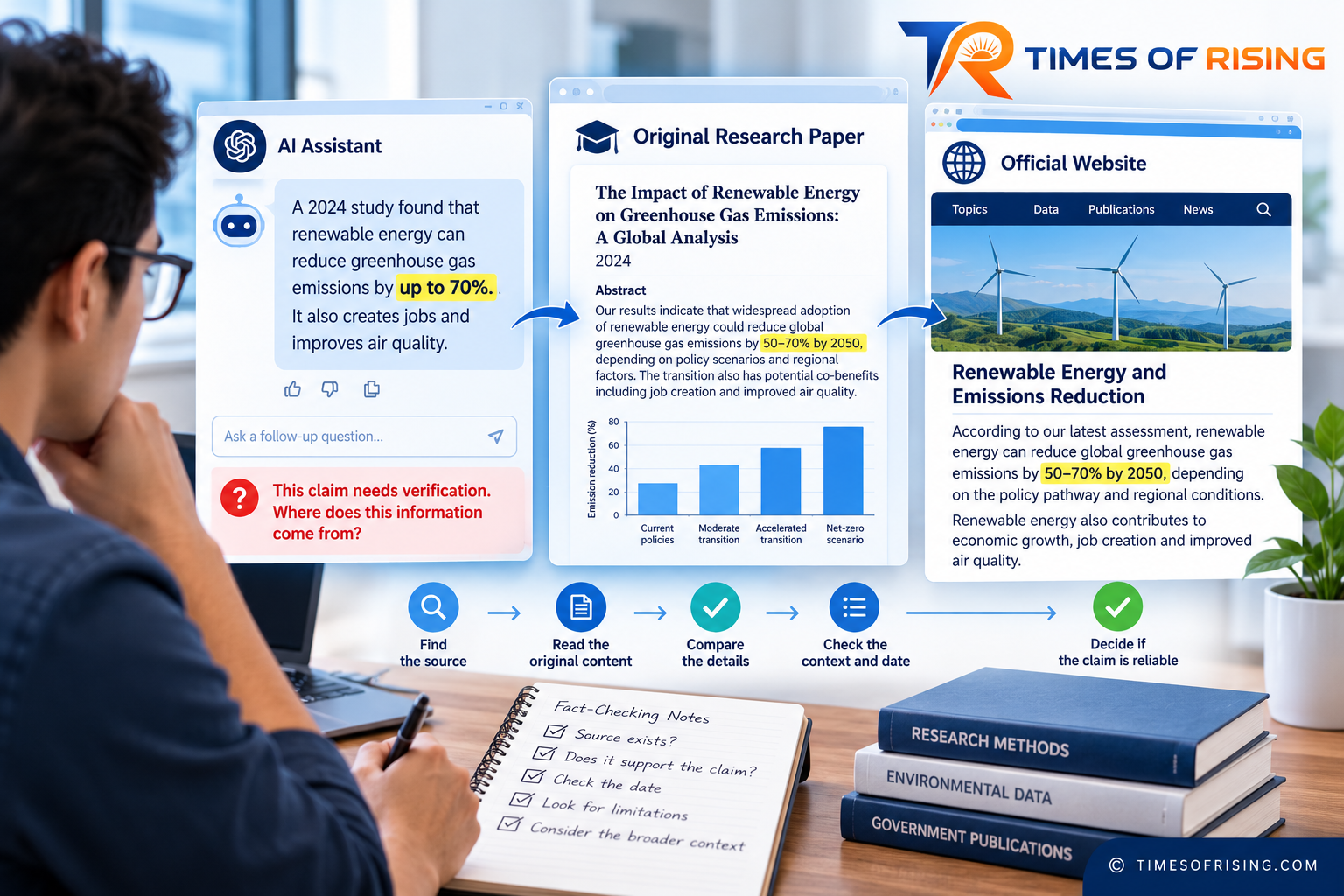
Finding a real source is only part of the verification process.
You must also confirm that the source actually says what the AI claims it says.
Imagine that an AI assistant summarises a research paper by stating:
“Researchers proved that using AI makes employees more productive in every industry.”
You find the original paper. It does report productivity improvements, but only among participants performing a specific set of tasks. The study does not cover every industry, and its findings may not apply to all types of work.
In this situation, the source exists and the AI has referred to genuine research. Yet the summary is still misleading because it exaggerates the findings.
This is why reading the relevant context matters.
When checking an original source, ask:
- What question was the source trying to answer?
- Who or what was studied?
- How many participants, cases, or observations were included?
- What methods did the researchers or authors use?
- What were the actual findings?
- Did the source identify limitations or uncertainty?
- Does the conclusion match the strength of the evidence?
- Is the information relevant to the situation described in the AI answer?
For research papers, the abstract can provide a useful overview, but it may not contain every limitation needed to evaluate a claim. Read the methods, results, discussion, and conclusion where relevant.
For official guidance, check the complete instructions, definitions, eligibility requirements, and exceptions rather than relying on a short excerpt.
For statistics, inspect the original table or dataset when possible. A figure without its date, population, geographic scope, or measurement method can be misleading.
For quotations, find the original speech, interview, publication, or transcript. Do not rely solely on another article repeating the same quotation.
The goal is to trace the answer back to the evidence and make sure the evidence supports the exact meaning presented.
4. Choose Sources That Are Appropriate for the Claim
Not all sources are equally useful for every question.
A personal blog may provide helpful first-hand experience, but it may not be the strongest evidence for a national statistic. A government website may be authoritative for an official application process, while a scientific journal may be more appropriate for a technical research claim.
The best source depends on the question you are trying to verify.
Official websites and primary documents
Official sources are often the best starting point for information about government rules, public services, regulations, official announcements, and administrative procedures.
For example, if an AI answer explains a government scheme in India, check the relevant government department’s official website and the current scheme guidelines.
If the answer discusses a company’s product feature, consult its official documentation. If it discusses a law, look for the applicable legislation, official rules, or guidance from the relevant authority.
Primary sources are especially valuable because they provide information directly from the organisation, person, dataset, or research project concerned.
However, an official source is not automatically sufficient for every question. A company’s own marketing page, for instance, may accurately describe its advertised features without independently proving that its product performs better than competitors.
Academic research and scholarly databases
For scientific, technical, or academic claims, search for the original paper or relevant review in a recognised scholarly database, university repository, or journal website.
Check whether the research has been corrected, retracted, superseded, or challenged by later evidence when that information is relevant.
Also distinguish between different types of evidence. A small exploratory study, an observational survey, a controlled experiment, and a systematic review do not necessarily support the same conclusions.
One study can provide useful evidence without settling an entire question.
Reputable news organisations
For current events, public announcements, and developing stories, established news organisations can help provide context and independent reporting.
Look for the original reporting, publication date, named sources, and supporting documents. When a claim is important or disputed, compare coverage from multiple independent outlets.
Several websites repeating the same unverified report do not necessarily provide independent confirmation.
Expert and professional sources
Professional associations, research institutions, recognised technical organisations, and qualified specialists can help explain complex subjects.
Their usefulness depends on their expertise, the evidence they present, and the relevance of their work to the question.
A source’s reputation should support your evaluation, not replace it.
How to evaluate a source quickly
Before accepting a source, consider these questions:
- Who created it?
- What evidence does it provide?
- When was it published or last updated?
- Does the author or organisation have relevant expertise?
- Does the source have a reason to promote a particular conclusion?
- Can you find the original information behind its claims?
- Do independent, credible sources support the same conclusion?
A trustworthy source is one that is suitable for the claim, transparent about its evidence, and reliable enough for the intended use.
5. Check Whether the Information Is Current
An AI answer can be historically accurate but no longer useful.
Some facts remain stable for decades. Others change regularly, sometimes within days.
For example, a basic mathematical principle is unlikely to become outdated. A software subscription price, government application process, product specification, or public policy may change.
This means that verification should include a check of when the information was published and whether it remains applicable.
Consider an AI-generated answer about a government benefit. It might describe eligibility requirements correctly based on an older policy document. If the rules have since changed, following the answer could cause confusion or an unsuccessful application.
Similarly, an AI response about a software feature may describe an older version of the product rather than the version currently available.
How to check for outdated information
Start by identifying the date associated with the claim. Is the AI referring to a specific year, an earlier version of a product, or an event that has already changed?
Next, search for the latest official documentation or announcement. Prefer a current source from the organisation responsible for the information.
Then compare the relevant details. Check whether prices, eligibility conditions, dates, requirements, or technical specifications have changed.
Finally, make sure the updated information applies to your situation. A rule may differ by country, state, product version, institution, or category of user.
Do not assume that a recently published page is automatically more accurate than an older primary source. Instead, determine which source is authoritative for the particular question and whether its information remains in force.
For current events, verify both the date of the report and the date of the event itself. An old report can circulate again and appear to describe something happening now.
6. Watch for AI Hallucinations and Confidently Presented Errors
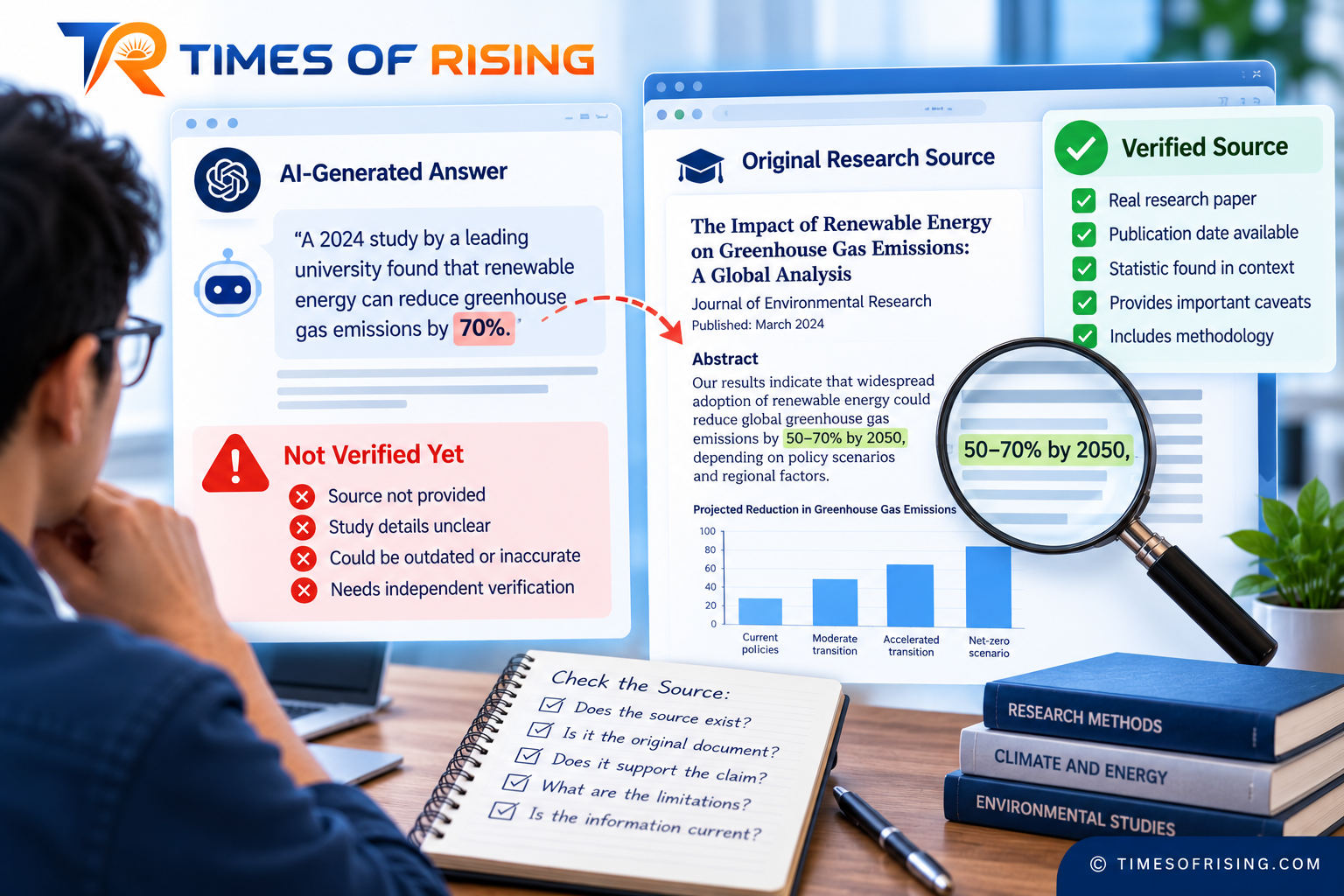
An AI hallucination occurs when an AI system generates information that is false, fabricated, or misleading while presenting it as part of an answer.
The term can sound unusual, but the practical problem is straightforward: the system produces something that looks like a factual statement without reliable support.
Hallucinations can appear in many forms.
Invented research papers
An AI tool may provide a plausible research title, researcher name, journal, and publication year. Yet the paper may not exist, or the details may combine information from different publications.
Search for the exact title and confirm the authors, publication, and date. If a DOI is supplied, check whether it resolves to the claimed paper.
Incorrect statistics
A response may provide a precise percentage without explaining where it came from.
The number might be incorrect, outdated, taken from a different population, or based on a survey that does not support the conclusion.
Look for the original dataset or report and confirm the context in which the figure was measured.
Misleading quotations
AI systems can produce quotation marks around words that were never spoken or published in that form.
A quotation may also be shortened in a way that changes its meaning.
Locate the original statement and compare the wording carefully before attributing it to a person.
Unsupported explanations
Sometimes, an AI answer includes a reasonable explanation that has not been established by evidence.
For example, it might claim that a company changed its pricing because of a particular business decision. The price change may be real, but the explanation could be speculation.
Distinguish between what is known, what is inferred, and what remains uncertain.
Incorrect details inside otherwise accurate answers
An answer does not have to be entirely wrong to be unreliable.
It might correctly describe a topic but include one incorrect date, a mistaken name, or an unsupported statistic. Because the surrounding explanation is accurate, the error can be difficult to notice.
This is why checking only the overall impression of an answer is insufficient.
One warning is worth remembering: confidence is not evidence. A response that sounds authoritative still needs independent verification.
7. Do Not Let a Second AI Answer Replace Fact-Checking
When an answer seems questionable, asking another AI tool can be a useful way to discover alternative explanations, missing details, or potential contradictions.
However, agreement between two AI tools does not establish that a claim is true.
Different systems may rely on overlapping information, repeat a widespread error, or generate similar-sounding explanations without independently verifying them.
Even the same tool may provide different answers when a question is rephrased.
A second AI response is therefore best used as an additional research lead, not as final confirmation.
For example, suppose one AI assistant claims that a particular research paper supports a statistic. A second assistant agrees and supplies a similar explanation.
The next step should not be to conclude that the statistic is correct. Instead, find the paper, read the relevant section, and confirm that the number and interpretation match the original research.
A useful approach is to ask a second tool:
“What important assumptions, limitations, or alternative explanations might be missing from this answer?”
Then investigate any relevant suggestions using appropriate evidence.
You can also search independently through official websites, scholarly databases, primary documents, and credible reporting.
This process helps you move beyond agreement between generated answers and toward evidence that can be inspected.
8. Look for Missing Context, Bias, and Overgeneralisation
An AI response may contain no obvious factual error and still leave the reader with a misleading impression.
This can happen when an answer leaves out important context, presents one perspective as universal, or draws a conclusion that is broader than the evidence allows.
Suppose an AI says:
“People who use productivity software complete their work faster.”
The statement may sound reasonable, but several questions remain unanswered.
Which people were studied? What kind of work did they perform? How much faster did they work? Was the difference measured or self-reported? Did the software introduce other costs or problems? Did the results apply to everyone?
Without these details, the claim may be too broad to support a practical decision.
Separate facts from interpretations
A useful habit is to divide the answer into three categories:
- Verified facts: Statements supported by reliable evidence.
- Interpretations: Conclusions drawn from the available facts.
- Unverified claims: Statements for which adequate evidence has not been found.
These categories can overlap in complex situations, but the distinction helps prevent assumptions from being mistaken for established information.
Check the wording carefully
Watch for phrases such as “everyone knows,” “always works,” “proves that,” or “the only reason.”
Such language is not automatically wrong, but it can signal that a nuanced subject is being oversimplified.
Ask whether the evidence genuinely supports such a broad statement.
Look for alternative explanations
If an answer presents one interpretation, consider what other explanations might fit the same evidence.
You can ask the AI to identify counterarguments, assumptions, and missing perspectives. Then verify the important points independently.
This is especially useful for disputed public issues, product comparisons, social questions, and topics where reasonable interpretations may differ.
The purpose is not to assume that every answer is biased. It is to evaluate whether the explanation is balanced, adequately supported, and appropriate for the question.
9. Test Calculations, Code, and Technical Instructions Separately
Some AI-generated answers contain information that can be tested directly.
Mathematical calculations, spreadsheet formulas, code snippets, and technical instructions require more than checking whether the explanation sounds reasonable.
They should be tested using appropriate methods.
Verify calculations
If an AI provides a percentage, financial estimate, or mathematical result, check the inputs and repeat the calculation independently.
For example, if a product’s price rises from ₹800 to ₹1,000, the increase is ₹200. Relative to the original price, the percentage increase is:
(₹200 ÷ ₹800) × 100 = 25%.
The important point is that the original value is the denominator when calculating a percentage increase.
For more complex calculations, use a calculator, spreadsheet, or appropriate analytical software. Check units, assumptions, rounding, and whether the formula matches the question.
Test spreadsheet formulas
When an AI suggests a spreadsheet formula, test it against a few inputs for which you already know the expected result.
Check empty cells, zero values, negative values, dates, and unusual inputs where relevant.
A formula that works for one example may fail in a different situation.
Review and test code
AI-generated code can contain syntax errors, incorrect assumptions, security weaknesses, or problems that appear only under certain conditions.
Review the code before using it. Run it in a suitable test environment, use representative test cases, and check the output against known results.
For code that handles personal data, payments, authentication, or other sensitive operations, appropriate security review is particularly important.
Do not run unfamiliar code in a system containing important data merely because the AI says it is safe.
Verify technical instructions
If an answer explains how to configure software or use a technical feature, compare it with the official documentation for the correct version.
Test the steps in a safe environment where possible, and pay attention to warnings, prerequisites, and possible side effects.
A plausible explanation is not a substitute for a working test.
10. Use a Risk-Based Approach to Verification
Not every AI answer needs the same amount of checking.
The appropriate level of verification depends on what the answer will be used for and what could happen if it is wrong.
Low-risk uses
Examples include brainstorming article ideas, suggesting creative names, generating a fictional scenario, or reorganising notes.
These tasks may not require extensive factual research, although factual claims introduced during the process should still be checked if you intend to use them.
Medium-risk uses
Examples include preparing a blog post, comparing ordinary consumer products, researching a school assignment, or drafting a workplace document.
Here, verify important facts, check source quality, confirm current information, and review the final output for errors or missing context.
If the material will be published, make sure the references and quotations are accurate before publication.
High-risk uses
Examples include medical decisions, legal matters, major financial decisions, safety-critical instructions, and other situations where incorrect information could have serious consequences.
For these uses, an AI answer should not be the sole basis for action. Consult an appropriately qualified professional or the relevant official authority, and verify the information using sources suitable for the decision.
A general chatbot may help explain terminology or prepare questions for a professional. It cannot replace the professional judgement required for an individual case.
When the consequences of an error are serious, the verification process should be correspondingly stronger.
11. A Simple Checklist for Checking AI-Generated Answers
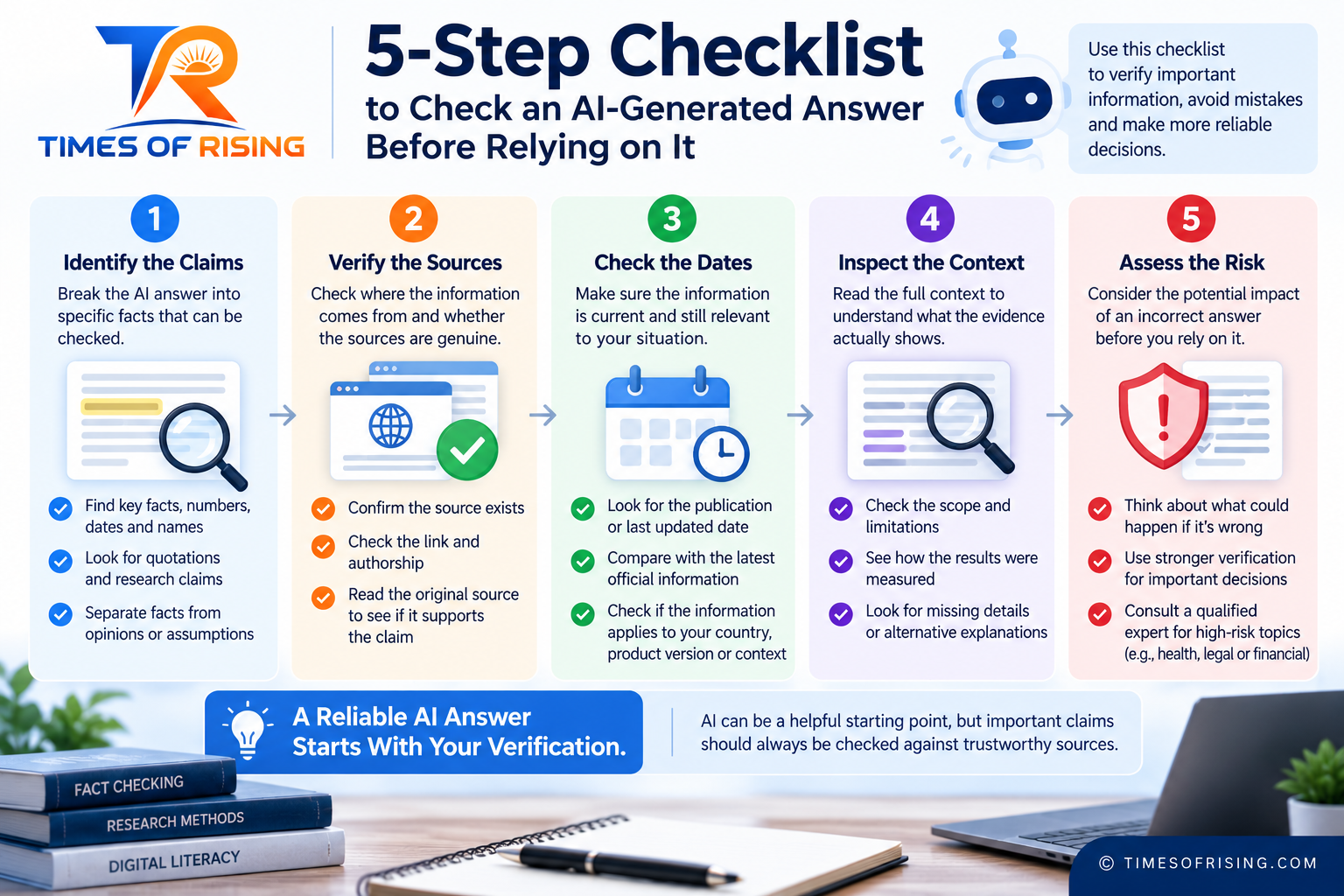
Before relying on an AI-generated answer, run through the following checklist.
Claim check
- Have I identified the main factual claims?
- Have I checked important names, dates, numbers, and quotations?
- Have I distinguished facts from assumptions and interpretations?
Source check
- Can I locate the sources the AI mentioned?
- Are the links genuine and relevant?
- Does each source actually support the claim attached to it?
- Have I checked the original evidence rather than relying only on a summary?
Currency check
- Is the information recent enough for my purpose?
- Have I checked the latest official guidance where needed?
- Does the information apply to the correct country, date, product version, or situation?
Context check
- Have I considered missing qualifications or exceptions?
- Does the evidence support the breadth of the conclusion?
- Are there important alternative explanations or conflicting findings?
Use check
- What could happen if the answer were wrong?
- Do I need a professional or subject expert to review it?
- Am I comfortable explaining why I believe the information is reliable?
If an important claim fails one of these checks, do not treat it as verified merely because the rest of the answer looks accurate.
You can revise the answer, remove the unsupported statement, investigate further, or clearly explain the uncertainty.
12. A Practical Example: Checking an AI-Generated Research Claim
Imagine you are writing an article about how artificial intelligence affects workplace productivity.
An AI assistant provides this statement:
“A 2024 university study found that AI tools increase employee productivity by 40% across all industries.”
Rather than copying the sentence directly, work through the verification process.
Step 1: Identify the claims.
The statement says that a study exists, that it was conducted or published in 2024, that a university was involved, that productivity increased by 40%, and that the result applies across all industries.
Step 2: Request the source.
Ask the AI for the study’s exact title, authors, publication, date, and direct link.
Step 3: Locate the original research.
Search the title through the university website, journal publisher, or a recognised scholarly database. If the study cannot be found, leave the claim unverified rather than inventing missing details.
Step 4: Confirm the number.
If the study exists, locate the relevant results. Check whether the reported figure is actually 40%, what was measured, and how the researchers calculated the result.
Step 5: Check the scope.
Determine whether the study examined one task, a particular group of workers, several industries, or a broad sample. Look for limitations and qualifications.
Step 6: Compare independent evidence.
Look for other credible research that examines the same question. Determine whether the findings are consistent or whether the results vary by task, workplace, or method.
Step 7: Rewrite the claim to match the evidence.
If the evidence supports a narrower conclusion, use narrower wording. For example, you might describe the observed effect in the particular task or group that was studied rather than claiming a universal productivity increase.
If the original study cannot be located, remove the unsupported statistic and continue researching the topic.
This example illustrates an important principle: fact-checking is not simply about deciding whether a sentence is true or false. It also involves determining how much the evidence allows you to say.
13. What to Do When You Cannot Verify an AI Answer
Sometimes, an answer cannot be confirmed immediately.
The source may be unavailable, the evidence may be incomplete, or reliable sources may disagree. In other cases, the AI may have combined several facts into a statement that is difficult to trace.
When this happens, avoid forcing a conclusion.
Start by narrowing the claim. A broad statement may contain several smaller questions that can be investigated separately.
Next, search for original documents, official records, relevant research, or independent reporting. Try different search terms based on the specific names, dates, and concepts involved.
If the claim remains unsupported, label it as unverified in your notes or leave it out of material intended for publication.
When credible sources disagree, examine why. They may use different definitions, study different populations, rely on different methods, or address different time periods.
In that situation, explain the disagreement rather than presenting one answer as certain without justification.
It is also reasonable to acknowledge that the available evidence does not support a definitive conclusion.
Reliable research does not require an answer to every question. It requires an honest distinction between what is known, what is uncertain, and what has not been established.
14. How to Ask AI for Answers That Are Easier to Verify
The quality of your question can influence how useful the response is for research.
A vague request such as “Tell me everything about this topic” may produce a broad explanation that is difficult to check. A more focused prompt can make the answer easier to investigate.
Try asking the AI to:
- Separate established facts from interpretations and speculation.
- Provide direct links to the original sources for important claims.
- Include publication dates and identify the organisation responsible for each source.
- State when it cannot verify a fact.
- Explain the limitations of the evidence.
- Identify assumptions and alternative explanations.
- Avoid inventing citations or filling gaps with guesses.
- Highlight information that may have changed since the source was published.
For example, a useful research prompt might be:
“Explain the main findings on this topic. For each important factual claim, provide a direct link to the original source and identify the relevant passage, table, or section where possible. Distinguish measured findings from interpretation, state any important limitations, and clearly mark anything you cannot independently verify.”
This approach encourages a more transparent response.
However, remember that a prompt cannot guarantee accuracy. The AI may still misunderstand a source, produce an incorrect citation, or omit important context.
A good prompt makes verification easier; it does not eliminate the need for verification.
15. How Writers and Publishers Should Verify AI-Assisted Content
People who publish online have an additional responsibility because incorrect information can reach many readers.
AI can help writers brainstorm topics, organise an outline, explain unfamiliar terminology, or identify questions worth researching. But generated text should not move directly from a chatbot into a published article without editorial review.
A responsible publishing workflow should include several checks.
Verify every important factual claim. This includes statistics, product specifications, historical details, quotations, research findings, and claims about people or organisations.
Check every citation. Open the original source, confirm the bibliographic details, and verify that it supports the statement being made.
Review the context. Make sure the article does not exaggerate research findings, remove important qualifications, or present a possibility as a certainty.
Check for outdated information. Review current details such as prices, regulations, product features, and public guidance before publication.
Add genuine editorial judgement. Explain what the evidence means for the reader, identify relevant limitations, and address practical questions the generated draft may have missed.
Take responsibility for the finished article. The person or organisation publishing the content should ensure that its factual claims are accurate, appropriately supported, and presented fairly.
For SEO-focused websites, this process is also important for reader trust. A page may include relevant keywords and polished headings yet still fail readers if its statistics are wrong or its references cannot be verified.
Useful content should solve a real problem, explain its reasoning, and help readers understand the evidence behind its conclusions.
AI can assist with the production process, but editorial quality depends on how the information is checked, interpreted, and presented.
Frequently Asked Questions
Can AI-generated answers be trusted?
AI-generated answers can be useful, but they should not be trusted automatically. Their reliability depends on the subject, the available evidence, the tools used, and the way the answer is checked. Verify important claims independently before relying on them.
What is the easiest way to fact-check an AI answer?
Start by identifying its main factual claims. Ask for direct sources, locate those sources independently, and check whether the original evidence supports the claims. For current information, confirm the date and look for the latest authoritative guidance.
Can AI make up sources or research papers?
Yes. AI systems can produce citations that look genuine but contain incorrect details or refer to publications that do not exist. Always search for the original publication and verify its authors, title, date, and content.
Is a confident AI answer more likely to be correct?
Not necessarily. A confident tone does not establish accuracy. Evaluate the evidence, check the original sources, and pay attention to uncertainty and limitations.
Should I use another AI tool to confirm an answer?
A second AI tool can help identify alternative explanations or potential errors, but agreement between AI systems is not proof. Confirm important claims using independent evidence, preferably from authoritative or primary sources.
How can I tell whether an AI answer is outdated?
Check the publication dates and compare the response with current official documentation or recent reliable reporting. This is particularly important for laws, government procedures, software features, prices, and developing events.
Should I verify every sentence written by AI?
The amount of checking should depend on how you plan to use the material. Creative suggestions may need little factual verification. Research claims, statistics, citations, and consequential recommendations require more attention. Before publishing an article, check every material factual claim.
What should I do if I cannot find evidence for an AI-generated claim?
Do not present the claim as verified. Search for the original evidence, narrow the question, or seek a qualified expert where appropriate. If the claim remains unsupported, remove it or clearly identify the uncertainty.
Can AI fact-check its own answers?
You can ask an AI system to review an earlier response, identify possible errors, or suggest sources. This can be a useful additional step, but the review may contain errors too. Independent verification remains important.
Final Thoughts
AI-generated answers can save time, simplify complicated subjects, and help people explore new ideas. Their usefulness, however, depends on how carefully their information is evaluated.
Before relying on an answer, identify its important claims, check the sources, read the original evidence, confirm that the information is current, and consider whether the conclusion leaves out important context.
Use additional tools when they help, but do not mistake agreement, polished writing, or precise-looking statistics for proof.
Most importantly, match the level of verification to the consequences of being wrong. A creative suggestion and a statement that could affect someone’s health, finances, legal position, or safety should not be treated in the same way.
The goal is not to question every AI response endlessly. It is to develop a consistent habit of checking the claims that matter.
Use AI to support your thinking, follow the evidence before accepting its answers, and take responsibility for the information you choose to rely on or share.

Niyami Cook
Niyami Cook covers software applications and digital productivity tools that help individuals and businesses work more efficiently. Her editorial focus includes software tutorials, collaboration platforms, productivity applications, feature comparisons and digital workflows. Her articles should prioritize practical instructions, current product documentation and transparent comparisons that explain both benefits and limitations.
Join the conversation
Share a thoughtful response, ask a question, or add something useful for other readers.
Be the first to add a helpful perspective.