

A Practical Checklist for Making a Better-Informed Decision About a Common Task
Everyday life is filled with decisions. Some take only a few seconds, such as deciding what to prepare for breakfast or which task to complete first. Others require more thought, such as choosing a service provider, planning a family activity, buying a household item, or deciding how to spend a limited amount of time.
Although these choices may appear simple, they can become surprisingly difficult when information is incomplete, priorities compete, or several options seem equally attractive. We may spend too much time comparing possibilities, rely on an assumption without checking it, or choose the most convenient option without considering its longer-term consequences.
The solution is not to analyze every small decision endlessly. It is to develop a practical process that helps us identify what matters, collect the right information, compare available choices, and act with reasonable confidence.
A better-informed decision is not necessarily a perfect decision. It is a decision made with a clear understanding of the problem, relevant evidence, realistic alternatives, personal priorities, and the uncertainty that remains.
This guide presents a practical checklist that can be used for ordinary decisions at home, at work, while managing personal responsibilities, and when planning everyday activities. The aim is to make decision-making more organized, less stressful, and easier to review.
Why Everyday Decisions Can Become Difficult
Many everyday choices seem straightforward until we begin considering all the details.
Imagine that you need to choose a new internet plan. At first, the task appears simple: compare prices and select the cheapest option. However, a closer look reveals other considerations. One provider may offer a lower introductory price but charge more after a promotional period. Another may offer better coverage, while a third may have more reliable customer support.
The decision becomes difficult because the cheapest option is not automatically the most suitable one.
Similar problems occur when choosing a daily schedule, planning a purchase, selecting a contractor, organizing a trip, or deciding which household task deserves attention first.
Several factors can make these decisions harder.
Too many options: Comparing a large number of alternatives can consume time without necessarily improving the final choice.
Unclear priorities: When we have not identified what matters most, it becomes difficult to determine which option is suitable.
Incomplete information: A decision based on missing details may overlook important costs, limitations, or practical requirements.
Emotional pressure: Excitement, frustration, urgency, or fear of making a mistake can influence how we evaluate alternatives.
Conflicting advice: Different people may recommend different solutions based on their experiences, preferences, or circumstances.
Fear of regret: The desire to avoid every possible mistake can lead to repeated comparisons and unnecessary delays.
The first step toward improving everyday decision-making is recognizing that these difficulties are normal. They do not necessarily mean that a person lacks judgment. Often, the problem is that the decision has not been organized into manageable steps.
A simple checklist creates that structure.
What Does It Mean to Make a Better-Informed Decision?
An informed decision is one that considers the available facts, relevant alternatives, likely consequences, and the needs of the people affected by the outcome.
It does not require complete knowledge of every possible detail. In many real situations, complete information is unavailable, too expensive to obtain, or unnecessary for the decision at hand.
Instead, a better-informed approach asks four basic questions:
- What exactly needs to be decided?
- What information is important for making the choice?
- Which available option best fits the relevant needs and constraints?
- What should happen next, and how will the result be evaluated?
These questions help separate the actual problem from distractions surrounding it.
For example, someone who wants to improve their morning routine may initially believe they need to wake up earlier. However, after examining their schedule, they may discover that preparing clothes and organizing work materials the previous evening would address the real problem more effectively.
The decision becomes easier once the underlying need is clear.
A structured process is especially useful when a decision involves several competing priorities, noticeable costs, uncertainty, or consequences that are difficult to reverse.
The Complete Checklist for Everyday Decisions
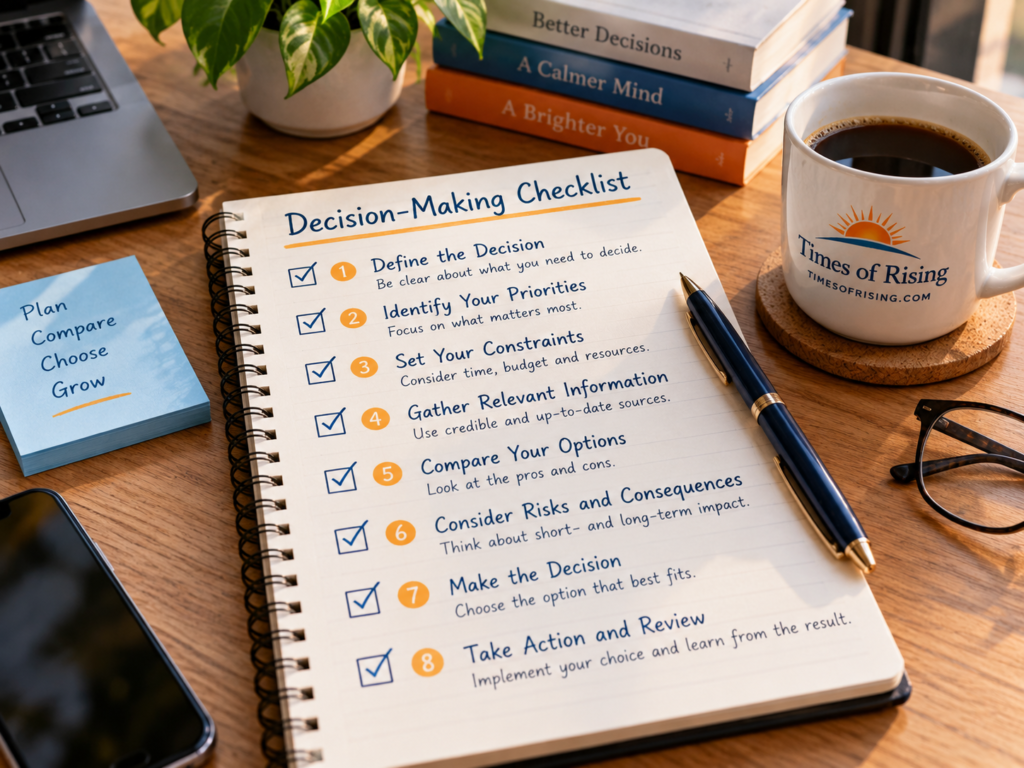
The following checklist can be adapted to different situations. For a small decision, it may take only a few minutes. For a more consequential choice, each step may deserve additional attention.
Step 1: Define the Decision Clearly
Before comparing options, write down the decision you actually need to make.
This sounds simple, but it prevents an important mistake: trying to solve a vague problem.
Consider the difference between these two statements:
- “I need to get my life organized.”
- “I need to decide which three tasks must be completed before Friday.”
The first statement describes a broad concern. The second identifies a specific decision that can be acted upon.
A clear decision statement should explain what needs to be chosen, why the choice matters, and any important limits.
Ask yourself:
- What is the exact decision I need to make?
- What problem am I trying to solve?
- What outcome would make this decision useful?
- What is included in the decision, and what is outside its scope?
- Is this a decision I need to make now?
For example, if you are choosing a new desk for a home workspace, the decision is not simply about finding an attractive desk. You may need a desk that fits a particular room, accommodates a computer, stays within a budget, and provides enough working space.
Defining these requirements gives the search a practical direction.
Checklist: I can describe the decision in one or two clear sentences and explain what I want it to achieve.
Step 2: Identify Your Priorities
Once the decision is clear, determine which factors matter most.
People often compare options without first establishing their priorities. As a result, they may repeatedly change their minds because each alternative offers a different advantage.
A useful starting point is to separate requirements into three categories.
Essential requirements: These are conditions an option must satisfy. A household appliance may need to fit a specific space, or a service provider may need to cover your location.
Important preferences: These factors improve the experience but may be negotiable. Examples include appearance, convenience, additional features, or flexible scheduling.
Optional extras: These are attractive benefits that are not necessary to achieve the main objective.
This distinction helps prevent appealing but unnecessary features from dominating the decision.
Suppose you are selecting a backpack for daily use. Your essential requirements might include adequate capacity, comfortable straps, and sufficient durability. Your preferences might include a particular color or additional compartments. A decorative feature may be enjoyable but less important than comfort and practicality.
Ask yourself:
- What must the chosen option provide?
- Which factors would make the decision more successful?
- Which preferences could I compromise on?
- What limitations can I not reasonably ignore?
- Which priorities matter most if I cannot have everything?
When several factors matter, rank the three most important ones. A short list is often more useful than an extensive collection of equally weighted preferences.
Checklist: I have identified my essential requirements, ranked my main priorities, and separated genuine needs from optional features.
Step 3: Set Your Constraints Before You Start Comparing
A good decision must fit the circumstances in which it will be implemented.
Constraints may include money, time, available space, skills, accessibility, existing commitments, or the resources needed to complete a task.
Ignoring these limitations can produce a theoretically attractive choice that is difficult to use in practice.
Suppose you are planning a weekend activity. An elaborate plan may look appealing, but it may not fit your available time, travel arrangements, or budget. Recognizing these limitations early helps you compare realistic alternatives instead of repeatedly considering options that cannot work.
Write down the relevant constraints.
- What is my maximum reasonable budget?
- How much time can I allocate?
- What resources are already available?
- Are there deadlines or scheduling restrictions?
- Do I depend on another person or organization?
- Are there legal, safety, accessibility, or practical requirements?
It is also useful to distinguish fixed constraints from flexible ones.
A fixed constraint might be a deadline imposed by an external requirement. A flexible constraint might be a preferred time that can be adjusted if another option offers a meaningful advantage.
This distinction prevents unnecessary rigidity while keeping the decision realistic.
Checklist: I understand the limits within which the decision must work, and I know which constraints can be adjusted.
Step 4: Gather Relevant Information
Once the decision and priorities are clear, gather the information needed to evaluate your alternatives.
The key word is relevant. More information is not automatically better information.
For a simple household decision, a few reliable details may be enough. For a significant purchase or a choice with longer-term consequences, you may need to compare official documentation, independent reviews, direct quotations, or advice from a qualified professional.
Start by identifying the information that could genuinely change your decision.
If you are selecting a mobile plan, for instance, the monthly charge, data allowance, coverage, contract length, and additional fees may be more important than promotional claims about unrelated features.
If you are deciding how to organize a workday, the duration of each task, deadlines, dependencies, and available time may be sufficient.
Use these questions to guide your research:
- Which facts do I need before I can compare the options fairly?
- Where can I find those facts?
- Is the source credible and relevant to my circumstances?
- Is the information current?
- Are important details missing?
- What evidence would cause me to reconsider my initial preference?
Prefer primary sources when they contain the information you need. For a service, this may mean checking the provider’s terms rather than relying entirely on a review. For a product, it may mean reviewing the manufacturer’s specifications alongside independent user experiences.
When consulting other people, distinguish between what they personally experienced and what they can establish about the option itself.
Checklist: I have gathered enough relevant, credible information to evaluate the realistic alternatives.
Step 5: Check Facts, Assumptions, and Unknowns
One of the most useful habits in everyday decision-making is separating facts from assumptions.
A fact is something supported by reliable evidence. An assumption is something being treated as true without sufficient confirmation. An unknown is a detail that remains unresolved.
These categories can easily become mixed together.
Imagine that you are considering a local service provider. You may know the quoted price and the stated completion date. You may assume that the service includes installation, even though the quotation does not explicitly say so. You may not yet know whether additional charges apply.
If you treat all three statements as equally certain, you could make an avoidable mistake.
A simple three-column note can help.
| Category | Example |
|---|---|
| Known fact | The written quotation lists the service price. |
| Assumption | Installation is included in that price. |
| Unknown | Whether extra travel charges apply. |
The next step is to verify the assumptions that could materially affect your choice.
Ask:
- Which details have I confirmed?
- Which beliefs are based on habit, expectation, or someone else’s opinion?
- What am I still unsure about?
- Could an unverified assumption change the outcome?
- Can I resolve the uncertainty at a reasonable cost?
Not every unknown needs investigation. If a detail has little effect on the choice, further research may not be worthwhile.
However, if an unresolved issue could change the cost, safety, suitability, or feasibility of an option, it deserves attention.
Checklist: I know which important details are confirmed, which are assumptions, and which uncertainties need further checking.
Step 6: Create a Realistic List of Alternatives
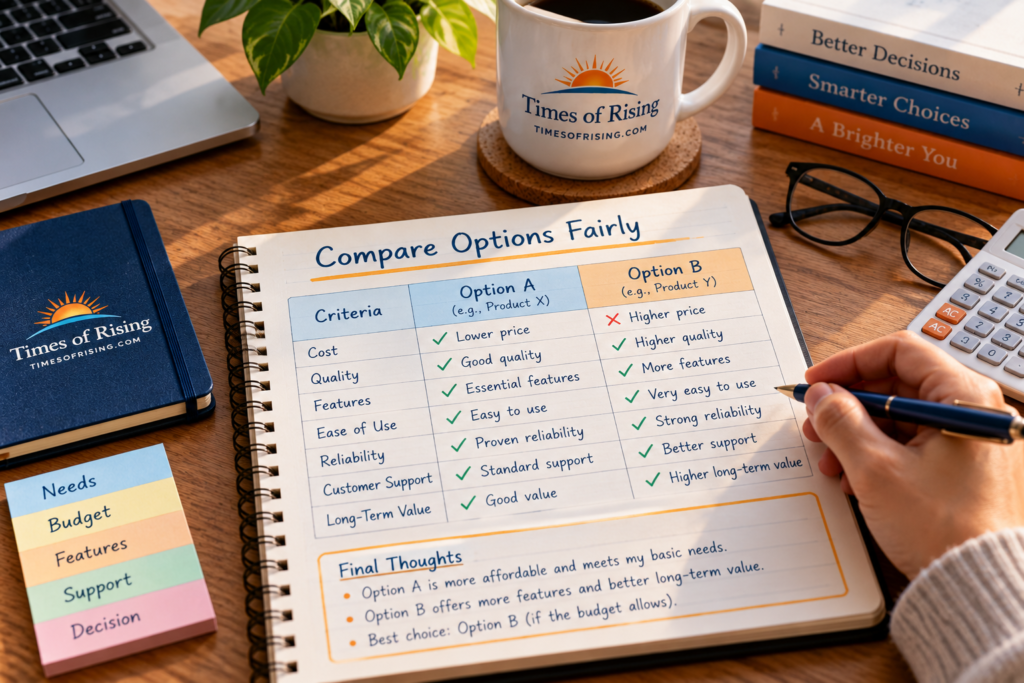
People sometimes compare only two options because those are the first choices that come to mind.
A better approach is to consider whether another realistic alternative exists.
For example, when deciding how to complete a household task, the options might include doing it immediately, scheduling it for a specific time, dividing it into smaller steps, asking for appropriate help, or postponing it until a necessary resource becomes available.
The most useful alternative is not always the most obvious one.
Try to identify at least two or three feasible choices when the decision warrants comparison. Include the possibility of maintaining the current arrangement, doing less, or waiting for important information when those options are reasonable.
Ask yourself:
- What are my main options?
- Is there a simpler way to achieve the same outcome?
- Could I divide the task into smaller parts?
- Is there an existing resource I can use?
- Would waiting for more information improve the decision?
- Is doing nothing temporarily a realistic option?
Avoid generating a huge list simply for the sake of completeness. The objective is to discover meaningful alternatives, not to turn a small decision into an endless exercise.
If one option fails an essential requirement, there is little reason to compare it further.
Checklist: I have considered the realistic alternatives, including any simpler or more flexible approach that could meet the same need.
Step 7: Compare Options Using Consistent Criteria
After identifying your alternatives, compare them using the same criteria.
This is important because people sometimes evaluate one option according to its strengths and another according to its weaknesses. Such comparisons can unintentionally favor the choice they already prefer.
Suppose you are comparing two ways to organize a busy morning. One method may be convenient but require more preparation the previous evening. Another may need less preparation but create more time pressure in the morning.
Instead of asking which method feels better in general, compare them according to consistent criteria.
| Criterion | Option A | Option B |
|---|---|---|
| Time required | Record the estimate | Record the estimate |
| Cost or resources | Record the likely cost | Record the likely cost |
| Convenience | Assess practical ease | Assess practical ease |
| Reliability | Consider supporting evidence | Consider supporting evidence |
| Main drawback | Identify the limitation | Identify the limitation |
The criteria should reflect your priorities rather than a generic definition of what makes an option good.
For some decisions, cost will matter most. For others, reliability, accessibility, convenience, or long-term usefulness may be more important.
You can also assign simple importance scores. For example, rate each criterion from 1 to 5 according to how much it matters to you, then assess how well each option meets it.
A numerical score can organize your thinking, but it should not be treated as an objective measurement of the best choice. Scores depend on the criteria and judgments you enter.
Use the comparison to identify trade-offs, not to pretend that every important consideration can be reduced to a number.
Checklist: I have compared the options fairly, using consistent criteria that reflect my actual priorities.
Step 8: Consider Costs, Benefits, and Possible Consequences
The immediate benefit of a choice is only part of the picture. Consider what may happen after the decision is implemented.
A low-cost option might require frequent repairs. A convenient solution might create more work later. A quick approach might solve today’s problem but fail to address its underlying cause.
Thinking about consequences does not mean predicting the future perfectly. It means identifying the most relevant likely outcomes before committing.
For each realistic option, consider three questions.
What could go well? Identify the main benefits and the ways the option could meet your objective.
What could go wrong? Consider plausible disadvantages, additional costs, delays, or practical difficulties.
What would happen next? Think about the steps needed to implement the choice and any ongoing responsibilities it creates.
For example, when choosing between two household products, the purchase price may be only one consideration. Expected maintenance, durability, energy use, replacement costs, and suitability may also matter.
For a scheduling decision, consider whether the proposed arrangement leaves enough time for unexpected tasks or creates difficulties for other people.
It can help to distinguish between a minor inconvenience and a consequence that would significantly undermine the decision.
Ask:
- What are the likely benefits?
- What are the main drawbacks?
- Could hidden costs arise?
- How might the choice affect my time or other responsibilities?
- What is the most important plausible downside?
- Can I reduce that downside?
Checklist: I have considered both immediate and longer-term consequences, including realistic disadvantages and implementation requirements.
Step 9: Recognize Personal Biases and Emotional Influences
Decisions are not made through facts alone. Previous experiences, expectations, emotions, habits, and social influences can shape what we notice and how we interpret it.
Recognizing these influences can improve judgment without requiring us to ignore our feelings entirely.
One common problem is confirmation bias: the tendency to favor information that supports an existing belief while giving less attention to information that challenges it.
For example, if you already prefer a particular product, you might focus on positive reviews while dismissing several credible reports of a problem.
Another influence is familiarity. An option may feel safer simply because you have used it before, even when another alternative deserves consideration.
Social pressure can also play a role. A choice that suits a friend or colleague may not suit your own circumstances.
Before making a decision, ask:
- Have I already decided what I want and started looking only for supporting evidence?
- Am I choosing this because it is familiar?
- Am I giving too much importance to one recent experience?
- Am I being influenced by urgency, frustration, excitement, or pressure?
- Would I evaluate this option differently if someone else recommended it?
- What is the strongest reasonable argument against my preferred choice?
A useful exercise is to imagine that your preferred option is unavailable. Would your second choice still meet your most important requirements? This can help reveal whether your judgment is based on genuine suitability or attachment to a particular alternative.
Emotions may also provide relevant information. Feeling uncomfortable about a choice can signal an unresolved concern, but the feeling alone does not establish that the choice is wrong.
Investigate the concern rather than automatically obeying or dismissing it.
Checklist: I have considered whether assumptions, habits, emotional reactions, or outside pressure are influencing my evaluation.
Step 10: Evaluate Uncertainty and the Risk of Being Wrong
Even after careful research, uncertainty remains.
A provider may change its terms. A schedule may be disrupted. A product may not perform exactly as expected. A plan may depend on circumstances outside your control.
The important question is not whether uncertainty exists, but whether you have considered the uncertainty that matters most.
Start by identifying what could change the outcome. Then ask how serious the consequences would be and whether you can take steps to reduce them.
For example, if you are organizing an outdoor activity, weather uncertainty may justify preparing an indoor alternative. If you are selecting a service, written confirmation of the agreed terms may reduce the risk of misunderstanding.
The appropriate level of investigation depends on the decision’s significance.
A minor, easily reversible choice usually does not justify extensive research. A decision involving substantial cost, safety, legal obligations, or long-lasting consequences may require stronger evidence and professional guidance where appropriate.
Consider these questions:
- What important information is still uncertain?
- How likely is the uncertainty to affect my decision?
- How serious would the consequences be?
- Can I reduce the risk with a simple precaution?
- Is there a way to test the option on a small scale?
- Would a short delay provide valuable information?
You do not need to eliminate every risk before acting. Instead, identify the risks that deserve attention and decide how you will manage them.
Checklist: I have identified the most important uncertainties and considered reasonable ways to reduce their potential impact.
Step 11: Decide When You Have Enough Information
Research can improve a decision, but continued research eventually produces diminishing returns.
At some point, another comparison, review, or opinion may add very little to what you already know. Continuing simply because you want complete certainty can delay a perfectly reasonable choice.
A practical stopping rule can help.
Decide in advance what information you need to proceed. For example, you might require confirmation that an option meets your essential requirements, fits your budget, and has no unresolved issue that could materially change the outcome.
Once those conditions are satisfied, make the decision unless new, relevant information appears.
Ask yourself:
- Have I answered the essential questions?
- Do the leading options satisfy my main requirements?
- Is there an unresolved issue that could change my choice?
- Would more research probably affect the decision?
- Is the cost of waiting greater than the likely benefit of further investigation?
For ordinary decisions, choosing a suitable option may be more useful than pursuing a hypothetical perfect alternative.
This does not mean ignoring important concerns or rushing a consequential decision. It means matching the amount of research to the importance of the choice.
Checklist: I have established a reasonable stopping point and can explain why the available evidence is sufficient for the decision.
Step 12: Make the Decision and Plan the Next Action
A decision becomes useful when it leads to appropriate action.
Once you have selected an option, identify the first step required to implement it. Depending on the situation, that may mean setting a reminder, confirming an appointment, preparing materials, communicating with another person, or recording an agreed plan.
Make the next action specific.
Instead of writing, “I will organize my week,” write, “I will spend 15 minutes on Sunday evening listing the week’s deadlines and selecting three priorities for Monday.”
A specific action makes it easier to begin and evaluate progress.
Also consider who needs to know about the decision. If other people are affected, communicate the relevant details clearly and allow them to raise important practical concerns.
A short action plan can include:
- The decision that has been made.
- The first step to take.
- The person responsible for the action, if applicable.
- The deadline or review date.
- Any resources required.
- The main issue to monitor.
Avoid reopening the entire decision every time a small inconvenience appears. Instead, distinguish between an ordinary implementation difficulty and genuinely new information that could justify reconsideration.
Checklist: I have identified the next action, the resources required, and any communication or timing arrangements needed to implement the choice.
Step 13: Review the Result and Learn From It

The final step is to review what happened.
A decision may produce a good outcome even when the process was weak, simply because circumstances worked in your favor. Similarly, a well-reasoned decision may produce a disappointing result because an unexpected event occurred.
For this reason, evaluate both the decision process and the outcome.
Ask:
- Did the choice address the original problem?
- Did it meet the priorities I identified?
- Were my assumptions accurate?
- What unexpected difficulties arose?
- Did I overlook any relevant information?
- What would I repeat or change next time?
For a small decision, a brief mental review may be sufficient. For a more consequential choice, write down the outcome and any lessons worth remembering.
Suppose you choose a new method for organizing household tasks. After two weeks, you discover that the method is easy to start but difficult to maintain. Rather than treating the experience as a failure, identify what needs adjustment. Perhaps the task list is too long, the schedule is unrealistic, or responsibilities need to be distributed differently.
The review converts experience into information that can improve future decisions.
It also helps distinguish between a poor decision and an unfavorable result that could not reasonably have been predicted.
Checklist: I have reviewed the result, identified useful lessons, and determined whether any adjustment is needed.
A Worked Example: Choosing How to Organize a Busy Week
The checklist becomes easier to understand when applied to a realistic situation.
Imagine that a person has several work responsibilities, household tasks, and personal commitments to manage during the coming week. They feel overwhelmed and are considering whether to use a digital planner, a paper notebook, or a simple daily list.
Instead of selecting the most popular method immediately, they work through the decision.
1. Define the problem. The goal is to keep track of deadlines and make sure important tasks are completed on time.
2. Identify priorities. The method must be easy to use, visible during the day, and quick to update.
3. Set constraints. The person does not want to spend more than a few minutes maintaining the system and prefers not to pay for another subscription.
4. Gather information. They review the tools they already have and consider how each method handles reminders, recurring tasks, and changing deadlines.
5. Separate facts from assumptions. They know they already have access to a digital calendar. They assume a more sophisticated application will make them more organized, but they have not tested that assumption.
6. Identify alternatives. The realistic options are a paper notebook, the existing digital calendar, or a short daily task list.
7. Compare consistently. Each option is evaluated for convenience, visibility, time required, and ability to track deadlines.
8. Consider consequences. A notebook may be easy to use but could be less convenient for reminders. A digital calendar may offer alerts but require regular updates.
9. Check for bias. The person notices that they are attracted to a new application because its interface looks impressive. That preference does not necessarily mean it will help them complete tasks.
10. Assess uncertainty. They are unsure whether digital reminders will improve their routine, but this can be tested without making a long-term commitment.
11. Set a stopping rule. They decide that the chosen method must meet their core requirements and be easy to maintain. Further comparisons are unnecessary once those conditions are met.
12. Take action. They use the existing calendar for deadlines and keep a short daily list of immediate priorities.
13. Review the outcome. After two weeks, they check whether deadlines were missed, whether the system was easy to maintain, and whether adjustments are needed.
The example illustrates an important principle: the best decision is not always the most sophisticated or expensive option. It is the option that addresses the actual problem while fitting the person’s needs and constraints.
How to Use the Checklist Without Overthinking
A checklist should simplify decision-making, not become another demanding task.
The amount of effort required should depend on the decision’s significance, uncertainty, cost, and reversibility.
Match the Process to the Decision
For a minor choice, such as deciding which routine task to complete first, you may need only three questions:
- What needs to be done?
- What matters most right now?
- What is the most sensible next step?
For a moderate decision, such as selecting a household item or planning a busy week, use the full checklist selectively. Compare alternatives, check relevant facts, and consider the main consequences.
For a major decision involving substantial financial commitments, safety, health, legal responsibilities, or long-term effects, take more time to gather reliable information. Seek qualified advice when the subject requires expertise beyond your own.
The objective is proportionality: use enough analysis to address the real risks without making every small choice unnecessarily complicated.
Limit the Number of Serious Alternatives
When many options are available, begin by identifying essential requirements and eliminating choices that do not meet them.
Then compare a manageable shortlist of realistic alternatives.
This reduces unnecessary work and helps keep attention on the factors that matter. It does not mean that a fixed number of options is ideal for every situation; the appropriate shortlist depends on the decision.
Set a Time Limit
A time limit can help prevent repeated comparisons.
For example, you might spend ten minutes deciding how to arrange a simple household task, while allowing several days to compare alternatives for a more expensive purchase.
These are illustrative limits, not universal rules. The right amount of time depends on the consequences of the decision and how much reliable information is available.
Set a deadline that allows adequate consideration without encouraging endless postponement.
Use a Written Record for Important Choices
Writing down your reasoning makes it easier to see what you know, what remains uncertain, and why you prefer one option.
For an important decision, record the main alternatives, the criteria you used, the most significant risks, and the reason for your choice.
You do not need a lengthy report. A few clear notes may be sufficient.
A written record can also help when you review the result later because it preserves what you reasonably expected at the time rather than allowing hindsight to reshape your memory.
Know When to Pause
Fatigue, interruptions, and emotional pressure can make careful comparison more difficult.
If you feel overwhelmed by an ordinary decision, a short break may help you return to it with a clearer perspective. If a deadline is approaching, identify the essential information and focus on the most consequential questions rather than attempting to investigate everything.
For a decision that is not urgent, consider whether postponing it briefly would allow you to gather better information or consult someone with relevant expertise.
A pause is useful when it improves judgment. It is less useful when it becomes a way to avoid making a necessary choice indefinitely.
Common Decision-Making Mistakes to Avoid
Even a structured process can be undermined by a few recurring habits.
Mistake 1: Choosing Before Defining the Problem
The first available solution may not address the actual need.
Better approach: State the problem and desired outcome before evaluating alternatives.
Mistake 2: Treating the Cheapest Option as the Best Option
Price is important, but it may not reflect durability, reliability, ongoing costs, or suitability.
Better approach: Compare total practical value using the criteria that matter for your circumstances.
Mistake 3: Collecting Information Without a Clear Purpose
Reading more reviews or seeking more opinions can create activity without resolving the decision.
Better approach: Identify the specific unanswered question each additional piece of information should address.
Mistake 4: Ignoring Disadvantages
An option may look attractive because its benefits are obvious while its drawbacks receive little attention.
Better approach: Identify the strongest reasonable argument against your preferred choice.
Mistake 5: Giving Every Criterion Equal Importance
Not every feature matters equally. Treating them as interchangeable can distract from essential requirements.
Better approach: Rank your priorities and eliminate options that fail non-negotiable conditions.
Mistake 6: Confusing Confidence With Accuracy
Feeling certain does not guarantee that a decision is well informed. Confidence can increase when information supports existing beliefs, even if important evidence is missing.
Better approach: Ask what evidence supports the decision and what would cause you to reconsider it.
Mistake 7: Seeking Universal Approval
Other people’s opinions can be valuable, but they may reflect different budgets, needs, preferences, or experiences.
Better approach: Seek relevant advice, then evaluate it against your own requirements and circumstances.
Mistake 8: Reopening a Decision Without New Information
Repeatedly reconsidering an adequately researched choice can consume time without improving the outcome.
Better approach: Record why you decided and specify what kind of new information would justify reviewing the decision.
Mistake 9: Failing to Review the Outcome
Without reflection, the same avoidable mistakes may occur repeatedly.
Better approach: Review important decisions and identify lessons that can improve future choices.
A Practical Worksheet You Can Reuse
The following worksheet turns the process into a simple routine. Copy it into a notebook, a digital document, or your preferred planning tool.
Decision statement: What exactly needs to be decided?
Desired outcome: What would a successful result look like?
Essential requirements: Which conditions must be met?
Top priorities: Which three factors matter most?
Constraints: What limits apply to time, money, resources, or feasibility?
Known facts: What information has been confirmed?
Assumptions and unknowns: What needs verification?
Alternatives: Which realistic options are available?
Comparison: How does each option perform against the same criteria?
Consequences: What are the main benefits, drawbacks, and possible risks?
Remaining uncertainty: What important issue is still unresolved?
Decision: Which option best fits the requirements and available evidence?
Next action: What is the first practical step?
Review point: When and how will the result be evaluated?
For a routine choice, this worksheet can be shortened to a few lines. For a consequential decision, completing each section may help make the reasoning more transparent and easier to discuss with other people.
Frequently Asked Questions
1. What is the easiest way to make a better everyday decision?
Start by defining the problem, identifying what matters most, and comparing a small number of realistic alternatives. Check the important facts, consider the main disadvantages, and choose an option that fits your circumstances. Review the result when useful.
2. How can I make an informed decision when information is incomplete?
Separate confirmed facts from assumptions and unknowns. Investigate the uncertainties that could materially change the choice, and assess the consequences of being wrong. If the remaining uncertainty is acceptable for the decision’s significance, proceed with a reasonable plan and identify what you will monitor.
3. How many options should I compare?
There is no universal ideal number. Start with the realistic alternatives that meet your essential requirements. A short list may be sufficient for a simple choice, while a complex decision may require broader investigation. The aim is to compare meaningful alternatives rather than maximize the number of choices considered.
4. How do I know when I have researched enough?
You have probably gathered enough information when you can explain the problem, identify your priorities, compare the leading alternatives fairly, and address the important risks. If additional research is unlikely to change the decision, continuing may not be worthwhile. Significant unresolved safety, financial, legal, or other material concerns deserve further attention.
5. Should I always make decisions based on facts rather than feelings?
Facts and feelings serve different purposes. Evidence helps establish what is likely to be true, while emotions may reveal preferences, concerns, or personal values. A thoughtful decision considers both without treating an emotional reaction as proof or ignoring relevant personal needs.
6. What should I do if two options seem equally good?
Return to your priorities and identify the trade-off that matters most. Consider long-term consequences, reversibility, convenience, and the cost of implementation. If the options remain similarly suitable and the decision is low risk, choose a reasonable alternative rather than spending excessive time searching for a difference that may not matter.
7. Is it better to make a quick decision or take more time?
Neither speed nor delay is automatically better. The appropriate process depends on the importance of the decision, the uncertainty involved, and the consequences of a mistake. Simple, reversible choices can often be made quickly. Decisions with substantial or lasting consequences usually deserve more careful investigation.
8. What if a well-considered decision produces a poor outcome?
Review the information available at the time, the assumptions made, and the factors that influenced the choice. Determine whether the outcome resulted from an avoidable error or an unexpected event. Use what you learn to improve the next decision rather than judging the original process solely by the result.
Final Thoughts: Make the Process Better, Not Perfect
Everyday decision-making becomes more manageable when it follows a clear, repeatable process.
You do not need to predict every outcome, examine every possible alternative, or eliminate all uncertainty. You need to understand the problem, identify your priorities, gather relevant information, compare realistic options, consider consequences, and decide when the available evidence is sufficient.
The checklist in this guide provides a practical starting point. Use it flexibly, giving simple decisions only the attention they require and reserving deeper analysis for choices with more significant consequences.
Most importantly, remember that making a decision is not the end of the process. Taking the next step, observing the result, and learning from experience are equally valuable parts of better judgment.
The goal is not to guarantee that every choice will turn out exactly as expected. It is to make choices that are thoughtful, proportionate, and consistent with what matters to you.
Start with one ordinary decision this week. Define it clearly, check the facts, compare your options, and take a sensible next step. With practice, a structured approach can make everyday decisions easier to explain, easier to act upon, and easier to improve over time.

Mariya Martin
Mariya Martin covers economic developments that affect households and everyday financial decisions in the United States. Her editorial focus includes inflation, purchasing power, interest rates, household expenses and economic indicators. Her articles aim to explain complex economic concepts in accessible language, using reliable data and clearly distinguishing verified statistics from analysis.
Join the conversation
Share a thoughtful response, ask a question, or add something useful for other readers.
Be the first to add a helpful perspective.