

A workable personal budget starts with calculating accurate net income, including irregular earnings, and tracking fixed and variable expenses. The guide recommends reviewing spending patterns, identifying leaks, setting SMART financial goals, and choosing a method such as 50/30/20, envelope, zero-based, or pay-yourself-first budgeting.
Sustainable budgeting requires balancing income and expenses, directing surpluses toward savings or debt, and adjusting deficits through spending cuts or increased income. Regular reviews, automated savings, and flexible updates help maintain progress as financial circumstances change.
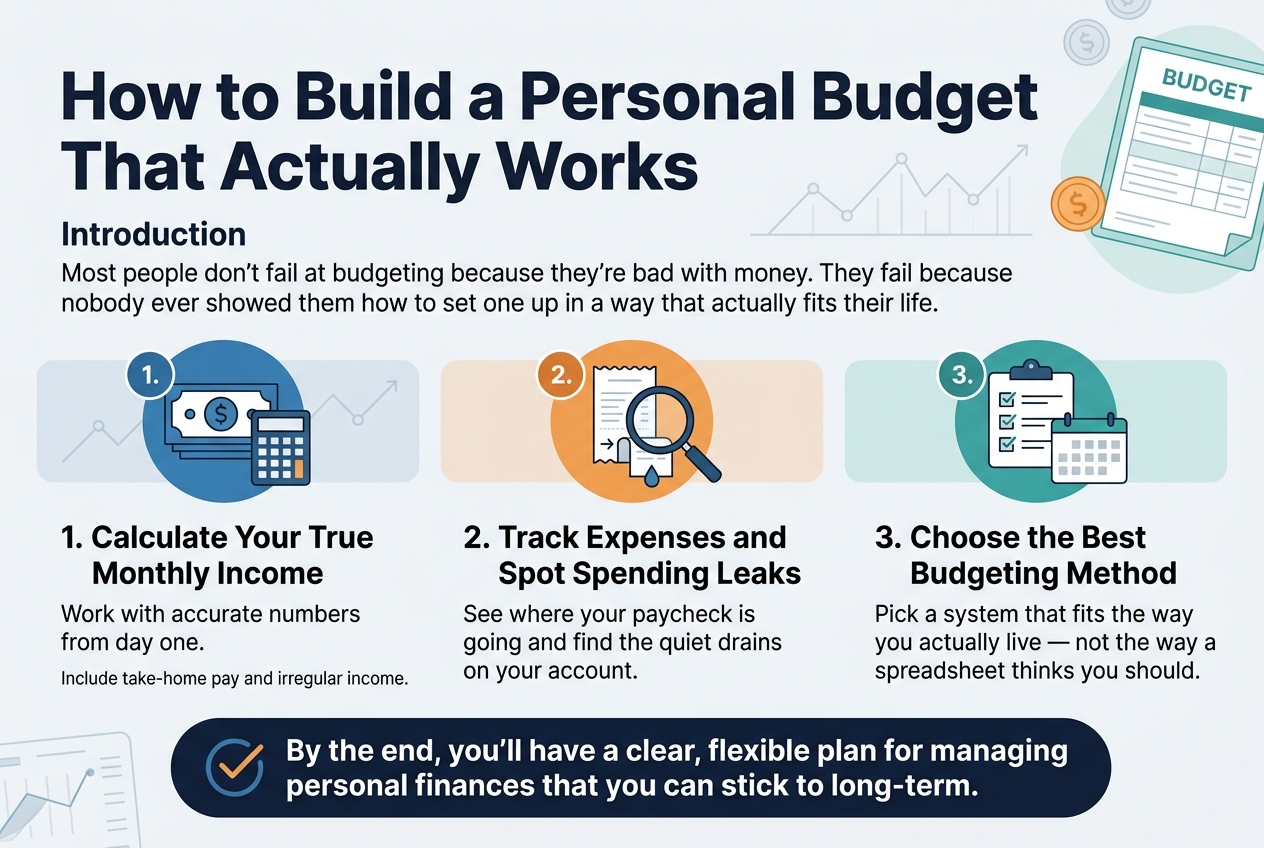
How to Build a Personal Budget That Actually Works
Most people don’t fail at budgeting because they’re bad with money. They fail because nobody ever showed them how to set one up in a way that actually fits their life.
This personal budget guide is for anyone who’s tired of guessing where their paycheck went — whether you’re just starting out, dealing with irregular income, or simply ready to stop living paycheck to paycheck. No finance degree needed here.
In this guide, you’ll learn how to calculate your true monthly income so you’re working with accurate numbers from day one, how to track expenses and spot the spending leaks quietly draining your account, and how to choose the best budgeting method for the way you actually live — not the way a spreadsheet thinks you should.
By the end, you’ll have a clear, flexible plan for managing personal finances that you can stick to long-term.
Rethink Your Relationship with Budgeting
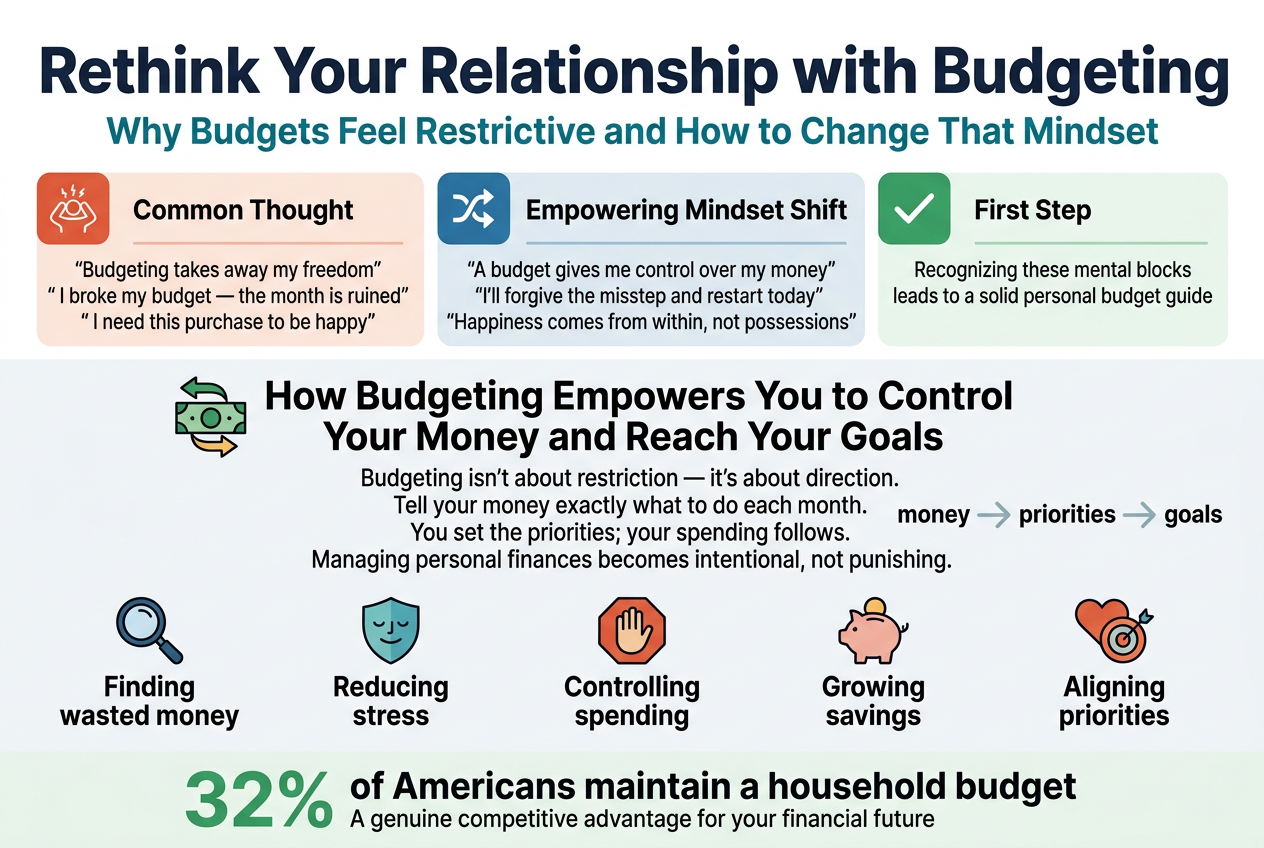
Why Budgets Feel Restrictive and How to Change That Mindset
The word “budget” triggers resistance for many people. A simple mindset reframe changes everything:
| Common Thought | Empowering Mindset Shift |
|---|---|
| Budgeting takes away my freedom | A budget gives me control over my money |
| I broke my budget — the month is ruined | I’ll forgive the misstep and restart today |
| I need this purchase to be happy | Happiness comes from within, not possessions |
Recognizing these mental blocks is the first step in any solid personal budget guide.
How Budgeting Empowers You to Control Your Money and Reach Your Goals
Budgeting isn’t about restriction — it’s about direction. When managing personal finances, a budget lets you tell your money exactly what to do each month. You set the priorities; your spending follows. This shift from passive to intentional spending is what makes budgeting for beginners feel transformative rather than punishing.
Key Benefits of Budgeting: From Reducing Debt to Building Confidence
Consistent budgeting delivers measurable results, including:
- Finding wasted money hiding in overlooked expenses
- Reducing stress by eliminating financial uncertainty
- Controlling spending before it controls you
- Growing savings toward meaningful goals
- Aligning priorities with what truly matters
Despite these benefits, only 32% of Americans maintain a household budget, making this habit a genuine competitive advantage for your financial future.
Calculate and Understand Your True Monthly Income
How to Identify All Sources of Income Including Gig Work and Benefits
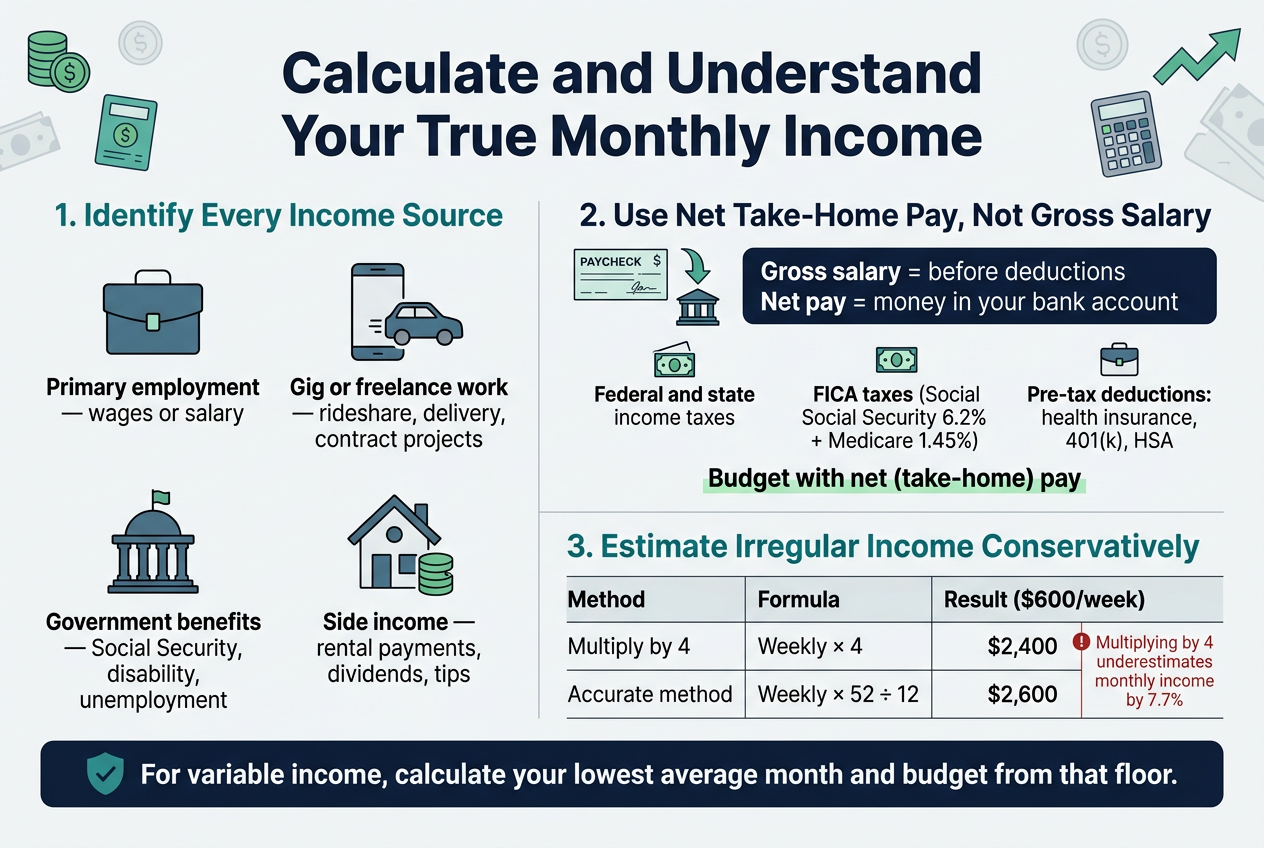
Building a reliable monthly budget planner starts with capturing every dollar flowing in. List all income streams:
- Primary employment — wages or salary
- Gig or freelance work — rideshare, delivery, contract projects
- Government benefits — Social Security, disability, unemployment
- Side income — rental payments, dividends, tips
Why Net Take-Home Pay Matters More Than Gross Salary
Your gross salary is what you earn before deductions — but it’s never what hits your bank account. For budgeting for beginners, always work with net (take-home) pay, which accounts for:
- Federal and state income taxes
- FICA taxes (Social Security 6.2% + Medicare 1.45%)
- Pre-tax deductions: health insurance, 401(k), HSA
Your actual spending power is your net figure, making it the only number that matters when managing personal finances.
How to Estimate Income Conservatively When Earnings Are Irregular
Avoid multiplying weekly pay by 4 — this underestimates monthly income by 7.7%. Use the accurate formula instead:
| Method | Formula | Result ($600/week) |
|---|---|---|
| Multiply by 4 | Weekly × 4 | $2,400 |
| Accurate method | Weekly × 52 ÷ 12 | $2,600 |
For variable income, calculate your lowest average month and budget from that floor.
Track and Categorize Every Monthly Expense
How to Identify Fixed Expenses That Stay the Same Each Month
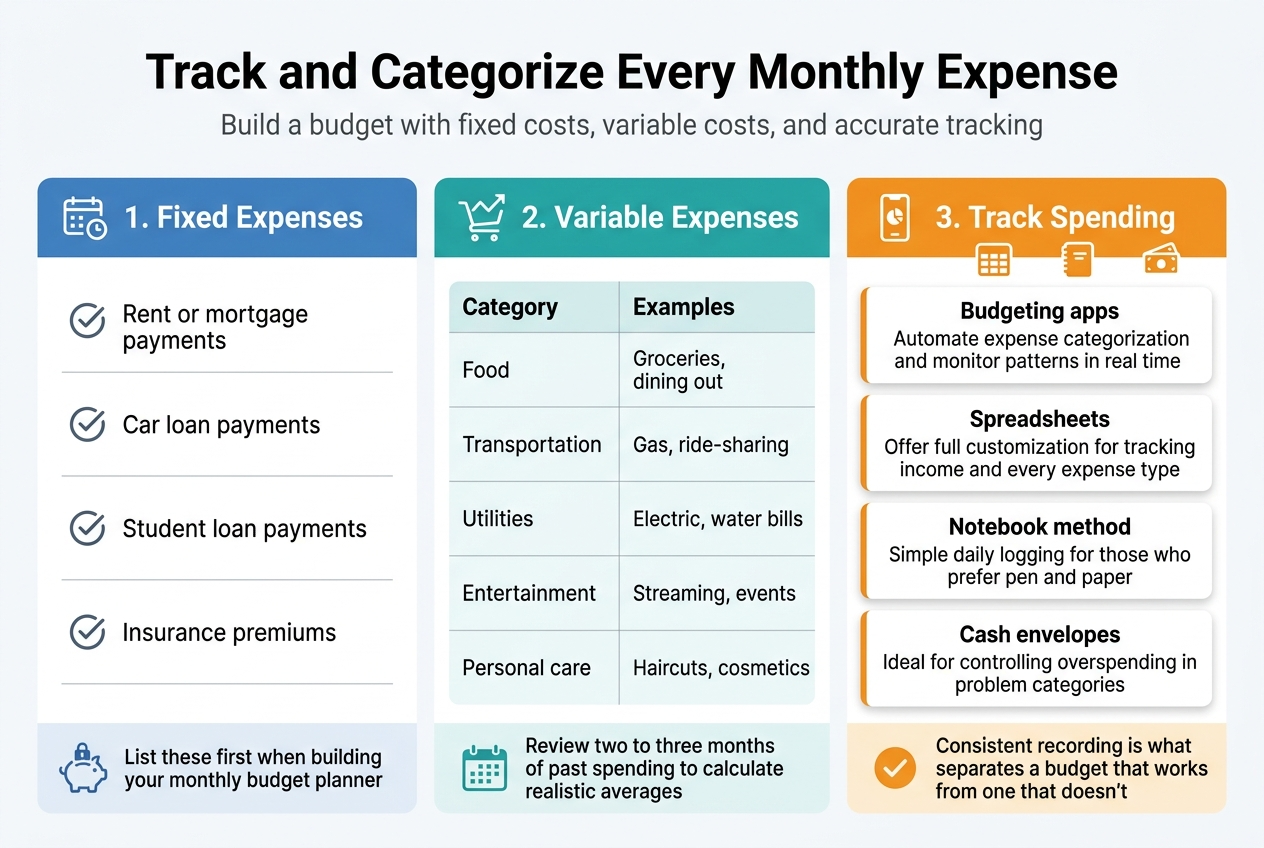
Fixed expenses are predictable — you pay the same amount every month. Common examples include:
- Rent or mortgage payments
- Car loan payments
- Student loan payments
- Insurance premiums
List these first when building your monthly budget planner, since they form your non-negotiable financial foundation.
How to Estimate Variable Expenses That Change Month to Month
Variable expenses shift regularly, making them trickier to track. Key categories include:
| Category | Examples |
|---|---|
| Food | Groceries, dining out |
| Transportation | Gas, ride-sharing |
| Utilities | Electric, water bills |
| Entertainment | Streaming, events |
| Personal care | Haircuts, cosmetics |
Review two to three months of past spending to calculate realistic averages for each category.
Tools and Methods to Record Your Spending Accurately
Now that we’ve covered what to track, here’s how to track it effectively:
- Budgeting apps – Automate expense categorization and monitor patterns in real time
- Spreadsheets – Offer full customization for tracking income and every expense type
- Notebook method – Simple daily logging for those who prefer pen and paper
- Cash envelopes – Ideal for controlling overspending in problem categories
Consistent recording is what separates a budget that works from one that doesn’t.
Set Clear and Motivating Financial Goals
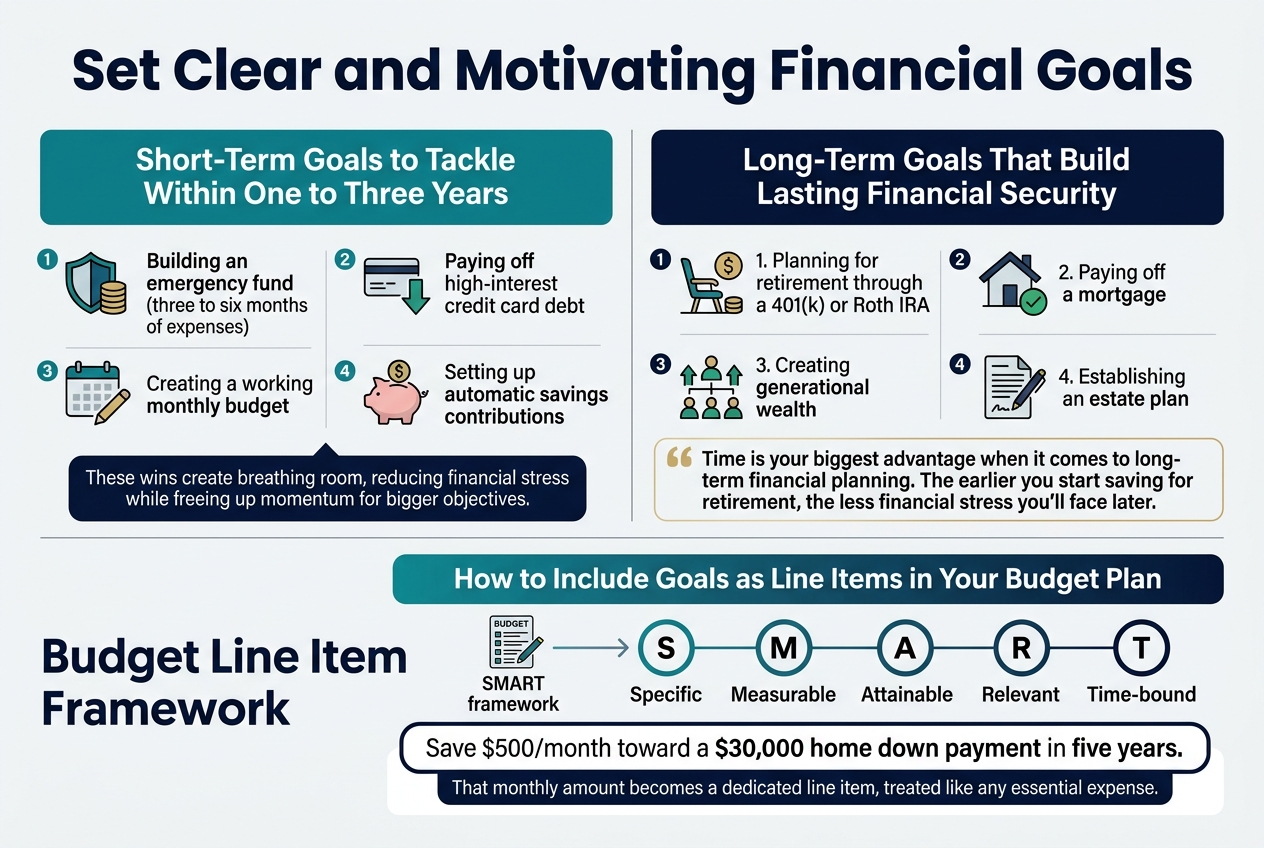
Short-Term Goals to Tackle Within One to Three Years
Short-term financial goals build the foundation for everything else. Focus on:
- Building an emergency fund (three to six months of expenses)
- Paying off high-interest credit card debt
- Creating a working monthly budget
- Setting up automatic savings contributions
These wins create breathing room, reducing financial stress while freeing up momentum for bigger objectives.
Long-Term Goals That Build Lasting Financial Security
Long-term goals take five or more years and target true financial independence. Common examples include:
- Planning for retirement through a 401(k) or Roth IRA
- Paying off a mortgage
- Creating generational wealth
- Establishing an estate plan
As financial advisor Noah Damsky notes, “Time is your biggest advantage when it comes to long-term financial planning. The earlier you start saving for retirement, the less financial stress you’ll face later.”
How to Include Goals as Line Items in Your Budget Plan
With this in mind, goals only become real when they appear in your budget. Use the SMART framework — Specific, Measurable, Attainable, Relevant, and Time-bound — to translate each goal into a monthly dollar amount.
For example: “Save $500/month toward a $30,000 home down payment in five years.”
That monthly amount becomes a dedicated line item, treated like any essential expense.
Build a Budget Plan That Balances Income and Expenses
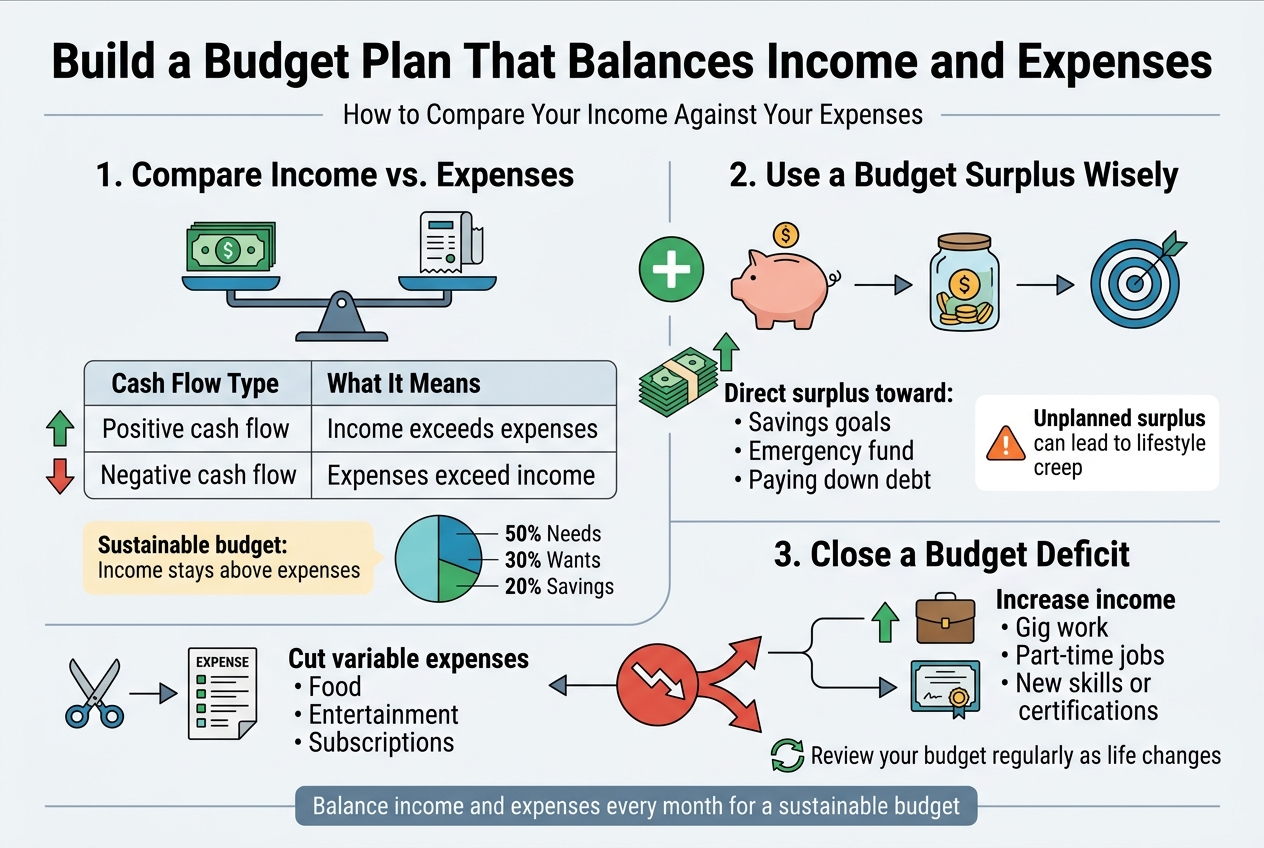
How to Compare Your Income Against Your Expenses
In accounting terms, the balance between income and expenses is called cash flow:
| Cash Flow Type | What It Means |
|---|---|
| Positive cash flow | Income exceeds expenses |
| Negative cash flow | Expenses exceed income |
A sustainable monthly budget requires income to consistently stay above expenses. A helpful benchmark is the 50/30/20 rule — 50% toward needs, 30% toward wants, and 20% into savings.
How to Handle a Budget Surplus by Directing Money Toward Goals
Now that we’ve covered how to compare income and expenses, a positive cash flow creates real opportunity. When your income exceeds expenses, direct that surplus intentionally — toward savings goals, an emergency fund, or paying down debt. Letting surplus money sit without a purpose often leads to lifestyle creep.
How to Close a Budget Deficit by Cutting Expenses or Increasing Income
With this in mind, a budget deficit requires action on one or both sides of the equation:
- Cut variable expenses — food, entertainment, and subscriptions are easier to trim than fixed costs like rent
- Increase income — consider gig work, part-time jobs, or pursuing higher-paying opportunities through new skills or certifications
Managing personal finances means revisiting this balance regularly as life circumstances change.
Choose the Right Budgeting Method for Your Lifestyle
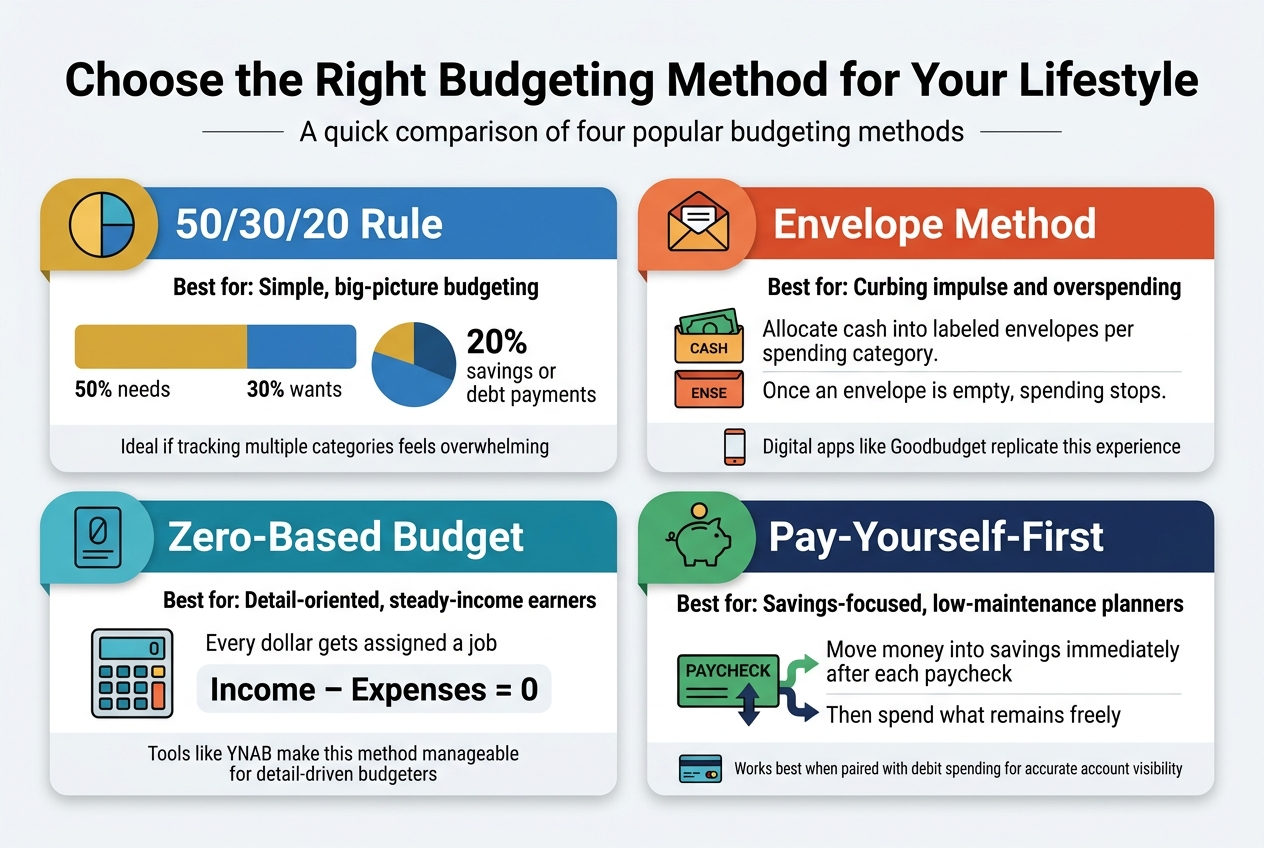
Now that we’ve built a solid budget plan, choosing the right budgeting method ensures it actually sticks. Here’s a quick comparison to guide your decision:
| Method | Best For |
|---|---|
| 50/30/20 Rule | Simple, big-picture budgeting |
| Envelope Method | Curbing impulse and overspending |
| Zero-Based Budget | Detail-oriented, steady-income earners |
| Pay-Yourself-First | Savings-focused, low-maintenance planners |
The 50/30/20 Rule for Balancing Needs, Wants, and Savings
Split your net income into 50% needs, 30% wants, and 20% savings or debt payments. It’s the easiest entry point in any personal budget guide—ideal if tracking multiple categories feels overwhelming.
The Envelope Method for People Who Struggle With Overspending
Allocate cash into labeled envelopes per spending category. Once an envelope is empty, spending stops. Prefer digital? Apps like Goodbudget replicate this experience without cash.
The Zero-Based Budget for Meticulous Planners With Steady Income
Every dollar gets assigned a job until income minus expenses equals zero. Tools like YNAB make this best budgeting method manageable for detail-driven budgeters.
The Pay-Yourself-First Approach for Prioritizing Savings
Move money into savings immediately after each paycheck, then spend what remains freely. This reverse budgeting method works best when paired with debit spending for accurate account visibility.
Stick to Your Budget With Smart Spending Habits
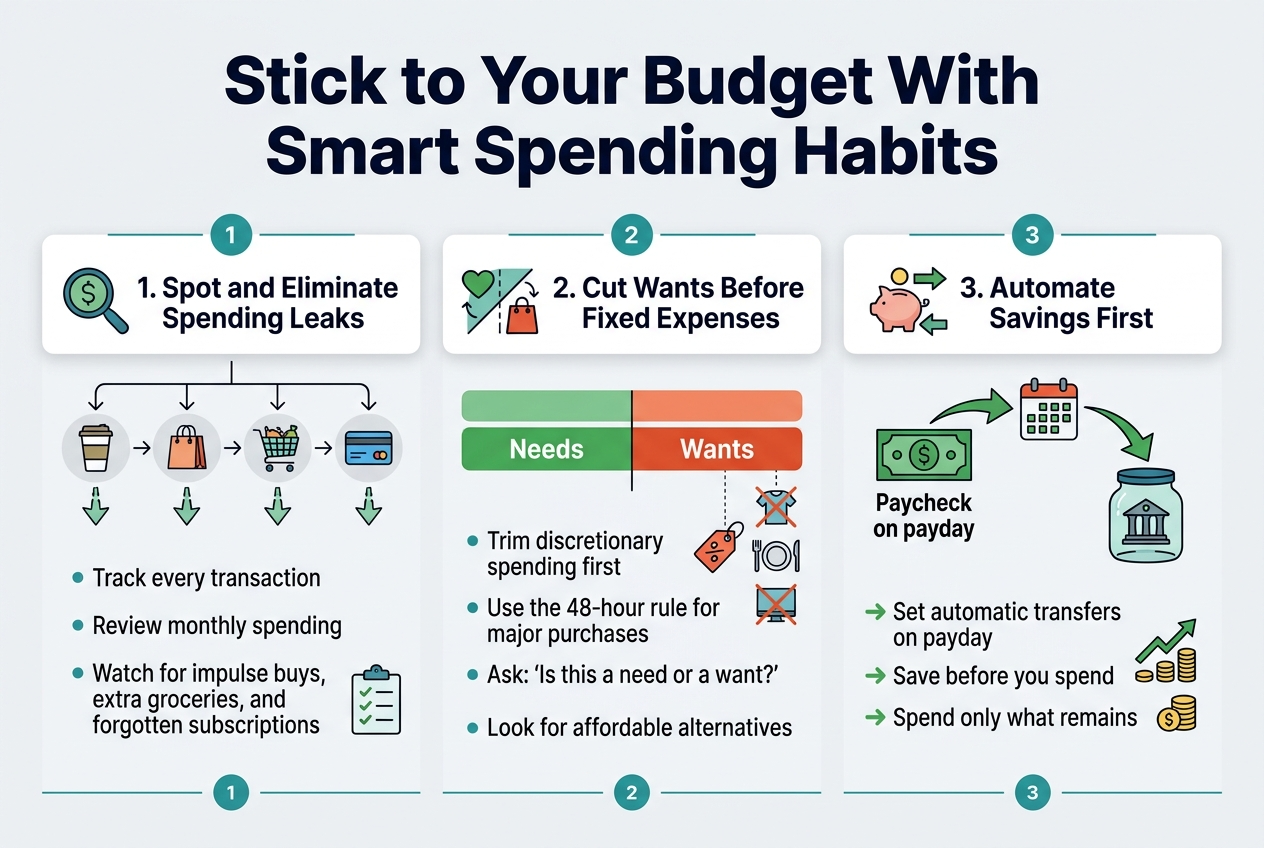
How to Spot and Eliminate Spending Leaks That Drain Your Budget
Spending leaks are small, unnoticed purchases that quietly drain your budget. Combat them by tracking every transaction and reviewing where your money actually goes each month. Common culprits include impulse buys, unplanned grocery items, and subscriptions you’ve forgotten about.
Try these tactics:
- Shop with a detailed list for groceries and essentials
- Apply the 48-hour rule before any major purchase
- Review recurring charges monthly and cancel unused services
Where to Cut Spending First: Wants Before Fixed Expenses
When budgeting for beginners, always trim discretionary spending before touching fixed expenses. The “no buy rule” is an effective strategy — pause purchases on non-essentials like clothing, electronics, or dining out until your budget stabilizes. Ask yourself: Is this a need or a want? Also look for affordable alternatives before committing to any purchase.
How Automating Savings Removes the Temptation to Overspend
Now that we’ve covered where to cut, let’s address consistency. Automating your savings eliminates the decision to spend money before setting it aside. When savings transfer automatically on payday, you naturally adjust spending to what remains — reinforcing smart spending habits without relying on willpower alone.
Review and Adjust Your Budget to Keep It Working Long-Term
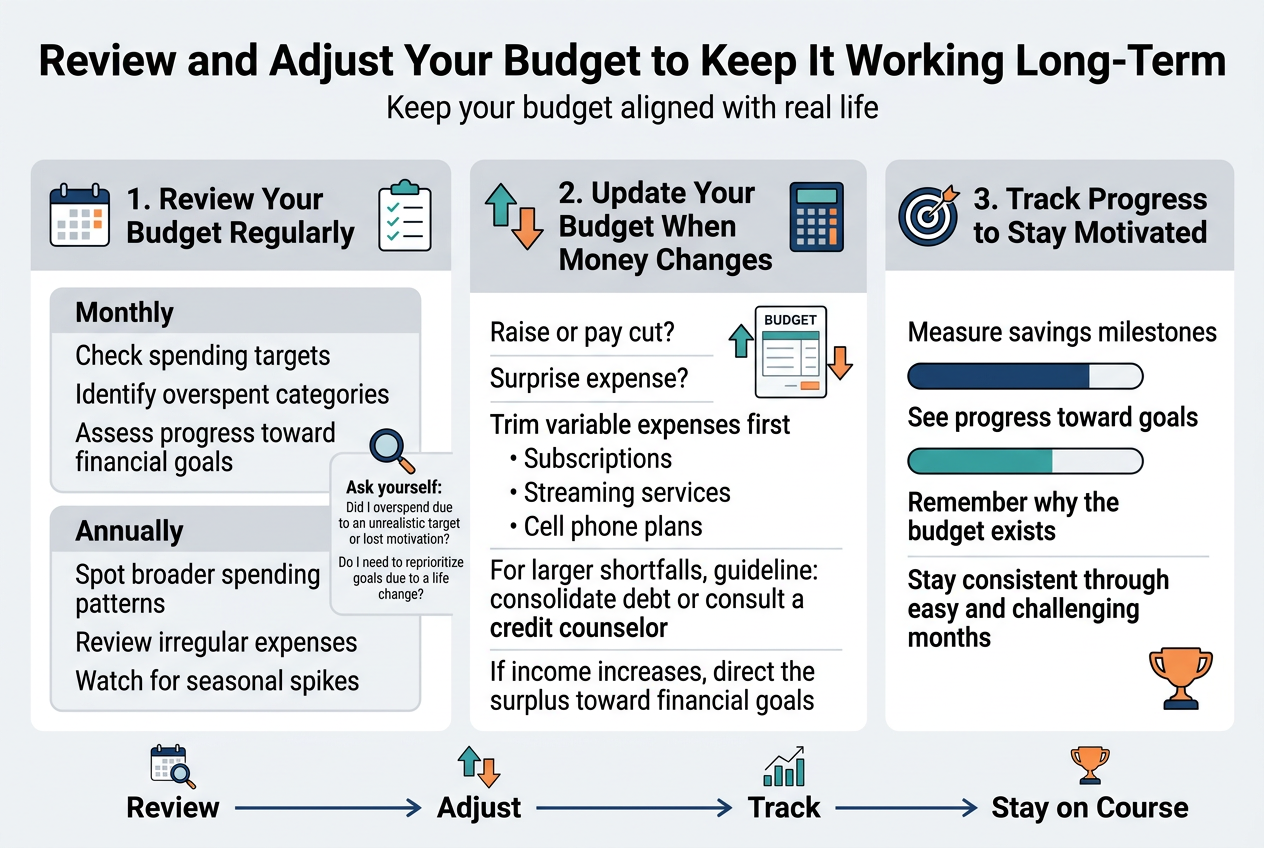
How Often to Review Your Budget and What to Look For
Review your budget at two key intervals:
- Monthly: Check whether you met your spending targets, identify overspent categories, and assess progress toward financial goals
- Annually: Spot broader patterns, irregular expenses (medical bills, vehicle registration), and seasonal spending spikes around holidays or summer
During each monthly review, ask yourself:
- Did I overspend due to an unrealistic target or lost motivation?
- Do I need to reprioritize goals due to a life change?
How to Update Your Budget When Income or Expenses Change
Now that we’ve covered review frequency, updating your budget when finances shift is equally critical. Whether you’ve received a raise, taken a pay cut, or been hit with surprise expenses, your budget must reflect reality.
Start by trimming variable expenses — subscriptions, streaming services, cell phone plans. For larger shortfalls, consider consolidating debt or consulting a credit counselor.
If income increases, redirect the surplus intentionally toward existing financial goals rather than inflating discretionary spending.
How Tracking Progress Toward Goals Keeps You Motivated
With this in mind, tracking goal progress transforms budgeting from a chore into a rewarding habit. When you regularly measure savings milestones, you reinforce why the budget exists — making it far easier to stay consistent through both easy and challenging months.
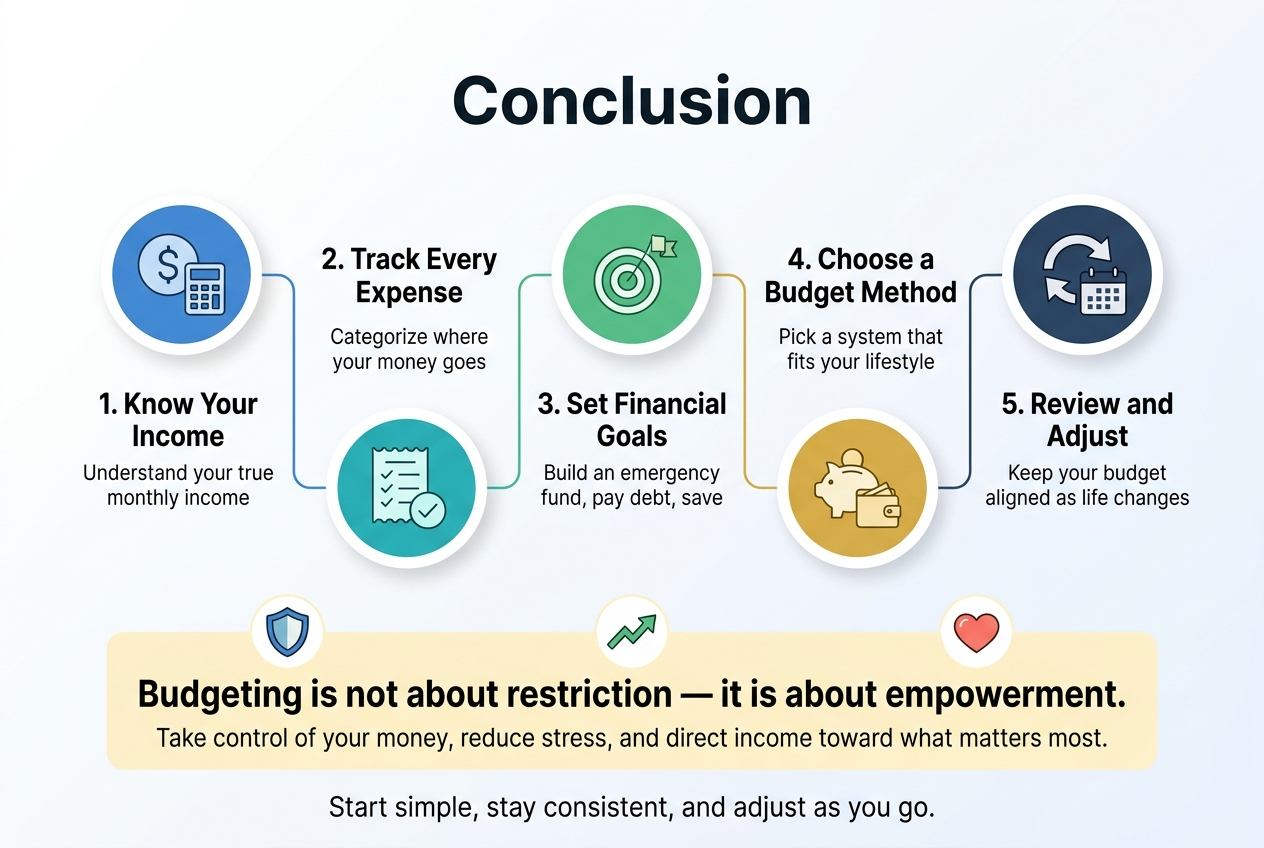
Building a personal budget that actually works comes down to a few core steps: understanding your true monthly income, tracking and categorizing every expense, setting clear financial goals, and choosing a budgeting method that fits your lifestyle. From there, developing smart spending habits and regularly reviewing your budget keeps everything on track as your life and finances evolve. Each of these pieces works together to give you a complete picture of where your money is going — and where you want it to go.
The most important thing to remember is that budgeting is not about restriction — it is about empowerment. It puts you in control of your money, reduces financial stress, and helps you direct your income toward the things that matter most to you. Whether you are building an emergency fund, paying down debt, or saving for a long-term goal, a budget is the tool that makes it possible. Start simple, stay consistent, and adjust as you go. The habit you build today can set you up for lasting financial confidence.




Join the conversation
Share a thoughtful response, ask a question, or add something useful for other readers.
Be the first to add a helpful perspective.
Share to join the conversation
Choose a network to start a 120-second countdown. The comment form opens when the timer finishes.
Social networks do not tell this website whether a share was finally published. This is a sharing prompt, not proof of a completed share or a spam-security measure.
Waiting period: 120 seconds after opening a sharing option. Completed shares cannot be verified by this website.