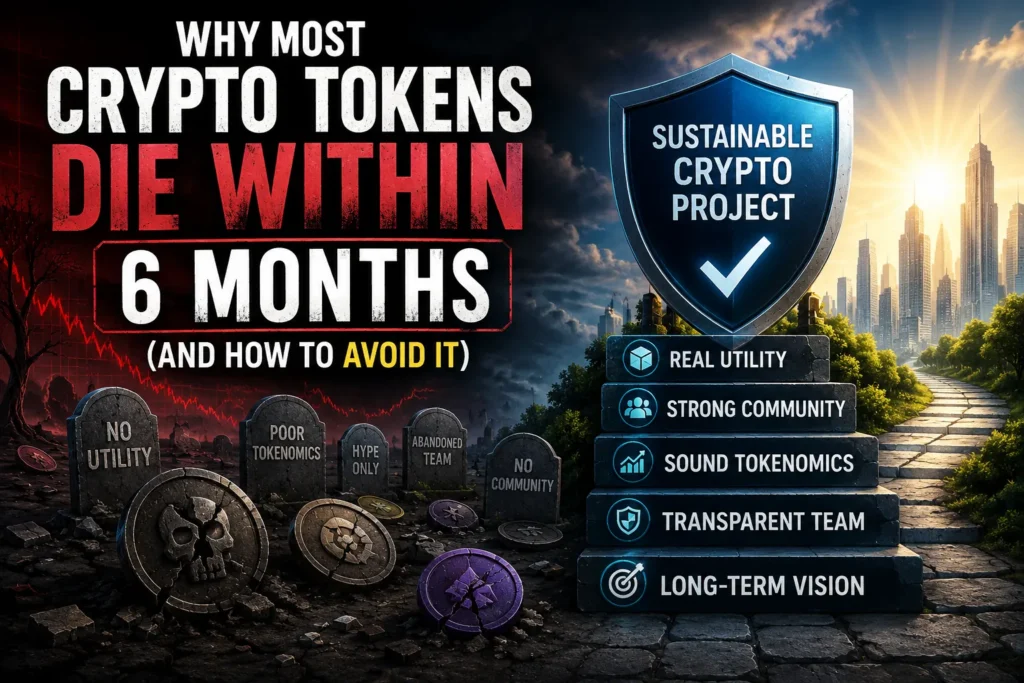
The Harsh Reality of Crypto Projects
Every year, thousands of new cryptocurrency tokens launch across blockchains like Ethereum, Solana, BNB Chain, Base, Avalanche, and countless others. Many begin with excitement, active communities, influencer promotions, and promises of revolutionary technology.
Yet the majority never survive their first six months.
Some lose liquidity. Others lose community support. Many disappear after the initial hype fades. Investors move on, developers abandon the project, and trading volume collapses.
While headlines often focus on the next 100x token, the reality is far less glamorous. Most crypto tokens fail—not because of market conditions alone, but because they were built on weak foundations.
Understanding why tokens die is essential for founders, developers, investors, and community members who want to create sustainable crypto projects rather than temporary hype cycles.
In this article, we’ll examine the most common reasons crypto tokens fail and explore practical strategies that can dramatically improve a project’s chances of long-term survival.
The Crypto Graveyard Is Bigger Than Most People Realize
Launching a token has never been easier.
Today, someone can create a token in minutes using automated launch tools and decentralized exchanges. The technical barriers that once existed have largely disappeared.
Unfortunately, this convenience has also created an environment flooded with low-quality projects.
Many tokens are launched with:
- No real business model
- No utility
- Anonymous teams
- Unsustainable tokenomics
- Artificial marketing campaigns
- Copy-and-paste whitepapers
As a result, a large percentage of tokens experience:
- Liquidity collapse
- Community abandonment
- Price crashes exceeding 90%
- Developer inactivity
- Delisting from exchanges
The issue isn’t that crypto lacks opportunity.
The issue is that creating a token is easy, while building a sustainable ecosystem is incredibly difficult.
1. No Real Utility
Perhaps the biggest reason tokens fail is simple:
They don’t solve a problem.
Many projects launch with vague claims about “revolutionizing finance” or “changing the future of Web3,” but provide no meaningful product or service.
A token without utility becomes dependent entirely on speculation.
When speculation disappears, demand disappears.
Strong projects typically have utility such as:
- Payment systems
- Governance rights
- Network access
- Staking mechanisms
- Gaming economies
- DeFi protocols
- AI integrations
- Infrastructure services
Users need a reason to hold a token beyond hoping someone else buys it at a higher price.
Without genuine utility, a token eventually loses relevance.
How To Avoid This
Before launching a token, answer one question:
What valuable action becomes possible because this token exists?
If no clear answer exists, the project may not need a token at all.
2. Unsustainable Tokenomics
Many founders spend months building branding and marketing while dedicating little attention to token economics.
This mistake can be fatal.
Common tokenomic problems include:
Excessive Founder Allocations
Large insider holdings create fear of future dumping.
High Inflation
Constant token emissions can overwhelm demand.
Poor Vesting Schedules
Unlock events often trigger massive sell pressure.
Weak Incentive Structures
Users receive rewards but have no reason to remain engaged.
Misaligned Stakeholder Interests
Founders, investors, and users pursue different outcomes.
When tokenomics are poorly designed, price pressure becomes inevitable.
How To Avoid This
Successful tokenomics often emphasize:
- Long-term incentives
- Gradual token releases
- Fair distribution
- Utility-driven demand
- Balanced emissions
The best tokenomics models reward participation while discouraging short-term extraction.
3. Community Built on Speculation Alone
Many projects mistake investors for community members.
They are not the same thing.
Speculators stay only while prices rise.
Communities stay because they believe in the mission.
Projects that attract people solely through price predictions often experience rapid growth followed by rapid collapse.
Warning signs include:
- Constant price discussions
- Lack of product conversations
- No user-generated content
- Minimal engagement outside token charts
- Influencer-driven narratives
Strong communities discuss:
- Product updates
- Roadmap progress
- Governance proposals
- Ecosystem growth
- Educational content
How To Avoid This
Focus on creating users before creating traders.
Build:
- Discord communities
- Educational resources
- Governance participation
- Ecosystem partnerships
- Community-led initiatives
Communities create resilience during bear markets.
Speculators do not.
4. Weak Leadership Teams
Crypto remains one of the most founder-dependent industries in the world.
A project’s success often reflects the quality of its leadership.
Unfortunately, many teams launch tokens before developing operational competence.
Common leadership failures include:
- Poor communication
- Unrealistic promises
- Missed deadlines
- Lack of transparency
- Frequent roadmap changes
- Team conflicts
Trust becomes difficult to rebuild once credibility is damaged.
How To Avoid This
Founders should prioritize:
- Transparent communication
- Realistic timelines
- Consistent updates
- Accountability
- Clear decision-making processes
Investors increasingly evaluate teams rather than marketing slogans.
5. Overreliance on Influencer Marketing
Many token launches depend heavily on influencers.
This creates a dangerous cycle.
The project gains temporary attention.
Volume spikes.
Price rises.
Influencers move on.
Attention disappears.
Without sustainable growth mechanisms, the project collapses.
Many failed projects spent enormous amounts on:
- Twitter promotions
- Telegram shilling
- YouTube sponsorships
- Paid communities
- Celebrity endorsements
Yet they invested very little in product development.
How To Avoid This
Marketing should amplify value—not replace it.
Prioritize:
- Product development
- User acquisition
- Community engagement
- Strategic partnerships
- Educational content
Long-term adoption beats short-term hype.
6. Lack of Revenue Generation
A surprising number of crypto projects have no business model.
They assume token appreciation will fund operations indefinitely.
This rarely works.
Projects need resources to pay for:
- Developers
- Security audits
- Infrastructure
- Marketing
- Operations
- Customer support
Without revenue, sustainability becomes difficult.
How To Avoid This
Design revenue streams early.
Examples include:
- Transaction fees
- Subscription services
- Premium features
- Protocol fees
- Enterprise solutions
- Infrastructure licensing
Revenue creates independence from market cycles.
7. Security Failures
One exploit can destroy years of progress.
The crypto industry has witnessed billions of dollars lost through:
- Smart contract vulnerabilities
- Bridge exploits
- Wallet compromises
- Governance attacks
- Flash loan exploits
Security failures often trigger:
- User panic
- Liquidity withdrawal
- Regulatory scrutiny
- Reputation damage
Many projects never recover.
How To Avoid This
Invest heavily in:
- Security audits
- Bug bounty programs
- Formal verification
- Multi-signature controls
- Continuous monitoring
Security should be viewed as an ongoing process, not a one-time expense.
8. Failure to Adapt
The crypto landscape evolves rapidly.
Narratives change.
Technologies improve.
User expectations shift.
Projects that refuse to evolve often become irrelevant.
Over the past few years, crypto has seen major shifts toward:
- DeFi
- NFTs
- Layer-2 solutions
- AI integration
- Real-world assets
- Decentralized infrastructure
Projects that ignore emerging trends frequently lose market share.
How To Avoid This
Stay connected to:
- User feedback
- Developer communities
- Industry innovation
- Competitive analysis
Adaptation often determines survival.
9. Bear Markets Expose Weak Projects
Bull markets can make almost any token appear successful.
Bear markets reveal reality.
When liquidity dries up:
- Weak communities disappear
- Unsustainable tokenomics fail
- Revenue shortages emerge
- Development slows
Projects without strong fundamentals rarely survive prolonged downturns.
How To Avoid This
Build as though a bear market will arrive tomorrow.
Maintain:
- Financial reserves
- Lean operations
- Sustainable growth plans
- Long-term roadmaps
Resilience matters more than rapid expansion.
10. No Ecosystem Strategy
Many tokens operate in isolation.
This limits growth.
Successful projects often become part of larger ecosystems.
Examples include partnerships with:
- Wallet providers
- Exchanges
- DeFi protocols
- Infrastructure providers
- Developer communities
- Enterprise users
Network effects create compounding value.
How To Avoid This
Think beyond the token itself.
Focus on:
- Ecosystem integration
- Strategic partnerships
- Developer adoption
- Cross-chain compatibility
- Community collaboration
Strong ecosystems are harder to replace than standalone tokens.
Characteristics of Crypto Projects That Survive
Although many tokens fail, some survive multiple market cycles.
They often share common traits:
Clear Utility
Users genuinely need the product.
Strong Leadership
Founders communicate effectively and execute consistently.
Sustainable Economics
Tokenomics support long-term growth.
Active Communities
Members contribute beyond speculation.
Revenue Generation
The project has financial sustainability.
Security Focus
Risk management remains a priority.
Adaptability
The team evolves with market conditions.
Ecosystem Integration
The project becomes part of a larger network.
These characteristics create resilience during both bull and bear markets.
A Framework for Building a Long-Term Crypto Project
Before launching a token, ask these questions:
- What problem are we solving?
- Why does this require a token?
- Who benefits from holding it?
- How will demand grow over time?
- What happens during a bear market?
- How does the project generate revenue?
- What incentives keep users engaged?
- How will we protect against security risks?
- What partnerships strengthen our ecosystem?
- Why will this project still matter in five years?
The answers often reveal whether a token is built for longevity or short-term speculation.
Final Thoughts
The crypto industry offers extraordinary opportunities, but success requires far more than launching a token and generating hype.
Most crypto tokens die within six months because they lack utility, sustainable economics, community engagement, revenue generation, security, or strategic direction.
The projects that survive are rarely the loudest. They are usually the ones quietly building products, solving real problems, and creating value for users.
For founders, the lesson is clear: focus less on token launches and more on building something worth using.
For investors, understanding the reasons tokens fail can help separate genuine opportunities from temporary trends.
In crypto, longevity is often the strongest signal of legitimacy.
A token that survives multiple market cycles has already overcome the challenge that destroys most projects: staying relevant when the hype disappears.